AI ROI measures how much business value a company gets from AI compared to the full cost of building, running, and maintaining it.
In 2026, AI ROI is no longer just about model accuracy or launching an AI feature. real measure is whether AI improves a named business outcome such as revenue, cost reduction, engineering velocity, customer retention, support efficiency, fraud prevention, or operational productivity.
Introduction
Many businesses are investing in AI.
Some are building chatbots. Some are automating support. Some are using AI agents for software development, sales, marketing, compliance, or internal operations.
But one question matters more than everything else:
Is the AI investment actually creating business value?
This is where AI ROI becomes important.
A company may build an AI feature, connect an LLM API, launch an internal assistant, or automate a workflow. But if that AI system does not reduce cost, increase revenue, improve productivity, lower risk, or save time, the ROI becomes weak.
The problem is that many AI programs fail because they start with technology instead of business outcomes.
Teams measure model accuracy, response speed, or number of AI features shipped. These metrics are useful, but they do not prove business value.
AI ROI should be measured against a clear business result.
For example:
- Did support cost per ticket reduce?
- Did engineering delivery speed improve?
- Did sales reps generate more qualified pipeline?
- Did document processing time reduce?
- Did fraud losses decrease?
- Did customer retention improve?
- Did operational cost go down?
AI ROI in 2026 is about connecting AI investment to measurable business outcomes.
What Is AI ROI?
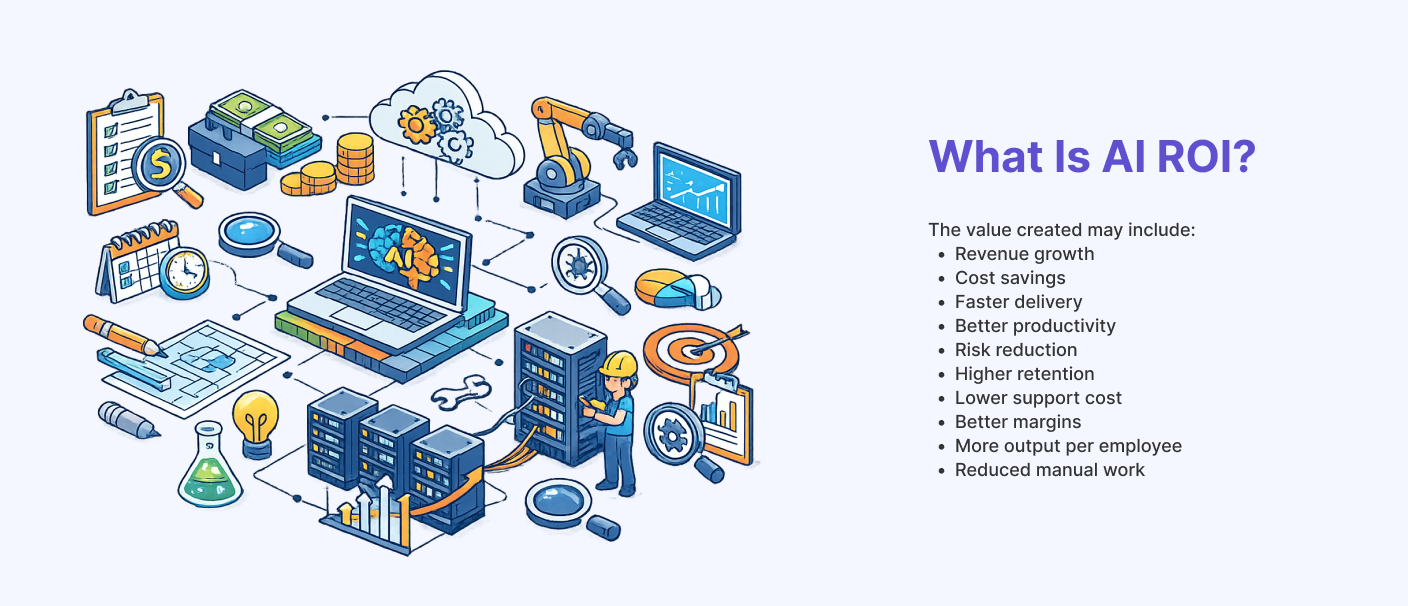
AI ROI is the return a business gets from its AI investment.
A simple formula is:
AI ROI = Business Outcome Lift − Fully Loaded AI Investment ÷ Fully Loaded AI Investment
In simple terms, AI ROI compares the value created by AI with the total cost of building and running it.
The value created may include:
- Revenue growth
- Cost savings
- Faster delivery
- Better productivity
- Risk reduction
- Higher retention
- Lower support cost
- Better margins
- More output per employee
- Reduced manual work
The investment may include:
- Engineering time
- AI tools
- LLM API costs
- Vector database hosting
- Evaluation pipelines
- Observability tools
- Data preparation
- Integration work
- Training
- Retention engineering
- Ongoing maintenance
AI ROI becomes misleading when teams only count API cost or software subscriptions.
A real AI ROI calculation should include all costs required to build, launch, monitor, and improve the AI system.
For practical examples of how businesses are turning AI investments into measurable results, explore our guide on AI ROI case studies, covering cost savings, faster delivery, productivity gains, and business growth.
What AI ROI Actually Means in 2026
AI ROI in 2026 means measuring AI against a named business outcome.
It does not mean:
- Model accuracy alone
- Number of AI features shipped
- Number of prompts created
- Number of agents launched
- Number of users testing a pilot
- Speed of AI response alone
These are technical or activity metrics.
They may help explain performance, but they do not prove ROI.
A chatbot with 95% accuracy has weak ROI if support tickets do not reduce.
An AI coding assistant has weak ROI if delivery speed does not improve.
An AI sales agent has weak ROI if qualified pipeline does not increase.
A document automation tool has weak ROI if processing cost stays the same.
The right question is not “Did the AI work technically?”
The right question is:
Which business metric improved because of AI?
Why AI ROI Measurement Matters
AI ROI measurement matters because AI programs can quickly become expensive.
A company may spend money on:
- AI engineers
- AI consultants
- API usage
- Model subscriptions
- Data pipelines
- Vector databases
- Monitoring tools
- Security reviews
- Compliance checks
- Internal training
- Post-launch support
If the company does not measure ROI properly, leadership may not know whether the investment is working.
This creates three problems.
First, teams may continue funding AI projects that do not create value.
Second, useful AI projects may be stopped too early because the wrong metrics are being tracked.
Third, leadership may lose trust in AI because early pilots fail to show clear business results.
AI ROI measurement gives businesses a practical way to decide:
- Which AI projects should continue
- Which projects should be stopped
- Which use cases should be scaled
- Which workflows need more investment
- Which vendors or partners are actually delivering outcomes
2026 AI ROI Benchmarks by Use Case
AI ROI varies by use case.
Some AI investments pay back quickly because they reduce obvious manual cost. Others take longer because the impact depends on revenue, adoption, sales cycles, or risk reduction.
Cost Reduction AI
Cost reduction use cases usually deliver strong and measurable ROI.
Examples include:
- Support deflection
- Document processing
- Internal operations automation
- Manual data entry automation
- Repetitive workflow automation
These use cases are easier to measure because the baseline cost is clear.
If a process previously required manual hours and AI reduces that effort, ROI can be calculated directly.
Typical ROI pattern: 3–8x within 9 months
Velocity Lift AI
Velocity lift AI improves how fast teams produce output.
Examples include:
- AI-first software development
- AI-assisted engineering workflows
- AI content production
- AI operations throughput
- Automated testing
- Faster product iteration
Velocity lift can create strong ROI because faster work means faster delivery, more releases, and quicker market learning.
Typical ROI pattern: 5–15x within 6 months
Revenue Uplift AI
Revenue uplift AI improves sales, conversion, upsell, or customer value.
Examples include:
- AI sales enablement
- Outreach personalization
- Lead scoring
- Conversion optimization
- Upsell recommendations
- AI growth workflows
Revenue ROI can be powerful, but it is harder to attribute because sales performance depends on many factors.
Typical ROI pattern: 1.5–3x within 12–18 months
Risk Reduction AI
Risk reduction AI helps reduce fraud, compliance gaps, quality issues, or operational incidents.
Examples include:
- Fraud detection
- Compliance automation
- Quality assurance
- Risk monitoring
- Security review
- Audit preparation
Risk reduction ROI can be harder to measure because it often depends on incidents avoided.
Typical ROI pattern: 2–5x within 12 months
How to Measure AI ROI: The 5-Step Framework
AI ROI should be measured before, during, and after implementation.
A proper AI ROI framework helps teams avoid vague goals and unclear results.
Step 1: Define the Outcome Metric Before Building
The first step is to name the exact business metric AI should improve.
Do this before development starts.
Examples of outcome metrics include:
- Support cost per ticket
- Ticket deflection rate
- Time from spec to production
- Revenue per sales rep
- Customer acquisition cost
- Gross margin per unit of work
- Document processing time
- Fraud loss rate
- Manual review time
- Customer retention rate
- NPS score
- 90-day customer activation
If a team cannot name the business metric, the AI project is not ready.
A strong AI project starts with a clear outcome.
Step 2: Baseline the Metric for at Least 30 Days
Before launching AI, teams should measure the current state.
This is the baseline.
For example:
- Current support ticket volume
- Current average resolution time
- Current engineering delivery cycle
- Current sales rep productivity
- Current document processing cost
- Current fraud review workload
- Current customer retention rate
Without a baseline, it is difficult to prove improvement.
A company may launch AI and see better numbers, but without a pre-AI baseline, the team cannot confidently say what changed.
Step 3: Track Fully Loaded AI Investment
Teams should calculate the full cost of AI, not just the visible software cost.
Fully loaded AI investment may include:
- Engineering hours
- AI architect time
- Product management time
- LLM API usage
- Vector database hosting
- Evaluation tooling
- Observability tools
- Prompt testing
- Data cleaning
- Integration work
- Security review
- Compliance review
- Training
- Retention engineering
- Maintenance
LLM API cost is usually only one part of the investment.
If the team ignores hidden costs, ROI may look much better than it really is.
Step 4: Measure Outcome Lift at 30, 60, and 90 Days
AI ROI should be measured after launch at clear checkpoints.
Use:
- 30 days for early signal
- 60 days to see whether the trend holds
- 90 days to understand steady-state performance
This matters because early results can be misleading.
Sometimes a new AI feature creates a short-term novelty boost. Users try it because it is new, but usage drops later.
A 90-day measurement gives a better picture of whether AI is creating lasting value.
Step 5: Recalculate ROI Quarterly
AI systems change over time.
User behavior changes. Data changes. Business processes change. Model performance may drift. Retrieval quality may weaken. Prompts may need updates.
That is why AI ROI should be reviewed quarterly after the first 90 days.
Quarterly measurement helps teams identify:
- ROI decay
- Data quality issues
- Adoption problems
- Model drift
- Workflow friction
- New optimization opportunities
- Need for retention engineering
AI ROI is not a one-time launch metric.
It needs ongoing tracking.
Why Most AI Programs Miss ROI Targets
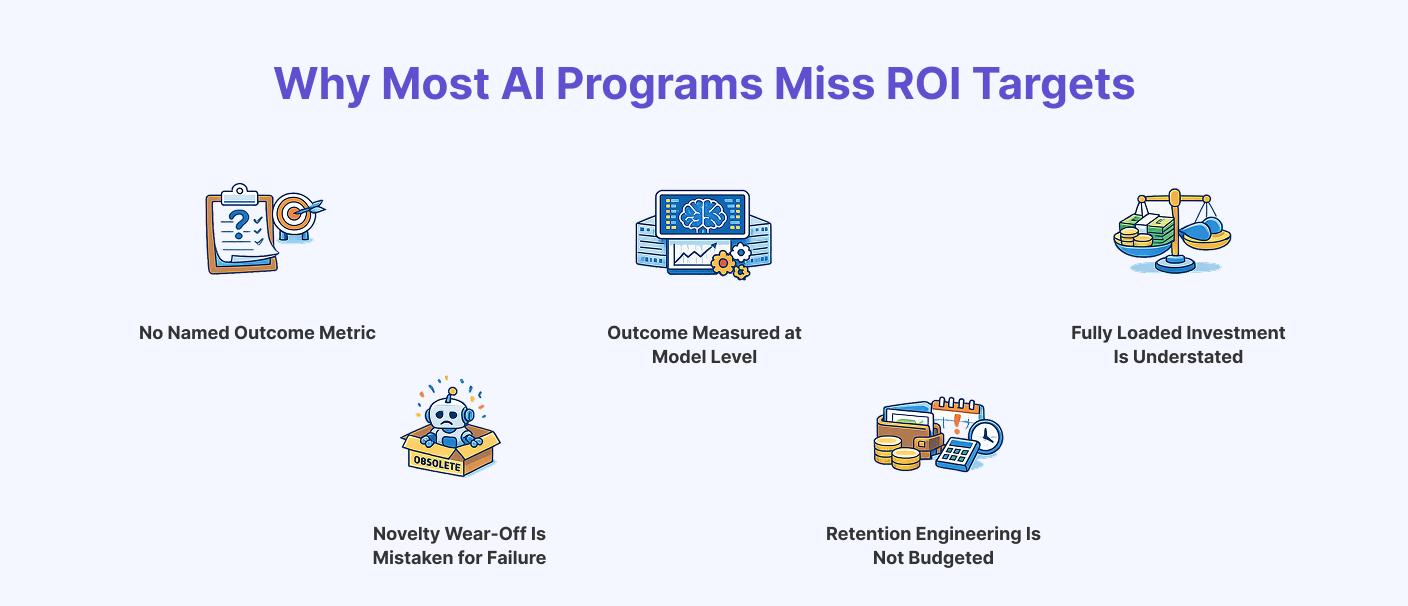
Many AI programs miss ROI targets because they are measured poorly, scoped loosely, or launched without business ownership.
1. No Named Outcome Metric
Some AI projects begin with a vague goal like “build an AI feature” or “add automation.”
This creates problems later.
When leadership asks whether the project worked, the team cannot answer clearly because no business metric was defined.
Fix this by naming the outcome metric in the first scoping conversation.
2. Outcome Measured at Model Level
Many teams report model-level performance such as accuracy, latency, or response quality.
These metrics matter, but they are not enough.
For example, a support bot may have high accuracy, but if support cost does not reduce, business ROI is weak.
Fix this by measuring AI against the business result, not only the model result.
3. Fully Loaded Investment Is Understated
Some teams calculate AI cost only using API spend.
This makes ROI look higher than it actually is.
Real AI cost includes engineering time, evaluation setup, observability, data preparation, training, and maintenance.
Fix this by tracking all AI-related cost in one place for at least the first 12 months.
4. Novelty Wear-Off Is Mistaken for Failure
AI tools may show strong results in the first 30 days because users are curious.
Later, usage may normalize.
This does not always mean the project failed.
A 4x lift at 30 days may become 1.5x at 90 days, and that may still be positive ROI.
Fix this by targeting the 90-day steady-state result instead of judging only the first month.
5. Retention Engineering Is Not Budgeted
AI systems need post-launch maintenance.
This may include:
- Evaluation pipeline updates
- Retrieval tuning
- Prompt regression testing
- Data refreshes
- Workflow improvements
- Observability reviews
- User feedback loops
If this work is not budgeted, quality can decay.
A project that looked strong at launch may underperform after 6–9 months.
Fix this by budgeting retention engineering as part of the AI investment.
Real Cost vs ROI Bands by Engagement Type
AI ROI also depends on the type of engagement.
Single AI Feature
A single AI feature may include a chatbot, classifier, document Q&A tool, or workflow assistant.
Typical investment: $60K–$180K
Best for:
- One named business metric
- Clear use case
- Specific workflow
- Controlled scope
Typical ROI: 2–4x within 12 months
AI Growth Partner Engagement
An AI growth partner engagement may include sales automation, content workflows, lead scoring, outbound systems, CRM automation, and revenue operations support.
Typical investment: $120K–$420K
Best for:
- Multi-channel growth
- Revenue improvement
- Sales productivity
- Marketing execution
- Pipeline acceleration
Typical ROI: 3–7x
AI-First Engineering Transformation
AI-first engineering transformation improves how software teams build, test, review, and ship products.
Typical investment: $240K–$840K
Best for:
- SaaS startups
- Product companies
- Engineering teams
- Platform rebuilds
- Faster delivery
- Better documentation and tests
Typical ROI: 5–12x within 18 months
Compliance-Grade AI Build
Compliance-grade AI builds are used in industries like healthcare, fintech, insurance, and enterprise software.
Typical investment: $320K–$960K
Best for:
- HIPAA
- SOC 2
- Regulated workflows
- Compliance automation
- Fraud prevention
- Audit preparation
Typical ROI: Variable, often measured through risk reduction and incidents avoided.
Pure AI Consulting
Pure consulting helps teams decide whether to build, buy, or avoid an AI investment.
Typical investment: $30K–$120K
Best for:
- AI strategy
- Readiness assessment
- Use-case prioritization
- Vendor selection
- ROI planning
Typical ROI is harder to attribute directly because the value is usually seen in downstream decisions.
The Three AI ROI Patterns We See Most Often
Pattern 1: Support Deflection Win
A mid-market SaaS company implements a custom AI chatbot trained on product documentation.
The AI assistant handles common customer questions and reduces the need for additional support hires.
The result:
- Tier-1 ticket deflection improves
- Support team does not need to hire additional reps
- Customer response times improve
- Support cost per ticket drops
In one engagement, ticket deflection increased to 38% within 90 days.
The company avoided hiring four additional Tier-1 support reps.
Net savings were around $280K per year against an $85K investment.
That created a 3.3x first-year ROI.
Pattern 2: Engineering Velocity Lift
A 12-person engineering team adopts AI-first development practices.
AI agents support:
- Code generation
- PR review
- Test coverage
- Infrastructure-as-code
- Documentation
- Release preparation
Time from specification to production drops from 4 weeks to 1 week on average.
The team ships more major features without increasing headcount.
Revenue per engineer improves because the same team delivers more output.
This type of transformation can create 6–8x ROI within 12 months when measured properly.
Pattern 3: Revenue Per Rep Lift
A B2B sales team adopts an AI-first growth partner model.
AI agents support:
- Account research
- Outreach personalization
- Follow-up sequencing
- Meeting preparation
- CRM updates
- Lead prioritization
Sales reps spend less time researching and more time selling.
In one pattern, sales rep productivity improved 2.3x within 9 months, and annual contract value increased through better targeting.
Revenue lift reached $1.4M against a $260K investment, creating a 5.4x ROI in 12 months.
When AI ROI Disappoints
AI ROI often disappoints when teams run pilots without clear ownership or build AI for the wrong metric.
The “Pilot Forever” Pattern
Multiple AI pilots run in parallel, but none reach production.
The company spends months and hundreds of thousands of dollars testing tools without moving a real business metric.
The fix is to limit pilots and require production movement within a defined timeline.
The “Wrong Model” Pattern
The team optimizes for technical metrics that do not affect the business.
For example, improving response latency may not matter if the main business problem is low adoption or poor workflow integration.
The fix is to define the business metric before model optimization begins.
The “Vendor Theater” Pattern
Some vendors deliver dashboards, demos, and AI branding without tying work to business outcomes.
The company gets deliverables, but no measurable improvement.
The fix is to evaluate AI partners based on outcome tracking, not only technical delivery.
How Cloudastra Measures AI ROI
Cloudastra measures AI ROI by starting each engagement with one clear business outcome.
Before building, Cloudastra helps define:
- The outcome metric
- The baseline
- The expected lift
- The investment required
- The measurement timeline
- The reporting process
- The post-launch improvement plan
Cloudastra tracks ROI at 30, 60, and 90 days after launch, then continues measurement quarterly.
This helps ensure AI projects are judged by business outcomes, not only technical activity.
Cloudastra’s AI-first approach supports:
- AI agent development
- AI-first engineering
- AI growth systems
- RAG applications
- AI workflow automation
- Compliance-grade AI systems
- AI readiness assessment
- AI ROI planning
- AI implementation measurement
- Retention engineering
The goal is not just to build AI.
The goal is to build AI systems that improve measurable business performance.
Who Should Use an AI ROI Framework?
An AI ROI framework is useful for:
- Founders
- CTOs
- CIOs
- Product leaders
- Engineering leaders
- Operations heads
- Revenue leaders
- Customer support leaders
- Compliance teams
- SaaS companies
- Fintech companies
- Healthcare companies
- Enterprise teams
- AI transformation teams
- Business owners evaluating AI investment
It is especially useful for companies that want to invest in AI but need a clear way to measure whether the investment is working
Want to explore more practical insights on AI development, automation, and conversational AI? Read more blogs at Cloudastra Technologies or contact us for business enquiries through Cloudastra Contact Us.
FAQs
1. What is AI ROI?
AI ROI is the business return generated from AI compared with the full cost of building, running, and maintaining the AI system.
2. How do you calculate AI ROI?
AI ROI can be calculated by subtracting fully loaded AI investment from business outcome lift, then dividing the result by fully loaded AI investment.
3. What is a good AI ROI in 2026?
A good AI ROI depends on the use case. Cost reduction and velocity lift use cases often show faster returns, while revenue and risk reduction use cases may take longer.
4. How long does AI take to pay back?
Cost reduction projects may pay back in 3–6 months. Velocity lift projects may show measurable gains in 6–12 weeks. Revenue uplift projects may take 9–18 months.
5. Why do AI projects fail to show ROI?
AI projects often fail when there is no named outcome metric, business results are not measured, full costs are understated, novelty is mistaken for success, or post-launch maintenance is ignored.
6. What is fully loaded AI investment?
Fully loaded AI investment includes engineering time, AI tools, LLM API spend, vector database hosting, evaluation pipelines, observability tools, data preparation, training, and retention engineering.
7. Should AI ROI be measured monthly or quarterly?
AI ROI should be measured at 30, 60, and 90 days after launch, then quarterly after that to track whether the gains are sustained.
8. How does Cloudastra help measure AI ROI?
Cloudastra helps define the business outcome metric, baseline current performance, build the AI system, instrument measurement, track ROI after launch, and improve the system through retention engineering.