AI ROI case studies help founders, CTOs, and business leaders understand how AI-first development can reduce cost, improve delivery speed, and create measurable business value.
Across fintech, e-commerce, enterprise knowledge management, and healthcare SaaS, AI can deliver strong returns when it is applied to the right workflows. The strongest AI ROI usually comes from faster product delivery, smaller teams, lower infrastructure costs, better automation, and measurable improvements in revenue or productivity.
Introduction
Many companies talk about AI transformation.
But business leaders do not invest in AI only because it sounds modern.
They invest because they want measurable results.
They want to know:
- Will AI reduce cost?
- Will it help us ship faster?
- Will it improve productivity?
- Will it increase revenue?
- Will it reduce manual work?
- Will the investment actually pay back?
This is why AI ROI case studies are important.
They show what happens when AI is used in real business projects, not just demos or experiments.
The value of AI becomes clearer when we look at measurable outcomes such as development speed, infrastructure savings, fraud reduction, revenue growth, productivity improvement, and time-to-market advantage.
Cloudastra has worked across AI-first development, fintech platforms, e-commerce rebuilds, enterprise RAG systems, healthcare SaaS, and production-ready AI applications.
The pattern is clear.
AI delivers the strongest ROI when it is used across workflows, not as a small feature added at the end.
What Are AI ROI Case Studies?
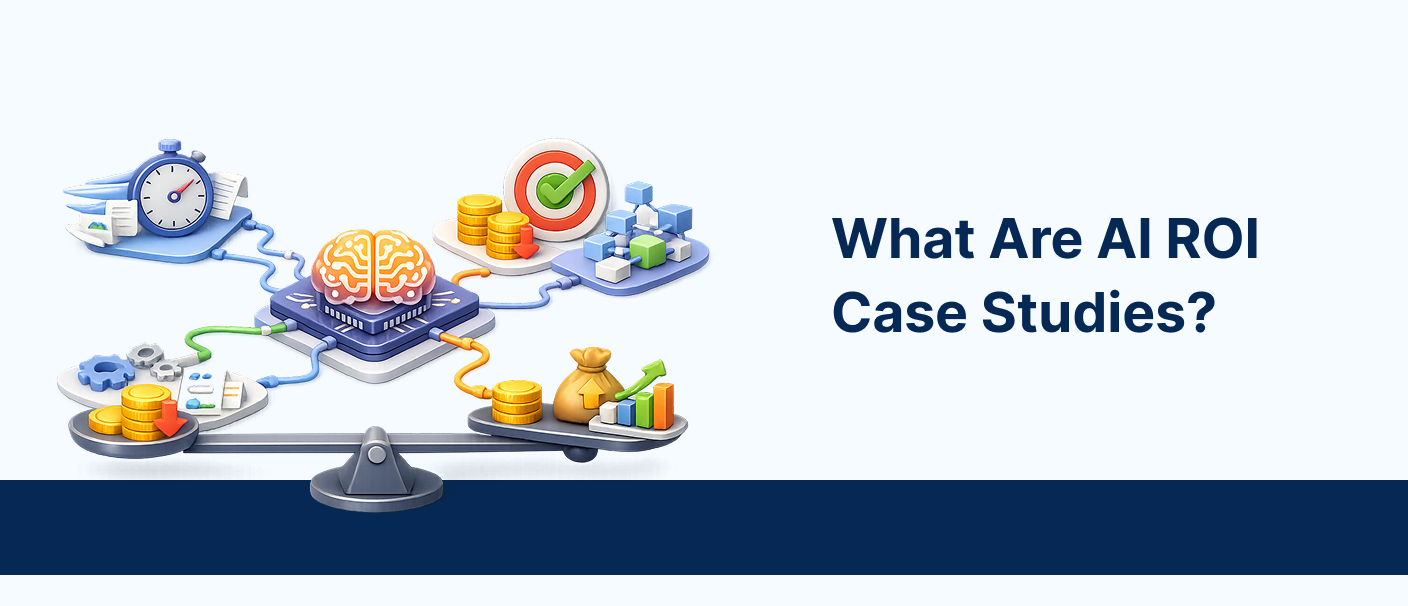
AI ROI case studies are real examples that show how AI investments create measurable business returns.
These returns may include:
- Lower development cost
- Faster product delivery
- Smaller engineering teams
- Reduced infrastructure spend
- Higher conversion rates
- Better fraud detection
- Faster customer support
- Improved employee productivity
- Faster onboarding
- Better decision-making
- Reduced manual work
- Higher revenue from faster launch
AI ROI does not come from using AI for the sake of using AI.
It comes from applying AI to a business problem where speed, cost, accuracy, or scale matters.
In simple terms, AI ROI case studies help answer:
What business value did AI create, and was that value higher than the cost of implementation?
Why AI ROI Matters for Businesses
AI ROI matters because AI projects can become expensive if they are not connected to clear business outcomes.
Many companies start AI initiatives without defining what success looks like.
They may build a chatbot, automate a small task, or experiment with a model, but fail to measure whether it saves money, increases revenue, or improves productivity.
This creates confusion.
A business should not measure AI success only by the number of AI features shipped.
It should measure outcomes such as:
- Cost saved
- Time saved
- Revenue gained
- Risk reduced
- Productivity improved
- Manual work removed
- Customer experience improved
- Delivery timelines shortened
AI ROI helps leaders decide whether an AI project is worth building, scaling, or stopping.
It also helps teams avoid investing in AI projects that look impressive but do not solve expensive problems.
How to Calculate AI ROI
AI ROI can be calculated by comparing the total business benefit created by AI against the total cost of implementing and running it.
A simple formula is:
AI ROI = Total AI Benefit ÷ Total AI Investment
The benefit may include:
- Team cost savings
- Infrastructure savings
- Revenue from faster delivery
- Productivity gains
- Manual work reduction
- Risk reduction
- Operational cost savings
The investment may include:
- Development cost
- AI tools and licenses
- API usage
- Infrastructure
- Data preparation
- Integration cost
- Training and onboarding
- Ongoing monitoring
A useful AI ROI calculation should include both direct and indirect value.
For example, if AI helps a company launch a product four months earlier, the ROI should include the revenue or market opportunity created by that earlier launch.
The Three-Layer AI ROI Model
AI ROI is not always one simple number.
It usually appears across three layers.
1. Direct Cost Savings
Direct cost savings are the easiest to measure.
These may include:
- Smaller development team
- Lower agency cost
- Reduced manual operations
- Fewer vendor tools
- Lower infrastructure spend
- Lower support cost
- Lower maintenance cost
For example, if an AI-first team builds a product for $42,000 instead of a traditional estimate of $210,000, the direct savings are clear.
2. Velocity Value
Velocity value comes from shipping faster.
If a product launches in 6 weeks instead of 6 months, the business gets several months of extra market presence.
This can create value through:
- Earlier revenue
- Faster customer feedback
- Faster product iteration
- Earlier investor traction
- Competitive advantage
- Faster sales cycles
Velocity is especially important for startups and fast-moving companies.
Every delayed month can mean missed customers, missed partnerships, or slower learning.
3. Opportunity Cost Avoided
Opportunity cost avoided is the value of not losing time, market share, or business momentum.
When a company spends too long building, competitors may move faster.
The business may miss:
- Early users
- Investor deadlines
- Enterprise deals
- Seasonal demand
- Market windows
- Partnership opportunities
AI-first development can reduce this risk by helping teams launch faster and iterate sooner.
AI ROI Case Study 1: Fintech Fraud Detection Platform
Client Background
A Series B fintech company was processing more than $2 billion in annual transactions.
The company needed real-time fraud prevention, but its existing fraud detection system was too slow for high-volume payment activity.
The Challenge
The fintech platform was facing major latency and fraud detection problems.
The system had:
- 850ms average API latency
- Poor user experience in some regions
- Unpredictable cold starts
- High infrastructure cost
- Missed fraudulent transactions
- Limited global coverage
For fraud detection, speed matters.
If a risky payment is detected too late, the funds may already move.
The company needed a faster and more reliable system that could support real-time fraud decisions.
The AI-First Approach
Cloudastra rebuilt the fraud detection API layer using an AI-first development process.
The implementation included:
- Edge-first architecture
- Cloudflare Workers
- Lightweight API routing
- AI-generated code reviewed by senior engineers
- Multi-agent testing
- Global rollout with canary releases
The goal was to reduce latency, improve fraud detection accuracy, and lower infrastructure cost.
Before vs After Results
The results were significant.
- API latency reduced from 850ms to 150ms
- Cold start time reduced from 500–1000ms to 0–5ms
- Global availability expanded from 3 regions to 310+ locations
- Monthly infrastructure cost reduced from $12,000 to $4,000
- Fraud detection accuracy improved from 85% to 97.2%
- Uptime improved from 99.5% to 99.9%
- Team size reduced from an estimated 7 engineers to 3 AI-fluent engineers
ROI Summary
The project cost with AI-first development was $42,000.
The traditional estimate for the same scope was $210,000.
The company also saved around $96,000 annually in infrastructure cost and reduced estimated fraud losses by $1.8 million per year.
This created a strong first-year AI implementation ROI for the fintech company.
AI ROI Case Study 2: E-Commerce Platform Rebuild
Client Background
A direct-to-consumer fashion brand with $15 million in annual revenue needed to rebuild its aging e-commerce platform.
The existing platform was slow, expensive to maintain, and unable to handle traffic spikes during flash sales.
The Challenge
The business was facing several problems:
- Product pages took more than 8 seconds to load
- Mobile bounce rate was high
- The system could not handle flash sale traffic
- Maintenance cost was high
- The technology stack was outdated
- Mobile experience was weak
- Conversion rate was below potential
The company was losing revenue because the shopping experience was slow and unreliable.
The AI-First Approach
Cloudastra rebuilt the platform in 6 weeks using an AI-first development approach.
The implementation included:
- Next.js 15 with App Router
- AI-generated UI components
- Multi-agent backend architecture
- Automated testing
- Performance optimization
- Improved mobile experience
- Scalable flash sale infrastructure
The focus was to improve speed, conversion, stability, and long-term maintainability.
Before vs After Results
The rebuild created measurable improvements.
- Page load time improved from 8.2 seconds to 1.1 seconds
- Mobile bounce rate dropped from 67% to 23%
- Flash sale capacity increased from 500 concurrent users to 50,000 concurrent users
- Monthly infrastructure cost reduced from $8,000 to $2,200
- Conversion rate improved from 1.8% to 3.4%
- Revenue impact increased by around $1.2 million per year
- Development time reduced from 5–6 months to 6 weeks
- Team size reduced from 6–8 developers to 3 developers
ROI Summary
The AI-first development cost was $35,000.
The traditional estimate was around $180,000.
Annual infrastructure savings were around $69,600, and improved conversion created an estimated $1.2 million in additional yearly revenue.
This made the e-commerce rebuild one of the strongest AI ROI examples.
AI ROI Case Study 3: Enterprise Knowledge Management RAG System
Client Background
A Fortune 500 manufacturing company with 12,000 employees had a serious knowledge management problem.
The organization had more than 50 disconnected systems, and employees struggled to find the information they needed.
The Challenge
The company was dealing with:
- Information spread across 50+ systems
- No unified search
- Knowledge locked inside departments
- Slow employee onboarding
- Compliance documentation gaps
- Repeated work across teams
- Low productivity caused by poor information access
Employees were spending hours searching for information.
This created productivity loss across the organization.
The AI-First RAG Implementation
Cloudastra built a Retrieval-Augmented Generation system for the enterprise.
The system included:
- Unified vector search
- PostgreSQL with pgvector
- AI-powered ingestion for 50+ data sources
- Support for 47 document formats
- Multi-agent RAG pipeline
- Citation-based answers
- Natural language interface for employees
- Consolidated knowledge access
The goal was to help employees find accurate information quickly without switching between multiple systems.
Before vs After Results
The RAG system created major productivity gains.
- Time to find information reduced from 4 hours to 30 seconds
- 50+ systems were consolidated into one unified platform
- Search relevance improved from 35% to 92%
- New hire onboarding reduced from 6 months to 3 weeks
- Monthly infrastructure cost reduced from $15,000 to $3,500
- Employee productivity value increased by around $3.6 million per year
- Development time reduced from 16 months to 2.5 months
Infrastructure Migration Savings
The company also reduced infrastructure cost by consolidating multiple services.
Monthly vendor cost dropped because separate systems such as vector databases, caching tools, and document storage workflows were replaced with a more efficient architecture.
This improved both cost and operational simplicity.
ROI Summary
The total project investment was $85,000.
The traditional estimate was $480,000.
The annual productivity value was estimated at $3.6 million, with additional annual infrastructure savings of around $138,000.
This shows how enterprise AI ROI can come from productivity improvement, system consolidation, and faster access to knowledge.
AI ROI Case Study 4: Healthcare SaaS Patient Portal
Client Background
A HealthTech startup was building a patient engagement platform.
The team needed to launch an MVP before a Series A funding deadline.
They had only 14 weeks until their investor pitch.
The Challenge
The startup needed a HIPAA-compliant patient portal with:
- Appointment scheduling
- Telehealth integration
- Secure messaging
- Insurance verification
- Patient data protection
- Audit logging
- Role-based access control
- Mobile access
Traditional agencies quoted 6–9 months and more than $300,000.
The startup did not have that much time or budget.
The AI-First Implementation
Cloudastra delivered the full MVP in 8 weeks using a 4-person AI-first team.
The stack included:
- React Native for cross-platform mobile
- Node.js with Express for backend APIs
- PostgreSQL with row-level encryption
- Twilio for telehealth video
- HIPAA-compliant access controls
- AI-generated audit logging
- Automated test coverage
- Secure messaging workflows
AI agents generated a large part of the boilerplate compliance code, while senior engineers reviewed and hardened the system.
Before vs After Results
The AI-first approach helped the startup launch before the funding deadline.
The results included:
- Development completed in 8 weeks
- Team size reduced from an estimated 8–10 developers to 4 AI-fluent engineers
- Total cost reduced from $300,000+ to $88,000
- HIPAA compliance boilerplate reduced from 6–8 weeks of work to 5 days
- Automated test coverage reached 91%
- Security audit findings were reduced to 3 minor issues
- MVP launched 6 weeks before the Series A pitch
Business Outcome
The startup closed a $4.2 million Series A round.
Investors specifically valued the speed of development and the quality of the technical architecture.
The platform later served more than 12,000 patients across 45 clinics.
ROI Summary
The total project cost was $88,000.
The cost saved compared with the traditional estimate was around $212,000.
The larger business impact came from launching early enough to support the Series A raise.
This is a strong example of AI development ROI where time-to-market created strategic value.
Industry Benchmarks for AI ROI
AI ROI varies by industry and use case.
Based on Cloudastra’s implementation experience, the strongest returns usually appear where AI improves speed, productivity, cost efficiency, or revenue.
Typical AI ROI patterns include:
- Fintech and financial services: strong gains from fraud detection, compliance automation, and faster platform delivery
- E-commerce: strong gains from conversion improvement, platform speed, and infrastructure savings
- Healthcare: strong gains from faster MVP delivery, compliance automation, and operational efficiency
- Enterprise and manufacturing: strong gains from knowledge management, internal search, and workflow automation
- SaaS and B2B platforms: strong gains from faster product development and smaller engineering teams
AI-first development tends to work best when the project has a clear business problem and measurable success metric.
Common AI ROI Pitfalls
Pitfall 1: Automating the Wrong Process
Some companies choose AI projects because they look impressive, not because they solve an expensive problem.
For example, a chatbot may not deliver strong ROI if the company receives very few support tickets.
The better approach is to start with the most expensive manual process.
Pitfall 2: Ignoring Change Management
AI tools only create ROI when people use them.
If employees do not adopt the new workflow, the business will not see meaningful returns.
Teams should budget for onboarding, training, documentation, and internal adoption.
Pitfall 3: Measuring the Wrong Metrics
Tracking the number of AI features shipped does not prove ROI.
The right metrics are:
- Revenue gained
- Cost reduced
- Time saved
- Productivity improved
- Risk reduced
- Manual work removed
Every AI project should have a business KPI before development begins.
Pitfall 4: Underestimating Data Quality Requirements
AI systems depend on good data.
If a RAG system is built on outdated or inconsistent documents, it will produce unreliable answers.
Data cleaning, normalization, and validation should be part of the project plan.
Pitfall 5: Overbuilding Before Validating
Some teams build complex custom AI models before proving that the use case works.
This increases cost and delays ROI.
A better approach is to start with the simplest AI integration that proves business value, then expand only when needed.
When to Invest in AI-First Development
AI-first development makes sense when speed, cost, and scalability are important.
Choose AI-First Development If
AI-first development is useful when:
- You need to ship in weeks, not months
- Your team is small but your goals are large
- You are building a new product or MVP
- You are rebuilding a legacy platform
- You need faster time to market
- You want smaller development teams
- You need strong documentation and test coverage
- You are building production-ready AI applications
- You want to reduce manual workflows
- You are evaluating AI-first engineers
Consider Traditional Development If
Traditional development may still make sense when:
- You are making small changes to a stable system
- Your codebase is highly specialized and proprietary
- Your team is not ready to adopt AI-assisted workflows
- You do not have time for training or review
- The business problem is not expensive enough to justify AI investment
- The project has no measurable ROI goal
AI-first development is powerful, but it should be used where it can create real business impact.
Key Insights From These AI ROI Case Studies
Velocity Gains Compound
Faster development does not only mean faster launch.
It also means more iterations, faster learning, and quicker response to customer feedback.
Smaller Teams Can Deliver More
A small team of AI-fluent engineers can often outperform a larger traditional team when the workflow is designed properly.
Infrastructure Costs Can Drop
AI-first architecture can reduce infrastructure cost through better caching, efficient data structures, optimized APIs, and simpler system design.
Testing Becomes More Comprehensive
AI-generated tests can cover more edge cases and reduce manual testing gaps.
This improves confidence before production release.
Documentation Improves
AI-first workflows can generate documentation alongside code.
This reduces the common problem of undocumented software.
Time-to-Market Creates Strategic Value
The healthcare startup’s funding outcome and the e-commerce brand’s revenue increase show that faster launch can create value beyond direct development savings.
How Cloudastra Helps Improve AI ROI
Cloudastra helps companies build AI-first products, AI agents, RAG systems, automation workflows, and production-ready AI applications with measurable business outcomes.
Cloudastra supports:
- AI-first product development
- MVP development
- AI agent teams
- RAG system development
- AI workflow automation
- AI-assisted software engineering
- Legacy platform modernization
- Cloud and infrastructure optimization
- AI-powered testing
- Documentation automation
- Secure AI application architecture
- AI ROI planning
- Use-case validation
The focus is not only on building AI features.
Cloudastra helps companies identify where AI can create measurable ROI, then builds the right system around that outcome.
This makes AI adoption more practical, measurable, and business-focused.
Who Should Read This Blog?
This blog is useful for:
- Founders
- CTOs
- CIOs
- Product leaders
- Engineering managers
- SaaS companies
- Fintech companies
- E-commerce brands
- Healthcare startups
- Enterprise technology teams
- AI transformation teams
- Operations leaders
- Business owners evaluating AI investment
It is especially useful for teams that want to understand the real business impact of AI before investing in a project.
Want to explore more practical insights on AI development, automation, and conversational AI? Read more blogs at Cloudastra Technologies or contact us for business enquiries through Cloudastra Contact Us.
FAQs
1. What are AI ROI case studies?
AI ROI case studies are real examples that show how AI creates measurable business value through cost savings, faster delivery, productivity improvement, revenue growth, or risk reduction.
2. How do you calculate AI ROI?
AI ROI can be calculated by comparing total AI benefit with total AI investment. Benefits may include cost savings, infrastructure savings, revenue gains, productivity improvements, and faster time to market.
3. What is AI development ROI?
AI development ROI measures the business return from using AI in software development, automation, product delivery, testing, documentation, or infrastructure optimization.
4. Which AI use cases deliver the highest ROI?
High-ROI AI use cases often include customer support automation, AI-assisted development, fraud detection, RAG knowledge systems, document automation, workflow automation, and e-commerce optimization.
5. How long does it take to see ROI from AI?
Some AI projects show results within weeks, while larger AI implementations may take 3–18 months depending on complexity, adoption, data quality, and business use case.
6. Why do some AI projects fail to deliver ROI?
AI projects usually fail when teams automate the wrong process, use poor-quality data, skip change management, measure the wrong metrics, or build complex systems before validating business value.
7. Is AI-first development better than traditional development?
AI-first development can be better when speed, cost efficiency, documentation, testing, and faster launch matter. Traditional development may still be better for small changes, highly proprietary systems, or teams not ready for AI workflows.
8. How does Cloudastra help companies improve AI ROI?
Cloudastra helps companies identify high-value AI use cases, build AI-first products, automate workflows, develop AI agents, create RAG systems, optimize infrastructure, and measure business outcomes from AI adoption