Real-time payment decisioning helps banks, fintech companies, NBFCs and payment platforms decide what should happen to a transaction while it is still being processed.
A payment-monitoring system may identify unusual activity. A risk-scoring system may calculate how suspicious the payment appears. However, the financial institution still needs to decide whether the transaction should pass, be flagged, require additional verification or be blocked.
That final action is payment decisioning.
A real-time payment decision engine combines transaction data, customer behaviour, beneficiary risk, device signals, payment velocity, sanctions exposure and configured fraud policies to return a clear action before funds settle.
Depending on the risk and the institution’s policy, the action may be:
- Pass the payment
- Flag the payment
- Request additional authentication
- Hold the payment
- Block the payment
- Escalate the transaction
- Send the case for analyst review
The objective is not to block every unusual transaction.
The objective is to apply the right action to the right payment without slowing genuine customers unnecessarily.
SecureFlow helps banks and fintechs evaluate payment risk when a transaction is initiated and return explainable pass, flag or block verdicts before funds clear.
In simple terms, real-time payment decisioning helps financial institutions answer one important question:
What should we do with this payment right now?
What Problem Does Real-Time Payment Decisioning Solve?
Banks and fintech companies process payments within seconds.
These payments may move through:
- UPI
- IMPS
- RTGS
- SWIFT
- ISO 20022 payment environments
- Wallet systems
- Merchant payment platforms
- Account-to-account transfers
- Cross-border payment networks
Fraud and compliance teams have very little time to evaluate each transaction before the payment is completed.
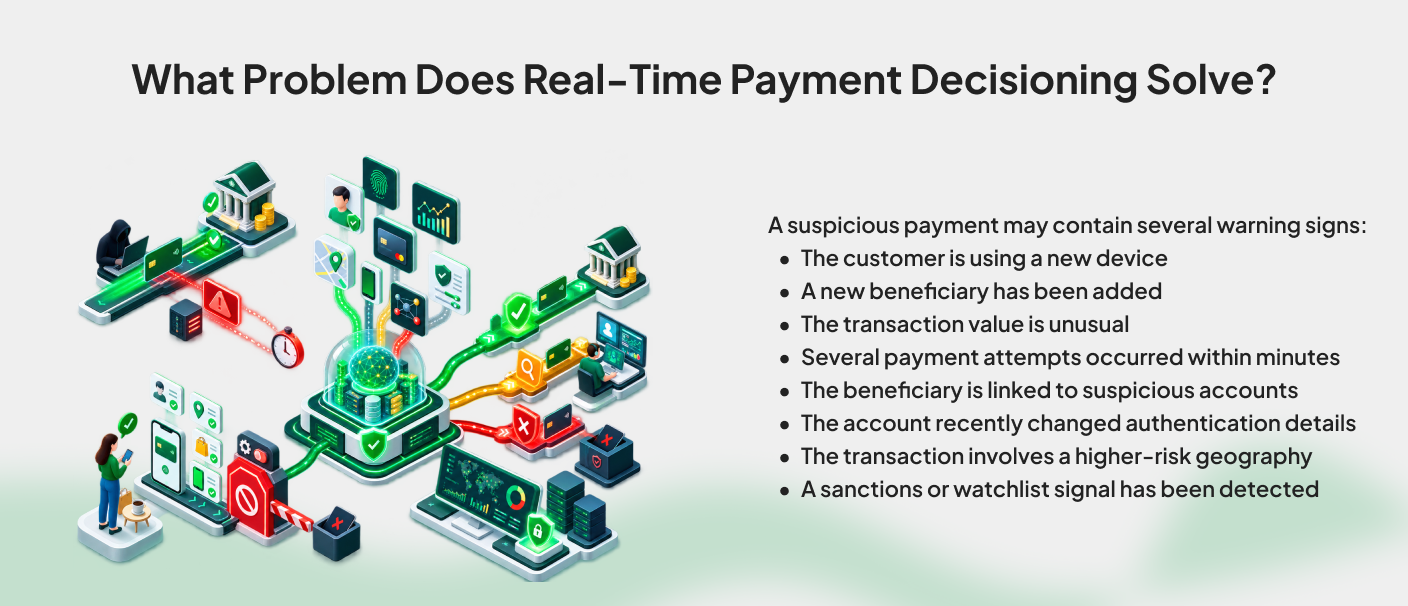
A suspicious payment may contain several warning signs:
- The customer is using a new device
- A new beneficiary has been added
- The transaction value is unusual
- Several payment attempts occurred within minutes
- The beneficiary is linked to suspicious accounts
- The account recently changed authentication details
- The transaction involves a higher-risk geography
- A sanctions or watchlist signal has been detected
Identifying these signals is only the first step.
The institution must still determine whether the payment should move.
Without a structured decisioning process, teams may depend on:
- Broad block rules
- Separate fraud systems
- Manual approval queues
- Delayed transaction reviews
- Fixed transaction limits
- Inconsistent risk policies
- Engineering-dependent controls
- Post-settlement investigations
- Incomplete decision records
- Different actions across payment channels
This creates two major risks.
First, a genuinely suspicious payment may be approved because the decision arrives too late.
Second, a legitimate payment may be blocked because one broad rule triggered without enough customer context.
Real-time payment decisioning solves this by connecting fraud signals, payment-risk scores and institutional policies to a clear transaction action.
What Is Real Time Payment Decisioning?
Real-time payment decisioning is the process of evaluating a transaction and returning an action while the payment is still active.
The decision engine may analyse:
- Transaction value
- Payment time
- Payment frequency
- Sender account
- Beneficiary account
- Customer history
- Account age
- Beneficiary age
- Device information
- IP address
- Customer location
- Authentication history
- New-beneficiary activity
- Previous fraud alerts
- Payment velocity
- Account relationships
- Mule-account indicators
- Sanctions signals
- Watchlist exposure
- Payment rail
- Cross-border information
These signals are compared against configured fraud rules, risk thresholds and decision policies.
The system then returns an action such as:
- Pass
- Flag
- Step-up authentication
- Hold
- Block
- Manual review
- Escalation
A strong payment decision should also explain why the action was returned.
For example:
Decision: Block
Reason: New device, recent password reset, new beneficiary and unusually high payment value
Risk typology: Possible account takeover
Another example may be:
Decision: Flag
Reason: Payment value is higher than normal, but the device and beneficiary are trusted
Risk typology: Behavioural anomaly
This makes payment decisions easier for fraud analysts, operations teams and auditors to understand.
Why Is Transaction Monitoring Alone Not Enough?
Transaction monitoring helps identify unusual activity.
It may generate an alert when:
- A payment exceeds a threshold
- A customer uses a new device
- Several transactions occur quickly
- A beneficiary receives funds from many accounts
- A payment involves a higher-risk region
However, an alert does not automatically determine what should happen to the payment.
The institution still needs a decision policy.
For example, a new-device alert may lead to different actions depending on the wider context.
Scenario 1: Low-Risk New Device
- New device detected
- Known customer location
- Existing beneficiary
- Normal payment amount
- No previous fraud alerts
The payment may pass or require a simple verification.
Scenario 2: High-Risk New Device
- New device detected
- Recent password reset
- New beneficiary
- Unusual location
- High-value transaction
The payment may require a hold, additional authentication or block.
Both transactions contain a new-device signal.
The difference comes from the complete payment context and the decision policy applied to it.
Why Is Payment Risk Scoring Alone Not Enough?
Payment risk scoring assigns a numerical or categorical risk level to a transaction.
For example:
- Low risk
- Medium risk
- High risk
- Critical risk
A score helps the institution understand how suspicious a payment appears.
However, a score is not the same as an action.
A payment with a risk score of 75 may require different decisions depending on:
- Payment value
- Payment rail
- Customer segment
- Beneficiary type
- Regulatory requirement
- Product policy
- Previous customer history
- Availability of additional authentication
- Institution risk appetite
For example:
- A medium-risk low-value payment may be flagged
- A medium-risk high-value payment may be held
- A high-risk payment may require additional authentication
- A critical sanctions-related payment may be blocked
- A high-risk business payment may be sent for analyst review
Risk scoring measures risk.
Payment decisioning converts that risk into an operational action.
Transaction Monitoring vs Risk Scoring vs Payment Decisioning
|
Capability |
Transaction monitoring |
Payment risk scoring |
Payment decisioning |
|
Main purpose |
Detect unusual activity |
Measure transaction risk |
Select the payment action |
|
Main output |
Alert or signal |
Risk score or category |
Pass, flag, hold or block |
|
Customer context |
May be limited |
Used to calculate risk |
Used to determine action |
|
Policy application |
Basic rules |
Risk weighting |
Business and risk policies |
|
Timing |
Real time or delayed |
Usually real time |
Must support immediate action |
|
Operational result |
Case created |
Risk prioritised |
Payment action returned |
|
Explainability |
Triggered alert |
Score and contributing signals |
Decision, reason and action |
|
Main user |
Monitoring team |
Risk team |
Payment, fraud and operations teams |
These three capabilities work best when they are connected.
Monitoring identifies signals.
Scoring combines those signals into a risk view.
Decisioning determines what happens next.
How Does Real-Time Payment Decisioning Work?
Real-time payment decisioning follows a structured process from transaction initiation to final action.
1. The Payment Event Is Received
When a payment is initiated, the decisioning platform receives the available transaction information.
This may include:
- Sender details
- Beneficiary details
- Transaction amount
- Payment time
- Payment purpose
- Payment rail
- Device information
- IP address
- Customer location
- Authentication information
- Account history
- Previous payment behaviour
- Existing fraud alerts
The payment event must reach the decision engine early enough for the institution to act before settlement.
2. Customer Context Is Added
The system compares the payment with the customer’s previous behaviour.
It may examine:
- Normal transaction amount
- Typical payment frequency
- Common beneficiaries
- Known devices
- Normal customer location
- Usual payment time
- Account age
- Previous alerts
- Recent profile changes
- Historical payment outcomes
A payment that appears unusual in isolation may be normal for that customer.
For example, frequent payments may be expected for a merchant but unusual for an individual account.
3. Beneficiary Risk Is Evaluated
The receiving account may also be evaluated.
Relevant signals may include:
- Beneficiary age
- Multiple incoming payments
- Payments from unrelated accounts
- Rapid outgoing transfers
- Low balance retention
- Shared devices
- Connected accounts
- Common beneficiaries
- Previous fraud complaints
- Previous payment alerts
- Sanctions or watchlist exposure
Beneficiary analysis is especially useful for detecting mule accounts and coordinated fraud networks.
4. Fraud Rules Are Applied
The transaction is evaluated against configured payment-risk rules.
Possible rules include:
- High-value payment rule
- New-beneficiary rule
- Payment velocity rule
- Device-change rule
- Location-anomaly rule
- Account-takeover rule
- Mule-account rule
- Transaction-splitting rule
- Dormant-account activity rule
- Sanctions rule
- Watchlist rule
- Cross-border risk rule
Different rules may apply to different customer segments and payment rails.
5. Risk Signals Are Combined
A single warning signal may not justify a strong action.
The decision engine combines related signals to identify a complete fraud pattern.
For example:
New device + password reset + new beneficiary + high-value payment
This combination may indicate account takeover.
Another example:
Multiple incoming payments + rapid outgoing transfers + low balance retention
This may indicate mule-account activity.
Another example:
Several payments just below a threshold + linked beneficiaries + unusual frequency
This may indicate transaction splitting or smurfing.
Combining related signals reduces dependence on isolated alerts.
6. A Payment Risk Score Is Calculated
The system assigns a risk score based on the number, strength and relationship of the detected signals.
The payment may be classified as:
- Low risk
- Medium risk
- High risk
- Critical risk
The system may also calculate risk by typology.
Examples include:
- Account-takeover risk
- Mule-account risk
- Velocity-abuse risk
- Transaction-splitting risk
- Beneficiary risk
- Sanctions risk
- Geographic risk
Typology-level scoring helps teams understand the type of threat connected to the payment.
7. Decision Policies Are Applied
The institution’s decision policy maps the risk result to an action.
For example:
|
Risk level |
Possible action |
|
Low risk |
Pass |
|
Medium risk |
Flag or request additional authentication |
|
High risk |
Hold or send for review |
|
Critical risk |
Block or escalate immediately |
The action may also depend on:
- Transaction value
- Customer type
- Payment rail
- Beneficiary risk
- Product policy
- Regulatory obligation
- Availability of verification
- Previous customer history
8. Conflicting Rules Are Resolved
A transaction may trigger several rules that recommend different actions.
For example:
- One rule recommends passing the transaction
- Another recommends flagging it
- A sanctions rule recommends holding it
The decisioning system needs a clear priority model.
Possible approaches include:
- Highest-risk action wins
- Regulatory rules override commercial rules
- Confirmed allowlists reduce selected alerts
- Critical typologies override general scores
- High-value payments use stricter thresholds
- Certain actions require manual approval
Conflict-resolution logic prevents inconsistent decisions.
9. A Decision Is Returned
The system returns the action to the payment environment.
The decision may include:
- Decision type
- Risk score
- Risk level
- Triggered rules
- Detected typology
- Supporting signals
- Recommended action
- Reason code
- Decision timestamp
The payment platform then applies the relevant action.
10. The Decision Is Recorded
Every decision should create a complete record.
The record may include:
- Transaction data
- Customer data
- Beneficiary data
- Risk score
- Triggered rules
- Fraud typology
- Decision
- Decision reason
- Rule version
- Reviewer information
- Escalation history
- Final outcome
- Timestamp
This supports investigations, internal reviews, audit readiness and rule optimisation.
What Payment Decisions Can a System Return?
Pass
The payment is allowed to continue.
A pass decision may be returned when:
- Risk is low
- The payment matches customer history
- The device is known
- The beneficiary is trusted
- No meaningful fraud signals are detected
Flag
The payment may proceed, but an alert or case is created.
A flag may be appropriate when:
- Risk is moderate
- The transaction is unusual but not clearly fraudulent
- Additional monitoring is required
- The institution wants an analyst to review the case later
Request Additional Authentication
The customer must complete another verification step.
This may include:
- Additional confirmation
- One-time password
- Biometric verification
- In-app approval
- Customer callback
- Additional identity question
This can help resolve uncertain transactions without immediately blocking them.
Hold
The transaction is temporarily paused.
A hold may be appropriate when:
- Risk is high
- Additional information is required
- An analyst needs to review the payment
- A sanctions alert requires investigation
- The institution needs customer confirmation
Block
The transaction is stopped.
A block may be returned when:
- Risk is critical
- Strong account-takeover indicators are present
- The beneficiary is connected to confirmed fraud
- A prohibited payment policy is triggered
- The transaction presents unacceptable risk
Manual Review
The transaction is routed to an analyst.
Manual review may be appropriate when:
- Signals conflict
- The customer is high value
- The transaction is high value
- A possible sanctions match needs verification
- The case involves unusual but explainable activity
- Automated evidence is insufficient
What Signals Are Used in Payment Decisioning?
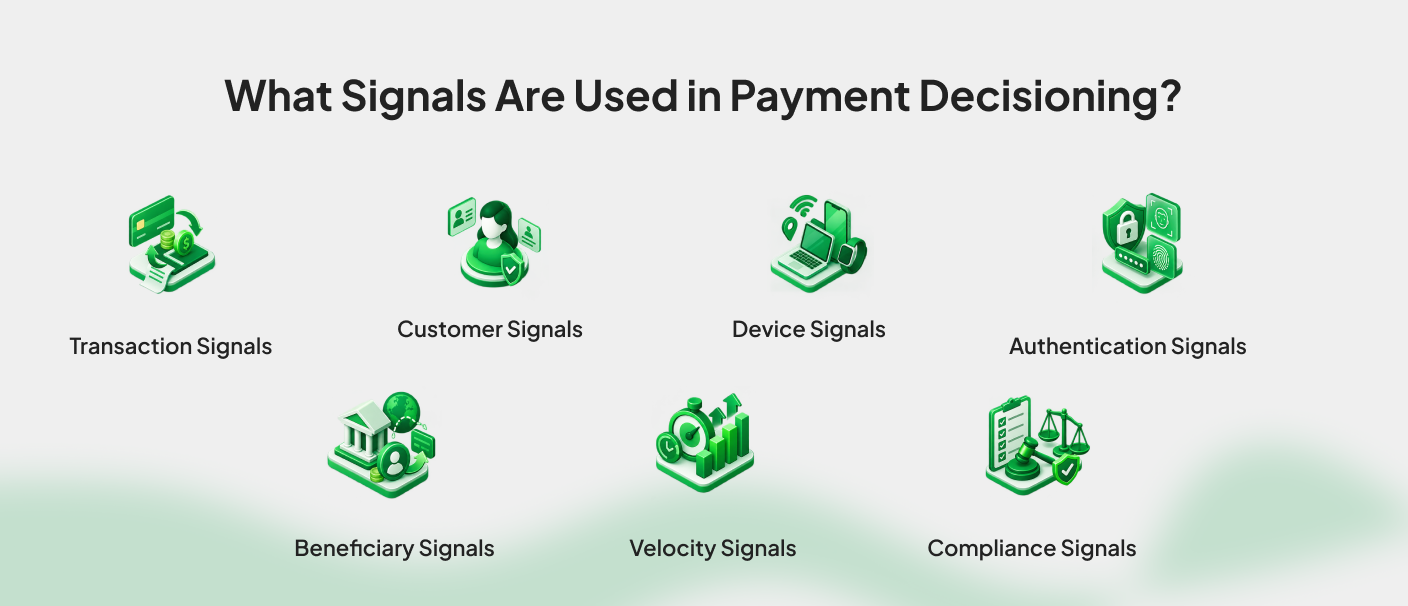
Transaction Signals
- Transaction amount
- Payment time
- Payment frequency
- Payment rail
- Payment purpose
- Currency
- Sender and beneficiary relationship
Customer Signals
- Customer risk level
- Account age
- Historical payment behaviour
- Previous fraud alerts
- Expected account activity
- Recent profile changes
Device Signals
- New device
- Shared device
- Device associated with previous fraud
- Device-location mismatch
- Multiple accounts using one device
Authentication Signals
- Password reset
- PIN change
- Failed login attempts
- Failed payment verification
- Recent account-recovery activity
Beneficiary Signals
- New beneficiary
- Beneficiary age
- Previous alerts
- Multiple unrelated senders
- Rapid outgoing transfers
- Low balance retention
- Connected suspicious accounts
Velocity Signals
- Multiple transactions within minutes
- Repeated failed attempts
- Sudden transaction spike
- Several new beneficiaries
- Rapid movement across connected accounts
Compliance Signals
- Sanctions result
- Watchlist result
- High-risk geography
- Restricted counterparty
- Cross-border risk
Key Use Cases of Real-Time Payment Decisioning
Account Takeover Prevention
A fraudster may gain access to a legitimate customer account.
The payment may appear genuine because it originates from an existing account.
Decisioning can combine:
- New device
- Password reset
- Unusual location
- New beneficiary
- High-value payment
- Multiple failed attempts
The resulting action may be additional authentication, hold or block.
Mule-Account Detection
A mule account may receive money from several unrelated accounts and transfer it quickly.
Decisioning can evaluate:
- Fan-in payments
- Fan-out transfers
- Shared devices
- Common beneficiaries
- Low balance retention
- Rapid fund movement
- Links to flagged accounts
High-risk payments to a suspected mule account may be flagged, held or blocked.
Payment Velocity Abuse
Fraudsters may attempt several payments before the account is stopped.
Velocity decisioning can monitor:
- Transactions per minute
- Failed payment attempts
- Beneficiaries added
- Total payment value
- Repeated device activity
- Connected account behaviour
Transaction Splitting
A fraudster may divide a large amount into smaller transactions to avoid thresholds.
Decisioning can analyse the combined activity instead of evaluating each payment separately.
New-Beneficiary Risk
A new beneficiary does not automatically mean fraud.
The system may combine the beneficiary’s age with:
- Device changes
- Customer location
- Payment amount
- Authentication changes
- Beneficiary history
- Previous alerts
Sanctions-Related Payment Decisions
A possible sanctions match may require:
- Payment hold
- Compliance review
- Additional identity comparison
- Escalation
- Block
A name similarity alone should not automatically be treated as a confirmed match.
Cross-Border Payment Decisions
Cross-border payments may require additional checks involving:
- Sender country
- Beneficiary country
- Payment purpose
- High-risk jurisdiction
- Sanctions exposure
- Unusual payment value
- Customer history
How Does Payment Decisioning Reduce False Positives?
False positives occur when genuine payments are incorrectly flagged or blocked.
They can create:
- Payment delays
- Customer frustration
- Support complaints
- Large review queues
- Analyst fatigue
- Lost customer trust
Real-time payment decisioning can reduce false positives by applying complete transaction context.
Combine Multiple Signals
Do not block a payment because of one weak signal.
A new device may be legitimate.
A new device combined with a recent password reset, new beneficiary and unusual payment value creates a stronger risk case.
Use Customer-Specific Behaviour
Compare the payment with the customer’s own history.
A high-value payment may be normal for a business but unusual for an individual account.
Segment Customers
Different decision policies may be needed for:
- Individuals
- Merchants
- Businesses
- Newly opened accounts
- High-value customers
- Cross-border customers
- High-risk customer categories
Apply Proportionate Actions
Not every suspicious payment requires a block.
A medium-risk payment may require additional authentication.
A higher-risk payment may require a hold.
Only critical-risk payments may require immediate blocking.
Use Analyst Feedback
Analyst outcomes should be used to improve decision policies.
Cases may be classified as:
- Confirmed fraud
- Genuine payment
- False positive
- Account takeover
- Mule activity
- Customer-authorised scam
- Suspicious but unconfirmed
- Policy violation
How Should Banks Design Payment Decision Policies?
Define Risk Thresholds
The institution should define what qualifies as:
- Low risk
- Medium risk
- High risk
- Critical risk
Define Actions for Each Risk Level
Each risk category should have a default action.
However, exceptions may be required for:
- High-value payments
- Sanctions alerts
- High-risk customers
- Certain payment rails
- Regulatory controls
Define Rule Priorities
The institution should document which rules override others.
For example:
- Sanctions controls override normal risk scoring
- Critical account-takeover signals override customer allowlists
- Regulatory restrictions override commercial preferences
Define Manual Override Controls
Authorised analysts may need to change a decision.
Every override should record:
- Original decision
- New decision
- Reviewer
- Reason
- Supporting evidence
- Timestamp
Define Expiry and Review Rules
A hold or review decision should not remain unresolved indefinitely.
The institution should define:
- Review deadline
- Escalation deadline
- Automatic expiry
- Customer-contact requirement
- Final action
What Features Should Payment Decisioning Software Have?
A strong payment decisioning platform should include:
- Real-time transaction evaluation
- Payment risk scoring
- Configurable decision policies
- Customer behaviour analysis
- Beneficiary risk analysis
- Device and location signals
- Velocity monitoring
- Account-takeover indicators
- Mule-account indicators
- Sanctions and watchlist signals
- Typology-level scoring
- Pass, flag or block verdicts
- Additional-authentication workflows
- Live payment interdiction
- Rule-priority management
- Analyst review workflows
- Decision reason codes
- Rule-version history
- Audit-grade decision trails
- API integration
- Multi-rail payment support
- Role-based access
- Secure data handling
- Performance reporting
For banks and fintechs, the most important features are decision speed, contextual scoring, explainability, flexible policies and complete decision records.
Manual Payment Decisions vs Real-Time Decisioning
|
Capability |
Manual or disconnected process |
Real-time payment decisioning |
|
Risk review |
Completed across separate tools |
Signals evaluated in one workflow |
|
Decision speed |
Delayed |
Returned during payment processing |
|
Customer context |
Manually reviewed |
Included automatically |
|
Beneficiary analysis |
Often limited |
Included in the risk decision |
|
Fraud rules |
Fixed across systems |
Configurable policies |
|
Decision output |
Analyst judgement |
Pass, flag, hold or block |
|
Rule conflicts |
Resolved manually |
Defined priority logic |
|
Explainability |
Notes across systems |
Structured decision reasons |
|
Audit history |
Scattered records |
Complete decision trail |
|
Payment action |
Often post-settlement |
Supports pre-settlement action |
How SecureFlow Supports Real-Time Payment Decisioning
SecureFlow by Cloudastra helps banks, fintech companies, NBFCs and payment platforms evaluate payment risk when a transaction is initiated.
The platform can score payments across:
- UPI
- IMPS
- RTGS
- SWIFT
- ISO 20022
- Cross-border payment environments
SecureFlow evaluates configured fraud rules, sanctions signals, velocity patterns, mule indicators and other transaction-risk factors.
It supports:
- Real-time payment scoring
- Pass, flag or block verdicts before funds clear
- Live interdiction for suspicious payments
- Visual rule editing
- Parallel rule evaluation
- Typology-level fraud scoring
- Mule-ring detection signals
- Smurfing indicators
- Account-takeover indicators
- Velocity-abuse checks
- UPI anomaly monitoring
- Native ISO 20022 support
- Audit-grade decision trails
- Decision history
- Faster fraud investigation workflows
- India-focused payment-risk coverage
SecureFlow helps risk teams connect payment monitoring, risk scoring and transaction action in one decision process.
Instead of generating an alert and waiting for a separate system to decide what should happen, SecureFlow can return an explainable verdict while action is still possible.
The platform records the rules, signals and risk context behind the decision.
This helps teams understand:
- Why a payment passed
- Why a transaction was flagged
- Why a payment was blocked
- Which rules triggered
- Which typology was identified
- Which risk signals contributed
- When the decision was returned
SecureFlow’s visual rule editor also helps authorised risk and compliance teams update payment controls with less dependence on engineering teams.
How Can Banks and Fintechs Implement Payment Decisioning?
Define Payment-Risk Scenarios
Document the risks the institution needs to detect.
Examples include:
- Account takeover
- Mule accounts
- Transaction splitting
- Velocity abuse
- New-beneficiary fraud
- Sanctions exposure
- Suspicious cross-border activity
Connect Relevant Data Sources
The decision engine may require data from:
- Payment switch
- Core banking system
- Customer database
- Device-intelligence system
- Authentication platform
- Beneficiary database
- Fraud case-management system
- Sanctions database
- Watchlist database
- Historical transaction repository
Create Decision Policies
Define:
- Risk thresholds
- Default actions
- Rule priorities
- Customer segments
- Payment-rail policies
- Manual-review conditions
- Override permissions
- Escalation timelines
Test in Monitoring Mode
Before blocking live payments, test the policies using historical data or shadow mode.
Measure:
- Decision volume
- Fraud detected
- False-positive rate
- Customer impact
- Analyst workload
- Decision speed
- Missing data
- Rule conflicts
Begin With Proportionate Actions
A new system may begin by:
- Passing low-risk payments
- Flagging medium-risk payments
- Sending high-risk payments for review
- Blocking only critical-risk transactions
Policies can be refined as teams gain confidence.
Create an Analyst Feedback Loop
Review outcomes should improve future decisions.
Monitor Decision Performance
The institution should regularly review:
- Pass rate
- Flag rate
- Hold rate
- Block rate
- False-positive rate
- Confirmed fraud rate
- Manual-review rate
- Decision latency
- Customer complaints
- Payment value prevented
- Override rate
What Metrics Should Teams Track?
Decision Latency
The time required to return the transaction action.
Pass Rate
The percentage of payments allowed to continue.
Flag Rate
The percentage of payments marked for monitoring or review.
Block Rate
The percentage of payments stopped.
Manual-Review Rate
The percentage of payments requiring analyst attention.
False-Positive Rate
The percentage of genuine payments incorrectly flagged or blocked.
Fraud-Detection Rate
The percentage of confirmed fraudulent transactions identified.
Pre-Settlement Prevention Rate
The number or value of suspicious payments stopped before completion.
Override Rate
The percentage of automated decisions changed by analysts.
A high override rate may indicate that thresholds or decision policies require adjustment.
Customer-Friction Rate
The percentage of genuine customers affected by additional authentication, holds or blocks.
Common Payment Decisioning Challenges
Slow Data Availability
A decision engine cannot act accurately when customer, device or beneficiary information arrives too late.
Conflicting Rules
Different rules may recommend different actions.
Clear priority logic is required.
Broad Decision Thresholds
Applying one threshold to every customer can create false positives.
Too Many Manual Reviews
If uncertain payments are always routed to analysts, the review queue may become unmanageable.
Weak Reason Codes
A decision such as “high risk” is not enough.
The system should explain which signals and rules contributed.
No Feedback Loop
Without analyst outcomes, decision policies cannot improve.
Incomplete Audit Records
Teams need to prove what information was evaluated and why the action was selected.
Overblocking
A fraud-prevention programme can harm customer experience when every anomaly leads to a block.
Benefits of Real-Time Payment Decisioning
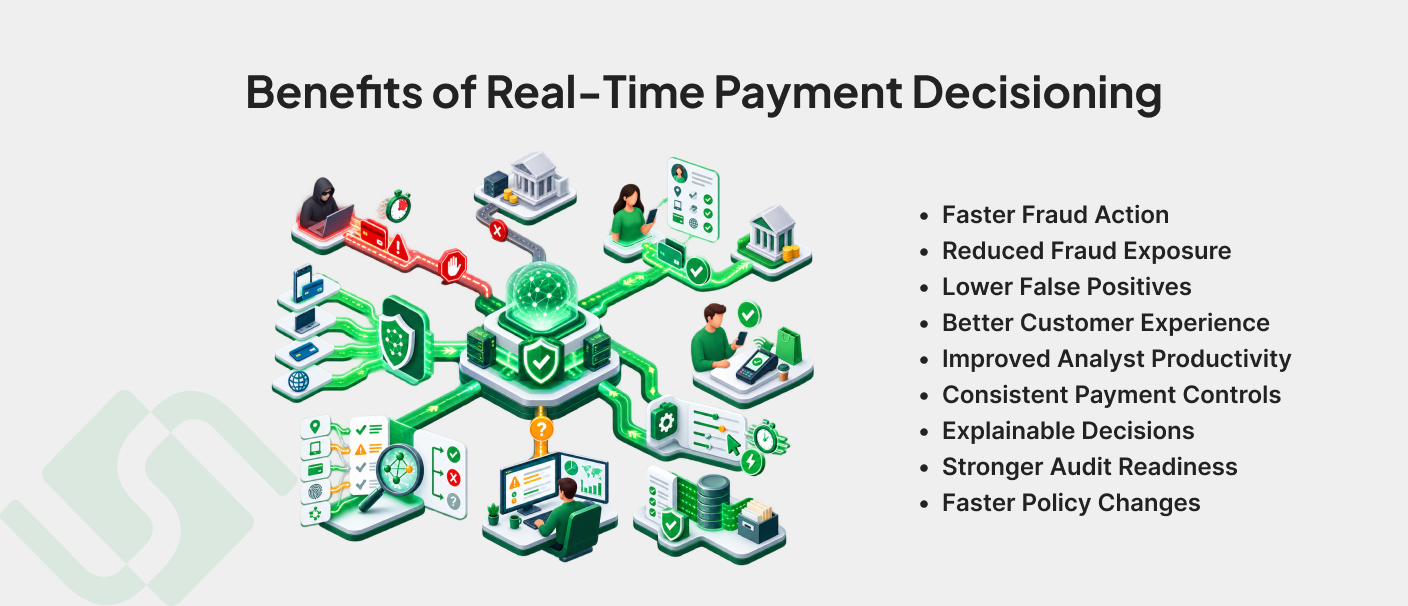
Faster Fraud Action
Suspicious payments can be acted on while they are still being processed.
Reduced Fraud Exposure
High-risk transactions may be stopped before settlement.
Lower False Positives
Contextual decision policies help distinguish unusual but legitimate payments from stronger fraud patterns.
Better Customer Experience
Low-risk payments can continue without unnecessary interruption.
Improved Analyst Productivity
Only uncertain or high-risk transactions require manual attention.
Consistent Payment Controls
The same decision policies can be applied across relevant customer segments and payment workflows.
Explainable Decisions
Teams can see which signals and rules led to the payment action.
Stronger Audit Readiness
Transaction decisions, rule versions and analyst actions can be recorded.
Faster Policy Changes
Risk teams can adjust thresholds and actions as fraud behaviour changes.
Who Should Use Real Time Payment Decisioning Software?
Real-time payment decisioning is useful for:
- Banks
- Fintech companies
- NBFCs
- Payment gateways
- Payment aggregators
- Digital lenders
- Neobanks
- Wallet providers
- Embedded finance platforms
- Merchant payment companies
- Cross-border payment providers
- Fraud operations teams
- Risk teams
- Compliance teams
- Transaction-monitoring teams
- Payment operations teams
Any organisation processing digital payments and needing to act on fraud signals before settlement should consider a real-time payment decisioning platform.
Want to explore more practical insights on AI development, automation, and conversational AI? Read more blogs at Cloudastra Technologies or contact us for business enquiries through Cloudastra Contact Us.
Frequently Asked Questions
1. What is real time payment decisioning?
Real-time payment decisioning is the process of evaluating a payment and returning an action such as pass, flag, hold or block while the transaction is still active.
2. What is a payment decision engine?
A payment decision engine combines transaction data, risk signals, fraud rules and institutional policies to determine what should happen to a payment.
3. What is the difference between risk scoring and payment decisioning?
Risk scoring measures how suspicious a payment appears. Payment decisioning converts that risk score into an operational action.
4. What decisions can a payment system return?
Possible decisions include pass, flag, additional authentication, hold, block, manual review and escalation.
5. Can payment decisioning reduce false positives?
Yes. It can reduce false positives by combining multiple signals, using customer context and applying proportionate actions instead of blocking every unusual payment.
6. What signals are used in payment decisioning?
Signals may include transaction amount, payment velocity, customer history, device information, location, beneficiary activity, authentication changes, sanctions results and previous alerts.
7. Does every high-risk payment need to be blocked?
No. The action depends on the transaction context, risk level, payment value, customer type and institutional policy.
8. Can payment decisioning support additional authentication?
Yes. Medium- or uncertain-risk payments may require additional verification instead of an immediate block.
9. What is live payment interdiction?
Live payment interdiction is the ability to stop or restrict a suspicious payment while it is being processed.
10. How does SecureFlow support payment decisioning?
SecureFlow scores payment risk in real time and can return pass, flag or block verdicts before funds clear.
11. Which payment rails does SecureFlow support?
SecureFlow supports risk evaluation across UPI, IMPS, RTGS, SWIFT, ISO 20022 and cross-border payment environments.
12. Does SecureFlow explain payment decisions?
SecureFlow can maintain the rules, risk signals, typology scores and decision history associated with a transaction.
13. Can risk teams update SecureFlow decision rules?
SecureFlow supports visual rule editing so authorised risk and compliance teams can configure payment controls with less dependence on engineering teams.
14. Who should use SecureFlow?
SecureFlow is useful for banks, fintech companies, NBFCs, payment platforms, digital lenders, wallet providers and payment-risk teams.