AI in legal, banking and healthcare has moved beyond experimentation.
In 2026, law firms, financial institutions and healthcare organisations are using production AI systems to automate high-volume work, improve risk detection, reduce operational delays and support faster professional decisions.
The biggest change is not that AI models have become more impressive. It is that organisations are now connecting those models to real business workflows.
Legal teams are using AI to review contracts, research cases and organise discovery documents. Banks are using AI for fraud detection, KYC automation, underwriting and customer service. Healthcare organisations are applying AI to diagnostics, clinical documentation, administrative work and drug discovery.
The organisations generating the strongest results are not attempting to automate every task at once.
They are identifying expensive, repetitive and data-heavy processes where AI can create measurable value while professionals remain responsible for complex judgement, oversight
and final decisions.This guide explains how AI is transforming legal, banking and healthcare in 2026, what is already being deployed, where organisations are generating returns and what businesses should consider before beginning their own AI implementation.
Why Is 2026 the Year AI Moved From Pilot to Production?
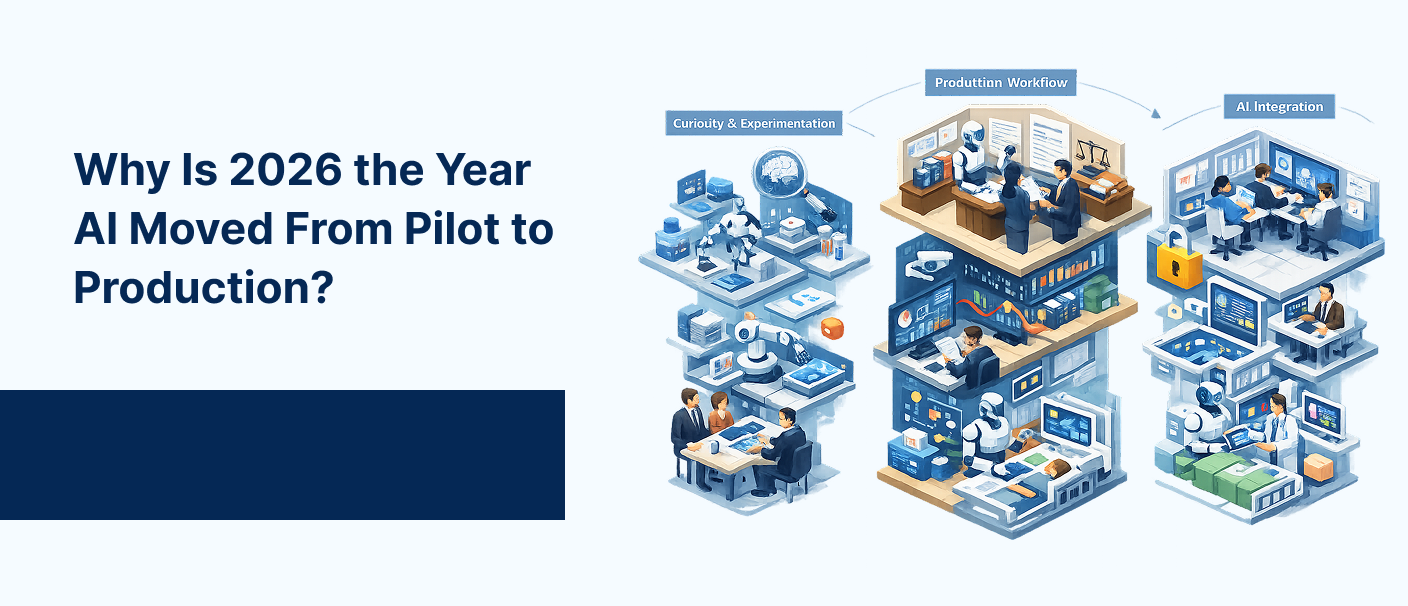
AI adoption usually develops through three stages:
- Curiosity
- Experimentation
- Production adoption
During the curiosity stage, organisations explore what the technology can do.
During the experimentation stage, teams run pilots, test models and evaluate limited use cases.
During the production stage, AI becomes part of a normal business workflow.
For many regulated and professional industries, 2026 represents the shift into this third stage.
Law firms are no longer testing whether AI can identify clauses in contracts. They are integrating contract-review systems into due-diligence workflows.
Banks are no longer experimenting with basic transaction models. They are using machine learning to analyse behavioural, device and network signals in real time.
Healthcare organisations are moving beyond isolated diagnostic trials and using AI for documentation, administrative automation and clinical decision support.
The competitive question has therefore changed.
It is no longer:
Can AI perform useful professional work?
The more important question is:
How quickly can an organisation deploy AI safely, integrate it with existing systems and generate measurable business value?
What Is Driving Enterprise AI Adoption in 2026?
Three important developments have accelerated AI adoption across regulated industries.
Model Quality Has Crossed the Professional Threshold
Early large language models were impressive general-purpose tools, but they were not always reliable enough for specialised professional work.
The situation has changed as organisations have developed domain-specific models, retrieval systems and carefully controlled AI workflows.
Modern AI platforms can now support tasks such as:
- Contract clause identification
- Legal document classification
- Transaction anomaly detection
- Customer risk assessment
- Medical image analysis
- Clinical documentation
- Regulatory monitoring
- Knowledge retrieval
- Large-scale document review
This does not mean AI should make every important decision independently.
It means AI has become reliable enough to perform the first layer of analysis, organise large volumes of information and route uncertain cases to qualified professionals.
Regulatory Frameworks Are Becoming Clearer
Regulated organisations were previously unsure how AI decisions would be reviewed, audited or challenged.
As regulators release more guidance on model governance, explainability, data protection, human oversight and high-risk AI systems, compliance teams have a clearer framework for evaluating deployments.
Important areas include:
- Data privacy
- Model risk management
- Human-in-the-loop review
- Decision explainability
- Bias monitoring
- Audit trails
- Access controls
- Performance monitoring
- Vendor accountability
- Incident response
Regulation does not automatically prevent AI adoption.
In many cases, clearer requirements make adoption easier because organisations know which controls must be established before deployment.
AI Integration Has Become More Practical
The main challenge in enterprise AI is often not the model itself.
The bigger challenge is connecting AI to:
- Legacy software
- Customer databases
- Document repositories
- Core banking systems
- Electronic health record systems
- Case-management platforms
- Internal APIs
- Reporting tools
- Security controls
- Approval workflows
Modern API-first platforms make it possible to add AI capabilities without replacing every existing system.
This has reduced the need for large data migrations and made focused AI implementations more practical.
How Is AI Transforming the Legal Industry?
AI is transforming legal services by reducing the time required for document-heavy and research-intensive tasks.
The strongest legal AI use cases are not replacing legal judgement.
They are helping lawyers spend less time searching, classifying and reviewing information so they can focus on negotiation, strategy and complex analysis.
AI Contract Review and Due Diligence
Contract review is one of the most repetitive and expensive activities in commercial legal work.
A merger, acquisition or financing transaction may require lawyers to examine hundreds or thousands of:
- Non-disclosure agreements
- Employment contracts
- Vendor agreements
- Intellectual property assignments
- Property leases
- Licensing agreements
- Customer contracts
- Data-processing agreements
A traditional review process requires associates to read each document, identify relevant clauses and record issues manually.
AI contract-review platforms can extract important information and identify:
- Non-standard clauses
- Missing provisions
- Termination rights
- Change-of-control clauses
- Indemnification obligations
- Liability limitations
- Renewal dates
- Compliance obligations
- Data-protection provisions
- Commercial risks
The system can organise the findings for lawyer review instead of requiring the legal team to begin with a blank document set.
According to figures referenced in the original article, AI-assisted contract review can reduce review costs by approximately 80% to 90% in some large document-review projects.
The exact result depends on document quality, contract complexity, model accuracy and the amount of professional review required.
AI-Powered Legal Research
Legal research requires lawyers to identify relevant cases, statutes, regulations and legal commentary.
Traditional search tools depend heavily on manually selected keywords.
AI research systems can process a natural-language question, identify relevant legal concepts and retrieve related material.
They may help lawyers:
- Find relevant case law
- Compare judicial interpretations
- Summarise long decisions
- Identify conflicting authorities
- Review statutory developments
- Organise research by legal issue
- Generate initial research outlines
- Locate material that keyword searches may miss
AI does not remove the lawyer’s responsibility to verify citations and interpret the law.
However, it can significantly reduce the time required to locate and organise relevant material.
The source article reports that AI-assisted research can allow lawyers to complete equivalent research tasks much faster while identifying additional relevant precedents.
Automated Compliance Monitoring
Law firms and in-house legal teams must monitor regulatory changes across multiple jurisdictions.
This can involve reviewing:
- New legislation
- Regulatory guidance
- Enforcement actions
- Court decisions
- Consultation papers
- Reporting requirements
- Industry-specific rules
- Licensing changes
Manual monitoring becomes difficult when an organisation operates across several markets.
AI compliance-monitoring systems can ingest regulatory information, classify it according to subject and compare changes with an organisation’s products, policies and obligations.
The system can then alert relevant teams and identify areas requiring review.
For example, a financial institution may receive a targeted alert when a regulatory update affects its lending, onboarding or customer-data processes.
This allows legal and compliance teams to focus on relevant changes rather than reviewing every regulatory update manually.
AI-Assisted E-Discovery
Electronic discovery involves collecting, reviewing and producing electronically stored information during litigation or investigation.
Large cases may involve:
- Emails
- Messages
- Documents
- Attachments
- Call records
- Internal reports
- Database exports
- Collaboration-platform content
Traditional document review requires teams to examine large volumes of material manually.
AI-powered e-discovery platforms can use predictive coding, concept clustering and document classification to reduce the review population.
The technology can help identify:
- Potentially relevant documents
- Duplicate documents
- Privileged material
- Important communication patterns
- Common topics
- Key individuals
- Unusual document groups
Human reviewers still validate the results, but they can focus on a smaller and more relevant document set.
Legal AI ROI Summary
The strongest returns from legal AI generally come from:
- Reducing contract-review time
- Accelerating due diligence
- Improving legal-research efficiency
- Monitoring regulatory changes
- Reducing e-discovery review populations
- Organising legal knowledge
- Automating routine document classification
Legal AI creates the most value when it supports professional judgement rather than attempting to replace it.
How Is AI Transforming Banking and Financial Services?
Banks have used statistical models for decades.
Credit scoring, fraud rules and risk assessment are not new. What has changed is the volume and variety of information modern AI systems can analyse.
Traditional systems may evaluate a limited number of variables.
AI-powered systems can examine hundreds or thousands of transaction, behavioural, device and network signals.
This allows banks to identify patterns that fixed rules may miss.
Real-Time AI Fraud Detection
Traditional fraud systems depend heavily on fixed rules.
Examples include:
- Flag a transaction above a set amount
- Block a card used in two distant locations
- Review repeated payment attempts
- Flag activity from a new device
- Stop transactions from high-risk locations
These rules are useful, but fraudsters can learn how to avoid them.
Modern AI fraud-detection systems analyse wider transaction context.
This may include:
- Device fingerprint
- Customer behaviour
- Transaction velocity
- Beneficiary history
- Merchant category
- Time of transaction
- Geographic movement
- Login activity
- Keystroke behaviour
- Account relationships
- Network-level patterns
- Previous fraud outcomes
A transaction may appear normal individually but become suspicious when connected with several related events.
AI systems can calculate a risk score and recommend whether a transaction should:
- Pass
- Be flagged
- Require additional authentication
- Be held
- Be blocked
- Be sent for analyst review
The source article reports that AI-enhanced fraud detection can reduce fraud losses and false declines when compared with broad rule-based monitoring.
AI-Powered KYC Automation
Know Your Customer processes require financial institutions to verify customer identity and assess financial crime risk.
For business customers, the process may also involve:
- Company registration review
- Director verification
- Beneficial ownership identification
- Sanctions screening
- PEP screening
- Adverse media checks
- Source-of-funds review
- Business activity assessment
- Customer risk scoring
Manual corporate onboarding may require several teams to collect, verify and review information.
AI-powered KYC systems can assist with:
- Document extraction
- Identity verification
- Data validation
- Name matching
- Beneficial ownership mapping
- Sanctions screening
- PEP screening
- Adverse media analysis
- Risk classification
- Case prioritisation
This can reduce manual review queues and allow lower-risk customers to move through onboarding more quickly.
The source article refers to banking deployments in which AI-assisted KYC significantly reduced onboarding time for standard accounts.
AI Credit Risk and Underwriting
Traditional credit models depend on a defined group of financial variables.
AI models can potentially incorporate a broader range of relevant information, including:
- Repayment history
- Income patterns
- Cash-flow behaviour
- Account activity
- Employment information
- Business performance
- Existing obligations
- Transaction volatility
- Customer stability
- Macroeconomic conditions
The purpose is not simply to approve more borrowers.
It is to assess risk more accurately.
A stronger model may help a lender:
- Reduce avoidable defaults
- Identify creditworthy applicants overlooked by traditional models
- Price loans according to risk
- Detect changing borrower conditions
- Improve portfolio monitoring
- Prioritise manual underwriting
AI credit models must also be monitored carefully for bias, explainability and compliance with fair-lending requirements.
A high-performing model is not acceptable if the institution cannot explain or govern its decisions.
AI Customer Service and Advisory
Banks receive high volumes of repetitive customer requests.
These may include:
- Balance queries
- Card-management requests
- Transaction questions
- Password-reset guidance
- Payment-status queries
- Product information
- Branch information
- Account-service requests
AI assistants can handle routine requests while transferring complex or sensitive matters to human agents.
This can reduce the cost per interaction and improve response availability.
The most effective approach is not to remove human support completely.
It is to allow AI to handle predictable, high-volume requests so human employees can focus on:
- Complaints
- Fraud cases
- Financial hardship
- Complex products
- Regulatory concerns
- Sensitive customer situations
Banking AI ROI Summary
AI is creating value in banking through:
- Faster fraud detection
- Fewer false declines
- Reduced KYC processing time
- Lower manual review workloads
- More accurate credit-risk assessment
- Faster customer support
- Better alert prioritisation
- Stronger transaction monitoring
The results depend on data quality, model governance, integration quality and ongoing human oversight.
How Is AI Transforming Healthcare?
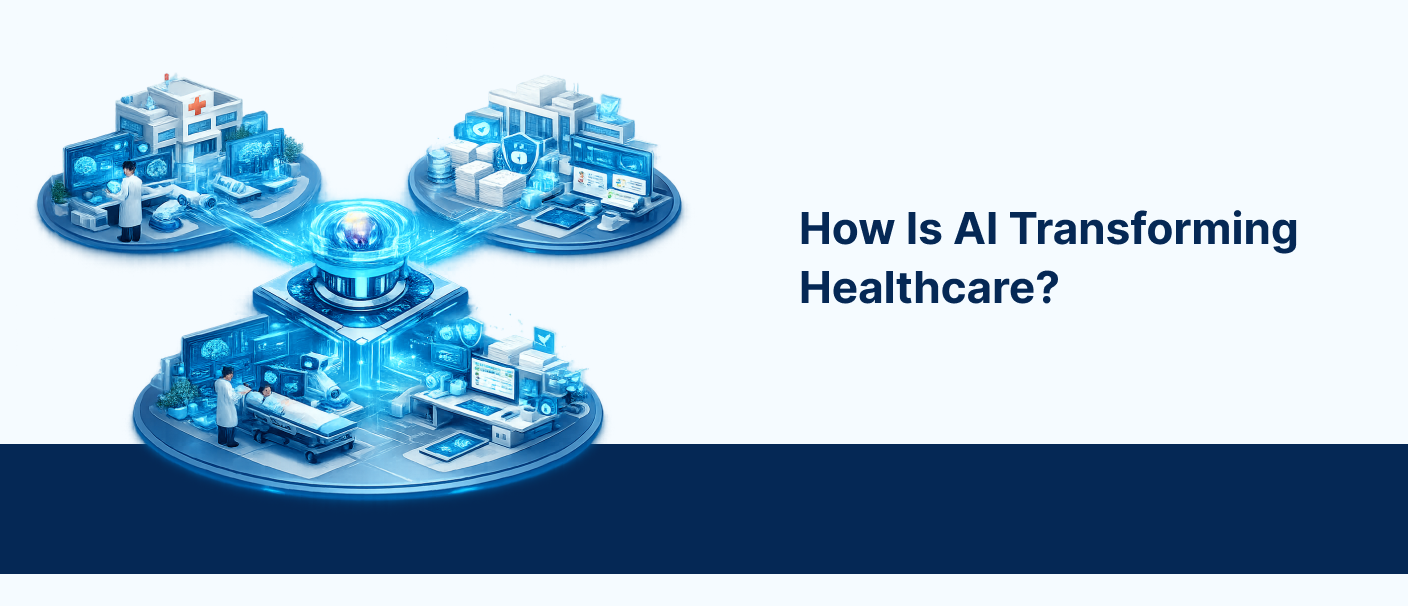
Healthcare AI includes both clinical and administrative applications.
Clinical AI supports diagnosis, treatment planning and medical research.
Administrative AI helps reduce documentation, authorisation and operational workload.
Healthcare implementations require especially strong controls because decisions may affect patient safety.
AI-Assisted Medical Diagnostics
AI diagnostic systems can analyse medical images and patient information to identify patterns associated with disease.
Applications include:
- Radiology
- Pathology
- Ophthalmology
- Dermatology
- Cardiology
- Cancer detection
- Stroke assessment
AI may help clinicians identify abnormalities, prioritise urgent cases and compare findings with large datasets.
The system does not replace the physician.
It provides an additional analytical layer that can support professional review.
The source article reports that AI-assisted imaging tools have improved the detection of some early-stage conditions in controlled and peer-reviewed studies.
Performance varies by tool, disease, dataset and clinical environment.
Therefore, diagnostic AI must be validated for its intended use and monitored after deployment.
AI Drug Discovery
Traditional drug development can require many years of research.
AI can support early stages of drug discovery by analysing:
- Molecular structures
- Biological targets
- Existing research
- Protein interactions
- Compound properties
- Clinical data
- Possible safety concerns
This can help researchers prioritise promising candidates earlier.
AI may also support:
- Target identification
- Compound screening
- Drug repurposing
- Clinical trial design
- Patient selection
- Research literature analysis
AI does not remove the need for laboratory testing, clinical trials or regulatory review.
It helps researchers narrow the search space and make early research more efficient.
AI Clinical Documentation
Clinical documentation consumes a significant amount of professional time.
Doctors may spend hours updating:
- Consultation notes
- Patient histories
- Treatment plans
- Discharge summaries
- Referral letters
- Billing information
- Follow-up records
Ambient AI documentation tools can listen to a consultation, generate a structured draft and allow the clinician to review and approve it.
This can reduce administrative work and allow clinicians to spend more time with patients.
The final record should always be reviewed for accuracy.
Healthcare Administrative Automation
Healthcare organisations also use AI to support:
- Prior authorisation
- Appointment scheduling
- Patient communication
- Claims processing
- Revenue-cycle management
- Coding assistance
- Record classification
- Capacity forecasting
- Supply planning
- Patient follow-up
These administrative applications may generate faster returns than complex diagnostic systems because they usually involve lower clinical risk.
Healthcare AI ROI Summary
Healthcare AI is creating value through:
- Faster clinical documentation
- Improved diagnostic support
- More efficient drug discovery
- Automated administrative work
- Reduced repetitive data entry
- Better case prioritisation
- Improved operational planning
Successful healthcare AI requires clinical validation, patient privacy, security controls and qualified human oversight.
What Do Successful AI Deployments Have in Common?
The most successful deployments across legal, banking and healthcare share several characteristics.
They Begin With a Specific Business Problem
Successful projects do not begin with:
We need to use AI.
They begin with a measurable problem such as:
- Contract review takes too long
- Fraud alerts create too many false positives
- KYC onboarding requires too many manual checks
- Clinicians spend too much time documenting appointments
- Regulatory updates are difficult to track
- Customer-service queues are growing
The use case should have a clear operational owner and a measurable outcome.
They Automate High-Volume Work First
The strongest early opportunities usually involve tasks that are:
- Repetitive
- Time-consuming
- Data-heavy
- Rules-supported
- Easy to measure
- Currently performed at high volume
Examples include:
- Document classification
- Fraud scoring
- Customer verification
- Record summarisation
- Clinical documentation
- Regulatory monitoring
- Customer query routing
They Keep Humans in the Decision Process
High-risk decisions should not depend entirely on an AI recommendation.
Human review is especially important for:
- Legal conclusions
- Credit decisions
- Fraud escalations
- Sanctions matches
- Medical diagnoses
- Treatment decisions
- Regulatory reporting
- Customer rejection
- Employment decisions
The AI system should organise information and identify risk, while qualified professionals remain responsible for important outcomes.
They Integrate With Existing Workflows
An AI tool creates limited value when employees must copy information manually between systems.
Successful deployments connect with existing:
- Document platforms
- Case-management tools
- Customer databases
- Banking systems
- Electronic health records
- Communication systems
- Reporting dashboards
- Approval workflows
They Measure Performance Continuously
AI performance can change over time.
Organisations should monitor:
- Accuracy
- False-positive rate
- False-negative rate
- Processing time
- Escalation rate
- User adoption
- Cost reduction
- Customer impact
- Model drift
- Compliance incidents
Which Industries Will AI Transform Next?
Legal, banking and healthcare are among the first major high-stakes industries to move AI into production.
The next wave includes industries where AI can support personalisation, forecasting, computer vision and operational optimisation.
AI in eCommerce
eCommerce businesses use AI for:
- Product recommendations
- Demand forecasting
- Dynamic pricing
- Inventory planning
- Visual search
- Customer segmentation
- Return-fraud detection
- Marketing personalisation
The source article reports that AI-powered personalisation can produce meaningful revenue improvements compared with static merchandising.
The result depends on customer data, catalogue quality, traffic volume and implementation maturity.
AI in Cybersecurity
Cybersecurity teams manage large volumes of:
- Network events
- User activity
- Threat intelligence
- Access logs
- Device data
- Security alerts
AI can help identify unusual behaviour and prioritise threats that require investigation.
Applications include:
- Behavioural anomaly detection
- Phishing detection
- Malware classification
- Identity-risk monitoring
- Automated alert triage
- Threat-intelligence analysis
- Security operations support
AI security systems should complement, not replace, established security controls and qualified analysts.
AI in Construction
Construction AI applications include:
- Site-safety monitoring
- Schedule-risk prediction
- Equipment optimisation
- Material forecasting
- Progress tracking
- Quality inspection
- Building information modelling
- Cost-overrun prediction
Computer-vision systems can analyse site images and identify potential safety or progress issues.
Predictive models can help project teams identify delays before they affect the entire schedule.
AI in Logistics
Logistics companies use AI for:
- Route optimisation
- Demand forecasting
- Carrier selection
- Warehouse planning
- Predictive maintenance
- Shipment monitoring
- Inventory optimisation
- Exception management
The strongest logistics applications connect forecasting with real-time operational decisions.
AI in Education
AI in education can support:
- Personalised learning
- Adaptive assessments
- AI tutoring
- Content recommendations
- Administrative automation
- Student-support systems
- Teacher planning
- Progress analysis
Schools and education platforms must also consider student privacy, age-appropriate design, transparency and teacher oversight.
Industry AI Comparison
|
Industry |
Main AI use case |
Potential business impact |
Typical implementation focus |
Key governance requirements |
|
Legal |
Contract review and due diligence |
Faster reviews and lower manual effort |
Document systems and legal workflows |
Confidentiality, accuracy and lawyer supervision |
|
Banking |
Fraud detection and KYC |
Lower fraud exposure and faster onboarding |
Transaction, customer and risk data |
Model governance, fair lending and explainability |
|
Healthcare |
Documentation and diagnostic support |
Reduced administrative work and better case support |
EHR integration and clinical validation |
Privacy, safety, validation and human oversight |
|
eCommerce |
Personalisation and forecasting |
Higher conversion and better inventory planning |
Customer and product data |
Consent, privacy and payment security |
|
Cybersecurity |
Behavioural anomaly detection |
Faster threat identification |
SIEM and identity-system integration |
Security controls and model monitoring |
|
Construction |
Safety and schedule monitoring |
Fewer incidents and improved project visibility |
Camera, BIM and project-system integration |
Worker privacy and site compliance |
|
Logistics |
Route and network optimisation |
Lower transport and inventory costs |
Fleet and supply-chain systems |
Driver privacy and cross-border data controls |
|
Education |
Adaptive learning and AI tutoring |
More personalised instruction |
LMS and student-data integration |
Student privacy, transparency and teacher oversight |
you can also check our product debtpulse for loan recovery.
How Can an Organisation Measure AI Readiness?
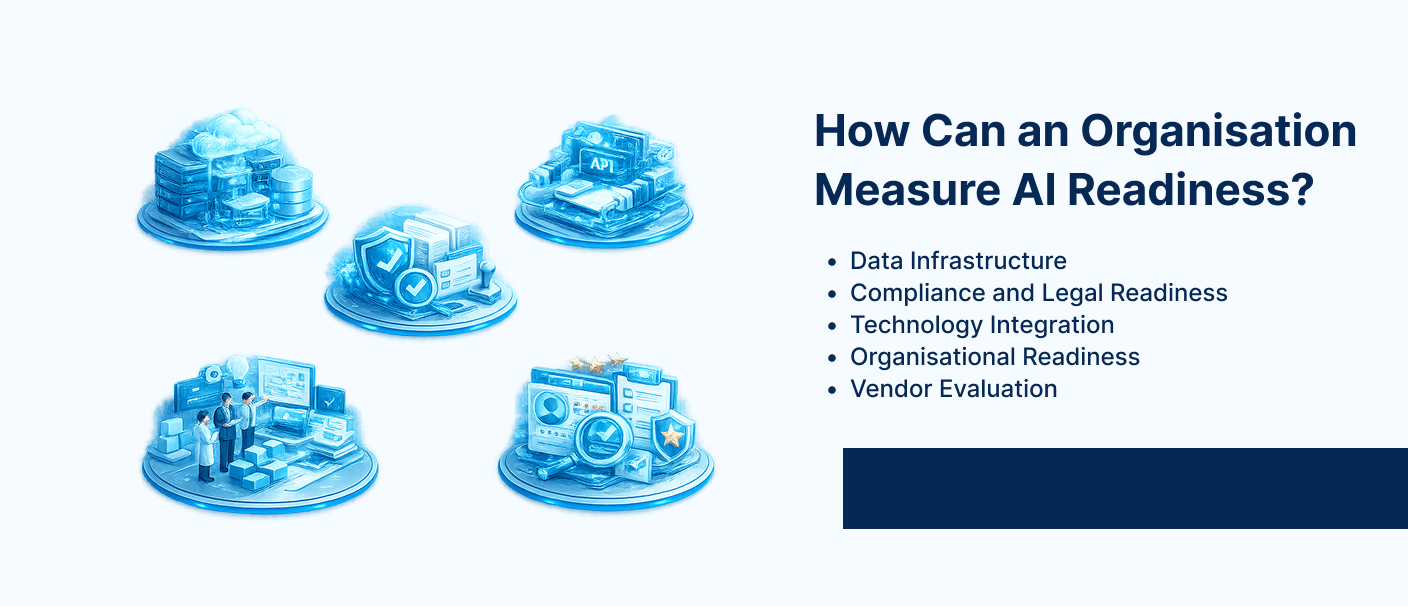
Before selecting a vendor or beginning development, organisations should evaluate their readiness across five areas.
Data Infrastructure
- Core data sources are accessible through APIs or structured exports
- Historical data is available for the selected use case
- Data quality has been assessed
- Missing and duplicate data rates are understood
- Sensitive data has been classified
- Data-access permissions are documented
- Data-retention policies are established
Compliance and Legal Readiness
- The intended AI use case has been reviewed by legal and compliance teams
- Relevant regulations have been identified
- High-risk decisions requiring human review have been defined
- Data-processing responsibilities are clear
- Vendor agreements cover security and data use
- Audit and explainability requirements are documented
- Model-risk governance has been planned
Technology Integration
- Existing systems support API or secure data integration
- A staging environment is available
- Security teams have reviewed the proposed architecture
- Monitoring and alerting are planned
- A rollback process has been defined
- Required identity and access controls are available
- Integration ownership is clear
Organisational Readiness
- An executive sponsor has been identified
- The operational team has participated in use-case selection
- Success metrics are defined
- Training resources are available
- Change-management requirements are understood
- A focused initial scope has been selected
- Employees understand how the AI system will affect their work
Vendor Evaluation
- Multiple vendors have been compared
- Same-industry references have been reviewed
- Accuracy claims have been tested using relevant data
- Total cost of ownership has been calculated
- Integration requirements are clear
- Security certifications have been reviewed
- Data ownership is defined
- Performance and uptime commitments are included in the agreement
- Exit and data-portability terms are understood
Key Takeaways
- AI has moved beyond isolated pilots in legal, banking and healthcare.
- The strongest AI returns come from automating high-volume, repetitive and data-heavy work.
- Legal teams are using AI for contract review, research, compliance monitoring and e-discovery.
- Banks are applying AI to fraud detection, KYC, underwriting and customer service.
- Healthcare organisations are using AI for diagnostics, documentation, administration and drug discovery.
- Human oversight remains essential for high-risk professional decisions.
- Integration, governance and data quality are as important as model performance.
- Organisations should begin with one measurable use case rather than attempting enterprise-wide automation immediately.
- Every major numerical or performance claim should be supported by a primary source before publication.
- AI should support trained professionals, not remove accountability for important decisions.
Want to explore more practical insights on AI development, automation, and conversational AI? Read more blogs at Cloudastra Technologies or contact us for business enquiries through Cloudastra Contact Us.
Frequently Asked Questions
1. How is AI transforming legal services in 2026?
AI is helping legal teams automate contract review, legal research, compliance monitoring and e-discovery. It reduces repetitive document work while allowing lawyers to focus on negotiation, legal strategy and complex analysis.
2. How is AI used in banking?
Banks use AI for fraud detection, KYC automation, credit-risk assessment, transaction monitoring, customer service and alert prioritisation.
3. How is AI changing healthcare?
Healthcare organisations use AI to support medical diagnostics, clinical documentation, drug discovery, patient communication and administrative workflows.
4. Why has enterprise AI adoption accelerated?
AI adoption has accelerated because model capabilities have improved, regulatory expectations have become clearer and modern platforms can integrate with existing systems more easily.
5. What business tasks generate the highest AI ROI?
The highest returns often come from high-volume and repetitive tasks such as document review, fraud scoring, customer verification, clinical documentation and support-query handling.
6. Does AI replace lawyers, bankers or healthcare professionals?
AI is most effective when it supports professionals. It can process information and automate routine work, but qualified people should remain responsible for complex, sensitive and high-risk decisions.
7. What are the main risks of enterprise AI?
Important risks include inaccurate outputs, poor data quality, privacy failures, bias, weak explainability, model drift, security problems and over-reliance on automated decisions.
8. What is human-in-the-loop AI?
Human-in-the-loop AI is an approach in which AI supports or recommends a decision, but a qualified person reviews sensitive, uncertain or high-risk cases before final action is taken.
9. How can a company assess its AI readiness?
A company should evaluate its data quality, integrations, security controls, compliance requirements, internal skills, leadership support, measurable goals and vendor options.
10. How long does enterprise AI implementation take?
Implementation time depends on the use case, data availability, integration requirements and regulatory complexity. A focused workflow may be deployed in weeks, while a complex regulated system may require several months.
11. What is the best first AI use case for an organisation?
The best first use case is usually a high-volume process with a measurable cost, clear data, defined ownership and manageable regulatory risk.
12. How should an organisation select an AI vendor?
An organisation should compare multiple vendors, test performance using relevant data, review security and integration requirements, verify references and calculate the total cost of ownership.