Automated debt collection software helps lenders manage overdue accounts by automatically triggering borrower reminders, prioritising recovery cases, assigning collection work, tracking repayment commitments and escalating accounts that require human attention.
For banks, NBFCs and fintech lenders, the problem is rarely just the number of overdue borrowers.
The bigger challenge is managing thousands of small collection actions consistently.
A collection team may need to:
- Identify newly overdue accounts
- Check days past due
- Review borrower repayment history
- Decide who should receive a reminder
- Select the appropriate communication
- Assign difficult cases to agents
- Track borrower responses
- Record promises to pay
- Monitor missed commitments
- Escalate higher-risk accounts
- Update collection dashboards
- Prepare recovery reports
When these actions depend heavily on spreadsheets, calling lists and individual agents, the collection process becomes difficult to scale.
Automated debt collection software connects these steps into structured recovery workflows.
Instead of collection teams manually deciding what should happen to every overdue account, the system can use borrower information, delinquency status, repayment behaviour and collection rules to determine the next appropriate action.
DebtPulse supports this approach through AI-driven borrower risk intelligence, automated collection workflows, account prioritisation, personalised borrower communication and portfolio-level recovery visibility.
In simple terms, automated debt collection software helps lenders move from:
“Which borrower should we follow up with today?”
to:
“The system has already identified the priority accounts, triggered routine actions and shown us which borrowers now require human attention.”
What Problem Does Automated Debt Collection Software Solve?
Loan portfolios can grow much faster than collection teams.
A lender that once managed a few hundred overdue accounts may eventually need to manage thousands or hundreds of thousands.
Every overdue account creates operational work.
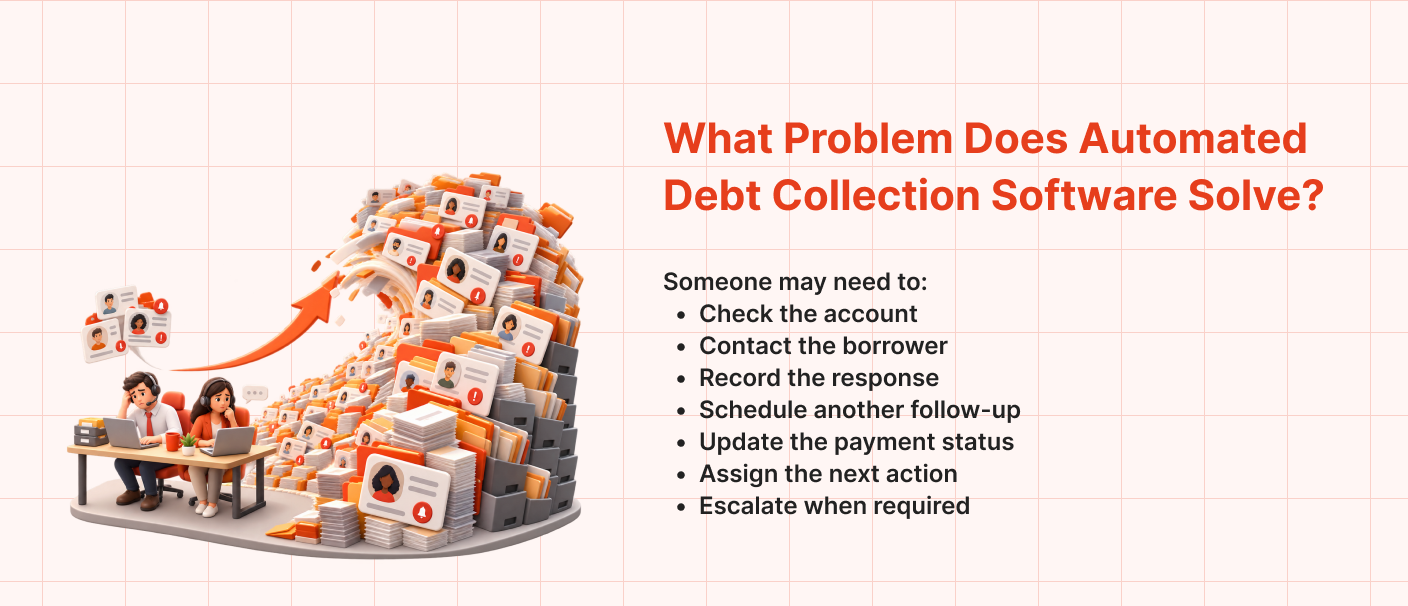
Someone may need to:
- Check the account
- Contact the borrower
- Record the response
- Schedule another follow-up
- Update the payment status
- Assign the next action
- Escalate when required
When this work is performed manually, several problems appear.
Borrower Follow-Ups Are Delayed
Agents cannot manually contact every borrower at exactly the right time.
Some borrowers may receive communication too late, allowing a minor missed payment to progress into deeper delinquency.
Every Borrower Receives Similar Treatment
A borrower who missed one EMI for the first time should not necessarily receive the same collection treatment as someone who repeatedly breaks payment commitments.
Manual processes often make this level of differentiation difficult.
Agents Spend Time on Low-Priority Accounts
Collection employees may work through accounts based on:
- Spreadsheet order
- Calling lists
- Personal judgement
- Old assignments
This can mean that higher-risk or higher-value accounts do not receive attention early enough.
Repayment Commitments Are Difficult to Track
When a borrower says:
“I will pay on Friday,”
that commitment needs to become a structured collection event.
The team needs to know:
- Promised date
- Promised amount
- Payment status
- Follow-up requirement
- Whether the promise was kept
- Whether escalation is necessary
Communication Becomes Inconsistent
Different agents may send different messages or follow different processes for similar borrowers.
Managers Lack Real-Time Visibility
Collection leaders may depend on manually prepared reports to understand:
- Portfolio delinquency
- Agent workload
- Recovery progress
- Broken promises
- Escalated accounts
- Expected payments
Automated debt collection software reduces these problems by turning recovery policies into structured workflows.
What Is Automated Debt Collection Software?
Automated debt collection software is a digital platform that uses predefined workflows, borrower data and risk information to automatically manage repetitive parts of the debt recovery process.
The software does not simply store overdue accounts.
It actively determines and triggers the next collection action.
Depending on the lender’s workflow, the system may automate:
- EMI reminders
- Follow-up scheduling
- Borrower segmentation
- Account prioritisation
- Agent assignment
- Communication workflows
- Promise-to-pay tracking
- Missed-promise alerts
- Repayment-plan tracking
- Escalation
- Portfolio reporting
- Collection task creation
Human collection agents remain important.
The purpose of automation is to remove repetitive coordination work so agents can concentrate on accounts that require conversation, negotiation, investigation or judgement.
How Is Automated Debt Collection Different From Manual Collections?
Manual collection relies heavily on employees deciding and executing each step.
Automated collections use workflow rules and borrower information to trigger routine actions.
|
Area |
Manual Collections |
Automated Debt Collection |
|
Account review |
Agent checks account |
System identifies required action |
|
Prioritisation |
Manual lists |
Risk-based queues |
|
Reminders |
Sent manually or separately |
Automatically triggered |
|
Follow-ups |
Personal scheduling |
Workflow scheduling |
|
Agent assignment |
Manual allocation |
Rule-based assignment |
|
Promise tracking |
Notes or spreadsheets |
Structured tracking |
|
Escalation |
Agent judgement/manual process |
Defined workflow triggers |
|
Communication history |
May be scattered |
Centralised |
|
Reporting |
Manually prepared |
Portfolio dashboards |
|
Management visibility |
Periodic |
More continuous |
|
Scale |
Requires more manual effort |
Handles higher volume systematically |
The objective is not necessarily to remove every manual interaction.
It is to automate the predictable work surrounding those interactions.
How Does Automated Debt Collection Software Work?
A strong automated collection workflow follows the borrower through several stages.
1. Overdue Accounts Enter the Collection Workflow
The process begins when an account meets the lender’s collection criteria.
For example:
- EMI becomes overdue
- Payment date passes
- Scheduled payment fails
- Account enters a DPD bucket
- Repayment commitment is missed
The system receives relevant account information such as:
- Borrower
- Loan
- Outstanding balance
- EMI amount
- Due date
- Days past due
- Previous payments
- Previous collection activity
- Borrower risk
- Previous promises
The account can then enter the appropriate recovery workflow.
2. Borrowers Are Segmented
Not every overdue borrower should receive the same treatment.
Automated debt collection software can help organise borrowers according to factors such as:
- Days past due
- Outstanding balance
- Previous repayment behaviour
- Number of missed payments
- Previous promises
- Borrower response
- Loan type
- Risk level
- Previous recovery outcome
Possible segments may include:
- First-time late borrower
- Low-risk overdue borrower
- Repeated late payer
- Broken-promise borrower
- Unresponsive borrower
- High-risk borrower
- Deep-delinquency account
Segmentation allows collection workflows to become more targeted.
3. Accounts Are Prioritised
Once borrowers are segmented, the system can determine which accounts require the most attention.
Priority may be influenced by:
- Borrower risk
- Days past due
- Outstanding balance
- Repayment history
- Previous contact
- Broken promises
- Delinquency stage
- Expected recovery probability
This helps agents avoid spending equal time on every account.
Lower-risk cases may remain in automated workflows.
Higher-risk cases can be moved to agent queues.
4. Automated Reminders Are Triggered
Routine repayment communication can be triggered according to defined schedules.
Possible communication points include:
Before the Due Date
A preventive reminder may notify the borrower about the upcoming payment.
On the Due Date
The borrower can receive a payment-due notification.
After a Missed Payment
A follow-up may explain that the account is overdue and provide approved repayment information.
After No Response
The workflow may trigger another communication or move the account to an agent.
Communication may use approved channels supported by the lender’s collection setup.
The key is that the communication is triggered automatically according to the borrower state instead of waiting for someone to manually send it.
5. Borrower Responses Update the Workflow
Automation should not continue blindly after the borrower responds.
The next action should depend on what happens.
For example:
Borrower Pays
The workflow can recognise the payment and stop unnecessary collection communication.
Borrower Promises to Pay
The commitment can be recorded with:
- Promise date
- Promise amount
- Next follow-up
Borrower Needs Assistance
The case may be moved to a human agent.
Borrower Does Not Respond
The workflow may continue through the approved follow-up sequence.
Borrower Disputes the Account
The case should move into the lender’s appropriate manual review process.
Automation becomes more useful when borrower responses influence what happens next.
6. Promise-to-Pay Commitments Are Tracked
Promises to pay are important recovery signals.
If a borrower says they will pay a specific amount on a certain date, the system should track:
- Promised amount
- Promised date
- Payment status
- Responsible agent
- Communication history
- Follow-up requirement
When the promise date arrives, the system checks the outcome.
Promise Kept
The repayment status is updated.
Promise Partially Kept
The remaining amount can stay in the appropriate workflow.
Promise Broken
The account may receive:
- Reminder
- Agent follow-up
- Higher priority
- Escalation
This prevents repayment commitments from being lost inside agent notes.
7. Accounts Are Assigned to Agents
Not every overdue account should require human contact.
Agent attention should be concentrated on accounts where it creates the most value.
Automated assignment may consider:
- Borrower risk
- Delinquency stage
- Account value
- Case complexity
- Previous response
- Agent workload
- Agent specialisation
The agent receives a prioritised worklist rather than searching manually through the entire overdue portfolio.
8. Follow-Up Tasks Are Created Automatically
When human action is required, the software can create the next task.
Examples include:
- Call borrower
- Review broken promise
- Check payment dispute
- Review repayment plan
- Escalate account
- Contact high-risk borrower
- Follow up after partial payment
Each task can contain the account context required by the collection employee.
9. Accounts Are Escalated According to Rules
Recovery workflows should define when an account moves from one stage to another.
Escalation may depend on:
- Days past due
- Repeated non-response
- Broken promises
- Outstanding balance
- Risk level
- Repeated missed payments
- Previous recovery attempts
A defined escalation workflow prevents accounts from remaining indefinitely in the wrong queue.
10. Collection Activity Is Recorded
Every meaningful recovery action should become part of the account history.
This may include:
- Reminder sent
- Agent assigned
- Contact attempted
- Borrower response
- Promise recorded
- Payment received
- Promise broken
- Case escalated
- Plan created
- Final outcome
A structured history improves visibility and supports future collection decisions.
What Debt Collection Tasks Can Be Automated?
Automated debt collection software can support multiple parts of the recovery lifecycle.
EMI Reminder Automation
Routine reminders can be triggered before and after payment due dates.
Borrower Segmentation
Accounts can be organised according to borrower risk and repayment behaviour.
Recovery Prioritisation
Higher-priority accounts can move to the top of agent queues.
Collection Workflow Automation
Tasks, reminders, follow-ups and escalations can be connected into defined workflows.
Agent Task Assignment
Cases can be routed to the appropriate collection team or agent.
Promise-to-Pay Tracking
Borrower commitments can be monitored automatically.
Repayment Plan Monitoring
Structured repayment arrangements can remain connected with the wider collection process.
Broken-Promise Detection
Missed commitments can trigger follow-up or escalation.
Portfolio Reporting
Managers can monitor recovery performance without relying entirely on manually prepared reports.
Communication History
Borrower interactions can be stored as part of the collection record.
What Should Not Be Fully Automated?
Automation works best for repetitive and predictable collection actions.
Some situations require human judgement.
Examples include:
- Borrower disputes
- Financial hardship
- Sensitive complaints
- Complex repayment negotiation
- Legal matters
- Vulnerable customer situations
- Unusual account behaviour
- Exceptions to policy
- High-impact decisions
The purpose of automated collections is not to force every borrower through an identical workflow.
It is to automate routine recovery actions while routing exceptions to the right people.
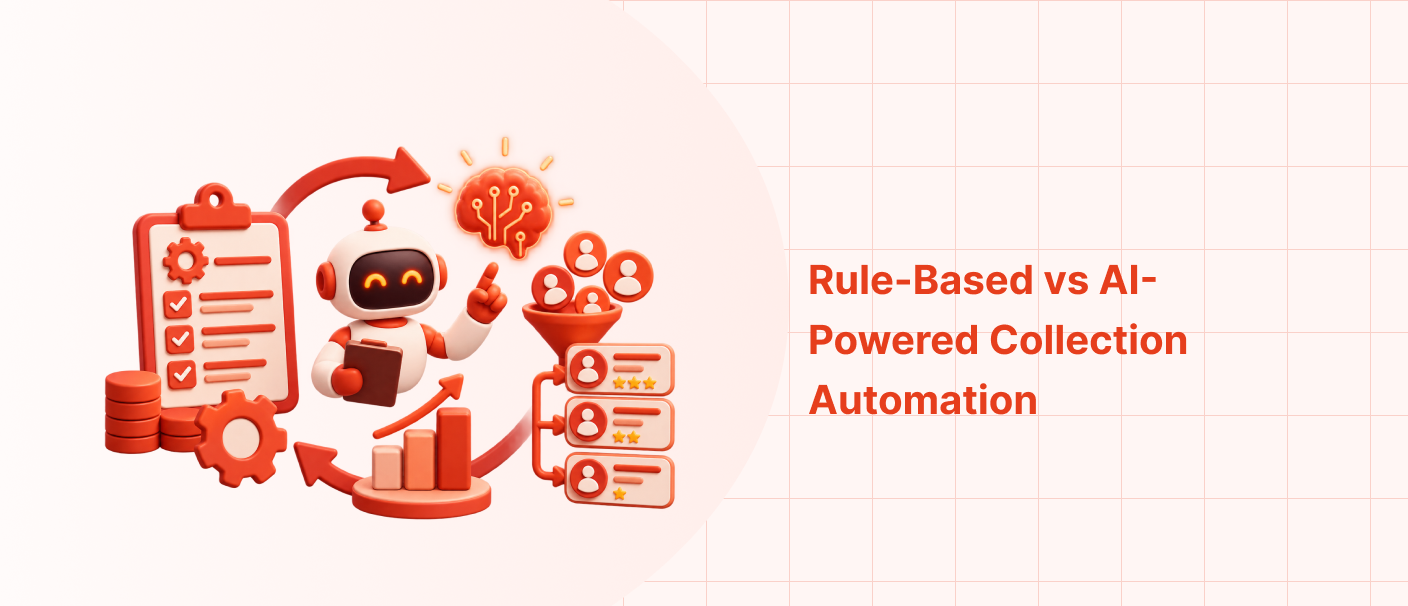
What Is AI-Powered Debt Collection Automation?
Traditional collection automation follows predefined rules.
AI-powered debt collection adds another layer by helping lenders analyse borrower information and decide where collection attention should be focused.
For example, rule-based automation may say:
If account reaches a specific DPD stage → create agent task.
AI-driven recovery intelligence can add context such as:
- Repayment behaviour
- Previous responses
- Risk indicators
- Recovery history
- Borrower segment
This can help lenders create more intelligent priority queues.
AI does not need to make every collection decision.
It can support the recovery process by helping teams determine:
- Which accounts deserve attention first
- Which borrowers may respond to automated communication
- Which cases should move to agents
- Which accounts show increasing recovery risk
Rule-Based vs AI-Powered Collection Automation
|
Area |
Rule-Based Automation |
AI-Powered Collection Automation |
|
Main input |
Predefined rules |
Rules + borrower risk signals |
|
Segmentation |
Fixed categories |
More contextual segmentation |
|
Prioritisation |
DPD or static criteria |
Multiple risk factors |
|
Communication |
Fixed sequences |
Can support more personalised workflows |
|
Agent assignment |
Rule based |
Risk-informed prioritisation |
|
Adaptability |
Requires rule changes |
Can use broader borrower context |
|
Best use |
Predictable workflows |
Complex portfolios and prioritisation |
The strongest collection systems can use both.
Rules create control and predictability.
AI can improve prioritisation and context.
Why Is Borrower Segmentation Important in Automated Collections?
A collection workflow becomes inefficient when every overdue borrower receives the same treatment.
Consider three borrowers.
Borrower A
- First missed EMI
- Strong repayment history
- Small overdue balance
- Responds immediately
Borrower B
- Several late payments
- Previous promise to pay
- Partial response history
Borrower C
- Deep delinquency
- Multiple broken promises
- Repeated non-response
- Higher outstanding balance
These accounts should not automatically receive identical recovery treatment.
Segmentation allows the lender to create different workflows.
Lower-Risk Segment
Possible actions:
- Automated reminder
- Self-service repayment option
- Limited agent involvement
Medium-Risk Segment
Possible actions:
- More frequent follow-up
- Promise tracking
- Agent intervention after non-response
Higher-Risk Segment
Possible actions:
- Faster agent assignment
- Stronger monitoring
- Escalation according to lender policy
This helps collection teams apply human effort more efficiently.
How Does Automated Borrower Communication Work?
Communication is one of the largest repetitive tasks in collection operations.
Without automation, employees may manually:
- Prepare contact lists
- Send reminders
- Schedule calls
- Update responses
- Create follow-up tasks
Automated borrower communication connects these activities with account status.
A basic workflow may look like:
Upcoming EMI → Reminder → Due Date → Missed Payment → Follow-Up → Borrower Response → Next Action
The next action should change based on the borrower response.
Why Personalised Communication Matters
Automation should not mean sending the exact same message to every borrower.
Communication can be adjusted according to factors such as:
- Delinquency stage
- Previous response
- Payment status
- Borrower segment
- Promise status
- Recovery stage
For example, a first-time late borrower may require a simple reminder.
A borrower who repeatedly misses commitments may require a different approved recovery workflow.
Personalisation helps communication remain relevant instead of becoming repetitive noise.
Automated Collections vs Manual Calling Lists
Many collection teams still depend heavily on daily calling lists.
These lists may show:
- Borrower
- Account
- Amount due
- Phone number
- DPD
The agent then decides what to do.
Automated debt collection changes this model.
The system can first determine:
- Which borrower needs communication
- Whether automation can handle the next step
- Whether the borrower already responded
- Whether a promise is active
- Whether payment was received
- Whether the account requires an agent
- How urgently the case should be handled
The calling list becomes a prioritised action queue.
How Does Automated Debt Collection Reduce Manual Work?
Fewer Manual Reminders
Routine borrower communication can be triggered automatically.
Less Spreadsheet Tracking
Account states and next actions can remain within a structured system.
Less Manual Task Assignment
Cases can be routed according to workflow rules.
Less Follow-Up Scheduling
Next actions can be generated automatically.
Faster Promise Tracking
Borrower commitments remain visible and can trigger reminders or alerts.
Easier Reporting
Portfolio information can be available through dashboards instead of manual consolidation.
More Focused Agent Work
Employees can concentrate on borrowers who need direct intervention.
How Can Automated Debt Collection Improve Recovery Operations?
Automation does not guarantee repayment.
It improves the process surrounding recovery.
Earlier Follow-Up
Accounts can enter recovery workflows as soon as the relevant condition is met.
More Consistent Contact
Routine actions do not depend entirely on agent availability.
Better Prioritisation
High-priority cases can receive attention earlier.
Faster Response to Broken Commitments
Missed promises can trigger immediate follow-up.
More Accurate Work Queues
Agents can see which borrowers genuinely require human intervention.
Better Portfolio Visibility
Managers can monitor account movement across recovery stages.
Reduced Operational Bottlenecks
Collection volume can increase without every additional account requiring the same amount of manual coordination.
What Features Should Automated Debt Collection Software Have?
A strong automated collections platform should include:
- Borrower risk scoring
- Delinquency tracking
- Automated EMI reminders
- Multi-channel collection workflows
- Borrower segmentation
- Account prioritisation
- Agent task assignment
- Promise-to-pay tracking
- Broken-promise monitoring
- Repayment-plan management
- Follow-up scheduling
- Escalation workflows
- Communication history
- Portfolio dashboards
- Recovery reporting
- Audit trails
- API integration
- Role-based access
- Secure data handling
For lenders, the most important requirement is that these features work together.
A reminder system alone is not a complete debt collection platform.
A useful system should connect:
Account status → borrower risk → communication → response → agent action → repayment → escalation → reporting
What Metrics Should Automated Collection Teams Track?
Automation should be measured using recovery outcomes rather than only the number of messages sent.
Recovery Rate
How much overdue value is successfully recovered?
Collection Rate
How much of the targeted outstanding amount is collected during a defined period?
Cure Rate
How many delinquent accounts return to an acceptable repayment status?
Promise-to-Pay Rate
How many contacted borrowers make a repayment commitment?
Promise Kept Rate
How many commitments result in the expected payment?
Broken Promise Rate
How many promised payments are missed?
Contact Rate
How many borrowers successfully receive or respond to recovery communication?
Agent Intervention Rate
What percentage of accounts require manual agent handling?
Average Resolution Time
How long does it take to resolve an overdue case?
Roll Rate
How many accounts move into deeper delinquency stages?
Recovery by Segment
Which borrower groups produce better or worse recovery outcomes?
Recovery by Workflow
Which automated sequences are most effective for different account types?
Agent Productivity
How many priority cases can agents resolve when routine work is automated?
These metrics help lenders understand whether automation is creating better recovery outcomes or simply generating more activity.
What Is the Role of Collection Dashboards?
Collection managers need portfolio-level visibility.
A useful recovery dashboard can help answer:
- How many accounts are overdue?
- Which DPD buckets are growing?
- How much outstanding value is at risk?
- Which accounts require immediate attention?
- Which borrowers have active promises?
- How many promises were broken?
- Which agents have high-priority cases?
- Which borrower segments are recovering?
- Which workflows are producing better outcomes?
This visibility allows managers to make decisions using current collection information rather than waiting for manually consolidated reports.
Common Problems With Debt Collection Automation
Automation can improve recovery operations, but poor implementation creates new problems.
Automating the Same Workflow for Everyone
The same collection sequence should not necessarily apply to every borrower.
Use segmentation.
Sending Communication After Payment
If payment information is not synchronised quickly, borrowers may receive unnecessary reminders.
Collection workflows should use current repayment status.
Too Many Messages
Automation makes communication easy to send.
That does not mean more communication is always better.
Frequency should follow the lender’s approved policies and borrower context.
No Human Escalation
Some cases require direct human intervention.
The system should define when automation stops.
Poor Data Quality
Incorrect phone numbers, payment status or customer information can make collection workflows unreliable.
Unclear Ownership
Automation still requires operational accountability.
Teams should know who owns:
- Workflow rules
- Failed automations
- Escalated cases
- Reporting
- Compliance
- System updates
Missing Audit History
Automated actions should still be traceable.
Teams need to know:
- What happened
- When it happened
- Which rule triggered it
- What the borrower did
- What action followed
Measuring Activity Instead of Recovery
Sending more reminders is not the objective.
Improving recovery efficiency is.
Manual Debt Collection vs Automated Debt Collection Software
|
Capability |
Manual Collections |
Automated Debt Collection Software |
|
Borrower segmentation |
Manual |
Structured/risk-based |
|
Reminder scheduling |
Agent dependent |
Automated |
|
Account prioritisation |
Calling lists |
Risk-informed queues |
|
Follow-up scheduling |
Manual |
Workflow-driven |
|
Agent assignment |
Manual |
Automated rules |
|
Promise tracking |
Notes/spreadsheets |
Structured |
|
Broken promises |
Manual discovery |
Workflow alerts |
|
Escalation |
Manual |
Defined triggers |
|
Communication history |
May be scattered |
Centralised |
|
Reporting |
Manual consolidation |
Dashboards |
|
Portfolio scalability |
Limited by team capacity |
Higher process scalability |
|
Agent focus |
Routine + complex work |
More focus on complex work |
How DebtPulse Supports Automated Debt Collection
DebtPulse is an AI-powered debt intelligence and recovery platform designed for banks, NBFCs, fintech lenders and other financial institutions managing borrower collections.
DebtPulse helps lenders move from reactive recovery work toward more structured, risk-informed collection operations.
The platform supports:
- Predicting high-risk borrowers before default
- AI-driven borrower risk intelligence
- Borrower segmentation
- Automated multi-channel collection workflows
- Account prioritisation
- Personalised borrower communication
- Promise-to-pay tracking
- Broken-promise monitoring
- Repayment-plan management
- Borrower self-service
- Agent case assignment
- Collection activity tracking
- Escalation workflows
- Portfolio recovery dashboards
- Recovery reporting
- Audit-ready collection history
This allows lenders to connect individual collection activities into one broader recovery workflow.
Instead of relying on separate reminder tools, spreadsheets, agent notes and reporting processes, DebtPulse gives collection teams a more structured way to manage overdue accounts.
How DebtPulse Fits Into an Automated Collection Workflow
Stage 1: Identify Risk
DebtPulse can help identify borrowers showing higher recovery risk.
Stage 2: Segment Borrowers
Accounts can be grouped according to borrower and delinquency characteristics.
Stage 3: Trigger Automated Communication
Routine recovery communication can be handled through automated workflows.
Stage 4: Monitor Response
Payment, non-response and borrower commitments can influence the next action.
Stage 5: Prioritise Agent Work
Cases requiring human intervention can move into agent queues.
Stage 6: Track Commitments
Promise-to-pay dates and repayment arrangements can remain visible within the recovery process.
Stage 7: Escalate Cases
Higher-risk or unresolved cases can move through defined escalation workflows.
Stage 8: Monitor Portfolio Performance
Collection leaders can use dashboards and reporting to understand recovery progress.
This creates a connected recovery lifecycle rather than a collection process built around isolated tasks.
Benefits of Automated Debt Collection With DebtPulse
Reduced Manual Collection Work
Routine reminders, task creation and follow-up scheduling can be automated.
Better Borrower Prioritisation
Collection teams can focus more attention on accounts carrying greater recovery risk.
Faster Follow-Up
Borrowers can enter the appropriate workflow without waiting for manual list preparation.
More Consistent Collection Processes
Similar account conditions can trigger defined actions.
Better Promise-to-Pay Tracking
Borrower commitments remain visible and connected to future recovery actions.
More Personalised Borrower Communication
Different borrower segments can follow different collection journeys.
Better Agent Productivity
Agents spend more time on cases requiring judgement instead of routine coordination.
Improved Portfolio Visibility
Managers can monitor recovery operations through structured dashboards and reporting.
Better Collection Records
Actions, responses, promises and escalations can remain part of the recovery history.
How Can Lenders Implement Automated Debt Collection Software?
1. Map the Current Collection Process
Document the complete manual workflow.
Include:
- When an account becomes overdue
- How borrowers are identified
- How lists are prepared
- Which reminders are sent
- How agents are assigned
- How promises are recorded
- How escalation works
- How reports are created
Automation should begin with a clear understanding of the existing process.
2. Define Borrower Segments
Determine which borrower groups require different treatment.
Possible factors include:
- DPD
- Repayment history
- Outstanding amount
- Risk
- Previous promises
- Communication response
3. Define Collection Journeys
For each segment, determine:
- First action
- Reminder timing
- Follow-up timing
- Agent trigger
- Promise handling
- Escalation trigger
4. Define What Can Be Automated
Routine actions may include:
- Reminders
- Follow-up creation
- Status updates
- Promise monitoring
- Task assignment
- Reporting
5. Define Human Intervention Points
Identify cases that always require manual review.
6. Connect Payment and Loan Data
The collection workflow needs accurate account information.
The system should be connected with relevant loan and payment data so actions reflect the current account state.
7. Configure Agent Queues
Agents should receive prioritised cases with enough information to act.
8. Define Escalation Rules
Specify what should happen when:
- Borrower does not respond
- Promise is broken
- Delinquency increases
- Risk rises
- Repeated contact fails
9. Test With Real Collection Scenarios
Test:
- Payment received before reminder
- Partial payment
- Broken promise
- First missed EMI
- Repeat delinquency
- Borrower dispute
- No response
- Multiple loans
- Failed communication
10. Measure the Outcome
Compare the automated workflow with the previous manual process.
Track:
- Recovery
- Response
- Agent effort
- Resolution time
- Broken promises
- Roll rates
- Operational workload
Who Should Use Automated Debt Collection Software?
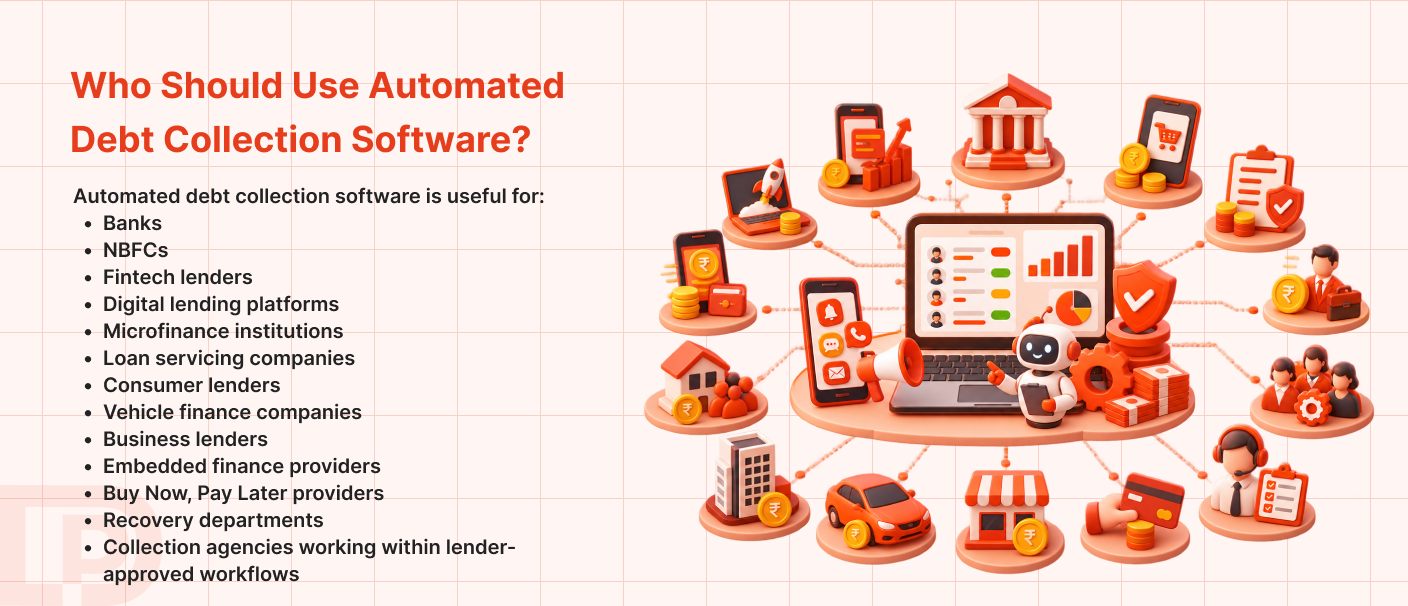
Automated debt collection software is useful for:
- Banks
- NBFCs
- Fintech lenders
- Digital lending platforms
- Microfinance institutions
- Loan servicing companies
- Consumer lenders
- Vehicle finance companies
- Business lenders
- Embedded finance providers
- Buy Now, Pay Later providers
- Recovery departments
- Collection agencies working within lender-approved workflows
It becomes particularly valuable when borrower volume grows beyond what manual calling lists and spreadsheets can manage efficiently.
Want to explore more practical insights on AI development, automation, and conversational AI? Read more blogs at Cloudastra Technologies or contact us for business enquiries through Cloudastra Contact Us.
Frequently Asked Questions
1. What is automated debt collection software?
Automated debt collection software helps lenders automate repetitive recovery tasks such as borrower reminders, follow-up scheduling, account prioritisation, task assignment, promise tracking and escalation.
2. How does automated debt collection software work?
The software uses borrower information, delinquency status and collection rules to determine the next appropriate action, such as sending a reminder, monitoring a promise or assigning the account to an agent.
3. What is debt collection automation?
Debt collection automation is the use of software workflows to automatically manage routine parts of the recovery process instead of requiring employees to perform every action manually.
4. Can debt collection software automate EMI reminders?
Yes. Automated collection workflows can trigger approved reminders before or after EMI due dates according to lender rules.
5. Can automated collections replace collection agents?
No. Automation is most useful for repetitive tasks. Agents remain important for complex conversations, disputes, repayment negotiations, sensitive cases and escalations.
6. How does automated debt collection prioritise borrowers?
Borrowers can be prioritised using factors such as days past due, outstanding balance, repayment history, previous promises, risk level and previous recovery behaviour.
7. Can automated debt collection track promises to pay?
Yes. A structured collection platform can record promised dates and amounts, monitor whether payment is received and trigger follow-up when a promise is missed.
8. What happens when a borrower does not respond?
The workflow can trigger another approved communication, create an agent task or move the account into another recovery stage according to lender policy.
9. Can debt collection automation support repayment plans?
Yes. Repayment-plan information can be incorporated into the wider collection workflow so future payments, missed commitments and follow-ups remain visible.
10. What features should automated debt collection software include?
Important features include borrower risk scoring, reminders, segmentation, workflow automation, agent assignment, promise tracking, escalation, communication history, dashboards and recovery reporting.
11. How does DebtPulse automate debt collection?
DebtPulse combines borrower risk intelligence, automated multi-channel collection workflows, account prioritisation, personalised communication, promise tracking, repayment-plan management and portfolio visibility.
12. Is DebtPulse useful for NBFCs?
Yes. DebtPulse is designed for financial institutions such as NBFCs, fintech lenders, banks and loan servicing teams managing borrower recovery operations.
13. Can DebtPulse help collection agents work more efficiently?
Yes. By automating routine actions and prioritising accounts, DebtPulse helps agents focus more attention on borrowers requiring direct human intervention.
14. Can managers track collection performance in DebtPulse?
DebtPulse supports portfolio-level recovery visibility through dashboards and reporting so collection leaders can monitor recovery operations.