Compliance alert management helps fintech companies organise, prioritise, investigate and resolve screening alerts without forcing analysts to manually work through every case in the same order.
Financial institutions perform multiple compliance checks across customers and related entities.
These may include:
- AML screening
- Sanctions screening
- PEP screening
- Watchlist monitoring
- Customer risk scoring
- High-risk customer identification
- Ongoing customer reviews
Each check can generate alerts that require attention.
The challenge is not simply detecting a possible risk.
The challenge is deciding:
- Which alert needs immediate attention?
- Which customer carries higher risk?
- How strong is the screening match?
- Has the customer triggered previous alerts?
- Which analyst owns the case?
- Does the alert require escalation?
- What information was reviewed?
- Why was the alert cleared or escalated?
- Can the institution prove how the decision was made?
When alert volumes increase, managing these questions through spreadsheets, emails and disconnected screening tools becomes difficult.
Compliance teams may spend too much time reviewing low-priority alerts while higher-risk cases wait in the same queue.
A structured compliance alert management process helps financial institutions separate alerts by severity, customer risk and match strength so analysts can focus attention where it matters most.
RiskIntel helps fintech companies organise compliance alerts, assign them to appropriate analysts or reviewers and maintain structured records of screening results, reviewer actions, escalations and final decisions.
In simple terms, compliance alert management helps financial institutions answer one important question:
Which compliance alert should we investigate first, and what should happen next?
What Problem Does Compliance Alert Management Solve?
Fintech companies need to screen large numbers of customers without slowing legitimate users unnecessarily.
A single customer may be evaluated against:
- Sanctions lists
- PEP databases
- Watchlists
- AML risk factors
- Customer-risk rules
- Related-party information
- Business-risk indicators
Each screening process may generate a possible match or risk alert.
Not every alert represents the same level of risk.
For example, one alert may involve:
- A weak name similarity
- A low-risk customer
- No matching date of birth
- No geographic connection
Another alert may involve:
- A stronger identity match
- A higher-risk customer
- Matching location information
- Previous compliance alerts
- Additional risk indicators
Treating both alerts with the same priority wastes analyst time.
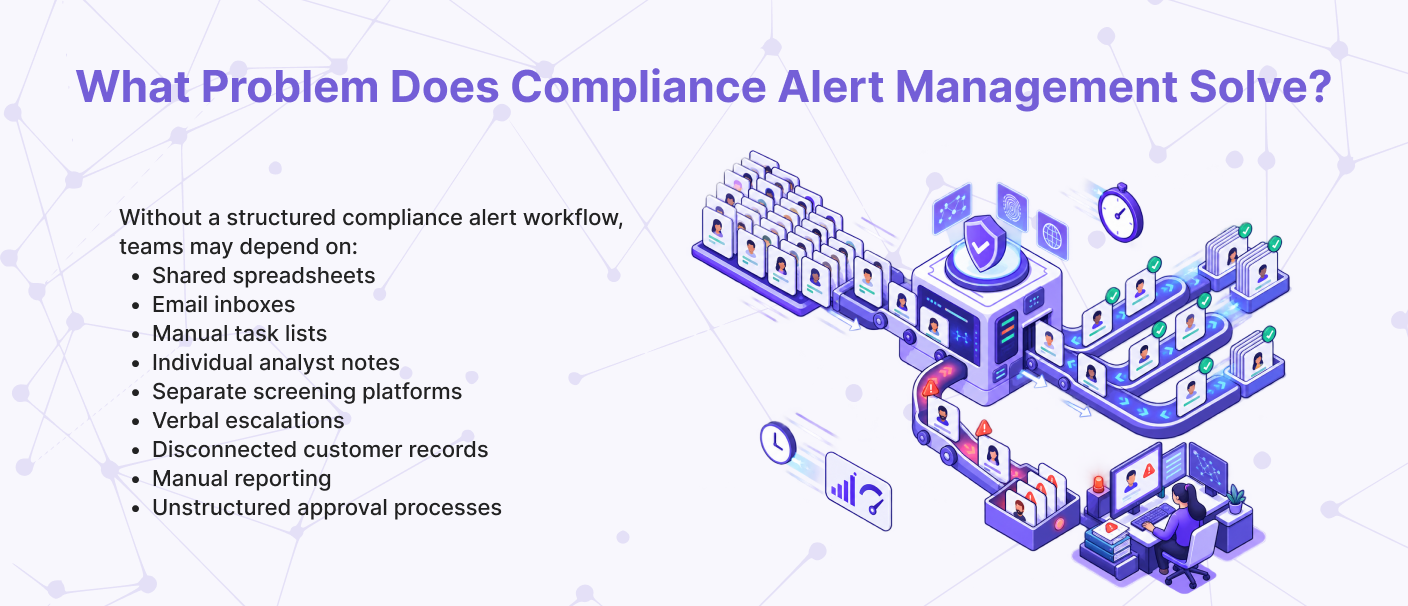
Without a structured compliance alert workflow, teams may depend on:
- Shared spreadsheets
- Email inboxes
- Manual task lists
- Individual analyst notes
- Separate screening platforms
- Verbal escalations
- Disconnected customer records
- Manual reporting
- Unstructured approval processes
This can create several operational problems.
High-Risk Alerts Can Become Buried
When all alerts enter one queue, critical cases may compete with low-quality matches for analyst attention.
Analysts Spend Time on False Positives
Broad screening can create possible matches that are unrelated to the actual customer.
Without supporting customer context, analysts may spend too much time clearing these cases.
Case Ownership Is Unclear
Teams may not know:
- Who owns the alert
- Whether it has been reviewed
- Whether additional information was requested
- Whether the case has been escalated
Decisions Are Difficult to Explain
A compliance decision should not exist only as:
“Cleared.”
Teams need to understand why the alert was cleared.
Escalations Are Inconsistent
One analyst may escalate a case immediately while another handles a similar alert differently.
Audit Evidence Is Scattered
Screening results, reviewer notes, approvals and decisions may exist across several systems.
Compliance alert management solves these problems by converting alerts into structured cases with ownership, priority, review actions and final outcomes.
What Is Compliance Alert Management?
Compliance alert management is the process of receiving, prioritising, assigning, investigating, escalating and resolving alerts generated by compliance screening systems.
A compliance alert may be triggered by:
- Possible sanctions match
- Possible PEP match
- Watchlist match
- High customer-risk score
- Customer profile change
- Related-party risk
- New high-risk information
- Scheduled customer review
- Internal compliance rule
The alert should then move through a defined workflow.
A basic workflow may include:
- Alert generated
- Priority calculated
- Analyst assigned
- Customer context reviewed
- Supporting information checked
- Alert cleared or escalated
- Additional review completed when necessary
- Final decision recorded
- Audit trail maintained
The goal is not to remove human judgement.
The goal is to give analysts the information and workflow they need to make consistent decisions faster.
What Is the Difference Between a Compliance Alert and a Compliance Case?
A compliance alert is a signal indicating that something may require review.
A compliance case is the structured investigation created around that alert.
For example:
A sanctions screening system may generate an alert because a customer’s name resembles a listed individual.
That is the alert.
The analyst then creates or reviews a case containing:
- Customer information
- Screening result
- Match details
- Customer risk score
- Supporting identifiers
- Analyst notes
- Review actions
- Escalation status
- Final decision
That becomes the compliance case.
|
Area |
Compliance Alert |
Compliance Case |
|
Purpose |
Identify potential risk |
Investigate and resolve risk |
|
Created by |
Screening or risk system |
Compliance workflow |
|
Main content |
Alert signal |
Full review context |
|
Ownership |
May be unassigned initially |
Assigned analyst or reviewer |
|
Status |
Open or triggered |
Investigation lifecycle |
|
Decision |
Not yet determined |
Cleared, escalated or resolved |
|
Audit record |
Initial signal |
Complete investigation history |
A strong compliance alert management system connects these two stages.
Why Do Fintech Companies Need Alert Prioritisation?
A compliance team may receive many alerts during customer onboarding and ongoing monitoring.
Reviewing every alert chronologically is inefficient because alert risk differs significantly.
Alert prioritisation helps analysts identify which cases should be investigated first.
RiskIntel can help organise alerts using factors such as:
- Severity
- Match strength
- Customer risk
These factors create a more useful review queue than a simple first-in, first-out approach.
What Factors Should Determine Compliance Alert Priority?
1. Alert Severity
The type of alert can influence priority.
For example, an alert connected to a serious sanctions concern may require faster attention than a lower-risk profile update.
Institutions should define severity according to their own compliance policies.
Possible classifications may include:
- Critical
- High
- Medium
- Low
2. Match Strength
A screening match should be reviewed according to how closely the customer information matches the screened record.
Relevant information may include:
- Name
- Date of birth
- Nationality
- Country
- Address
- Business information
- Associated entities
- Other available identifiers
A weak name-only similarity should not automatically receive the same treatment as a match supported by several identifiers.
3. Customer Risk Level
An alert involving an existing high-risk customer may need more attention than the same weak signal involving a low-risk profile.
Customer risk may be influenced by:
- Geography
- Customer type
- Business activity
- PEP status
- Screening results
- Ownership structure
- Previous compliance history
4. Previous Alerts
Repeated alerts can provide additional context.
Analysts may need to understand:
- Has this customer triggered the same alert before?
- Was the previous alert cleared?
- What evidence supported that decision?
- Has new information appeared?
- Is the risk becoming stronger?
5. Customer Relationship Stage
Alerts may appear during:
- Initial onboarding
- Account approval
- Periodic review
- Ongoing monitoring
- Customer profile update
The required response may differ depending on when the alert appears.
6. Number of Risk Signals
One weak signal may be less significant than several related signals appearing together.
For example:
- PEP result
- Higher-risk geography
- Complex ownership structure
- Previous review history
Together, these may justify a more detailed review.
How Does Compliance Alert Management Work?
A structured compliance alert workflow can move from detection to final decision through several stages.
1. The Screening Alert Is Generated
An alert may originate from:
- Sanctions screening
- PEP screening
- Watchlist monitoring
- AML checks
- Customer risk scoring
- Ongoing monitoring
- Periodic customer review
The alert should record:
- Customer
- Alert type
- Screening source
- Trigger
- Timestamp
- Relevant matched information
2. Customer Context Is Added
An alert cannot always be reviewed accurately in isolation.
Analysts may need access to:
- Customer identity
- Date of birth
- Address
- Nationality
- Business type
- Customer risk score
- Previous screening results
- Related parties
- Previous alerts
- Previous decisions
- Onboarding information
This context helps analysts distinguish genuine risk from unrelated matches.
3. The Alert Is Prioritised
The alert can be placed into a review queue based on factors such as:
- Severity
- Match strength
- Customer risk
- Previous alert history
Possible priorities may include:
- Critical
- High
- Medium
- Standard
The organisation should define these levels according to its compliance framework.
4. An Analyst Is Assigned
Every alert requiring review should have a clear owner.
Assignment may depend on:
- Alert type
- Customer risk
- Analyst workload
- Business unit
- Geography
- Review complexity
- Required expertise
This reduces duplicate work and prevents alerts from remaining unattended.
5. The Analyst Reviews the Match
The analyst compares the screening result with available customer information.
For example, a possible sanctions match may be reviewed using:
- Full name
- Date of birth
- Nationality
- Address
- Country
- Associated entities
- Other available identifiers
The objective is to determine whether the screened record is likely to relate to the actual customer.
6. The Analyst Records the Review
The review should not exist only in the analyst’s memory.
The case record may include:
- Information reviewed
- Matching identifiers
- Non-matching identifiers
- Analyst notes
- Supporting evidence
- Risk factors
- Recommended action
7. The Alert Is Cleared or Escalated
The analyst may determine that:
- The alert is unrelated
- Additional information is required
- The case needs senior review
- Enhanced due diligence is required
- Customer risk needs updating
- Another compliance action is required
The exact decision should follow the institution’s policies.
8. Escalated Cases Receive Additional Review
Higher-risk cases may require:
- Senior compliance review
- Additional documentation
- Enhanced due diligence
- Further customer information
- Related-party review
- Updated risk scoring
- Management approval
Every escalation should have a clear owner and status.
9. The Final Decision Is Recorded
The final case record should show:
- Alert type
- Customer
- Screening result
- Analyst
- Review actions
- Evidence
- Escalation
- Final decision
- Decision reason
- Reviewer
- Timestamp
10. The Record Is Maintained for Future Reviews
Previous decisions can provide context when the same customer generates another alert.
This allows future analysts to understand:
- What happened previously
- Why a match was cleared
- Whether anything has changed
- Whether the previous evidence is still relevant
What Types of Compliance Alerts Need Management?
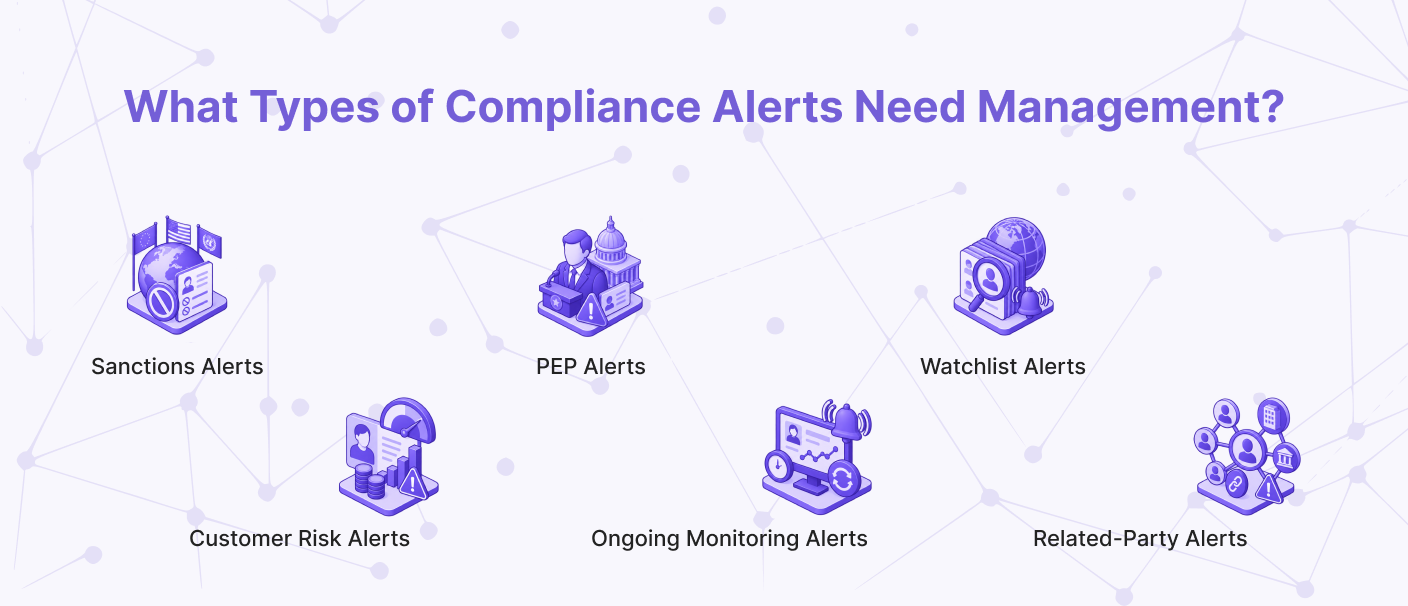
Sanctions Alerts
Sanctions alerts may occur when customer or related-party information matches a sanctions record.
Possible review information may include:
- Name
- Date of birth
- Nationality
- Location
- Associated entity
- Customer type
- Other identifiers
A possible match does not automatically mean the customer is the listed person or entity.
The alert requires review.
PEP Alerts
PEP screening may identify a possible politically exposed person.
A PEP match may require deeper customer due diligence depending on institutional policy.
The review may consider:
- Identity match
- Political role
- Geography
- Related-party information
- Customer-risk level
- Existing due diligence
Watchlist Alerts
Watchlist monitoring may identify customers or entities appearing in relevant risk databases.
These alerts should be reviewed using available customer context.
Customer Risk Alerts
A customer-risk score may increase because of:
- Geography
- Business activity
- Screening result
- Ownership
- PEP exposure
- New risk information
This may trigger additional review.
Ongoing Monitoring Alerts
A customer may be cleared at onboarding but generate new information later.
Ongoing monitoring can create alerts when customer risk changes.
Related-Party Alerts
For businesses, risk may appear through:
- Directors
- Beneficial owners
- Shareholders
- Partners
- Connected entities
A related-party alert may require the customer relationship to be reviewed in wider context.
What Is Compliance Case Management?
Compliance case management is the process of managing an alert as an investigation from opening to final decision.
A case should give analysts a complete view of:
- Customer information
- Alert details
- Risk factors
- Screening information
- Analyst notes
- Reviewer actions
- Escalation status
- Final decision
A case-management workflow helps prevent important compliance information from being scattered across emails, spreadsheets and separate screening applications.
What Information Should a Compliance Case Include?
Customer Information
- Customer name
- Customer ID
- Date of birth or incorporation
- Geography
- Customer type
- Business activity
- Customer risk score
Alert Information
- Alert type
- Screening source
- Match information
- Match strength
- Severity
- Alert date
Investigation Information
- Analyst
- Review date
- Evidence reviewed
- Notes
- Supporting identifiers
- Additional information requested
Decision Information
- Alert cleared
- Additional review required
- Escalated
- Updated risk decision
- Final outcome
- Decision reason
Audit Information
- Reviewer actions
- Timestamps
- Escalation history
- Final approver
- Case closure
How Can Compliance Alert Management Reduce False Positives?
False-positive alerts can consume large amounts of analyst time.
A false positive occurs when screening generates a possible match that does not relate to the actual customer.
For example:
A customer’s name may resemble the name on a sanctions or watchlist record, but:
- Date of birth differs
- Nationality differs
- Location differs
- Other identifiers do not match
A better alert-management workflow helps analysts review these factors together.
Use Additional Customer Context
A name alone is often not enough to evaluate a match.
Where available, analysts can compare additional identifying information.
Use Match Strength
Alerts can be organised according to the quality of the match.
Stronger matches may receive higher priority.
Use Customer Risk
A weak match involving a high-risk customer may deserve different attention from the same match involving a low-risk customer.
Keep Previous Decisions
If a customer repeatedly generates the same false-positive match, previous review information may help analysts understand the history.
The institution should still determine whether any relevant information has changed.
Standardise Review Reasons
Instead of writing unstructured notes such as:
“Not a match.”
analysts can record clearer reasons such as:
- Date of birth mismatch
- Nationality mismatch
- Different entity
- Different geography
- Insufficient matching identifiers
This creates better decision evidence.
How Can Fintechs Reduce Compliance Review Backlogs?
Prioritise Alerts Instead of Reviewing Chronologically
Critical and higher-risk alerts should receive attention before weak, low-priority matches.
Assign Clear Case Ownership
Every active alert should have an assigned analyst or reviewer.
Use Standard Review Workflows
Analysts should follow a consistent process for common alert types.
Give Analysts Complete Customer Context
Reviewers should not need to search several systems for basic customer information.
Separate Simple and Complex Reviews
Straightforward false positives may be handled through a simpler workflow.
More complex cases can move to senior reviewers.
Track Escalations
Managers should know which cases are:
- Open
- In review
- Waiting for information
- Escalated
- Completed
Monitor Ageing Alerts
Cases remaining open for too long should be visible.
Review Alert Quality
If one screening configuration creates large volumes of weak alerts, the institution may need to review its screening approach and thresholds.
What Metrics Should Compliance Teams Track?
Compliance alert management should provide operational visibility.
Useful metrics include:
Total Alerts Generated
Shows the overall screening workload.
Alerts by Type
Examples include:
- Sanctions
- PEP
- Watchlist
- Customer risk
- Ongoing monitoring
Alerts by Priority
Shows how many cases are:
- Critical
- High
- Medium
- Standard
Open Alerts
Shows the current review backlog.
Alert Age
Shows how long cases remain unresolved.
Average Review Time
Measures how long analysts take to resolve alerts.
Escalation Rate
Shows how many alerts require deeper review.
False-Positive Rate
Shows how many possible matches are ultimately cleared as unrelated.
Alerts per Analyst
Helps managers understand workload distribution.
Cases Awaiting Information
Shows where reviews are blocked because additional documentation or customer information is required.
Completed Decisions
Shows the number of alerts resolved during a defined period.
Alert Volume vs Alert Quality
Compliance teams should not judge screening performance only by how many alerts are generated.
A system that generates more alerts is not automatically safer.
For example:
|
Approach |
Result |
|
Very broad screening |
High alert volume, potentially high manual workload |
|
Weak prioritisation |
Analysts review cases in the wrong order |
|
Limited customer context |
Longer investigation time |
|
Structured prioritisation |
Higher-risk cases reviewed first |
|
Contextual review |
Faster clearing of unrelated matches |
|
Recorded outcomes |
Better audit evidence |
The objective should be to surface meaningful risk and manage it efficiently.
Manual Alert Management vs Structured Compliance Alert Management
|
Capability |
Manual process |
Structured alert management |
|
Alert queue |
Spreadsheet or separate systems |
Centralised workflow |
|
Priority |
Often chronological |
Risk-based |
|
Assignment |
Email or manual allocation |
Clear analyst ownership |
|
Customer context |
Retrieved manually |
Connected with the case |
|
Analyst notes |
Emails or spreadsheets |
Structured review record |
|
Escalation |
Informal or manual |
Defined workflow |
|
Case status |
Difficult to monitor |
Trackable lifecycle |
|
Previous decisions |
Difficult to locate |
Maintained with case history |
|
Management reporting |
Manually prepared |
Structured visibility |
|
Audit trail |
Scattered evidence |
Centralised decision history |
What Features Should Compliance Alert Management Software Have?
A strong compliance alert-management system should include:
- Centralised alert queue
- Sanctions alert management
- PEP alert management
- Watchlist alert management
- Customer risk alerts
- Alert prioritisation
- Match-strength information
- Customer-risk context
- Case assignment
- Analyst review workflows
- Case notes
- Supporting evidence
- Escalation management
- Approval workflows
- Case-status tracking
- Customer-risk updates
- Previous decision history
- Audit trails
- Reporting
- Role-based access
- Secure data handling
- API integration
For fintech companies, the most important capabilities are alert prioritisation, clear ownership, contextual screening information, structured decisions and complete audit records.
How RiskIntel Helps Fintechs Manage Compliance Alerts
RiskIntel by Cloudastra helps fintech companies, banks, NBFCs and digital lenders organise customer screening and compliance-risk decisions in a structured workflow.
RiskIntel supports:
- AML compliance checks
- Sanctions screening
- PEP screening
- Watchlist monitoring
- Customer risk scoring
- High-risk customer identification
- Compliance alerts
- Ongoing customer monitoring
- Scheduled customer reviews
- Alert organisation
- Analyst or reviewer assignment
- Risk-based alert prioritisation
- Reviewer actions
- Escalation history
- Final decision records
- Audit-ready compliance records
RiskIntel can help compliance teams organise alerts according to:
- Severity
- Match strength
- Customer risk
This allows teams to move away from one large undifferentiated review queue.
Instead, higher-priority alerts can receive attention earlier while analysts review lower-risk alerts through the appropriate workflow.
RiskIntel also maintains context around the compliance decision.
This can include:
- Screening results
- Customer risk
- Reviewer actions
- Escalation history
- Final decision
For compliance managers, this creates better visibility into both risk and workload.
For analysts, it provides a more structured way to understand what needs review and what has already happened.
For audit and internal review, it provides a clearer record of how compliance decisions were reached.
How RiskIntel Fits Into the Wider Compliance Workflow
Compliance alert management is only one part of customer-risk management.
RiskIntel connects alerts with other customer compliance processes.
Customer Screening
RiskIntel supports sanctions, PEP and watchlist screening.
Customer Risk Scoring
Screening and customer information can contribute to a broader customer-risk view.
Alert Prioritisation
Alerts can be prioritised using risk context.
Analyst Review
Cases can be assigned to the appropriate reviewer.
Escalation
Higher-risk or uncertain cases can move into additional review.
Ongoing Monitoring
RiskIntel can support continued customer monitoring after onboarding.
Scheduled Reviews
Existing customers can be reviewed periodically when required.
Audit-Ready Decisions
Screening checks, alerts, reviewer actions and final decisions can be maintained as part of the compliance history.
This gives fintech teams a more connected process from detection to decision.
Benefits of Compliance Alert Management With RiskIntel
Better Alert Prioritisation
Analysts can focus first on alerts carrying greater severity, stronger matches or higher customer risk.
Reduced Manual Sorting
Teams spend less time manually deciding which alert should be handled next.
Clear Case Ownership
Alerts can be assigned to appropriate analysts or reviewers.
Faster Investigation
Customer risk and screening information can be reviewed in a more structured workflow.
Better Escalation Visibility
Managers can understand which cases require additional review.
Stronger Decision Consistency
Structured case records make it easier for teams to follow similar review processes.
Better False-Positive Handling
Additional customer context can help analysts clear unrelated matches more efficiently.
Improved Audit Readiness
Reviewer actions, escalation history and final decisions can be maintained in an audit-ready record.
Better Management Visibility
Managers can understand the status of compliance alerts instead of depending only on manual updates.
How Can Fintech Companies Implement Compliance Alert Management?
1. Identify Alert Sources
Document every system that generates compliance alerts.
These may include:
- AML screening
- Sanctions screening
- PEP screening
- Watchlist monitoring
- Customer risk scoring
- Ongoing monitoring
2. Define Alert Categories
Create consistent classifications for different alert types.
3. Define Priority Levels
Decide how alerts will be classified according to:
- Severity
- Match strength
- Customer risk
- Other institution-specific factors
4. Define Case Ownership
Determine which teams handle:
- Sanctions cases
- PEP cases
- Watchlist cases
- High-risk customers
- Escalated cases
5. Create Review Procedures
For each alert type, define:
- Information to review
- Evidence required
- Possible outcomes
- Escalation criteria
- Approval requirements
6. Standardise Decision Reasons
Create clear outcome categories.
Examples may include:
- False positive
- Customer confirmed
- Additional review required
- Escalated
- Risk score updated
- Additional information required
The exact categories should reflect institutional policy.
7. Define Escalation Rules
Document when a case should move to:
- Senior analyst
- Compliance manager
- Enhanced due diligence
- Another approved review process
8. Track Review Timelines
Compliance managers should understand:
- Which cases are new
- Which are being reviewed
- Which are waiting for information
- Which are overdue
- Which have been escalated
9. Keep Complete Decision Records
Every completed case should retain enough information to explain the outcome later.
10. Review Alert Performance
Teams should periodically examine:
- Alert volume
- False positives
- Review time
- Escalation rate
- Backlog
- Workload distribution
Common Compliance Alert Management Challenges
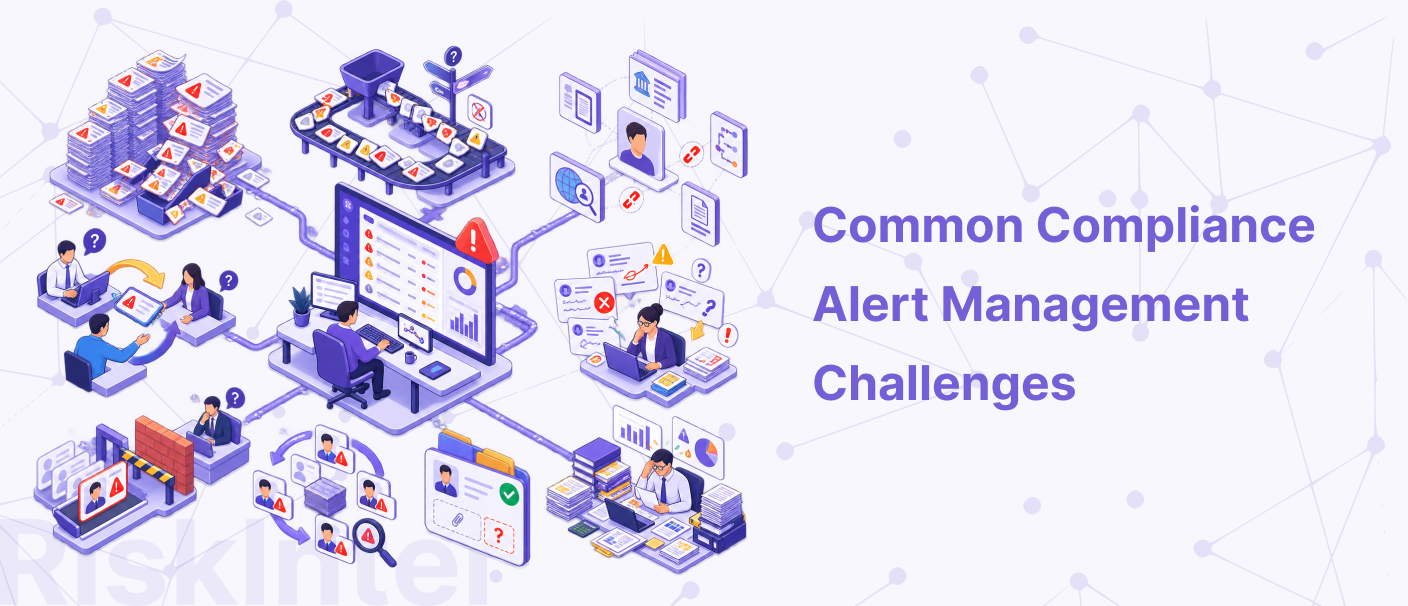
Too Many Low-Quality Alerts
Broad screening may generate large numbers of weak matches.
This increases analyst workload.
No Priority Model
Without defined priorities, teams may simply review alerts in chronological order.
Disconnected Customer Context
Analysts may need to search several systems before understanding a customer.
Unclear Case Ownership
Alerts can remain unresolved when responsibility is unclear.
Inconsistent Analyst Notes
Unstructured notes make future reviews and audits difficult.
Poor Escalation Visibility
Managers may not know which high-risk cases are waiting for approval.
Repeated False Positives
The same customer may repeatedly trigger similar alerts without previous decisions being easy to access.
Missing Audit Evidence
A final decision without supporting context may be difficult to defend later.
Manual Reporting
Compliance managers may spend significant time combining spreadsheets and analyst updates.
Who Should Use Compliance Alert Management Software?
Compliance alert management software is useful for:
- Fintech companies
- Banks
- NBFCs
- Digital lenders
- Neobanks
- Payment companies
- Payment aggregators
- Embedded finance platforms
- Wealthtech companies
- Insurtech companies
- Merchant onboarding platforms
- Cross-border payment providers
- AML teams
- Compliance teams
- Customer due diligence teams
- Financial crime teams
- Risk teams
Any financial institution managing multiple screening alerts and compliance reviews can benefit from a structured alert-management workflow.
Want to explore more practical insights on AI development, automation, and conversational AI? Read more blogs at Cloudastra Technologies or contact us for business enquiries through Cloudastra Contact Us.
Frequently Asked Questions
1. What is compliance alert management?
Compliance alert management is the process of organising, prioritising, assigning, investigating, escalating and resolving alerts generated by compliance screening systems.
2. What types of compliance alerts can fintech companies receive?
Alerts may come from sanctions screening, PEP screening, watchlist monitoring, customer risk scoring, AML checks and ongoing customer monitoring.
3. Why is alert prioritisation important?
Alert prioritisation helps analysts focus first on cases carrying greater severity, stronger screening matches or higher customer risk.
4. What is AML alert management?
AML alert management is the workflow used to review and resolve alerts connected to potential money-laundering or customer-compliance risk.
5. What is compliance case management?
Compliance case management converts an alert into a structured investigation containing customer information, risk signals, analyst actions, notes, escalations and a final decision.
6. How can compliance teams reduce alert backlogs?
Teams can reduce backlogs by prioritising alerts, assigning clear ownership, centralising customer context, standardising review workflows and tracking case status.
7. What is a false-positive compliance alert?
A false positive occurs when screening creates a possible match that is ultimately determined not to relate to the actual customer.
8. Should every screening alert be treated as high risk?
No. Alerts should be reviewed using factors such as match strength, customer information, severity and customer-risk context.
9. What information should an alert investigation record?
The case should record the screening result, customer information, evidence reviewed, analyst actions, escalation history, decision and reason for the outcome.
10. How does RiskIntel support compliance alert management?
RiskIntel helps organise compliance alerts, assign them to appropriate analysts or reviewers and prioritise cases using severity, match strength and customer risk.
11. Does RiskIntel support sanctions and PEP screening?
Yes. RiskIntel supports sanctions screening, PEP screening and watchlist monitoring as part of its customer-risk workflow.
12. Can RiskIntel maintain analyst review history?
Yes. RiskIntel can maintain screening checks, alerts, reviewer actions, escalation history and final decisions.
13. Can RiskIntel support ongoing monitoring?
Yes. RiskIntel can support ongoing customer monitoring, scheduled reviews and investigation of changes in customer risk.
14. Who should use RiskIntel?
RiskIntel is suitable for fintech companies, banks, NBFCs, digital lenders, neobanks, payment companies and teams managing customer compliance risk.