The AI voice agents build-vs-buy decision depends on whether voice automation is simply a feature your business needs or a core part of the product you sell.
Buying a managed AI voice platform is usually the better choice when you need to launch quickly, your use case is fairly standard and your call volume does not yet justify custom infrastructure.
Building a custom AI voice agent makes more sense when voice is central to your product, you need full control over latency and conversation behaviour, your call volume makes platform fees expensive or sensitive call data must remain within your own environment.
For many companies, the most practical option is hybrid.
They begin with a managed platform to validate the use case, collect real-call data and understand customer behaviour. They then build or replace the components that become strategically important.
In simple terms:
- Buy to launch and learn
- Build to control and differentiate
- Use hybrid to get speed now and ownership later
The right decision should be based on call volume, data requirements, required integrations, latency expectations, internal skills and the strategic importance of voice to the business.
What Does Build vs Buy Mean for AI Voice Agents?
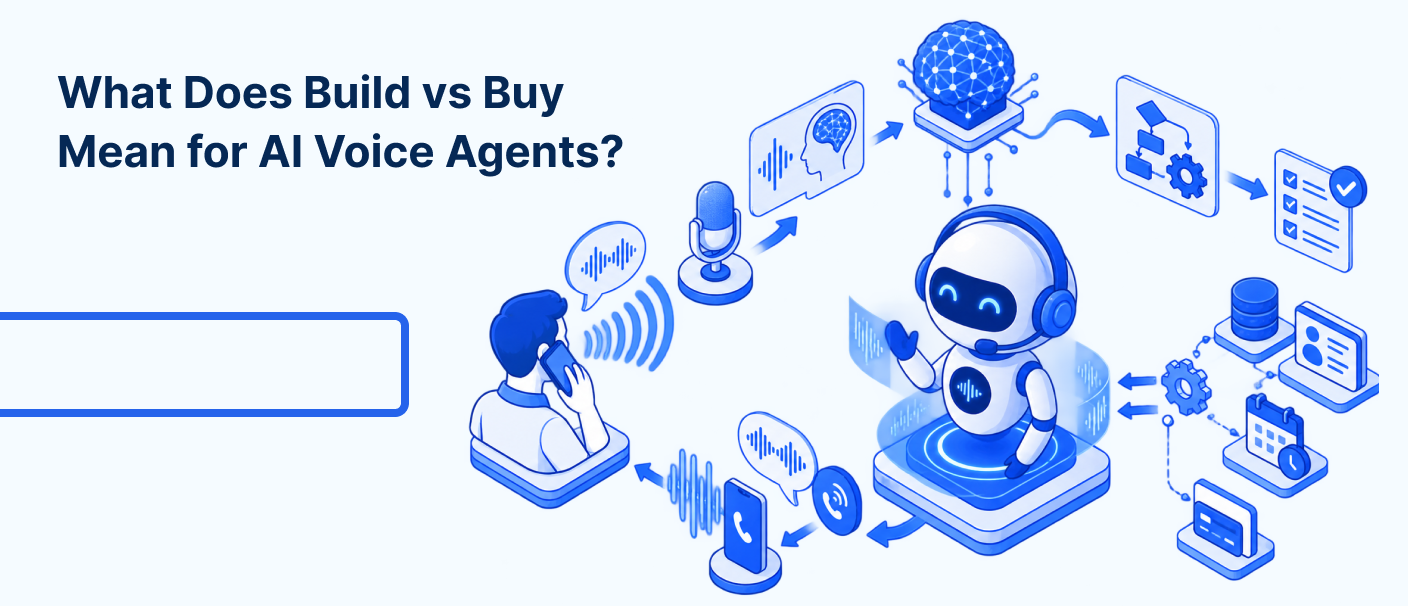
An AI voice agent is a real-time system that can listen to a caller, understand the request, decide what to do, respond through speech and complete actions inside connected business systems.
A typical AI voice agent combines:
- Speech-to-text
- A large language model
- Text-to-speech
- Telephony
- Conversation orchestration
- Business rules
- CRM or software integrations
- Knowledge retrieval
- Monitoring
- Human handoff
Speech-to-text converts the caller’s voice into text.
The language model interprets what the caller wants, chooses the next action and generates an appropriate response.
Text-to-speech converts the response into natural-sounding audio.
Telephony connects the system to inbound or outbound calls.
The orchestration layer manages turn-taking, interruptions, tools, prompts, business logic and escalation.
The difference between building and buying is mainly about who owns and manages these components.
What Does Buying an AI Voice Agent Mean?
Buying means using a managed AI voice platform that bundles most of the required technology behind an API and dashboard.
Platforms may provide:
- Phone-number management
- Telephony connections
- Speech-to-text
- Language-model access
- Text-to-speech
- Prompt configuration
- Call recording
- Tool calling
- Basic analytics
- Webhooks
- Human transfer
- Conversation logs
Common managed platforms considered by teams include Vapi, Retell AI, Bland AI and ElevenLabs Agents.
A business can configure the agent, connect its tools and begin testing calls without building the complete real-time infrastructure.
The company usually pays through a subscription, usage-based pricing, per-minute pricing or a combination of these.
What Does Building an AI Voice Agent Mean?
Building means designing and owning the voice-agent architecture.
The company or development team chooses and connects:
- Speech-to-text provider
- Language model
- Text-to-speech provider
- Telephony provider
- Voice activity detection
- Turn-taking logic
- Interruption handling
- Prompt and memory system
- Tool integrations
- Data storage
- Monitoring
- Evaluation
- Security controls
- Deployment infrastructure
Building does not necessarily mean creating every AI model from scratch.
A custom voice agent may still use third-party speech, model and telephony APIs. The difference is that the company owns the orchestration, data flow, business logic and deployment architecture.
What Does a Hybrid AI Voice Agent Mean?
A hybrid approach uses managed services for standard infrastructure while keeping strategic parts under company control.
For example, a company may use:
- A managed telephony platform
- A third-party speech-to-text API
- A third-party text-to-speech API
- A custom orchestration layer
- Custom business logic
- A private knowledge base
- Internal analytics
- Company-controlled customer data
Another company may launch fully on a managed voice platform and later move its highest-volume workflows to custom infrastructure.
Hybrid is useful when a company needs speed but expects voice automation to become more important over time.
Quick Verdict: Should You Build or Buy an AI Voice Agent?
Buy an AI Voice Agent Platform If:
- You need a working agent in days or weeks
- Your use case is standard
- You want to validate demand
- Your monthly call volume is low or moderate
- You do not have a real-time AI engineering team
- Platform-level customisation is sufficient
- Per-minute pricing is acceptable
- Speed is more important than complete control
Standard use cases may include:
- Appointment booking
- Lead qualification
- Customer-support triage
- Order-status calls
- Frequently asked questions
- Reminder calls
- Basic outbound campaigns
- After-hours support
Build a Custom AI Voice Agent If:
- Voice is central to your product
- You expect high call volume
- Per-minute platform costs are becoming expensive
- You need complete control over latency
- You need custom conversation behaviour
- You require specialised business logic
- Sensitive data must remain in your environment
- You need a proprietary product advantage
- You need custom monitoring and evaluation
- Managed-platform limitations affect the customer experience
Choose a Hybrid Approach If:
- You need to launch quickly
- You expect the system to become strategic
- Some components are standard
- Your business logic is highly specialised
- You want to validate before building
- Only some workflows have high call volume
- You need stronger control over data or orchestration
- You want to migrate gradually
The lowest-risk approach for many businesses is to validate the voice agent using a platform and build only after real usage proves which capabilities need to be owned.
AI Voice Agents Build vs Buy Comparison
|
Decision factor |
Buy a managed platform |
Build a custom voice agent |
|
Time to first call |
Days to weeks |
Weeks to months |
|
Initial investment |
Lower |
Higher |
|
Cost structure |
Subscription and usage based |
Engineering plus direct infrastructure usage |
|
Cost at scale |
Per-minute costs continue increasing |
Marginal cost may become lower |
|
Technical control |
Limited by platform capabilities |
Full architecture and workflow control |
|
Voice control |
Platform-supported voices and settings |
Custom provider and voice selection |
|
Latency control |
Bounded by platform architecture |
Can be optimised across the full stack |
|
Data control |
Data passes through external platform systems |
Can remain inside company-controlled infrastructure |
|
Compliance flexibility |
Depends on platform support |
Controls can be designed for the use case |
|
Integration flexibility |
Limited to supported APIs and tools |
Custom integrations can be developed |
|
Differentiation |
Competitors can use the same platform |
Custom workflows can become proprietary |
|
Maintenance |
Mostly handled by the platform |
Managed by your team |
|
Reliability ownership |
Platform responsibility |
Company responsibility |
|
Monitoring |
Platform analytics |
Custom observability and evaluation |
|
Best for |
Fast validation and standard workflows |
Strategic, high-volume or specialised use cases |
What Is the Real Cost of Buying an AI Voice Agent?
Buying usually has a lower starting cost because the infrastructure already exists.
However, the total cost includes more than the advertised platform rate.
Platform Subscription
Some platforms charge a recurring subscription for access to dashboards, environments, analytics, integrations or advanced features.
Per-Minute Usage
Many managed platforms charge according to call duration.
The fee may include some or all of the following:
- Speech-to-text
- Language-model usage
- Text-to-speech
- Platform orchestration
- Call processing
At low volume, this can be affordable and predictable.
At high volume, usage charges may become the largest cost.
Telephony Charges
Phone numbers, inbound calls, outbound calls, carrier fees and international calling may be charged separately.
Model and Voice Charges
Some platforms include model and voice costs. Others pass them through separately.
Premium voices, larger models and low-latency options may increase the cost.
Integration Work
Even a managed platform may require development work to connect:
- CRM
- Calendar
- Help desk
- Payment system
- Knowledge base
- Internal APIs
- Customer database
- Order-management system
Compliance and Enterprise Features
Security reviews, dedicated environments, data-retention settings, private networking, service agreements and enterprise support may require higher plans.
Ongoing Optimisation
The platform handles infrastructure, but your team must still improve:
- Prompts
- Call flows
- Knowledge content
- Tool behaviour
- Escalation rules
- Evaluation datasets
- Customer experience
A useful monthly buying-cost model is:
Platform subscription + call-minute charges + telephony + model or voice fees + integrations + support and compliance add-ons
What Is the Real Cost of Building a Custom AI Voice Agent?
Building has a higher initial cost because the company must design, connect and operate the system.
Product Discovery and Architecture
The team must define:
- Use case
- Call flows
- Integrations
- Compliance requirements
- Latency target
- Escalation path
- Success metrics
- Call-volume expectations
Real-Time Voice Engineering
The system must handle:
- Speech recognition
- Audio streaming
- Turn-taking
- Silence detection
- Interruptions
- Background noise
- Accents
- Partial speech
- Response timing
- Call disconnections
Voice systems are less forgiving than chat systems because even a small delay can make a conversation feel unnatural.
AI Orchestration
The custom system needs logic for:
- Prompt management
- Tool selection
- Knowledge retrieval
- Conversation memory
- Business rules
- Error recovery
- Guardrails
- Confirmation
- Escalation
Business-System Integrations
The agent may need access to:
- CRM
- Calendar
- Customer profile
- Order database
- Ticketing platform
- Payment system
- Knowledge base
- Internal workflow tools
Infrastructure
The company must operate:
- Application servers
- Streaming connections
- Databases
- Queues
- Logging
- Monitoring
- Alerting
- Backup
- Security controls
Usage Costs
A custom system may still pay directly for:
- Speech-to-text
- Language models
- Text-to-speech
- Telephony
- Storage
- Cloud infrastructure
The difference is that the company avoids some of the bundled platform margin and has more control over provider selection.
Evaluation and Quality Assurance
Voice-agent evaluation must cover:
- Conversation quality
- Latency
- Call completion
- Tool accuracy
- Interruptions
- Accent handling
- Background noise
- Dead air
- Hallucinations
- Human transfer
- Failure recovery
Maintenance and On-Call Ownership
The company is responsible for:
- Uptime
- Provider failures
- Model updates
- Integration changes
- Monitoring
- Incident response
- Security patches
- Quality regression
A useful monthly building-cost model is:
Amortised engineering cost + direct speech/model/voice usage + telephony + cloud infrastructure + maintenance + evaluation + on-call support
When Does Building Become Cheaper Than Buying?
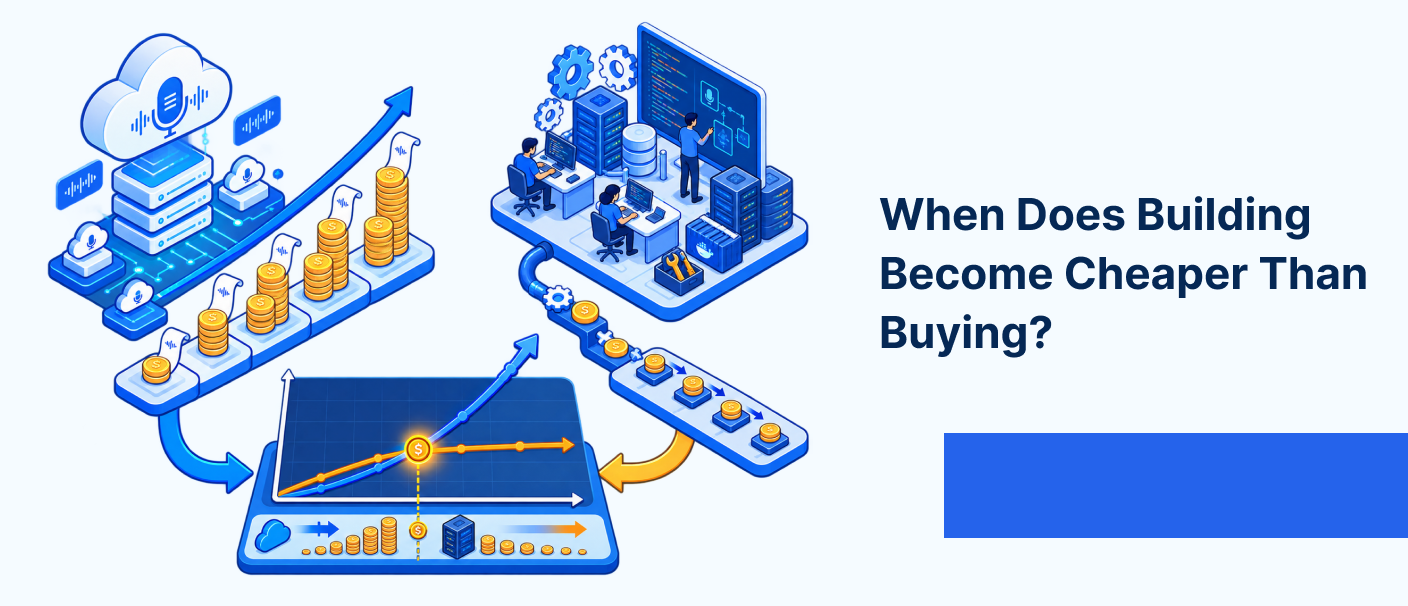
Building becomes financially attractive when the total cost of managed-platform usage exceeds the amortised cost of custom development and operation.
The crossover point depends on:
- Monthly call minutes
- Average call duration
- Platform price
- Telephony cost
- Model usage
- Voice cost
- Engineering cost
- Maintenance cost
- Infrastructure cost
- Compliance requirements
- Number of workflows
- Required customisation
There is no universal break-even call volume.
A standard appointment-booking agent may remain cheaper on a platform for a long time.
A high-volume voice product with specialised logic may reach the crossover point much earlier.
Companies should model at least three scenarios:
- Current monthly volume
- Expected volume in six months
- Expected volume in twelve months
The calculation should also include operational ownership, not only API usage.
A custom system may have a lower cost per call but still require experienced engineers to keep it reliable.
When Should You Buy an AI Voice Agent Platform?
Buying is the better choice when speed and validation are the main priorities.
You Need to Launch Quickly
A managed platform can reduce the time required to connect telephony, speech models and basic workflows.
This makes it useful for proofs of concept and early production deployments.
Your Use Case Is Standard
Platforms work well for predictable workflows such as:
- Booking
- Qualification
- Support triage
- Reminders
- Frequently asked questions
- Basic customer follow-up
You Have Not Validated Demand
Building custom infrastructure before real customers use the system creates unnecessary risk.
A platform lets the team test:
- Whether customers engage
- Which calls succeed
- Where conversations fail
- Which integrations are required
- How much volume exists
- Whether the use case creates value
You Have Limited Engineering Capacity
A managed platform reduces the need to operate real-time audio infrastructure and manage multiple AI providers.
Your Call Volume Is Still Moderate
Usage-based pricing may remain more economical than maintaining a custom engineering team at low or moderate volume.
When Should You Build a Custom AI Voice Agent?
Building is the better choice when voice is strategic and platform constraints create real business limitations.
Voice Is the Product
A company selling voice automation should not depend entirely on the same platform its competitors can access.
Owning the orchestration, evaluation and business logic can create differentiation.
You Need Complete Behavioural Control
Custom development allows the company to control:
- Turn-taking
- Interruptions
- Confirmation logic
- Tone
- Memory
- Tool use
- Escalation
- Response timing
- Fallback behaviour
You Need Stronger Data Control
A custom system can be designed so sensitive call data remains within company-controlled infrastructure.
This may be important for:
- Banking
- Healthcare
- Insurance
- Legal services
- Government
- Enterprise customer support
Your Call Volume Is High
At high volume, platform fees may become more expensive than owning the orchestration and paying providers directly.
You Need Complex Integrations
A custom system may be necessary when the agent must coordinate several internal tools, legacy systems and approval workflows.
You Need Custom Evaluation
A proprietary evaluation system can measure the exact outcomes that matter to the business.
Examples include:
- Appointment completion
- Qualified-lead rate
- Successful payment collection
- Support resolution
- Compliance accuracy
- Escalation quality
When Is a Hybrid Voice-Agent Architecture Best?
Hybrid is often the most practical long-term approach.
A company can use managed infrastructure where it adds speed and build custom components where it adds business value.
Examples include:
Managed Telephony With Custom Orchestration
The company uses a telephony provider but owns the conversation engine and business logic.
Managed Speech With Private Business Logic
Speech recognition and voice generation remain external, while customer data and decisions remain in a private application layer.
Platform Validation Followed by Gradual Migration
The company begins with a managed voice platform and later replaces:
- Prompt orchestration
- Knowledge retrieval
- High-volume workflows
- Analytics
- Evaluation
- Customer-data handling
Custom High-Volume Flows With Platform-Based Experiments
Established call types run on custom infrastructure, while new experiments remain on the managed platform.
Hybrid allows the company to avoid rebuilding standard infrastructure while still controlling strategic components.
Where Does Buying an AI Voice Agent Go Wrong?
Over-Customising the Platform
Teams may try to force a managed platform to support workflows beyond its intended design.
This creates custom-development complexity without full architectural control.
If the team is constantly working around platform limitations, the strategic component may need to be built.
Ignoring Cost Growth
Per-minute pricing may appear inexpensive during testing.
As call volume grows, the total monthly bill may increase faster than expected.
Usage should be reviewed regularly.
Depending on One Vendor
A tightly coupled platform implementation can make migration difficult.
Important business logic and data should not exist only inside proprietary configurations.
Accepting Limited Observability
A basic dashboard may not provide enough information to understand:
- Why the agent failed
- Which tool caused an error
- Where latency increased
- Why customers requested transfer
- Which prompts reduced completion
Assuming the Platform Handles Quality
The platform provides infrastructure, but the company remains responsible for the conversation design, knowledge quality and business outcomes.
Where Does Building a Custom Voice Agent Go Wrong?
Building Before Validating
A company may spend months building infrastructure before confirming that customers want the voice experience.
A platform-based pilot can reduce this risk.
Underestimating Latency
A delay that is acceptable in chat may feel broken during a phone call.
Latency must be measured across:
- Audio capture
- Speech recognition
- Model response
- Tool calls
- Text-to-speech
- Audio playback
Underestimating Voice Evaluation
Voice agents fail in ways that text agents do not.
How AI Is Transforming Legal, Banking and Healthcare in 2026
They must handle:
- Interruptions
- Accents
- Noise
- Silence
- Misheard numbers
- Repeated questions
- Caller frustration
- Disconnections
Forgetting Human Handoff
A voice agent without a reliable escalation path can damage customer trust.
The handoff should include:
- Clear transfer conditions
- Conversation summary
- Customer details
- Reason for escalation
- Relevant actions already completed
Ignoring Maintenance
The system requires ongoing ownership after launch.
Models, APIs, integrations and customer behaviour will change.
Trying to Build Every Component
Building custom orchestration does not require creating proprietary speech and language models.
Companies should build only the components that create meaningful control or differentiation.
What Does It Take to Build a Production AI Voice Agent?
A production-ready system requires more than connecting speech-to-text, a model and a voice API.
Real-Time Conversation Loop
The system must process audio and respond with minimal delay.
Turn-Taking and Interruption Handling
The agent must know when the caller has finished speaking and when to stop speaking if interrupted.
Reliable Tool Calling
The agent must safely perform actions such as:
- Book appointment
- Update CRM
- Check order
- Create ticket
- Send message
- Transfer call
- Verify information
Knowledge Retrieval
The agent needs accurate access to company policies, product information and customer-specific context.
Guardrails
The system should prevent unsupported claims, unsafe actions and unauthorised access.
Human Handoff
The caller should be transferred when:
- The request is sensitive
- The agent is uncertain
- A tool fails
- The customer asks for a human
- A policy requires escalation
Monitoring and Analytics
The team should monitor:
- Call volume
- Call duration
- Latency
- Completion rate
- Transfer rate
- Tool success
- Customer sentiment
- Cost per call
- Failure reasons
Evaluation
The team should test the agent against realistic conversations before and after deployment.
Which Metrics Should You Compare?
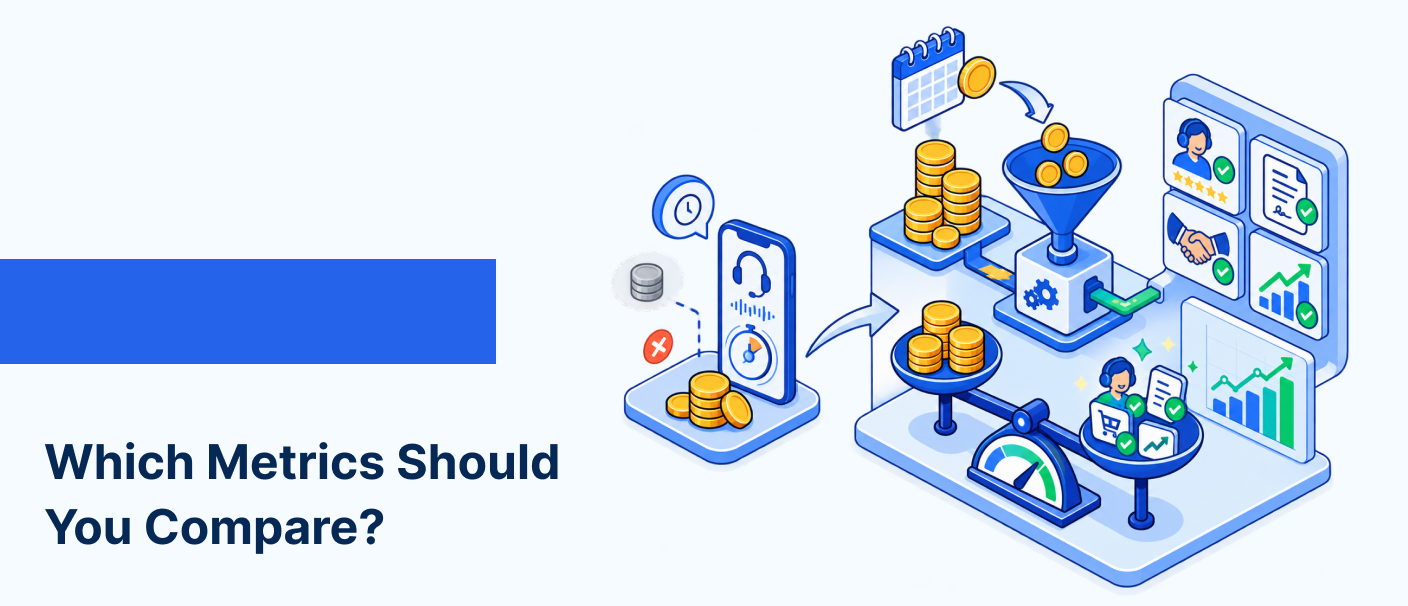
The build-vs-buy decision should include both technical and business metrics.
Important metrics include:
- Time to first call
- Monthly call minutes
- Cost per completed call
- Average response latency
- Task-completion rate
- Human-transfer rate
- Tool-call success rate
- Call-abandonment rate
- Customer satisfaction
- Failed-call rate
- Accuracy of captured information
- Compliance incidents
- Engineering maintenance time
- Platform downtime
- Cost of unsuccessful calls
Cost per minute alone does not show whether the agent is creating value.
A more useful metric is:
Total monthly cost divided by successful business outcomes
AI Voice Agent Build-vs-Buy Decision Checklist
Map Your Requirements
- Define the exact use case
- Estimate current monthly call minutes
- Estimate twelve-month call volume
- Identify inbound, outbound or mixed calling
- Define required languages
- Identify required voices
- List CRM and software integrations
- Define human-handoff requirements
- Set a latency target
- Define success metrics
Check Your Constraints
- Confirm whether call data can leave your environment
- Identify relevant privacy requirements
- Identify regulatory requirements
- Define required data residency
- Confirm recording and consent requirements
- Assess internal engineering capacity
- Define uptime requirements
- Identify security requirements
- Determine how much behavioural control is required
Run the Numbers
- Calculate platform subscription costs
- Estimate per-minute usage
- Include telephony fees
- Include model and voice costs
- Include enterprise and compliance add-ons
- Estimate custom development cost
- Estimate infrastructure cost
- Include maintenance and evaluation
- Include on-call ownership
- Calculate projected twelve-month cost
Before You Commit
- Validate demand using real calls
- Test platform limitations
- Review data-export options
- Design human handoff
- Test interruptions and noise
- Test different accents
- Measure end-to-end latency
- Confirm migration options
- Define the hybrid boundary
- Re-run the decision as volume changes
Want to explore more practical insights on AI development, automation, and conversational AI? Read more blogs at Cloudastra Technologies or contact us for business enquiries through Cloudastra Contact Us.
Frequently Asked Questions
1. Should I build or buy an AI voice agent?
Buy a platform when you need to launch quickly, your use case is standard and call volume is still moderate. Build when voice is central to your product, you require full control or your volume makes platform pricing expensive. A hybrid approach is suitable when you need speed now and ownership later.
2. Is it cheaper to build or buy an AI voice agent?
Buying is usually cheaper initially because it requires less engineering and infrastructure. Building costs more upfront but may produce a lower marginal cost at high volume. The break-even point depends on usage, integrations, technical ownership and maintenance.
3. What does it take to build a custom AI voice agent?
A custom AI voice agent requires speech-to-text, a language model, text-to-speech, telephony, real-time orchestration, turn-taking, interruption handling, tool integrations, monitoring, evaluation, security and human handoff.
4. What are the main AI voice agent platforms?
Managed AI voice-agent options considered by teams include Vapi, Retell AI, Bland AI and ElevenLabs Agents. Platform suitability depends on use case, integrations, latency, pricing, data requirements and supported regions.
5. Can I start by buying and build later?
Yes. Starting on a managed platform is often the lowest-risk approach. It allows the company to validate real demand before investing in custom infrastructure.
6. What is a hybrid AI voice agent?
A hybrid voice agent combines managed services with custom components. A company may use external telephony and speech providers while owning the orchestration, data, business logic and evaluation layer.
7. When does a custom voice agent become worthwhile?
Custom development becomes more attractive when call volume is high, voice is strategically important, platform limitations affect the product or strict data and compliance controls are required.
8. What are the biggest risks of building a voice agent?
The main risks include high upfront cost, latency problems, poor interruption handling, insufficient evaluation, integration failures, maintenance burden and unreliable human handoff.
9. What are the biggest risks of buying a voice-agent platform?
The main risks include rising per-minute costs, limited control, platform lock-in, restricted observability, data-handling concerns and difficulty supporting highly specialised workflows.
10. How long does it take to launch an AI voice agent?
A platform-based proof of concept may be launched within days or weeks. A production custom system usually takes longer because it requires architecture, integrations, testing, security, monitoring and evaluation.
11. How important is latency for AI voice agents?
Latency is critical. Long pauses make the conversation feel unnatural and can cause callers to interrupt, repeat themselves or abandon the call.
12. Does an AI voice agent need human handoff?
Yes. A reliable human-handoff process is necessary for complex, sensitive, uncertain or high-impact situations.