Agent Swarm Architecture: How Human + AI Collaboration Builds Software Faster
Agent swarm architecture is a software development model where multiple specialized AI agents work together under human supervision to plan, build, test, review, deploy, and improve software faster.
Instead of depending on one AI assistant or fully autonomous AI, agent swarm architecture uses a coordinated team of agents, each responsible for a specific part of the development workflow. Human engineers still make the important decisions, review the output, handle business context, and approve final work.
For AI-first development teams, this creates a better balance: AI agents handle repeatable execution, while humans stay responsible for architecture, quality, security, and accountability.
What Problem Does Agent Swarm Architecture Solve?
Traditional software development is slow because most work happens sequentially.
A product requirement moves from product manager to architect, then to frontend developer, backend developer, QA team, DevOps team, and finally production monitoring. Each stage depends on handoffs, meetings, reviews, and manual coordination.
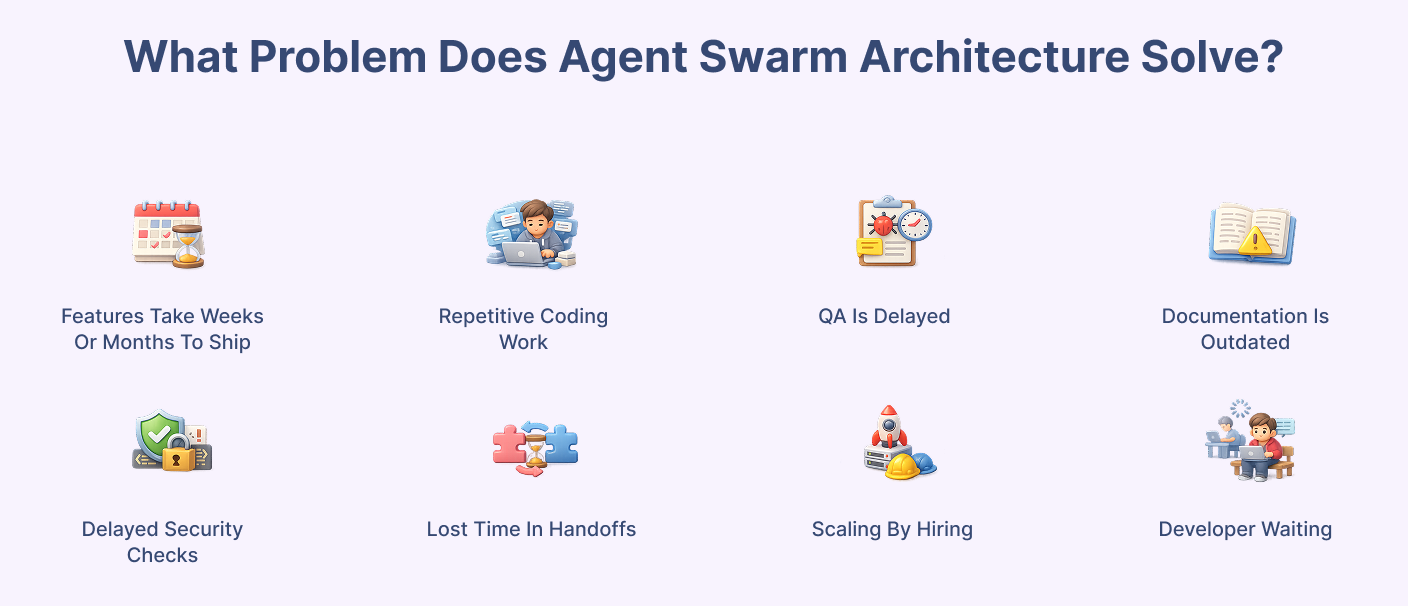
This creates common problems:
- Features take weeks or months to ship
- Developers spend too much time on repetitive coding
- QA starts late in the cycle
- Documentation becomes outdated
- Security checks happen after code is written
- Teams lose time in handoffs and context switching
- Scaling output usually means hiring more engineers
- One developer often waits for another team member to finish
Single AI assistants help, but they do not solve the full workflow problem. Tools like code autocomplete or chat-based coding support can make one developer faster, but they do not turn the whole team into a parallel execution system.
Agent swarm architecture solves this by dividing work across multiple specialized AI agents that can operate at the same time. A frontend agent can build UI components while a backend agent builds APIs, a database agent prepares schema changes, a testing agent writes tests, and a security agent scans for risk.
Human engineers guide and approve the process, but the routine execution becomes much faster.
For teams adopting AI-first software development, IntegraAI can support secure enterprise AI usage with better privacy, model flexibility, and controlled access for internal teams.
What Is Agent Swarm Architecture?
Agent swarm architecture is a multi-agent system where several specialized AI agents work together on different parts of a software development task, coordinated by an orchestration layer and reviewed by human engineers.
Each agent has a specific responsibility. For example, one agent may focus on frontend work, another on backend APIs, another on database design, another on security checks, and another on documentation.
In simple terms, agent swarm architecture helps teams answer questions like:
- Which parts of this feature can be built in parallel?
- Which agent should handle frontend, backend, testing, or security work?
- How do agents share context without conflicting?
- How do we make sure AI-generated code is reviewed properly?
- Where should humans approve the final decision?
- How do we keep quality, security, and documentation consistent?
- Can we ship faster without losing control?
The key idea is not full automation. The key idea is coordinated human AI collaboration.
AI agents execute the repeatable work. Humans provide judgment, business context, architecture decisions, security approval, and accountability.
Why Does Agent Swarm Architecture Matter in AI-First Development?
Agent swarm architecture matters because software development is not one type of work. It includes planning, architecture, frontend development, backend development, database design, testing, security, deployment, documentation, and monitoring.
A single AI assistant cannot manage all of this well at scale.
Even powerful AI tools face context limits. If one assistant tries to understand the whole product, write frontend code, build APIs, manage the database, test everything, scan for security issues, and update documentation, the workflow quickly becomes messy.
Agent swarm architecture works better because it separates responsibilities.
A frontend agent focuses only on UI patterns. A backend agent focuses on APIs and business logic. A database agent focuses on schemas and migrations. A testing agent focuses on test coverage. A security agent focuses on vulnerabilities. A documentation agent keeps records updated.
This mirrors how strong human teams work.
Good engineering teams do not expect one person to do everything. They divide responsibilities across specialists. Agent swarm architecture applies the same principle to AI-first development.
How Agent Swarms Are Different from Single AI Assistants
A single AI assistant helps one person complete one task at a time.
An agent swarm works more like a coordinated team.
The difference is important.
A single assistant can suggest code, explain errors, generate a component, or help with debugging. This is useful, but the developer still drives the workflow manually.
An agent swarm can break down a feature, assign different parts to specialized agents, run multiple tasks in parallel, create tests, scan for security issues, update documentation, and pass work through review gates.
The main differences are:
- Single assistants work one task at a time
- Agent swarms work across multiple tasks in parallel
- Single assistants are general-purpose
- Agent swarms use specialized agents
- Single assistants depend heavily on the human to manage workflow
- Agent swarms use orchestration to coordinate execution
- Single assistants improve individual productivity
- Agent swarms improve team-level delivery speed
This is why agent swarm architecture is better suited for AI-first development teams building complete products, not just writing small pieces of code.
Why Human Oversight Still Matters
Agent swarm development is not fully autonomous software development.
This point is important.
AI can write code, generate tests, scan for issues, summarize documentation, and suggest architecture options. But AI does not fully understand business priorities, customer needs, compliance trade-offs, stakeholder pressure, or long-term product strategy the way humans do.
Human oversight is required because:
- Business context needs human judgment
- Architecture decisions involve trade-offs
- Security-sensitive decisions need accountability
- Edge cases may not fit standard patterns
- Product decisions depend on user understanding
- Stakeholder communication needs empathy and clarity
- Production issues still need responsible owners
AI agents can execute fast, but humans decide what should be built, why it matters, and whether the final output is acceptable.
The right model is not “AI replaces engineers.”
The right model is “AI agents amplify engineers.”
How Big Is the Opportunity for Agent Swarm Architecture?
AI-first development is growing because companies want to ship software faster without increasing engineering headcount linearly.
The original Cloudastra article explains that agent swarm architecture is designed to deliver 10–20X faster development by using specialized AI agent teams with human oversight.
The speed gain comes from parallel execution. Instead of one engineer waiting for another task to finish, multiple agents can work at the same time across frontend, backend, database, testing, security, documentation, and DevOps tasks.
The same article also notes that agent swarm development keeps humans in the loop for architecture, quality, complex logic, security-sensitive work, and business decisions.
External AI industry research also shows rising interest in agentic systems. The original blog references sources such as LangChain’s State of AI Agents Report, MarkTechPost’s AI agent architecture coverage, and Datagrid’s agentic AI market research to show how multi-agent systems are becoming more relevant for production workflows.
For software teams, the bigger point is simple: companies are no longer asking only, “Can AI help developers write code?” They are asking, “Can AI agent teams change how software teams operate?”
Agent swarm architecture is one answer to that question.
How Agent Swarm Architecture Works
Agent swarm architecture works through a structured orchestration process.
The system receives a requirement, breaks it into smaller tasks, assigns each task to the right agent, allows agents to work in parallel, shares context between agents, runs quality checks, and sends the final output to human reviewers.
A typical workflow looks like this:
- Requirements are collected
- Tasks are decomposed
- Dependencies are mapped
- Agents are assigned
- Relevant context is loaded
- Agents execute work in parallel
- Outputs are merged and reviewed
- Tests and security checks run
- Human engineers approve or request changes
- Feedback improves future cycles
This process creates speed without giving up control.
The orchestration layer is important because agent swarms can become messy without coordination. If two agents change the same file, use different assumptions, or miss updated context, conflicts can happen.
That is why strong agent swarm architecture needs shared context, clear ownership, defined task boundaries, quality gates, and human approval.
Key Components of Agent Swarm Architecture
1. Architecture Agents
Architecture agents analyze requirements and suggest system designs.
They can review existing code patterns, identify affected modules, propose technical approaches, and highlight trade-offs.
They help with:
- System design options
- Scalability planning
- Technology choices
- Performance considerations
- Integration points
- Architecture consistency
Human engineers still make the final architecture decision because business context, cost, compliance, and long-term strategy require judgment.
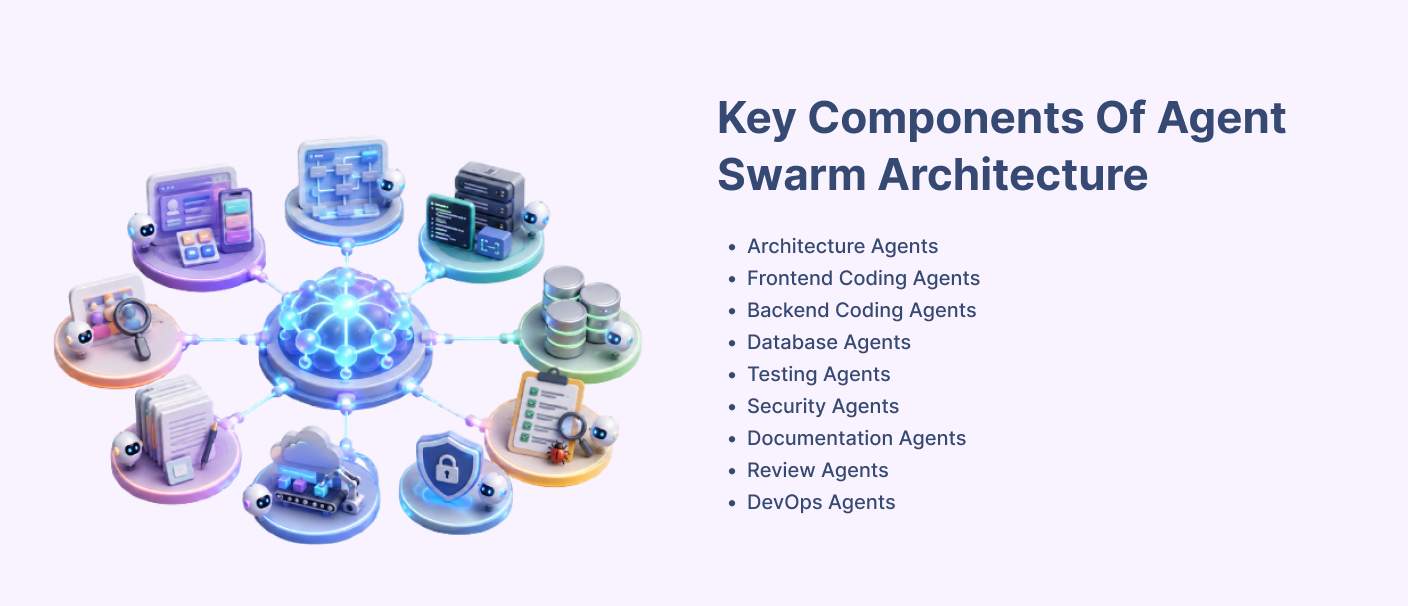
2. Frontend Coding Agents
Frontend agents focus on user interface development.
They can generate components, layouts, state management logic, responsive screens, form validation, and API integration code.
They are useful for:
- React, Vue, or Angular components
- Dashboard screens
- Forms and tables
- Responsive layouts
- UI state handling
- Accessibility improvements
- API-connected frontend flows
Frontend agents work best when design systems, component rules, and UI patterns are clearly defined.
3. Backend Coding Agents
Backend agents focus on server-side logic, APIs, authentication, authorization, and business workflows.
They can help with:
- REST or GraphQL APIs
- Business logic
- Authentication flows
- Authorization checks
- Database interactions
- Caching strategies
- Background jobs
- Integration workflows
Human engineers should review backend output carefully because backend code often handles core business logic, permissions, data flow, and security-sensitive actions.
4. Database Agents
Database agents support data modeling, schema changes, migrations, indexing, and query optimization.
They can help with:
- Database schema design
- Migration scripts
- Query optimization
- Index suggestions
- Data validation rules
- Relationship mapping
- Caching layers
Database agents are useful because schema changes affect long-term maintainability. But final approval should still come from human engineers, especially for production systems.
5. Testing Agents
Testing agents are one of the strongest parts of agent swarm architecture.
They can generate unit tests, integration tests, end-to-end tests, test data, fixtures, and regression checks.
They help teams improve:
- Test coverage
- Error path testing
- API test consistency
- UI flow validation
- Regression protection
- Quality confidence before release
The uploaded Cloudastra article mentions that agent swarm workflows can reach 85–95% test coverage, compared with lower coverage in many traditional development processes.
The real benefit is not just higher coverage. It is that tests are created continuously while the system is being built, not added as an afterthought.
6. Security Agents
Security agents scan code for common vulnerabilities, weak patterns, insecure dependencies, authentication issues, authorization gaps, and sensitive data exposure.
They can help detect:
- SQL injection
- XSS
- Command injection
- Weak authentication
- Broken authorization
- Exposed secrets
- Vulnerable dependencies
- Poor data handling
- Misconfigured security headers
Security agents help catch common issues early. But security-critical decisions should still involve human engineers.
This is especially important for fintech, healthcare, payment, SaaS, and enterprise systems where mistakes can create serious business risk.
7. Documentation Agents
Documentation agents keep project documentation updated as the system changes.
They can generate:
- API documentation
- README updates
- Architecture notes
- Code comments
- Setup guides
- Change summaries
- Technical handover notes
This is useful because documentation often becomes outdated in traditional teams. In agent swarm development, documentation can be updated continuously alongside code.
8. Review Agents
Review agents perform early quality checks before human engineers review the code.
They can flag:
- Code style issues
- Formatting problems
- Anti-patterns
- Unused code
- Maintainability concerns
- Potential bugs
- Performance risks
This reduces the noise that reaches human reviewers.
Human engineers can then focus on deeper questions: Does this meet the business requirement? Is the architecture right? Are edge cases handled? Is this maintainable in production?
9. DevOps Agents
DevOps agents help with infrastructure, CI/CD, deployment scripts, monitoring setup, environment configuration, and release checks.
They can support:
- Infrastructure-as-code
- CI/CD pipelines
- Deployment scripts
- Environment variables
- Logging setup
- Monitoring configuration
- Rollback workflows
This helps teams reduce routine DevOps work while still keeping humans responsible for production approval and critical release decisions.
What AI Agents Do vs What Humans Do
Agent swarm architecture works only when responsibilities are clearly divided.
AI agents are best for work that is structured, repeatable, pattern-based, and rule-governed.
AI agents can handle:
- Writing boilerplate code
- Building standard CRUD workflows
- Creating UI components
- Generating API endpoints
- Writing tests
- Updating documentation
- Running static analysis
- Scanning for common vulnerabilities
- Formatting code
- Refactoring based on known patterns
- Creating database migrations
- Producing first-draft implementations
Human engineers are needed for work that requires business context, judgment, creativity, accountability, and communication.
Humans should handle:
- Defining requirements
- Making architecture decisions
- Reviewing code quality
- Approving security-sensitive work
- Handling complex business logic
- Managing stakeholder expectations
- Evaluating trade-offs
- Solving unusual edge cases
- Validating user experience
- Taking responsibility for production outcomes
This balance is what makes human AI collaboration effective.
The agents create leverage. Humans provide direction and accountability.
Key Use Cases of Agent Swarm Architecture
1. AI-First Product Development
Agent swarm architecture is useful for building software products faster.
For SaaS platforms, internal tools, dashboards, and web applications, agents can divide work across frontend, backend, database, testing, and documentation tasks.
This helps teams move from idea to working product faster without waiting for every task to happen sequentially.
2. MVP Development
Startups often need to test ideas quickly.
Agent swarm architecture can help compress MVP development timelines because multiple agents can build independent product areas at the same time.
A frontend agent can build the product interface, a backend agent can build APIs, a testing agent can validate flows, and a documentation agent can keep handover notes ready.
This is useful when founders need to launch quickly, test the market, and iterate based on user feedback.
3. API and Integration Development
API development is a strong fit for AI agent teams because it is structured and pattern-based.
Agents can help create endpoints, validation logic, authentication checks, API tests, documentation, and integration flows.
This works especially well when the API contracts are clear.
4. Legacy System Modernization
Agent swarms can help with legacy modernization by analyzing old code, identifying patterns, generating migration plans, writing tests, and refactoring parts of the system.
Humans should still decide what to keep, rewrite, or replace.
Agent swarms are helpful in modernization because they can reduce the manual effort required to understand and update large codebases.
5. Testing and QA Automation
Testing is one of the most practical use cases.
Testing agents can generate test cases, cover edge paths, run regression checks, and report failed cases quickly.
This helps teams improve release confidence and reduce QA delays.
6. Security and Compliance Workflows
Security agents can continuously scan for vulnerabilities and risky patterns.
For regulated industries, agent swarm workflows can support compliance-focused development by producing audit trails, security checks, access control reviews, and documentation.
This is useful for fintech, healthcare, SaaS, and enterprise systems where code quality and accountability matter.
7. Documentation and Knowledge Management
Documentation agents can keep technical documentation, API references, setup instructions, and architecture notes updated automatically.
This reduces the documentation gap that often appears after fast development cycles.
Common Challenges in Agent Swarm Architecture
Conflicting Agent Outputs
When multiple agents work in parallel, two agents may produce changes that conflict with each other.
This can be reduced through clear task boundaries, dependency mapping, shared context, and merge review.
Poor Requirements Lead to Poor Output
Agents need clear input. If requirements are vague, agents may produce technically correct work that does not match business needs.
Human product and engineering leaders must define clear requirements before execution begins.
Weak Context Sharing Creates Inconsistency
If agents do not share context properly, one agent may use old assumptions while another uses new ones.
A central knowledge base helps keep architecture decisions, API contracts, coding patterns, and task updates consistent.
Overtrusting AI Output Is Risky
AI-generated code should not move to production without review.
Human engineers must check architecture, security, business logic, edge cases, and maintainability.
Security Still Needs Human Accountability
Security agents can detect common issues, but they cannot take responsibility for risk acceptance, compliance sign-off, or production security decisions.
Human oversight remains essential.
Orchestration Can Become Complex
The more agents involved, the more important orchestration becomes.
A good swarm needs task ownership, conflict resolution, logging, review gates, and clear approval flows.
What Features Should an Agent Swarm System Have?
A strong agent swarm system should include:
- Task decomposition
- Agent specialization
- Dependency mapping
- Shared context store
- Central orchestration
- Parallel execution support
- Quality gates
- Automated testing
- Security scanning
- Code review workflows
- Documentation generation
- Conflict resolution
- Human approval checkpoints
- Audit trails
- Access control
- Monitoring and feedback loops
Without these foundations, an agent swarm can become difficult to manage.
The goal is not to add more agents randomly. The goal is to coordinate the right agents around the right workflow.
How Cloudastra Uses Agent Swarm Architecture
Cloudastra uses AI agent teams to help companies build production-ready software faster through AI-first development.
The approach is built around specialized agents working across planning, coding, testing, documentation, security, and deployment while human engineers stay responsible for architecture, quality, and business decisions.
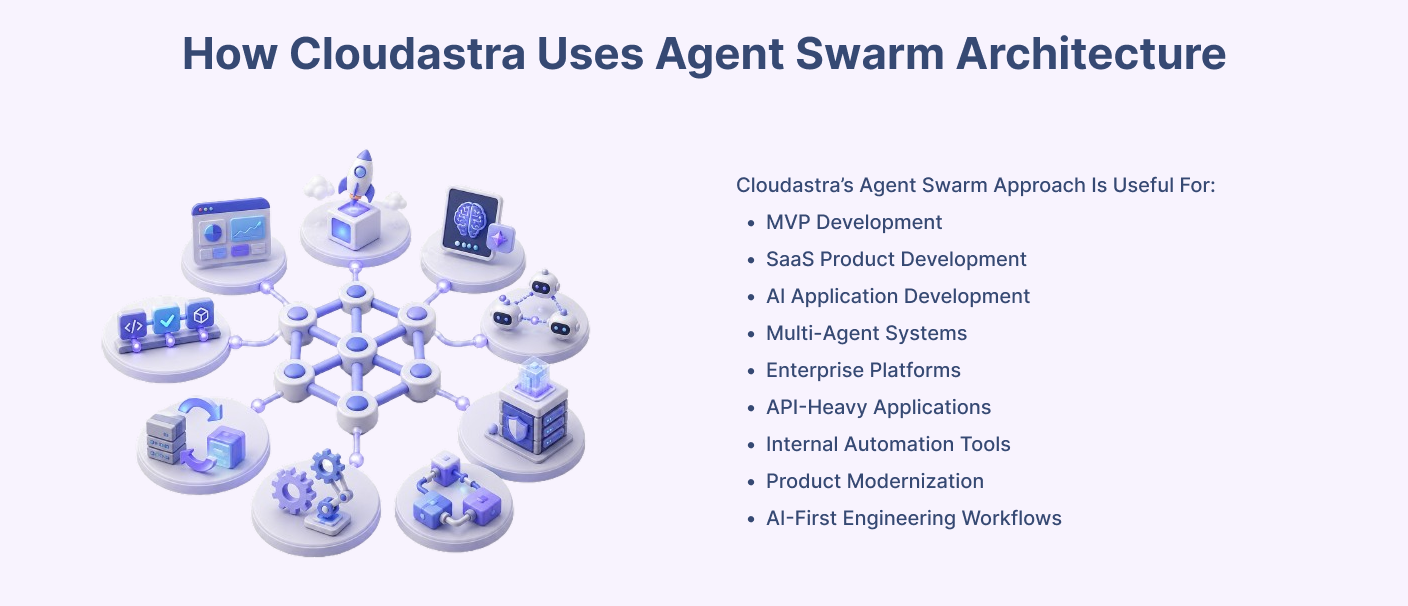
Cloudastra’s agent swarm approach is useful for:
- MVP development
- SaaS product development
- AI application development
- Multi-agent systems
- Enterprise platforms
- API-heavy applications
- Internal automation tools
- Product modernization
- AI-first engineering workflows
Instead of treating AI as a simple coding assistant, Cloudastra structures AI agents as a coordinated engineering system.
This helps teams ship faster while keeping human review, security checks, quality control, and accountability in place.
Who Should Use Agent Swarm Architecture?
Agent swarm architecture is useful for:
- CTOs
- Startup founders
- SaaS founders
- Engineering leaders
- Product teams
- AI-first startups
- Software agencies
- Enterprise innovation teams
- Teams building MVPs
- Companies modernizing legacy platforms
- Businesses building AI applications
- Teams that need faster software delivery
It is especially useful for teams that want faster development without fully depending on larger engineering headcount.
For teams moving beyond single AI assistants, Agent-Driven SDLC can help coordinate specialized AI agents for faster, human-reviewed software delivery.
Want to explore more helpful insights on AI, automation, and enterprise technology? Read more blogs at Cloudastra Technologies or connect with us for business enquiries through Cloudastra Contact Us.
FAQs
1. What is agent swarm architecture?
Agent swarm architecture is a multi-agent software development model where multiple specialized AI agents work together on planning, coding, testing, security, documentation, and deployment tasks under human supervision.
2. Is agent swarm development fully autonomous?
No. Agent swarm development is not fully autonomous. Human engineers still define requirements, make architecture decisions, review code, approve security-sensitive changes, and take responsibility for final outcomes.
3. How is agent swarm architecture different from GitHub Copilot?
GitHub Copilot works as a single AI coding assistant for individual developers. Agent swarm architecture uses multiple specialized AI agents working in parallel across the full development workflow, with orchestration and human review.
4. How do agents communicate with each other?
Agents communicate through a shared context system or knowledge base. When one agent makes a change, related agents receive updated information so they can adjust their work and avoid inconsistencies.
5. What happens when agents make mistakes?
Mistakes are handled through testing, static analysis, security scans, review agents, and human code review. A good agent swarm system uses multiple quality layers before work is approved.
6. What use cases are best suited for agent swarm architecture?
Agent swarm architecture works well for MVP development, SaaS products, API development, web and mobile apps, dashboards, integrations, testing automation, documentation, and structured modernization work.
7. How does Cloudastra help with agent swarm development?
Cloudastra helps companies build software faster using AI agent teams, AI-first development workflows, human-reviewed engineering, testing automation, security checks, and production-ready delivery processes.