Payment risk scoring helps fintech companies, banks, NBFCs, and payment platforms evaluate every transaction in real time and decide which payments should pass, be flagged, be blocked, or be reviewed by a risk team.
For fast-moving payment systems, the biggest challenge is not only detecting fraud. It is deciding which transactions are risky enough to stop before funds move. SecureFlow helps teams score payment risk using transaction signals, velocity patterns, mule indicators, sanctions checks, and custom rules so suspicious activity can be prioritized before review.
Introduction
Digital payments move quickly, and fraud teams often have very little time to act.
A suspicious transaction may look normal on its own. But when it is seen with account history, device behavior, beneficiary patterns, payment velocity, location changes, and previous activity, the risk becomes clearer.
This is why fintech companies need payment risk scoring.
Without a scoring layer, risk teams often face two problems. They either allow risky payments to pass because the signal was missed, or they generate too many alerts and overwhelm analysts with false positives.
Both outcomes are expensive.
Payment risk scoring gives teams a structured way to evaluate transaction risk before settlement. Instead of reviewing every transaction manually, teams can focus on the payments that show the strongest risk signals.
What Is Payment Risk Scoring?
Payment risk scoring is the process of assigning a risk score to a transaction based on multiple fraud, compliance, behavioral, and payment signals.
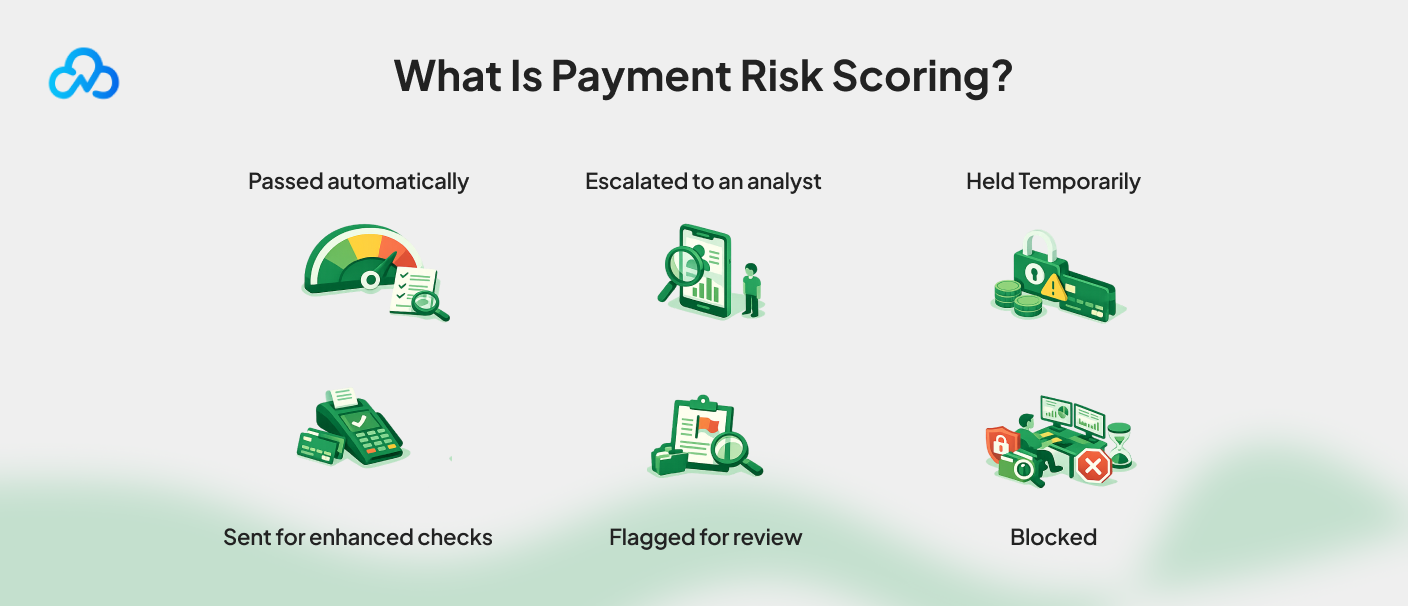
The score helps risk teams decide whether a transaction should be:
- Passed automatically
- Flagged for review
- Held temporarily
- Blocked
- Escalated to an analyst
- Sent for enhanced checks
A payment risk score can be based on signals such as:
- Transaction amount
- Payment frequency
- Beneficiary history
- New payee activity
- Device mismatch
- Location anomaly
- Account age
- Customer risk profile
- Payment rail
- Time of transaction
- Velocity patterns
- Mule account indicators
- Sanctions or watchlist exposure
- Previous failed attempts
- Suspicious account network behavior
In simple terms, payment risk scoring helps fintech teams answer one important question:
Is this payment safe enough to move right now?
What Is Payment Risk Scoring
Why Fintech Companies Need Payment Risk Scoring
Fintech companies need payment risk scoring because transaction speed has reduced the time available for manual checks.
Payments can move across UPI, IMPS, RTGS, SWIFT, wallets, and cross-border rails within seconds or minutes. If risk is detected after settlement, the team is already in recovery mode.
That creates problems such as:
- Fraud detected after funds move
- Manual review queues becoming too large
- Analysts spending time on low-risk alerts
- High-risk transactions not prioritized early
- Inconsistent pass, flag, or block decisions
- Weak explanation behind fraud decisions
- Delayed escalation
- Poor visibility into transaction risk
- Difficulty proving why a payment was allowed or stopped
Payment risk scoring reduces these gaps by giving every transaction a clear risk value before action is taken.
For fintech teams, this is useful because not every alert carries the same risk. A transaction with one weak signal may not need manual review. A transaction with multiple connected signals may need immediate action.
How Payment Risk Scoring Works
Payment risk scoring works by collecting transaction data, checking it against risk signals, calculating a score, and returning a decision.
Here is the usual workflow.
1. Transaction Data Is Ingested
The system first receives payment data when the transaction is initiated.
This may include:
- Sender account
- Receiver account
- Payment amount
- Payment rail
- Timestamp
- Device information
- Location information
- Customer profile
- Beneficiary details
- Payment message
- Previous transaction history
This data becomes the base for transaction risk scoring.
The faster this data is processed, the better the chance of stopping suspicious activity before settlement.
2. Risk Signals Are Checked
The transaction is then checked against different risk signals.
These signals may include:
- High transaction velocity
- Sudden change in payment amount
- New beneficiary added recently
- Multiple transfers in a short time
- Unusual payment timing
- Account-to-account pattern changes
- Repeated small-value transfers
- Activity from a new device
- Unusual location
- Sanctions or watchlist match
- High-risk counterparty
- Mule account behavior
Each signal adds context.
A single signal may not be enough to stop a payment. But multiple signals together can show a stronger risk pattern.
3. Rules and Models Apply Risk Weight
Not all signals should carry the same importance.
For example, a small payment from a familiar device may be low risk. But a high-value payment to a new beneficiary from a new device after multiple failed attempts may be high risk.
Payment risk scoring systems assign weight to each signal based on risk importance.
This helps teams avoid treating every alert equally.
Signals can be weighted by:
- Fraud typology
- Transaction amount
- Customer segment
- Payment rail
- Account history
- Counterparty risk
- Velocity pattern
- Compliance exposure
- Risk team policy
This is where fraud risk scoring becomes more useful than simple rule-based alerts.
4. The Transaction Gets a Risk Score
After signals are evaluated, the transaction receives a score.
A simple scoring model may classify payments as:
- Low risk
- Medium risk
- High risk
- Critical risk
A more advanced model may create typology-level scores such as:
- Mule risk score
- Account takeover risk score
- Smurfing risk score
- Velocity risk score
- Sanctions exposure score
- Beneficiary risk score
This helps analysts understand why a payment is risky, not just that it is risky.
5. The System Returns a Decision
Once the score is calculated, the system returns a decision.
The decision may be:
- Pass
- Flag
- Block
- Hold
- Escalate
A strong system should also show the reason behind the decision.
For example:
- New beneficiary + high amount + new device
- Multiple small transfers within 10 minutes
- Unusual location + account age below threshold
- Possible mule activity based on fan-in and fan-out pattern
- Payment linked to high-risk counterparty
This makes suspicious transaction detection easier for risk teams and helps support audit review.
Key Features of a Payment Risk Scoring System
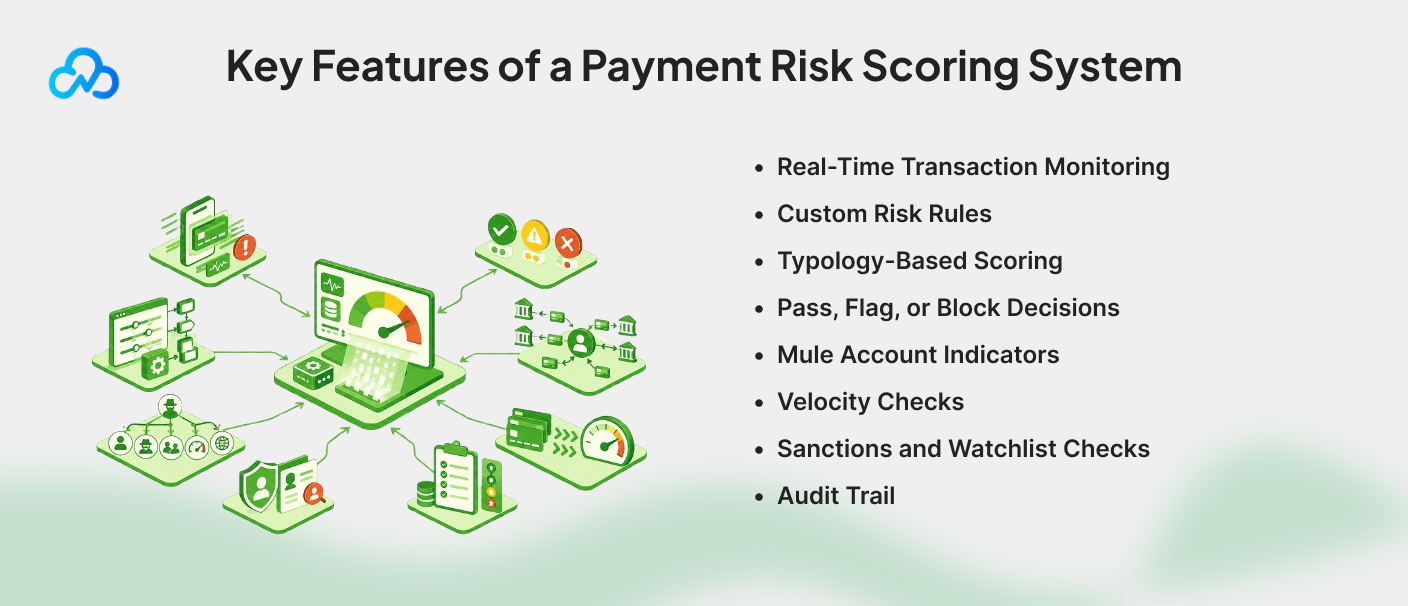
Real-Time Transaction Monitoring
The system should monitor payments as they happen.
Real time transaction monitoring is important because delayed alerts may not help if the payment has already settled.
Custom Risk Rulesf
Risk teams should be able to create and adjust rules based on current fraud patterns.
A good system should not require engineering support for every small rule change.
Typology-Based Scoring
Typology based scoring helps teams understand whether a transaction looks like mule activity, account takeover, smurfing, velocity abuse, or sanctions exposure.
This gives analysts better context.
Pass, Flag, or Block Decisions
The system should return clear decisions that can be used inside the payment flow.
This helps teams act before funds move.
Mule Account Indicators
Mule account indicators help identify accounts used to receive and move suspicious funds.
Signals may include rapid fund movement, fan-in and fan out activity, low balance retention, and repeated transfers.
Velocity Checks
Velocity checks detect unusual transaction speed or frequency.
This is useful for spotting rapid payment attempts, repeated transfers, and abnormal payment bursts.
Sanctions and Watchlist Checks
Payment risk scoring should also consider compliance exposure when a transaction involves restricted entities, high risk counterparties, or suspicious names.
Audit Trail
Every decision should be logged with score, rule triggers, signals, timestamp, and outcome.
This helps teams explain why a payment was passed, flagged, or blocked.
Use Cases of Payment Risk Scoring
1. High-Risk Payment Prioritization
Payment risk scoring helps teams prioritize the transactions that need immediate review.
Instead of looking at all alerts equally, analysts can focus on the highest risk payments first.
2. Mule Account Detection
Mule accounts often look normal in isolated transactions.
Risk scoring helps detect suspicious account behavior across transaction patterns, incoming funds, outgoing transfers, and network movement.
3. Account Takeover Risk Detection
When a fraudster takes over an account, the payment may show sudden changes in device, location, beneficiary, or amount.
Payment risk scoring helps connect these signals before the transaction clears.
4. Smurfing Pattern Detection
Smurfing involves splitting larger amounts into smaller payments to avoid basic thresholds.
A scoring system can detect repeated small transactions, linked accounts, and unusual frequency.
5. New Beneficiary Risk Checks
Payments to new beneficiaries can carry higher risk, especially when combined with device changes, high-value transfers, or unusual timing.
A risk score helps decide whether the payment should pass or be reviewed.
6. Cross-Border Payment Risk
Cross border payments can involve additional risks such as sanctions exposure, high risk geographies, and unusual counterparty behavior.
Payment risk scoring helps create a more controlled review process.
7. Analyst Queue Prioritization
Risk teams often receive more alerts than they can review manually.
Scoring helps order the queue so analysts review the most important cases first.
Benefits of Payment Risk Scoring
Faster Fraud Decisions
Risk scoring helps teams make faster pass, flag, or block decisions.
This is important for payment environments where timing matters.
Fewer Low Quality Alerts
A scoring layer helps reduce unnecessary manual review by separating weak signals from stronger risk patterns.
This helps reduce alert fatigue.
Better Analyst Productivity
Analysts can focus on the most suspicious transactions instead of manually checking every alert.
This improves investigation efficiency.
Stronger Pre Settlement Control
Payment risk scoring helps teams act before funds move.
This reduces dependency on post settlement recovery.
More Explainable Decisions
A good score should include rule triggers and risk reasons.
This makes decisions easier to explain during internal reviews, audits, and investigations.
Improved Customer Experience
When risk scoring is accurate, genuine customers face less unnecessary friction.
Only suspicious or high risk transactions are slowed down.
Better Fraud Pattern Visibility
Risk scoring helps teams see which typologies are increasing, which rules are triggering often, and where risk is appearing across payment flows.
Common Challenges in Payment Risk Scoring
Too Many False Positives
If the scoring model is too sensitive, too many genuine payments may be flagged.
This creates customer friction and analyst overload.
Weak Signal Weighting
If every signal is treated equally, the score may not reflect true risk.
A pricing page visit, a device change, and a sanctions match should not carry the same weight. In payments, signal weight matters.
No Real-Time Decisioning
If risk scoring happens after settlement, it becomes reporting, not prevention.
For payment fraud control, scoring must happen at the point of payment initiation.
Static Rules That Do Not Change
Fraud patterns change quickly.
If rules are not updated, fraudsters can learn how to avoid them.
No Audit Trail
Without a decision trail, teams cannot prove why a payment was passed, flagged, or blocked.
This creates investigation and compliance gaps.
Scattered Risk Data
If device data, customer data, payment data, and sanctions data are spread across different tools, risk scoring becomes incomplete.
A strong system needs connected data.
How SecureFlow Helps With Payment Risk Scoring
SecureFlow by Cloudastra helps fintech companies, banks, NBFCs, and payment platforms score transaction risk before funds settle.
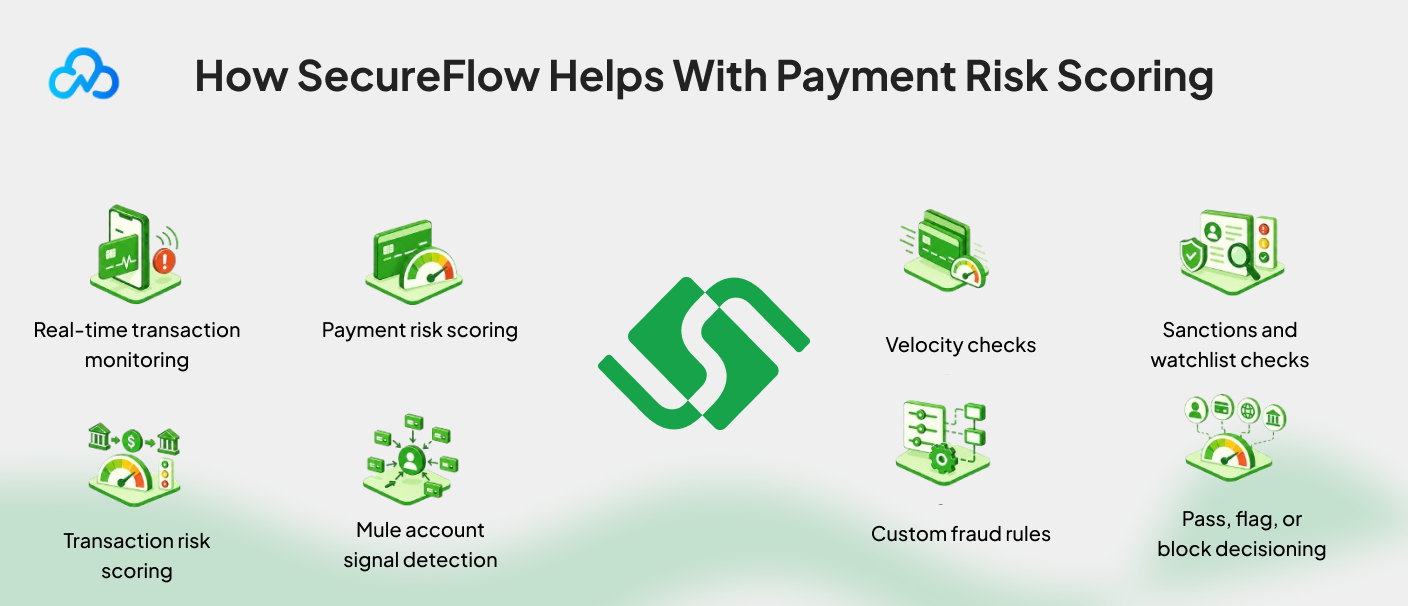
SecureFlow supports:
- Real-time transaction monitoring
- Payment risk scoring
- Transaction risk scoring
- Mule account signal detection
- Velocity checks
- Sanctions and watchlist checks
- Custom fraud rules
- Typology level scoring
- Pass, flag, or block decisioning
- Audit grade trails
- Payment rail coverage
- Rule tuning for risk teams
Instead of waiting until suspicious activity becomes a recovery problem, SecureFlow helps teams evaluate payment risk at the transaction moment.
For risk and compliance teams, this creates a more structured way to detect suspicious transactions, prioritize analyst review, and stop high risk payments before funds move.
Who Should Use SecureFlow?
SecureFlow is useful for:
- Fintech companies
- Banks
- NBFCs
- Payment gateways
- Payment aggregators
- Digital lenders
- Wallet companies
- Neo banks
- Embedded finance platforms
- Cross-border payment providers
- Risk teams
- Fraud operations teams
- Compliance teams
- Transaction monitoring teams
It is especially useful for teams that process high payment volume and need fast, explainable transaction decisions.
Want to explore more helpful insights on AI, automation, and enterprise technology? Read more blogs at Cloudastra Technologies or connect with us for business enquiries through Cloudastra Contact Us.
FAQs
1. What is payment risk scoring?
Payment risk scoring is the process of assigning a risk score to a transaction based on signals such as payment amount, velocity, device behavior, beneficiary history, customer profile, mule indicators, and sanctions exposure.
2. Why do fintech companies need payment risk scoring?
Fintech companies need payment risk scoring because digital payments move quickly. A scoring layer helps teams identify suspicious transactions before funds settle and prioritize high risk payments for review.
3. How is payment risk scoring different from basic fraud rules?
Basic fraud rules usually trigger alerts based on fixed conditions. Payment risk scoring combines multiple signals, applies risk weight, and produces a more complete transaction risk view.
4. What signals are used in transaction risk scoring?
Transaction risk scoring may use transaction amount, payment frequency, account age, device data, location data, beneficiary history, customer risk profile, payment rail, sanctions signals, and previous behavior.
5. Can payment risk scoring reduce false positives?
Yes. Better scoring can reduce false positives by combining multiple risk signals and prioritizing only transactions that show stronger suspicious patterns.
6. How does SecureFlow help with payment risk scoring?
SecureFlow helps teams score payment risk in real time, detect suspicious transaction patterns, check velocity and mule signals, apply custom rules, and return pass, flag, or block decisions before settlement.
7. Who should use payment risk scoring software?
Payment risk scoring software is useful for fintech companies, banks, NBFCs, payment gateways, payment aggregators, digital lenders, wallet providers, and transaction monitoring teams.
8. Does SecureFlow support audit-ready fraud decisions?
Yes. SecureFlow maintains audit grade trails with decision reasons, rule triggers, scores, and transaction context so teams can review why a payment was passed, flagged, or blocked.