Agentic SDLC for Startups and SMBs: How Small Teams Ship Faster Without Hiring More Engineers
Agentic SDLC is a software development lifecycle where AI agents take ownership of complete development tasks such as planning tickets, writing code, running tests, fixing failures, and opening pull requests under human review.
For startups and SMBs, the biggest benefit is simple: a small team can ship more software without immediately hiring a larger engineering team. But agentic development only works safely when the right guardrails are in place. Without clear specs, tests, CI, review gates, and human approval, agents can produce wrong code faster than a traditional team.
That is why agentic SDLC is not about replacing engineers. It is about helping engineers move faster by giving AI agents the repeatable work while humans stay responsible for architecture, security, business logic, and final decisions.
What Problem Does Agentic SDLC Solve?
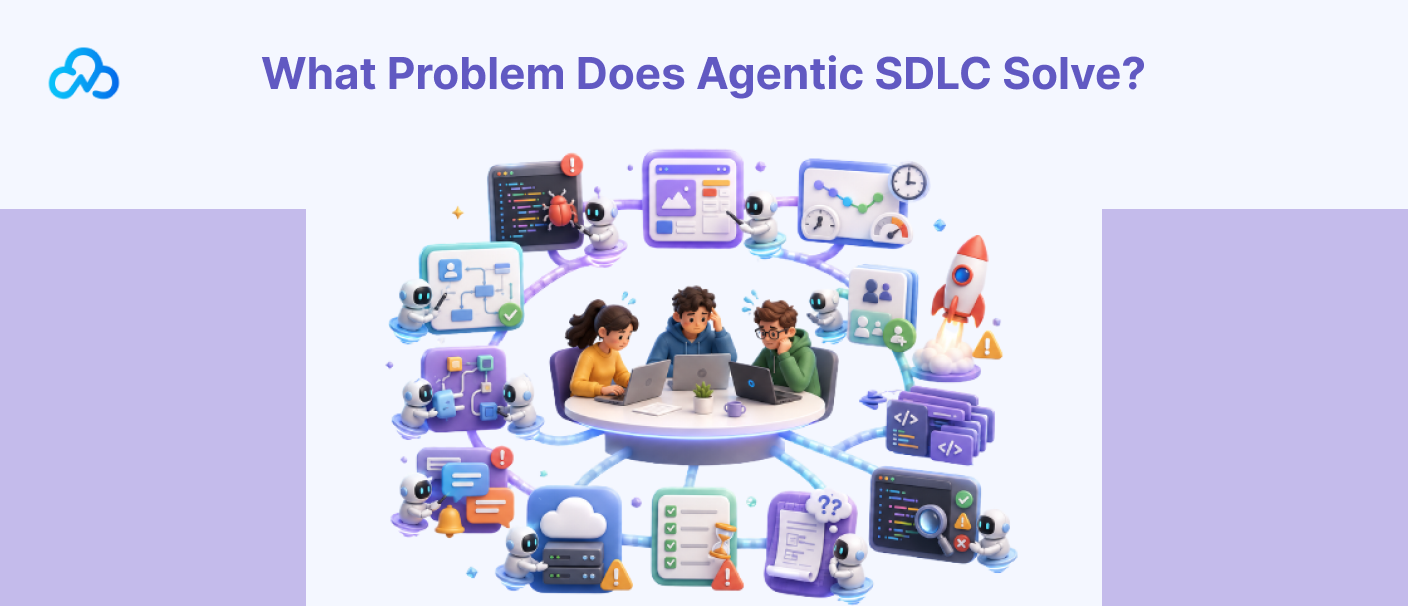
Startups and SMBs usually have more product work than engineering capacity.
A small team may need to build new features, fix bugs, improve onboarding, maintain integrations, handle customer requests, update infrastructure, write tests, and ship releases at the same time. But hiring more engineers takes time, budget, onboarding effort, and management bandwidth.
Traditional development creates common problems for small teams:
- Product roadmaps move slower than expected
- Engineers spend too much time on repetitive implementation
- Bug fixes compete with new feature work
- Testing is delayed or skipped under pressure
- Specs are unclear or stored in people’s heads
- Code review becomes inconsistent
- Deployment risk increases as the team moves faster
- Scaling output means hiring more people
AI coding assistants help, but they do not fully solve the delivery problem. A tool that suggests code still depends on the developer to drive every step.
Agentic SDLC solves a deeper workflow problem by letting AI agents own complete, well-defined units of work. The agent can read a ticket, plan the change, edit multiple files, run tests, fix errors, and submit a pull request for human review.
The human still owns the expensive decisions. The agent handles the repeatable execution.
What Is Agentic SDLC?
Agentic SDLC is a software development lifecycle where AI agents handle whole development tasks across planning, coding, testing, review preparation, and pull request creation, while humans provide direction, review, and approval.
The important difference is ownership.
In AI-assisted development, the human owns the task and AI suggests small pieces of code. In agentic development, the AI agent owns a complete unit of work with a clear definition of done.
For example, instead of asking AI to “write a function,” the team gives an agent a full task such as:
- Add this API endpoint
- Fix this bug using the failing test
- Refactor this module without changing behaviour
- Add validation to this form
- Update this integration
- Create tests for this feature
- Open a pull request for review
The agent then works through the task, makes code changes, runs checks, and prepares the output for review.
In simple terms, agentic SDLC helps small teams answer questions like:
- Can agents handle well-scoped tickets?
- Can agents write and run tests before review?
- Can small teams ship more without adding headcount?
- Which decisions should stay human-owned?
- What guardrails are needed before agents touch production code?
- How do we avoid confident but wrong AI output?
- Where should startups begin safely?
For startups and SMBs, agentic SDLC is valuable because engineering hours are often the biggest constraint.
Why Agentic SDLC Matters More for Startups and SMBs
Agentic SDLC matters more for startups and SMBs because small teams feel engineering bottlenecks faster than large enterprises.
A large enterprise may adopt AI agents to improve efficiency by a small percentage. A startup may adopt agentic SDLC because it changes what the team can build at all.
When five engineers own the whole roadmap, every hour matters. A small team cannot afford long handoffs, slow QA cycles, delayed refactors, and repetitive implementation work that blocks important features.
Agentic SDLC helps because:
- Agents can work on bounded tasks in parallel
- Developers spend less time on repetitive coding
- Tests can be generated faster
- Bug fixes can move quicker when failing tests exist
- Refactors become easier to execute safely
- Pull requests can be prepared faster
- Engineers can focus more on architecture and product judgment
This is especially useful for startups that already ship in small, well-scoped feature slices.
The key condition is verification. Agents can produce output quickly, but the team needs tests, review gates, and clear acceptance criteria to make that output safe.
For most startups, the question is not “Can AI agents write code?” The better question is “Do we have the guardrails to safely review and ship agent-written code?”
Agentic SDLC vs AI-Augmented vs Traditional Development
It is important to separate agentic SDLC from normal AI coding tools.
Traditional development means humans write the code, run tests, fix bugs, and ship the work manually. The speed depends mostly on engineering headcount, experience, and process quality.
AI-augmented development means engineers use AI tools for support. The AI may suggest code, explain errors, generate snippets, or help debug. But the human still owns the whole task from start to finish.
Agentic SDLC is different because the AI agent owns a complete task.
The difference looks like this:
- Traditional development: human writes and manages everything
- AI-augmented development: human owns the task and AI assists
- Agentic SDLC: AI agent owns the task execution and human owns the decision
This shift changes the role of the engineer.
Instead of spending all day writing every line, the engineer spends more time writing clear specs, setting guardrails, reviewing pull requests, validating architecture, and making decisions that are expensive to reverse.
This is where agentic development becomes useful for small teams. It moves human effort from repetitive execution to higher-value review and direction.
How Agentic SDLC Works Stage by Stage
1. Planning and Specification
In agentic SDLC, planning starts with a clear spec.
A human writes the requirement, acceptance criteria, constraints, and expected behaviour. This step must stay human-led because AI cannot fully understand business priorities, customer expectations, or product trade-offs without clear direction.
A good agent-ready ticket should include:
- What needs to change
- Why it matters
- Acceptance criteria
- Files or modules likely affected
- Business rules
- Edge cases
- Test expectations
- What should not change
Once the spec is clear, the agent can break the task into smaller steps and prepare an execution plan.
The quality of agent output is directly connected to the quality of the input spec. Poor specs create poor code.
2. Build and Implementation
After planning, the agent starts implementation.
Unlike autocomplete tools, an agent can edit across multiple files, create new files, update logic, adjust tests, and prepare a pull request.
This is where the raw speed comes from.
The agent can handle work such as:
- Adding standard features
- Updating UI components
- Creating API endpoints
- Fixing bugs with clear reproduction steps
- Refactoring code with clear before-and-after behaviour
- Updating dependencies
- Adding validation
- Writing boilerplate code
- Translating logic between frameworks
For small teams, this reduces the amount of repetitive implementation work engineers need to do manually.
But agents should not be given unlimited access. They should work inside branches, behind CI, with clear boundaries around what they can change.
3. Testing and Repair Loop
Testing is what separates safe agentic SDLC from risky AI code generation.
A proper agentic workflow does not stop after code is written. The agent should run tests, read failures, repair its own code, and repeat the loop until the task passes defined checks.
This is why automated tests are so important.
If there are no tests, the agent has no reliable signal to know whether the change works. It may produce code that looks correct but fails in real usage.
Testing agents or coding agents can help with:
- Unit tests
- Integration tests
- Regression tests
- Test data
- Failing test reproduction
- Edge case coverage
- Fixing test failures
- Verifying expected behaviour
For startups and SMBs, this means the first step toward agentic SDLC is often not “add more agents.” It is “build better tests.”
4. Review and Quality Gate
After the agent completes the task and passes checks, the work should go through review.
A second AI agent can perform a first-pass review for style, obvious bugs, missing tests, or consistency issues. But human review remains essential.
The human reviewer should focus on:
- Does this meet the requirement?
- Is the business logic correct?
- Are edge cases handled?
- Is the architecture still clean?
- Are there security risks?
- Is sensitive data handled properly?
- Is the change maintainable?
- Can this be safely merged?
Agentic SDLC should not remove code review. It should make code review more focused.
The goal is to let AI handle routine checks so humans can focus on judgment.
5. Shipping and Deployment
The merge and deployment decision should stay human-owned, especially in the early stages of adoption.
This is the expensive-to-reverse moment.
Agents can prepare the pull request, run checks, summarize changes, and help generate release notes. But the human should approve the merge after reviewing quality, risk, and production impact.
A safe shipping process includes:
- Branch-based agent work
- CI checks
- Automated tests
- Code review
- Security review for sensitive changes
- Human merge approval
- Controlled deployment
- Rollback plan
Speed should come from faster build and testing loops, not from removing the final human gate.
Where AI Agents Help Most
AI agents are most useful when the work is well-scoped, repeatable, and easy to verify.
Good use cases include:
- Bug fixes with failing tests
- Test generation
- Refactors with clear behaviour
- CRUD workflows
- UI form updates
- API endpoint creation
- Dependency upgrades
- Documentation updates
- Standard validation logic
- Simple integration work
- Framework migration support
- Repetitive implementation tasks
Startups and SMBs can use Cloudastra’s AI-First Product Engineering service to combine AI-agent execution with senior engineering oversight across planning, development, testing, deployment, and product scaling.
These tasks work well because the expected output is clear and the result can be checked through tests, CI, or review.
For startups and SMBs, this is the safest place to begin. Start with tasks where the agent can move fast and mistakes are easy to catch.
Where Humans Still Need to Own the Work
Humans should continue to own decisions that are expensive to reverse.
This includes:
- System architecture
- Build-vs-buy decisions
- Security and data-handling choices
- Authentication and authorization design
- Payment-related logic
- Compliance-sensitive workflows
- Ambiguous product trade-offs
- Final merge decisions
- Production release approvals
- Stakeholder communication
Agents can assist with options, code, tests, and summaries. But humans should decide when the decision affects long-term architecture, customer trust, money movement, user data, or compliance exposure.
This is the main rule of safe agentic development:
Agents own high-volume work that is cheap to verify. Humans own rare decisions that are expensive to reverse.
What Guardrails Are Needed for Agentic SDLC?
Agentic SDLC is not only a generation problem. It is a verification problem.
The agents are useful only when the verification layer is strong enough to catch mistakes before they reach production.
A safe agentic SDLC needs four core guardrails.
1. Automated Tests
Automated tests are the safety net.
Agents can fix their own failures only when tests exist. Without tests, the agent may produce code that looks correct but breaks real workflows.
Start with tests around:
- Critical user flows
- APIs
- Payment or billing logic
- Authentication
- Data processing
- Important business rules
- Known bug-prone areas
2. Human Code Review
Every agent pull request needs human review.
This does not mean humans review every formatting choice manually. It means humans check the decisions that matter: product logic, architecture, data handling, security, and maintainability.
3. Clear Specifications
Agents need tickets they can understand.
A one-line task like “fix onboarding” is not enough. A good spec should explain the expected behaviour, edge cases, acceptance criteria, and boundaries.
Clear specs reduce rework and prevent agents from guessing.
4. Blast-Radius Limits
Agents should not have unrestricted production access.
They should work in controlled branches, behind CI, with limited permissions. They should not directly deploy to production or merge without human approval.
Blast-radius limits keep mistakes contained.
Common Challenges in Agentic SDLC
Agents Can Produce Confident but Wrong Code
AI agents may generate code that looks reasonable but does not fully match the requirement. This is why tests and review gates are required.
Weak Specs Reduce Output Quality
If the ticket is unclear, the agent may guess. The result may be technically valid but product-wise wrong.
No Tests Means No Safe Repair Loop
Without automated tests, agents cannot reliably know whether their changes work. Teams with near-zero test coverage should fix this before expanding autonomy.
Review Can Become a Bottleneck
If agents generate too many pull requests without proper prioritization, human reviewers may become overloaded. Teams need review rules and task boundaries.
Security-Sensitive Work Needs Extra Care
Agents should not independently handle authentication, payments, permissions, or sensitive data flows without senior human review.
Small Teams May Lack Platform Guardrails
Many startups do not already have strong CI, test coverage, security scanning, and review workflows. In those cases, adopting agentic SDLC with an experienced AI-first engineering partner may be faster than building the full pipeline from scratch.
How to Start With Agentic SDLC Safely
Start small. Do not switch the whole engineering team to agents overnight.
A safer adoption path looks like this:
Step 1: Start Where Verification Is Easy
Begin with tasks that have clear expected outcomes.
Good starting points include:
- Test writing
- Bug fixes with failing tests
- Small refactors
- Documentation updates
- Dependency upgrades
- Simple UI changes
These tasks are easier to verify and help the team build trust.
Step 2: Keep Human Merge Approval
Do not remove human review early.
The goal is not to automate the merge. The goal is to make planning, building, testing, and pull request preparation faster.
Human approval should stay in place until the team has enough evidence that the pipeline is safe.
Step 3: Measure Both Throughput and Escapes
Track how much more the team ships, but also track how many agent-created bugs reach production.
Measure:
- Pull requests completed
- Lead time per task
- Test pass rate
- Review rework
- Escaped defects
- Production incidents
- Developer time saved
If escaped bugs increase, the issue is usually weak guardrails, not simply “bad agents.”
Step 4: Expand Autonomy Gradually
Give agents more responsibility only where they have proven reliable.
Do not hand over architecture, security, authentication, payments, or compliance workflows early.
Expand by evidence, not hope.
What Features Should an Agentic SDLC Pipeline Have?
A strong agentic SDLC pipeline should include:
- Clear ticket specifications
- Acceptance criteria
- AI agent task execution
- Branch-based development
- Automated testing
- CI checks
- Static analysis
- Security scanning
- Pull request generation
- AI first-pass review
- Human code review
- Human merge approval
- Audit logs
- Rollback process
- Permission controls
- Performance monitoring
For startups and SMBs, the most important features are clear specs, test coverage, CI, review gates, and limited agent permissions.
These are what make agentic development safe enough to use in real software delivery.
How Cloudastra Helps Startups and SMBs Run Agentic SDLC
Cloudastra helps startups and SMBs adopt agentic SDLC without building the full pipeline from scratch.
The approach combines AI agent development, AI-first product engineering, senior human review, testing workflows, CI guardrails, and production-ready delivery processes.
Cloudastra helps teams with:
- Agentic SDLC setup
- AI-first product engineering
- AI agent development
- MVP development
- Test and CI guardrails
- Code review workflows
- Pull request pipelines
- Architecture review
- Secure implementation practices
- Faster product delivery
- AI Sprint execution
Instead of giving teams only a tool, Cloudastra helps run the actual guardrailed workflow. That means agents can help plan, build, test, and prepare work while human engineers keep control over architecture, security, and final approval.
This is especially useful for startups and SMBs that want faster engineering throughput but do not have time to build a full internal agent pipeline before shipping their roadmap.
Who Should Use Agentic SDLC?
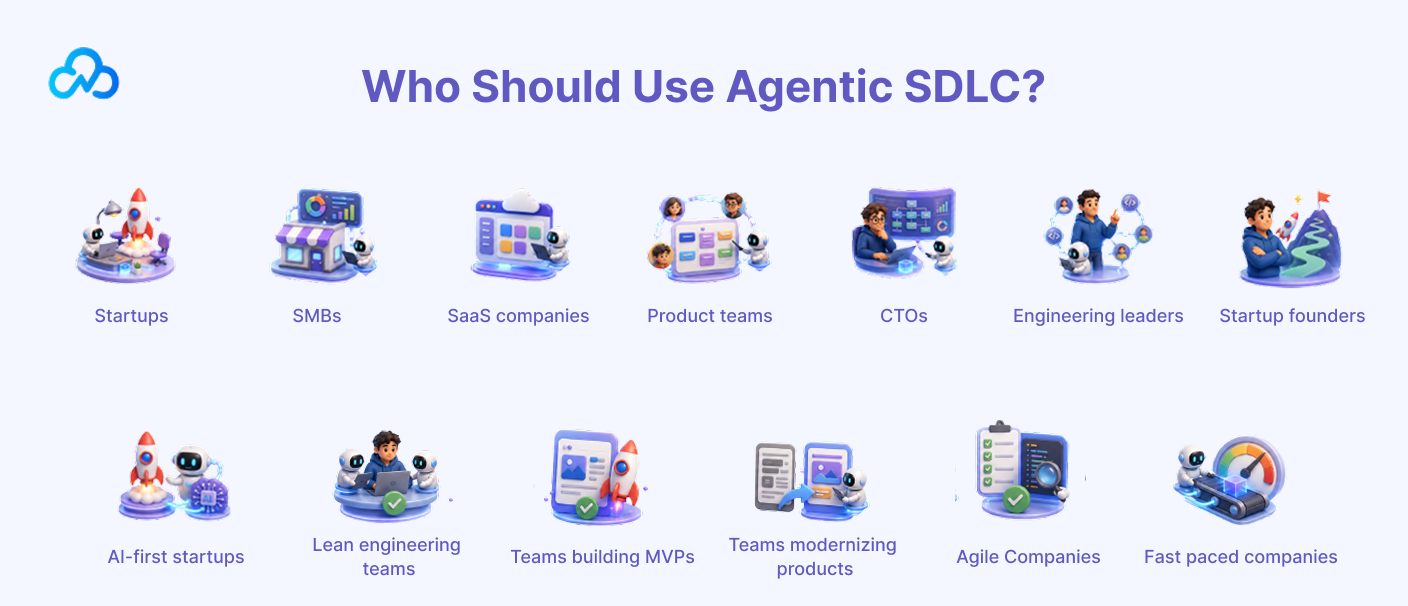
Agentic SDLC is useful for:
- Startups
- SMBs
- SaaS companies
- Product teams
- CTOs
- Engineering leaders
- Startup founders
- AI-first startups
- Lean engineering teams
- Teams building MVPs
- Teams modernizing products
- Companies with clear tickets and review habits
- Businesses that need faster delivery without immediate headcount growth
It is especially useful when engineering hours are the bottleneck and the team already has, or is willing to build, strong verification guardrails.
When several specialized agents need to work across development tasks in parallel, agent swarm architecture provides a structured model for coordinating their responsibilities, context, and output.
Want to explore more practical insights on AI-first engineering, automation, and software delivery? Read more blogs at Cloudastra Technologies or contact us for business enquiries through Cloudastra Contact Us.
FAQs
1. What is agentic SDLC?
Agentic SDLC is a software development lifecycle where AI agents take ownership of complete development tasks such as planning changes, editing code, running tests, fixing failures, and opening pull requests, while humans approve important decisions.
2. How is agentic SDLC different from GitHub Copilot?
GitHub Copilot helps developers write code by suggesting snippets or completions. Agentic SDLC gives AI agents ownership of whole tasks, including reading tickets, editing multiple files, running tests, fixing errors, and preparing pull requests for review.
3. Is agentic SDLC safe for startups and SMBs?
Agentic SDLC can be safe if the team has proper guardrails such as automated tests, CI checks, clear specs, human code review, and no direct production access for agents.
4. Will agentic development replace engineers?
No. Agentic development changes the engineer’s role. Engineers spend less time writing repetitive code and more time defining requirements, reviewing output, owning architecture, handling security, and making final decisions.
5. Where should small teams start with agentic SDLC?
Small teams should start with low-risk, easy-to-verify work such as test writing, bug fixes with failing tests, documentation updates, dependency upgrades, small refactors, and simple UI changes.
6. What guardrails are needed before using agentic SDLC?
The key guardrails are automated tests, CI checks, clear specifications, human review, branch-based work, limited permissions, security scanning, and human merge approval.
7. How does Cloudastra help with agentic SDLC?
Cloudastra helps startups and SMBs set up and run a guardrailed agentic SDLC pipeline using AI agent development, AI-first product engineering, testing workflows, CI checks, human review, and production-ready delivery processes.