Anti fraud AI helps fintech companies detect suspicious transactions, unusual customer behavior, mule activity, account takeover signals, and emerging fraud patterns in real time.
Unlike static fraud rules that only detect known conditions, AI fraud detection evaluates multiple signals together. SecureFlow helps risk teams combine behavioral analysis, transaction anomaly detection, configurable rules, and human review to stop suspicious activity without blocking genuine customers unnecessarily.
Introduction
Fraud patterns do not remain the same for long.
When fintech companies create a rule to stop one type of fraud, fraudsters often change how they operate. They may reduce transaction values, split payments across multiple accounts, use new devices, create mule networks, or make suspicious transactions look similar to normal customer activity.
Static fraud rules are still useful, but they have limitations.
A rule can detect a known condition, such as a high-value transaction or repeated payment attempts. However, it may fail to identify fraud that does not cross a fixed threshold.
Making rules too strict creates another problem: false positives.
Genuine customers may have their transactions blocked because they changed devices, travelled to another location, added a new beneficiary, or made an unusually large payment.
Anti fraud AI gives risk teams more context. It analyzes how multiple signals connect and identifies behavior that differs from what is expected.
This helps fintech companies detect new fraud patterns while reducing unnecessary friction for genuine customers.
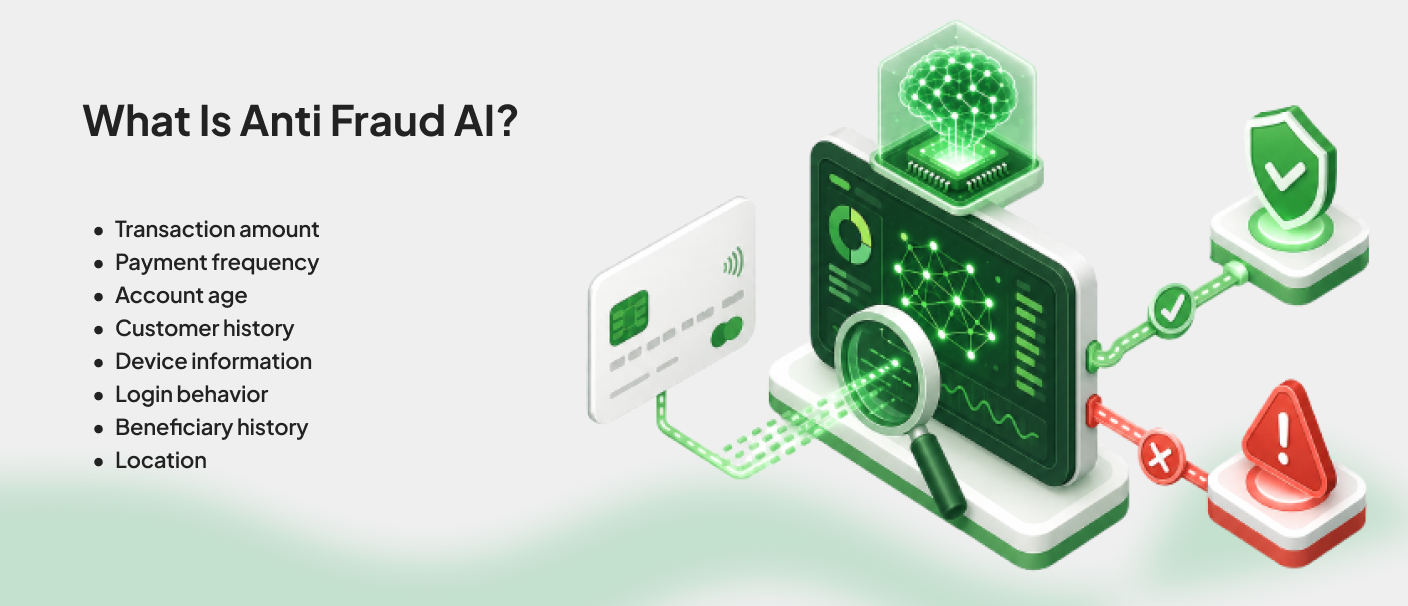
What Is Anti Fraud AI?
Anti fraud AI is the use of artificial intelligence and machine learning to detect suspicious transactions, accounts, devices, identities, and payment behavior.
It analyzes multiple risk signals together instead of relying only on one fixed rule.
These signals may include:
- Transaction amount
- Payment frequency
- Account age
- Customer history
- Device information
- Login behavior
- Beneficiary history
- Location
- Transaction time
- Payment velocity
- Failed attempts
- Linked accounts
- Previous fraud outcomes
Anti fraud AI compares current activity with normal customer behavior, similar customer profiles, known fraud patterns, and historical transaction data.
It can then produce:
- A fraud risk score
- A suspicious activity alert
- A recommended action
- A request for manual review
- A pass, hold, flag, or block decision
In simple terms, anti fraud AI helps fintech teams answer one important question:
Does this transaction look normal, or does it show signs of fraud?
Why Fintech Companies Need Anti Fraud AI
Fintech companies need anti fraud AI because digital payments move faster than manual fraud teams can review them.
A payment platform may process thousands of transactions within minutes. A digital lender may receive applications from different devices and locations. A wallet provider may manage rapid transfers between newly created accounts.
Manual review cannot examine every transaction signal in real time.
Traditional rule-based systems also create gaps.
For example, a rule may flag every payment above ₹50,000. This may catch some risky transactions, but it can also block genuine customers who regularly make high-value payments.
At the same time, fraudsters may avoid the rule by dividing one large payment into several smaller transactions.
Anti fraud AI helps by evaluating the wider context.
It can determine whether a payment is unusual based on the customer’s own behavior, account history, device, beneficiary, location, and transaction pattern.
This helps fintech companies:
- Detect emerging fraud patterns
- Identify suspicious behavior earlier
- Reduce false positives
- Prioritize high-risk alerts
- Improve analyst efficiency
- Detect account takeover
- Identify mule accounts
- Reduce unnecessary customer friction
- Strengthen fraud decision-making
How Anti Fraud AI Works
Anti fraud AI works by collecting transaction and behavioral data, understanding normal patterns, identifying anomalies, calculating risk, and recommending an action.
1. Transaction and Customer Data Is Collected
The system first collects data from payment, account, device, customer, and identity systems.
This may include:
- Sender and receiver accounts
- Transaction value
- Payment time
- Payment rail
- Device details
- IP address
- Customer location
- Account creation date
- Beneficiary history
- Previous payments
- Failed payment attempts
- Login activity
- KYC details
- Historical fraud outcomes
The quality of this data directly affects fraud detection accuracy.
Missing or delayed data may prevent the system from seeing the full risk context.
2. Normal Customer Behavior Is Established
The system analyzes previous activity to understand what normal behavior looks like for each customer.
For example, a customer may normally:
- Use one device
- Make payments during specific hours
- Transact within a particular value range
- Send money to familiar beneficiaries
- Operate from one location
- Make only a few transactions each day
A single change does not automatically mean fraud.
However, several unusual changes happening together may increase risk.
For example:
- New device
- New beneficiary
- Unusual location
- High-value payment
- Activity at an unusual time
Behavioral fraud detection helps evaluate all these signals together.
3. Transaction Anomalies Are Detected
Transaction anomaly detection identifies activity that differs from expected behavior.
Examples include:
- Sudden increase in payment amount
- Unusual transaction frequency
- Rapid movement of received funds
- Multiple small payments to avoid limits
- Payments from an unfamiliar location
- Sudden activity after long inactivity
- Repeated failed payment attempts
- Unusual beneficiary activity
- Fast transfers across linked accounts
Anomaly detection is useful because new fraud patterns may not match an existing rule.
4. Known Fraud Patterns Are Compared
The system also compares current activity with known fraud typologies.
These may include:
- Account takeover
- Mule account activity
- Smurfing
- Synthetic identity fraud
- Payment splitting
- Velocity abuse
- Suspicious beneficiary networks
- Coordinated account activity
- Rapid fund movement
Combining anomaly detection with known fraud pattern detection gives risk teams broader protection.
5. A Fraud Risk Score Is Created
After evaluating the available signals, the system assigns a fraud risk score.
The score may consider:
- Behavioral deviation
- Number of triggered signals
- Severity of each signal
- Account history
- Customer risk profile
- Device and location risk
- Beneficiary history
- Network relationships
- Similarity to previous fraud cases
The transaction may then be classified as:
- Low risk
- Medium risk
- High risk
- Critical risk
This helps teams decide which transactions can pass automatically and which need further review.
6. A Decision Is Recommended
Based on the fraud risk score and configured policy, the system may recommend:
- Pass
- Flag
- Hold
- Block
- Request additional authentication
- Send for manual review
- Escalate to a senior analyst
Not every high-impact decision should be fully automated.
Human review remains important for uncertain, sensitive, or high-risk cases.
7. Analyst Feedback Improves Future Detection
Fraud analysts can review alerts and mark them as:
- Confirmed fraud
- False positive
- Genuine activity
- Suspicious but unconfirmed
- Requires more information
This feedback helps improve future scoring, rule thresholds, and alert prioritization.
Without a feedback loop, the system may continue generating the same low-quality alerts.
Key Features of Anti Fraud AI
Behavioral Fraud Detection
Behavioral fraud detection compares current customer activity with expected behavior.
It helps identify changes that fixed fraud rules may miss.
Transaction Anomaly Detection
Transaction anomaly detection highlights payments and account activities that differ significantly from normal patterns.
This is useful for detecting new fraud methods.
Real-Time Risk Scoring
The system should evaluate transaction risk before funds move.
Delayed scoring may only help after the fraud has already happened.
Device and Location Intelligence
Device and location signals can help detect account takeover, unusual access, and suspicious payment behavior.
Mule Account Detection
Mule accounts may receive money from several sources and quickly transfer it elsewhere.
AI can identify fan-in, fan-out, linked accounts, and rapid fund movement patterns.
Velocity Monitoring
Velocity monitoring tracks how quickly and frequently transactions occur.
Unexpected activity may indicate automated abuse, account takeover, or suspicious fund movement.
Explainable Risk Signals
Fraud analysts need to understand why a transaction was flagged.
A strong system should show the triggered signals, behavioral changes, and rules behind each score.
Analyst Feedback Loop
Analyst decisions should be used to improve future detection and false positive reduction.
AI and Rule Combination
AI should work together with configurable fraud rules.
Rules provide control and consistency, while AI adds context and pattern recognition.
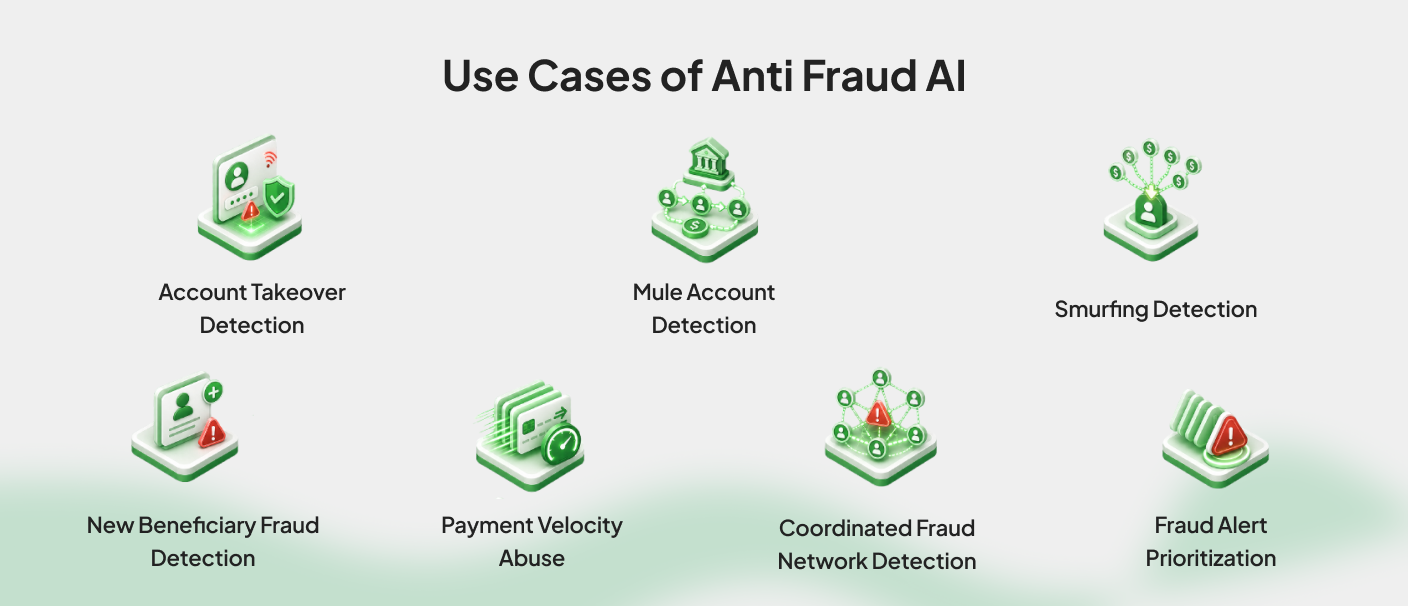
Use Cases of Anti Fraud AI
1. Account Takeover Detection
Account takeover occurs when a fraudster gains control of a genuine customer account.
Anti fraud AI can identify signals such as:
- New device login
- Password reset
- Unusual location
- New beneficiary
- High-value payment
- Abnormal login time
- Multiple failed authentication attempts
When several signals appear together, the transaction can be flagged for stronger authentication or review.
2. Mule Account Detection
Mule accounts are used to receive and transfer fraudulent funds.
AI can identify:
- Multiple incoming payments
- Rapid outgoing transfers
- Low balance retention
- Common beneficiaries
- Fan-in and fan-out patterns
- Similar behavior across connected accounts
Individual mule transactions may look normal, but the wider account network can reveal the risk.
3. Smurfing Detection
Smurfing involves splitting a large amount into several smaller transactions to avoid thresholds.
Anti fraud AI can detect repeated small payments, linked accounts, unusual timing, and beneficiary relationships.
4. New Beneficiary Fraud Detection
A payment to a new beneficiary is not automatically fraudulent.
However, risk increases when it appears with:
- New device
- High transaction value
- Unusual location
- Recent password change
- Multiple failed attempts
- Different customer behavior
AI helps evaluate the full context instead of blocking every new beneficiary.
5. Payment Velocity Abuse
Fraudsters may attempt many transactions in a short time.
AI can identify unusual transaction frequency based on the customer’s normal activity rather than using only one universal threshold.
6. Coordinated Fraud Network Detection
Some fraud involves multiple accounts, devices, identities, and beneficiaries.
AI can identify:
- Shared devices
- Common beneficiaries
- Similar transaction sequences
- Repeated fund movement paths
- Linked identity patterns
7. Fraud Alert Prioritization
Fraud teams often receive more alerts than they can review immediately.
Anti fraud AI helps prioritize alerts so analysts can focus first on cases with the strongest risk signals.
Benefits of Anti Fraud AI
Detects New Fraud Patterns
AI can identify unusual behavior even when there is no existing fraud rule for it.
This helps teams detect emerging threats.
Supports False Positive Reduction
Contextual analysis helps separate genuine customer activity from suspicious behavior.
This reduces unnecessary transaction blocks and manual reviews.
Enables Faster Fraud Decisions
Real-time scoring helps teams make faster pass, flag, hold, or block decisions.
Improves Analyst Productivity
Fraud analysts can focus on higher-risk cases instead of reviewing every weak alert.
Protects Customer Experience
Genuine customers face less unnecessary friction when the system evaluates multiple signals instead of using overly broad rules.
Provides Better Fraud Visibility
Teams can see which behaviors, devices, accounts, and fraud typologies are generating risk.
Improves Over Time
Analyst feedback and confirmed fraud outcomes can improve future scoring and alert prioritization.
Common Challenges in Anti Fraud AI
Poor Data Quality
Missing or inconsistent data can reduce the accuracy of AI fraud detection.
Reliable transaction, account, device, and customer data is necessary.
Black-Box Decisions
A fraud score without an explanation is difficult for analysts to trust.
Every alert should include clear supporting signals.
Model Drift
Customer behavior and fraud techniques change over time.
Models, rules, and thresholds must be monitored and updated regularly.
Too Much Automation
Fully automating every decision can create unnecessary risk.
High-risk and uncertain cases may still require human review.
Biased Historical Data
If previous analyst decisions were inconsistent, the AI may learn those inconsistencies.
Historical data should be reviewed carefully.
Ignoring Rule-Based Controls
AI alone is not enough.
Rules remain useful for regulatory thresholds, known fraud indicators, sanctions matches, and business policies.
Missing Analyst Feedback
Without analyst feedback, the system cannot learn which alerts were valuable and which were false positives.
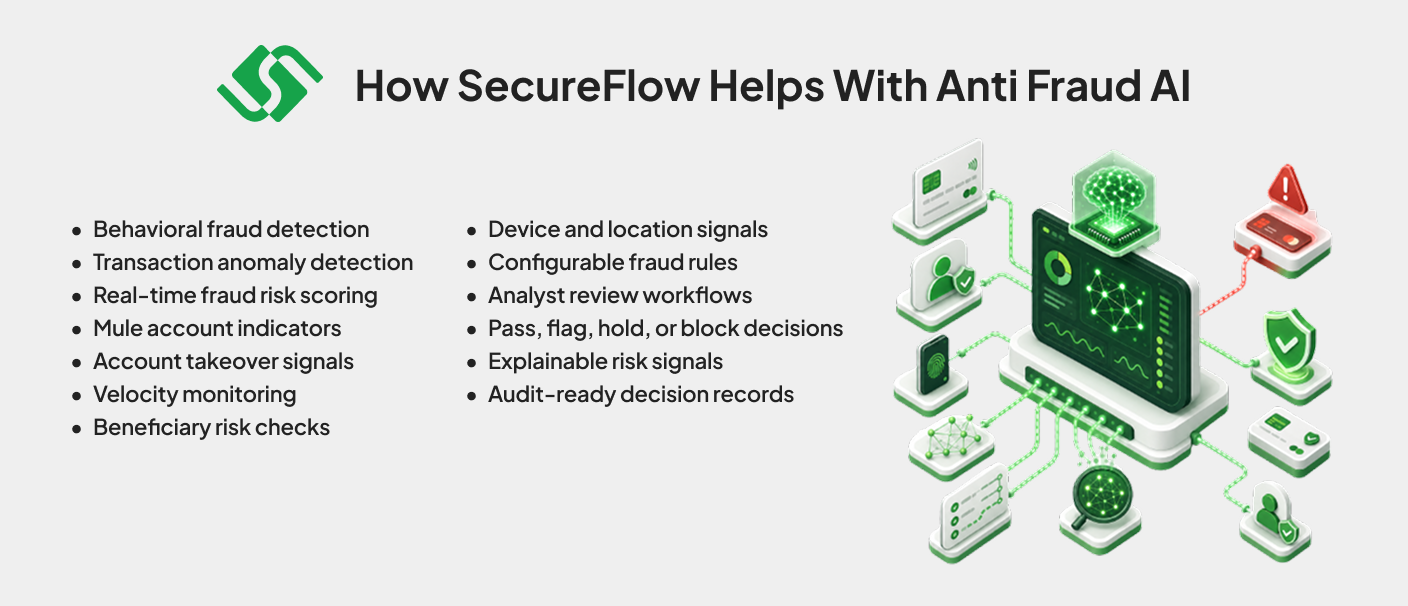
How SecureFlow Helps With Anti Fraud AI
SecureFlow by Cloudastra helps fintech companies, banks, NBFCs, and payment platforms combine anti fraud AI with configurable transaction rules and human review.
SecureFlow supports:
- Behavioral fraud detection
- Transaction anomaly detection
- Real-time fraud risk scoring
- Mule account indicators
- Account takeover signals
- Velocity monitoring
- Beneficiary risk checks
- Device and location signals
- Configurable fraud rules
- Analyst review workflows
- Pass, flag, hold, or block decisions
- Explainable risk signals
- Audit-ready decision records
Instead of depending only on static rules, SecureFlow helps teams evaluate transaction risk using broader behavioral and payment context.
This allows fintech risk teams to identify evolving fraud patterns, prioritize meaningful alerts, and reduce unnecessary friction for genuine customers.
Who Should Use SecureFlow?
SecureFlow is useful for:
- Fintech companies
- Banks
- NBFCs
- Payment gateways
- Payment aggregators
- Digital lenders
- Wallet providers
- Neobanks
- Embedded finance platforms
- Cross-border payment providers
- Fraud operations teams
- Risk teams
- Compliance teams
- Transaction monitoring teams
It is especially useful for organizations processing high transaction volumes that need stronger fraud detection and false positive reduction.
Want to explore more practical insights on AI development, automation, and conversational AI? Read more blogs at Cloudastra Technologies or contact us for business enquiries through Cloudastra Contact Us.
FAQs
1. What is anti fraud AI?
Anti fraud AI uses artificial intelligence and machine learning to analyze transactions, customers, devices, accounts, and behavioral patterns for signs of suspicious activity.
2. Why do fintech companies need anti fraud AI?
Fintech companies need anti fraud AI because fixed rules and manual reviews may not identify new or complex fraud patterns in real time.
3. How is AI fraud detection different from rule-based detection?
Rule-based fraud detection checks fixed conditions. AI fraud detection evaluates behavioral patterns, anomalies, relationships, and transaction context.
4. Can anti fraud AI reduce false positives?
Yes. Anti fraud AI supports false positive reduction by combining several signals and comparing transactions with the customer’s normal behavior.
5. What is behavioral fraud detection?
Behavioral fraud detection identifies unusual changes in how a customer logs in, uses devices, adds beneficiaries, and completes transactions.
6. What is transaction anomaly detection?
Transaction anomaly detection identifies payments or account activity that differ significantly from expected behavior.
7. Does anti fraud AI replace fraud analysts?
No. AI helps detect and prioritize risk, while analysts review uncertain, sensitive, and high-impact cases.
8. How does SecureFlow support anti fraud AI?
SecureFlow combines behavioral signals, transaction anomalies, configurable rules, real-time risk scoring, analyst review, and explainable decisions to help fintech teams detect fraud faster