AI for B2B Lead Generation: How to Build a Better Pipeline with AI-Powered Prospecting
AI for B2B lead generation helps companies identify the right accounts, detect buying signals, research decision-makers, personalize outreach, score leads, and hand qualified opportunities to sales faster.
For B2B companies, the problem is not just finding more leads. The real challenge is finding the right buyers at the right time with the right message. Manual prospecting takes too much time, generic outreach gets ignored, and poor lead quality wastes sales effort. AI-powered B2B lead generation solves this by turning prospecting into a structured system built around data, intent signals, personalization, and fast sales follow-up.
That is why modern B2B teams use AI lead generation systems to reduce manual research, improve lead quality, personalize outreach at scale, and build a more predictable pipeline.
What Problem Does AI for B2B Lead Generation Solve?
Most B2B lead generation fails because teams focus on volume before quality.
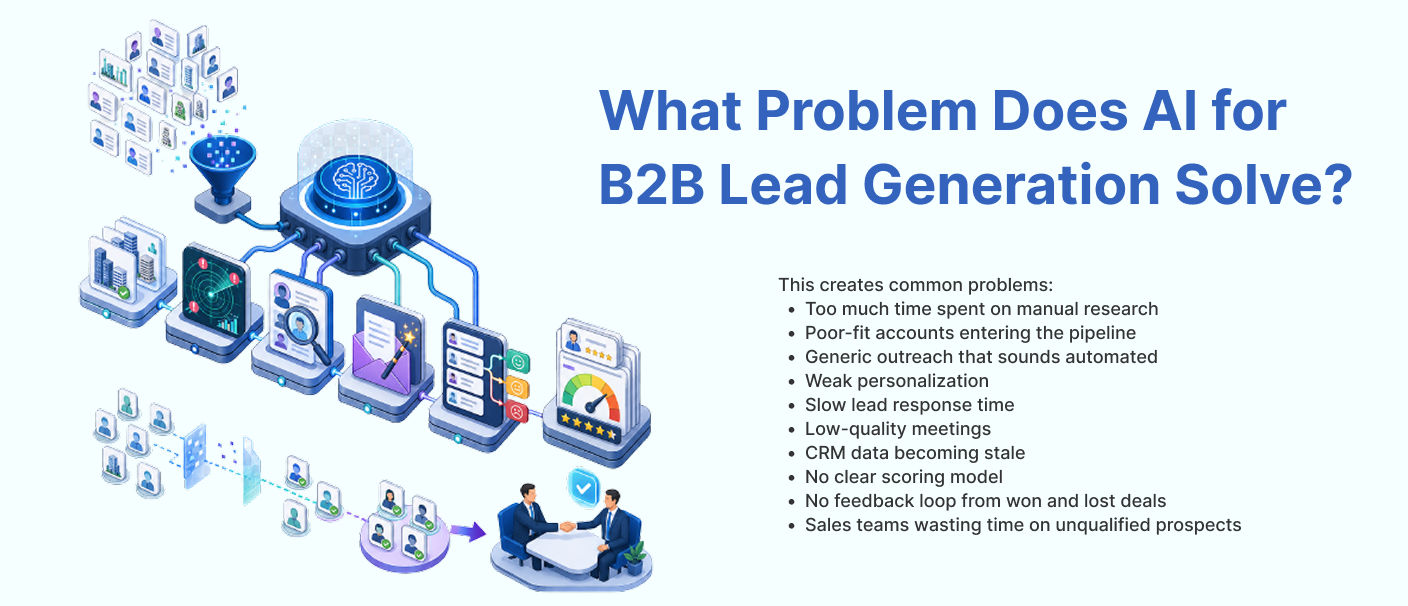
Sales and marketing teams often buy lists, scrape contacts, send generic emails, and hope a small percentage responds. This creates low reply rates, weak meetings, poor sender reputation, and wasted sales time.
The bigger issue is that human prospecting does not scale well. A sales rep may need to research accounts, check LinkedIn, review company websites, find contacts, verify emails, write personalized messages, update the CRM, track replies, and follow up manually.
This creates common problems:
- Too much time spent on manual research
- Poor-fit accounts entering the pipeline
- Generic outreach that sounds automated
- Weak personalization
- Slow lead response time
- Low-quality meetings
- CRM data becoming stale
- No clear scoring model
- No feedback loop from won and lost deals
- Sales teams wasting time on unqualified prospects
AI for B2B lead generation solves this by using AI systems to identify better-fit accounts, detect buying signals, research contacts, personalize outreach, classify replies, and score leads before sales spends time on them.
The goal is not to send more emails blindly. The goal is to build a smarter lead generation system that produces better-qualified conversations.
What Is AI for B2B Lead Generation?
AI for B2B lead generation means using AI models, automation tools, data enrichment, intent signals, and agent systems to find, qualify, research, and engage potential business buyers.
It can support the full lead generation workflow, including:
- Ideal customer profile analysis
- Account identification
- Intent signal tracking
- Contact research
- Lead enrichment
- Outreach personalization
- Multi-channel sequencing
- Reply classification
- Lead scoring
- CRM updates
- Sales handoff
- Pipeline reporting
In simple terms, AI for B2B lead generation helps teams answer practical questions like:
- Which companies match our ICP?
- Which accounts are showing buying intent?
- Who is the right decision-maker?
- What should we say to this prospect?
- Which leads should sales contact first?
- Which replies need human follow-up immediately?
- Which accounts should enter nurture?
- What signals predict closed-won deals?
- How do we improve lead quality over time?
This is different from buying a static lead list. A lead list gives contact data. AI-powered B2B lead generation builds a live system that uses signals, context, scoring, and feedback to improve pipeline quality.
Why B2B Companies Need AI Lead Generation
B2B companies need AI lead generation because buyers are harder to reach and generic outreach no longer works.
Decision-makers receive too many cold emails, LinkedIn messages, and sales pitches. If the message is generic, it gets ignored. If the company is not in-market, the timing is wrong. If the lead is not qualified, the sales call becomes a waste of time.
AI helps by improving three things: targeting, timing, and personalization.
Targeting improves because AI can analyze firmographic, technographic, hiring, funding, website, and CRM data to identify accounts that look similar to good customers.
Timing improves because AI can track signals such as website visits, funding events, job postings, technology changes, content engagement, and category intent.
Personalization improves because AI can research the account and contact, then create outreach based on real context instead of using the same template for everyone.
For B2B teams, this means fewer low-quality touches and more relevant conversations.
How Big Is the Opportunity in AI-Powered B2B Lead Generation?
The opportunity is strong because sales and marketing teams spend a large share of time on work that can be partially automated.
The uploaded Cloudastra playbook explains that manual prospecting can consume 60–70% of sales and marketing team capacity, especially when teams rely on manual research, contact enrichment, list building, CRM updates, and outreach preparation.
The same playbook also shows what good AI lead generation can look like in a B2B SaaS context:
- 200–500 ICP-matching accounts identified and scored per month
- 80–150 contacts researched and enriched per month
- 60–120 personalized first touches per month across email and LinkedIn
- 6–12% reply rate for well-personalized sequences with strong ICP fit
- 3–6% positive reply rate
- 40–60% meeting booking rate from positive replies
- 4–10 outbound meetings booked per month at this volume
- $300–$800 cost per meeting booked, compared with higher manual SDR costs
These numbers show why AI lead generation is valuable. The goal is not to create a spam machine. The goal is to improve the quality, relevance, timing, and follow-up speed of B2B prospecting.
The 5 Stages of AI-Powered B2B Lead Generation
1. ICP Definition and Account Identification
Every AI lead generation system should start with a precise Ideal Customer Profile.
A weak ICP creates weak outreach. If the system targets the wrong companies, even the best personalization will not create pipeline.
A strong ICP should include:
- Industry
- Company size
- Revenue range
- Geography
- Funding stage
- Technology stack
- Team size
- Hiring signals
- Pain points
- Buyer roles
- Trigger events
- Existing customer patterns
AI can help by analyzing closed-won, closed-lost, churned, and expansion accounts inside the CRM. This helps identify patterns that are not obvious from gut feeling alone.
For example, AI may find that the best customers are not simply “B2B SaaS companies with 50–500 employees,” but companies with a specific tech stack, hiring pattern, recent funding signal, and clear operational pain.
This creates a scored ICP that helps sales and marketing teams prioritize better accounts.
2. Intent Signal Detection and Prioritization
Not every ICP-fit account is ready to buy.
Intent signals help identify which accounts are more likely to be in-market now.
AI can track and combine different types of intent signals, such as:
- Website visits
- Pricing page views
- Content downloads
- Webinar attendance
- Funding events
- Hiring activity
- Job postings
- Technology stack changes
- Competitor tool replacement
- Category research
- LinkedIn activity
- Email engagement
The AI layer combines these signals into a composite account score.
This helps teams avoid treating all accounts the same. A company that visited your pricing page three times in a week is not the same as a company that only matches your industry filter.
First-party intent signals, such as website engagement and direct content interaction, should usually be weighted higher than third-party signals because they show direct interest in your business.
3. Contact Research and Personalization
Once the right account is identified, the next step is finding the right person.
AI can help research the contact’s role, LinkedIn profile, recent activity, company context, department priorities, and likely pain points.
Good contact research may include:
- Current role
- Seniority
- Tenure
- Previous companies
- Recent posts or activity
- Company announcements
- Hiring plans
- Funding news
- Product launches
- Technology changes
- Relevant business pain
This research becomes the base for personalized outreach.
The goal is not fake personalization like “I saw your company is growing.” The goal is specific, timely context.
For example, if a company recently raised funding and is hiring a revenue operations team, outreach can speak directly to scaling pipeline systems, not generic growth.
This is where AI can help produce personalized messages faster, but human review is still important to keep the tone natural and avoid robotic copy.
4. Multi-Channel Outreach and Sequence Execution
B2B lead generation works better when outreach is coordinated across channels.
A typical sequence may include:
- Email on day 1
- LinkedIn connection on day 3
- Follow-up email on day 7
- LinkedIn message on day 10
- Final email on day 18
AI can help tailor each touchpoint to the channel.
Emails can include more context and a clear call to action. LinkedIn messages should be shorter, more conversational, and less formal.
AI can also support:
- Follow-up writing
- Reply classification
- Out-of-office handling
- Sequence timing adjustments
- Prospect engagement tracking
- CRM activity logging
- Drafting responses for human review
The important rule is this: AI can assist the reply flow, but a human should handle warm replies quickly.
A warm reply is the most valuable moment in outbound. If the prospect asks a question or shows interest, the system should route that reply to a human immediately.
5. Lead Scoring and Handoff to Sales
Not every reply is equal.
A lead scoring model helps decide which leads should move to sales, which should stay in nurture, and which should be disqualified.
A good AI lead scoring model can consider:
- ICP fit
- Intent strength
- Recency of signal
- Engagement level
- Reply sentiment
- Company size
- Role relevance
- Website activity
- Email engagement
- CRM history
- Deal similarity
- Sales cycle stage
The sales handoff is where many AI lead generation systems fail.
They generate replies, but they do not have a clean process for getting a human into the conversation fast. If a prospect replies with interest and waits hours for a response, conversion drops.
A strong AI SDR system should route warm replies immediately, create CRM tasks, notify the right person, and include context so sales can respond without starting from zero.
AI Lead Generation Tool Stack in 2026
A practical AI lead generation system usually includes several tools working together.
ICP and Account Research Tools
These tools help identify companies that match the target customer profile.
Common tools include:
- Clay
- Apollo
- Clearbit
- LinkedIn Sales Navigator
- BuiltWith
- Datanyze
They help collect firmographic, technographic, and account-level data.
Intent Signal Tools
Intent tools help identify accounts that may be actively researching or preparing to buy.
Common sources include:
- Bombora
- 6sense
- G2 Buyer Intent
- TechTarget
- Website visitor identification tools
- Funding alert tools
- Job posting monitoring tools
For early-stage companies, paid intent tools may be too expensive at first. Lower-cost signals such as job postings, funding alerts, website engagement, and LinkedIn activity can be a better starting point.
Contact Research and Enrichment Tools
These tools help find the right people and enrich contact details.
They may include:
- Apollo
- Clearbit
- Clay
- LinkedIn Sales Navigator
- People databases
- Email verification tools
AI can then use this data to prepare account summaries, lead briefs, and personalized outreach.
Outreach Execution Tools
These tools help send and manage outreach sequences.
Common tools include:
- Instantly
- Outreach
- Salesloft
- Lemlist
- HubSpot sequences
The outreach tool should connect with CRM activity, reply tracking, unsubscribe handling, and deliverability controls.
CRM and Lead Scoring Tools
A CRM is needed to track accounts, contacts, activity, lead scores, replies, meetings, and sales outcomes.
Common tools include:
- HubSpot
- Salesforce
- Pipedrive
- Zoho CRM
AI lead scoring can be built inside the CRM or through a custom layer connected to CRM data.
AI Layer and Custom Workflow Automation
The AI layer connects research, scoring, personalization, reply classification, and sales handoff.
This may include:
- LLM-based personalization
- Reply classification
- Lead scoring model
- CRM update automation
- AI SDR workflow
- Human review queue
- Reporting dashboard
- Feedback loop from sales outcomes
This layer is what turns disconnected tools into a real B2B lead generation automation system.
What Good AI Lead Generation Looks Like
A good AI lead generation system is not judged by how many emails it sends.
It is judged by lead quality, meeting quality, conversion rate, and pipeline impact.
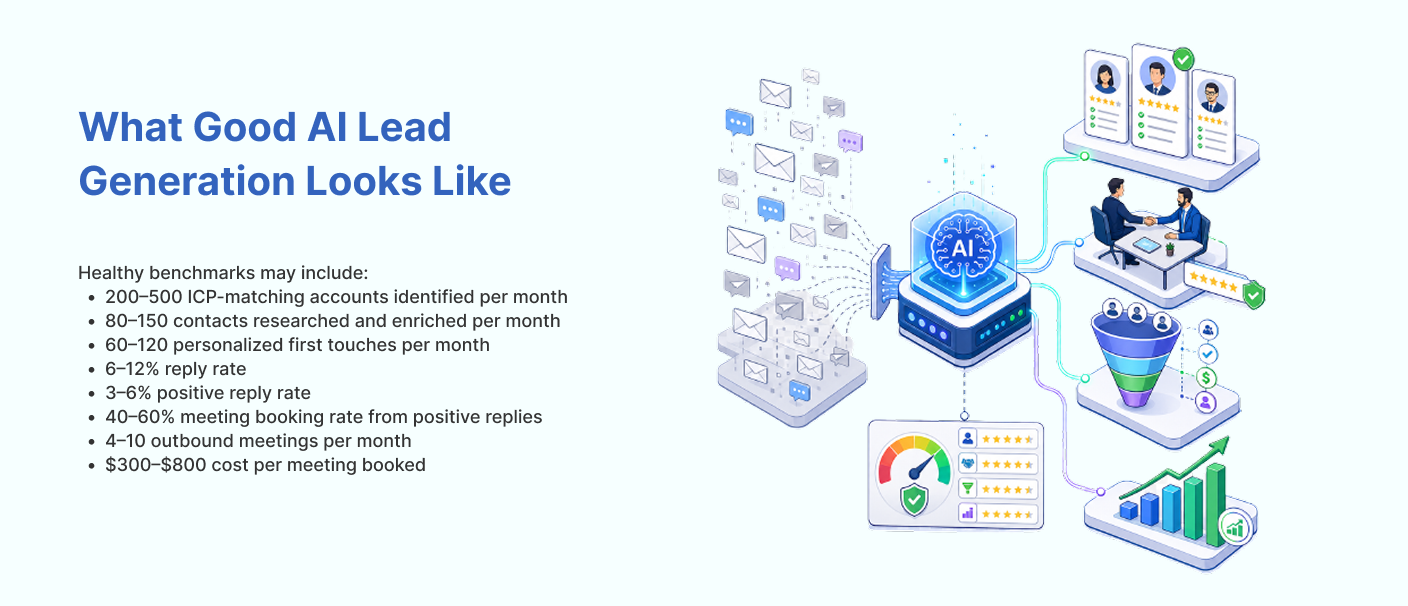
Healthy benchmarks may include:
- 200–500 ICP-matching accounts identified per month
- 80–150 contacts researched and enriched per month
- 60–120 personalized first touches per month
- 6–12% reply rate
- 3–6% positive reply rate
- 40–60% meeting booking rate from positive replies
- 4–10 outbound meetings per month
- $300–$800 cost per meeting booked
The most important metrics are:
- ICP match rate
- Positive reply rate
- Meeting booking rate
- Meeting quality
- Sales acceptance rate
- Pipeline created
- Closed-won conversion
- Cost per qualified meeting
- Sender reputation
- Unsubscribe and complaint rate
A system that sends 10,000 generic emails and creates weak calls is not working. A system that sends fewer, better-researched messages and creates qualified meetings is much stronger.
Common Failures in AI Lead Generation
1. Volume Without Quality Gates
The biggest mistake is using AI to send more bad emails faster.
High-volume outreach to weak-fit accounts damages sender reputation, increases spam complaints, and fills the pipeline with poor conversations.
AI should improve targeting and personalization first. Volume should come later.
2. No Human in the Reply Flow
Fully automated replies can fail when a prospect asks a specific question, raises an objection, or wants a real conversation.
Warm replies should go to a human quickly.
AI can classify replies, draft suggested responses, and summarize context, but a human should manage important buyer conversations.
3. Treating All Intent Signals Equally
Not all signals have the same value.
A pricing page visit is stronger than a broad third-party content signal. A reply to outreach is stronger than a job posting. A product demo page visit is stronger than a generic blog view.
Lead scoring should weight signals based on their actual relationship to conversion.
4. No Feedback Loop From Closed-Won and Closed-Lost Deals
Lead scoring gets weaker if it is never updated.
The AI system should learn from sales outcomes. Closed-won, closed-lost, no-show, and disqualified deals should feed back into the scoring model.
This helps the system improve over time and avoid repeating the same targeting mistakes.
AI Lead Generation for Different Company Stages
Early-Stage Startups
Early-stage startups should not start with expensive intent data platforms.
They should begin with a lightweight system using tools like Clay, LinkedIn Sales Navigator, Apollo, Instantly, and HubSpot or Pipedrive.
The focus should be on:
- Clear ICP
- 30–50 high-quality accounts
- Deep research
- Personalized outreach
- Manual review of messages
- Fast founder or sales follow-up
At this stage, quality matters more than volume.
Series A and Growth-Stage Companies
Growth-stage companies can use more advanced AI-powered B2B lead generation systems.
They usually have more CRM data, clearer ICPs, and enough deal history to train scoring models.
The focus should be on:
- Intent data
- Account scoring
- Multi-channel outreach
- CRM automation
- AI SDR workflows
- Reply classification
- Sales handoff speed
- Pipeline reporting
This stage is where AI can help scale outbound without adding the same number of SDRs.
SMBs and Service Companies
SMBs and service companies should use AI lead generation to reduce manual research and improve outreach quality.
The best setup may include:
- ICP account lists
- Contact enrichment
- Founder-led or sales-led messaging
- AI-assisted personalization
- CRM hygiene
- LinkedIn and email coordination
- Human follow-up
For SMBs, the goal is not massive outbound volume. The goal is to create consistent qualified conversations every month.
Established B2B Companies
Established B2B companies can use AI lead generation across inbound, outbound, account-based marketing, and sales operations.
The focus should be on:
- Intent signal scoring
- Website visitor identification
- Account-based outreach
- Lead routing
- AI-powered nurturing
- CRM data enrichment
- Closed-won feedback loops
- Sales productivity dashboards
For larger companies, AI lead generation works best when marketing, sales, RevOps, and CRM systems are aligned.
Can AI Lead Generation Work Without Cold Outreach?
Yes. AI lead generation can also work through inbound.
An inbound AI lead generation system may include:
- SEO content targeting commercial queries
- AI-optimized content for search and answer engines
- Website visitor identification
- AI-personalized CTAs
- Lead capture optimization
- Inbound lead scoring
- Chat-based qualification
- Automated nurture sequences
- CRM routing
This is useful for companies that do not want to rely only on cold outbound.
The strongest B2B systems often combine inbound and outbound. Content creates demand, while AI SDR workflows identify and engage high-fit accounts directly.
How to Implement AI for B2B Lead Generation
Phase 1: Define the ICP and Signals
Start by defining the exact customer profile and buying signals.
Clarify:
- Who is the target account?
- Which industries matter?
- What company size is ideal?
- Which job titles are decision-makers?
- What trigger events show buying intent?
- Which existing customers are the best pattern to copy?
- Which accounts should be excluded?
This phase prevents AI from targeting the wrong accounts.
Phase 2: Build the Research and Data Layer
Next, set up tools for account research, contact enrichment, intent signals, and CRM updates.
This layer should collect:
- Company data
- Contact data
- Job postings
- Funding events
- Website engagement
- Tech stack information
- LinkedIn context
- CRM history
The data layer is the foundation of the system. Bad data leads to bad outreach.
Phase 3: Create Personalization and Outreach Workflows
Once accounts and contacts are researched, build the outreach workflow.
This includes:
- Email sequence structure
- LinkedIn touchpoints
- Personalization prompts
- Message review rules
- Follow-up timing
- Reply classification
- Unsubscribe handling
- CRM logging
The goal is to create messages that are specific, relevant, and natural.
AI can write first drafts, but humans should review early campaigns until quality is proven.
Phase 4: Add Lead Scoring and Sales Handoff
After outreach begins, add lead scoring and handoff workflows.
The system should classify:
- Positive replies
- Neutral replies
- Negative replies
- Out-of-office replies
- Questions
- Unsubscribes
- High-intent website visits
- Warm accounts
Warm leads should be routed to sales quickly with full context.
A good handoff includes:
- Account summary
- Contact role
- Reason for outreach
- Intent signals
- Engagement history
- Suggested next step
Phase 5: Measure and Improve
AI lead generation needs continuous improvement.
Track:
- Reply rate
- Positive reply rate
- Meeting booking rate
- Meeting quality
- No-show rate
- Sales acceptance rate
- Pipeline created
- Closed-won deals
- Sender reputation
- Unsubscribe rate
- Spam complaints
Use closed-won and closed-lost data to improve ICP scoring, message quality, and signal weighting.
This feedback loop is what separates a real AI lead generation system from a one-time outreach campaign.
What Features Should an AI B2B Lead Generation System Have?
A strong AI lead generation system should include:
- ICP scoring
- Account identification
- Intent signal tracking
- Contact enrichment
- Email verification
- AI-powered research
- Outreach personalization
- Multi-channel sequencing
- Reply classification
- CRM integration
- Lead scoring
- Sales handoff alerts
- Human review workflow
- Deliverability controls
- Unsubscribe handling
- Closed-won feedback loop
- Reporting dashboard
These features help teams keep quality high while increasing output.
How Cloudastra Helps Build AI Lead Generation Systems
Cloudastra helps B2B companies design and implement AI-powered lead generation systems from ICP definition to sales handoff.
Companies looking to build customized AI-powered lead generation workflows can explore AI Development Services to create intelligent automation, AI agents, data-driven systems, and business integrations.
Cloudastra’s AI Growth Engine approach can help with:
- ICP analysis
- Account identification
- Intent signal tracking
- Lead enrichment
- AI-powered research
- Personalized outreach workflows
- AI SDR system setup
- CRM integration
- Lead scoring models
- Reply classification
- Sales handoff workflows
- Reporting dashboards
- Closed-won feedback loops
Instead of simply adding one AI tool, Cloudastra helps build the complete system: data, AI workflows, automation, CRM integration, human review, and measurement.
This is useful for startups, SMBs, SaaS companies, agencies, and B2B teams that want a more predictable pipeline without adding large SDR headcount.
Who Should Use AI for B2B Lead Generation?
AI for B2B lead generation is useful for:
- B2B SaaS companies
- Startups
- SMBs
- Service companies
- Agencies
- RevOps teams
- Sales teams
- Marketing teams
- Founders doing outbound
- Companies with a clear ICP
- Teams with CRM data
- Businesses selling to specific industries
- Companies that need more qualified meetings
It is especially useful when sales teams are spending too much time on research, enrichment, personalization, CRM updates, and manual follow-up.
Companies looking to build customized AI-powered lead generation workflows can explore AI-First Engineering solutions.
Businesses looking to improve their B2B sales and marketing workflows can explore Cloudastra Technologies and learn more about AI-powered automation and intelligent business systems.
FAQs
1. What is AI for B2B lead generation?
AI for B2B lead generation means using AI tools, data enrichment, intent signals, and automated agent systems to identify, qualify, research, personalize outreach, score, and hand off potential buyers to sales.
2. How is AI lead generation different from buying a lead list?
Buying a lead list gives static contact data. AI lead generation builds a dynamic pipeline using ICP fit, intent signals, account research, personalization, engagement tracking, and lead scoring.
3. Is AI lead generation compliant with GDPR and CAN-SPAM?
AI lead generation can be compliant if implemented properly. Teams need lawful data sources, clear unsubscribe options, sender identification, a physical business address in emails, and proper handling of personal data.
4. Can AI generate leads without cold outreach?
Yes. AI can support inbound lead generation through SEO content, website visitor identification, AI-personalized CTAs, inbound lead scoring, chat qualification, and automated nurture workflows.
5. How long does it take to set up an AI lead generation system?
A lightweight AI outbound system can be set up in 2–3 weeks. A full-stack system with intent data, ML scoring, CRM integration, and feedback loops may take 6–10 weeks plus additional time to optimize.
6. What is the ROI timeline for AI lead generation?
First meetings from outbound may appear in weeks 3–6. Full ROI usually depends on the sales cycle, deal size, close rate, and system cost. Many B2B teams evaluate results over a 4–8 month window.
7. How does AI lead generation integrate with CRM?
AI lead generation integrates with CRMs such as HubSpot, Salesforce, or Pipedrive by pushing enriched contact data, logging outreach activity, updating lead scores, tracking replies, and creating sales handoff tasks.
8. How does Cloudastra help with AI-powered B2B lead generation?
Cloudastra helps companies build AI-powered lead generation systems covering ICP definition, tool selection, intent signals, contact research, outreach personalization, CRM integration, lead scoring, and sales handoff workflows.