UPI fraud detection helps banks, fintech companies, NBFCs, and payment platforms identify suspicious transactions, risky accounts, mule activity, and unusual payment behaviour before financial losses increase.
For financial institutions, the problem is not only detecting a fraudulent payment. The bigger challenge is identifying risk while the transaction is still active. UPI payments happen quickly, which gives fraud teams very little time to review account activity, beneficiary behaviour, payment velocity, and other warning signals.
That is why banks and fintech companies need real-time UPI fraud detection. It helps risk teams monitor payment activity, score transaction risk, flag unusual behaviour, and decide whether a payment should pass, be reviewed, or be blocked before funds move.
What Problem Does UPI Fraud Detection Solve?
Banks and fintech companies face one major challenge: they need to keep UPI payments fast without allowing fraud to move through the system faster than their risk teams can detect it.
A suspicious payment may be completed within seconds. A fraudster may take control of a customer account, add a new beneficiary, and transfer money before the customer notices. Mule accounts may receive funds from several users and transfer the money to other accounts immediately.
When fraud monitoring is manual or delayed, suspicious transactions may be identified only after settlement.
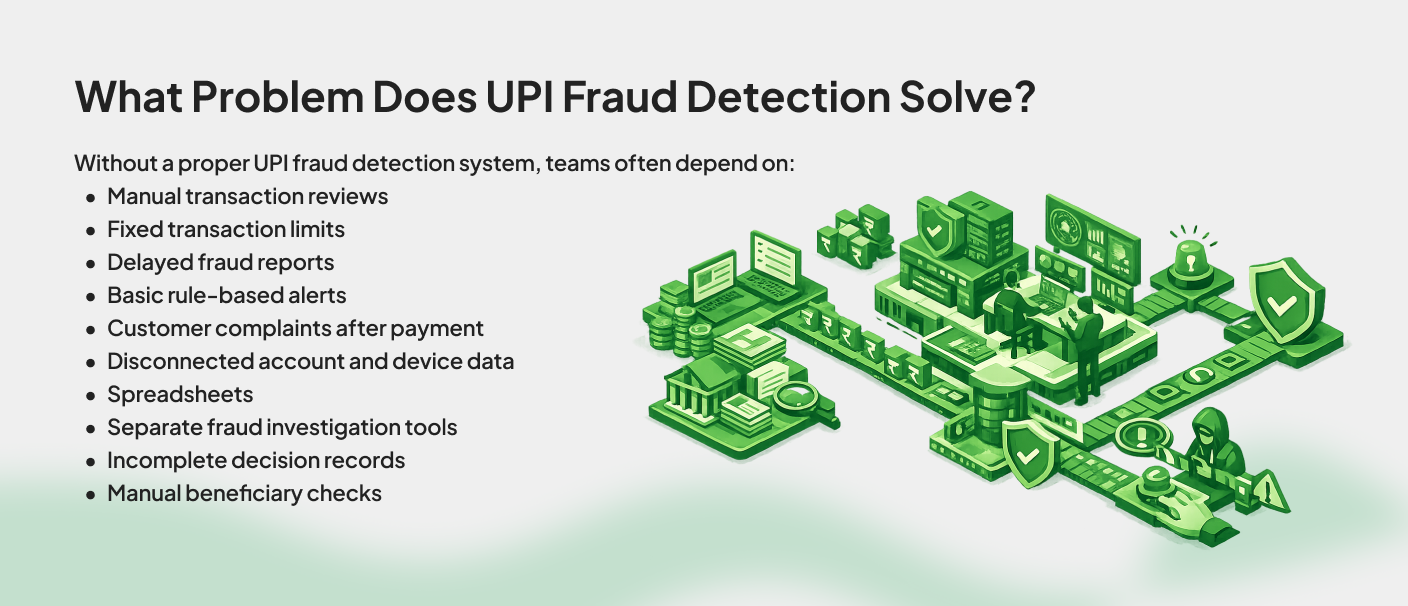
Without a proper UPI fraud detection system, teams often depend on:
- Manual transaction reviews
- Fixed transaction limits
- Delayed fraud reports
- Basic rule-based alerts
- Customer complaints after payment
- Disconnected account and device data
- Spreadsheets
- Separate fraud investigation tools
- Incomplete decision records
- Manual beneficiary checks
These methods may work when payment volume is low. However, they become difficult to manage when a bank or fintech company processes thousands or millions of UPI transactions.
UPI fraud detection solves this by helping teams evaluate transaction risk in real time, identify suspicious patterns, and take action while the payment can still be stopped.
What Is UPI Fraud Detection?
UPI fraud detection is the process of monitoring UPI transactions, customer accounts, devices, beneficiaries, and payment behaviour to identify activity that may indicate fraud.
It helps financial institutions examine every payment using signals such as:
- Transaction amount
- Transaction time
- Sender account
- Beneficiary account
- Payment frequency
- Customer transaction history
- Device information
- IP address
- Customer location
- Account age
- New beneficiary activity
- Previous failed attempts
- Linked-account behaviour
- Mule account indicators
- Payment velocity
- Previous fraud alerts
- Sanctions or watchlist exposure
The system uses these signals to decide whether a payment should:
- Pass
- Be flagged
- Be held
- Be blocked
- Be sent for manual review
- Require additional authentication
- Be escalated to a fraud analyst
In simple terms, UPI fraud detection helps fraud and risk teams answer practical questions such as:
- Is this payment normal for the customer?
- Is the beneficiary linked to suspicious activity?
- Is the transaction value unusual?
- Is the customer using a new device?
- Are too many payments happening within a short period?
- Does the transaction show signs of account takeover?
- Should this payment pass, be flagged, or be blocked?
- Can we explain why the payment was stopped?
- Can we prove the decision during an investigation or audit?
For banks and fintech companies, UPI fraud detection is not only a security tool. It is a real-time payment risk control system.
Why Do Banks and Fintechs Need UPI Fraud Detection?
Banks and fintech companies need UPI fraud detection because digital payments are instant, high-volume, and available throughout the day.
Customers expect fast transactions and a smooth payment experience. They do not want every payment to be delayed by manual reviews or unnecessary verification.
Fraudsters use the same speed to their advantage.
They may use stolen credentials, compromised devices, fake payment requests, mule accounts, social-engineering scams, and linked accounts to move money before fraud teams can react.
When UPI fraud checks are delayed, several problems can occur:
- Suspicious payments may settle before investigation
- Mule accounts may remain active
- Fraudsters may transfer money through several accounts
- Customers may report fraud only after the loss
- Analysts may receive too many low-quality alerts
- Genuine payments may be blocked by broad rules
- High-risk transactions may not be prioritised
- Fraud decisions may be difficult to explain
- Investigation records may remain incomplete
- Recovery may become difficult after funds move
Real-time UPI fraud detection reduces these gaps by monitoring transaction activity, combining risk signals, and returning a decision before the payment is completed.
The goal is not to block every unusual payment. The goal is to stop genuinely suspicious transactions while allowing legitimate customers to continue using UPI without unnecessary friction.
Why Is UPI Fraud Difficult to Detect?
UPI fraud is difficult to detect because a suspicious transaction may look normal when reviewed on its own.
For example, a customer may legitimately:
- Use a new device
- Make a high-value payment
- Add a new beneficiary
- Complete a transaction at an unusual time
- Make several payments within a short period
- Transact from a different location
None of these actions automatically means fraud.
The risk becomes clearer when several warning signals appear together.
For example:
- New device
- Recent password reset
- New beneficiary
- Unusual location
- High-value payment
Together, these signals may indicate account takeover.
Another example may include:
- Multiple incoming payments
- Different sender accounts
- Rapid outgoing transfers
- Low balance retention
- Repeated payments to linked beneficiaries
Together, these signals may indicate mule account activity.
This is why banks and fintechs cannot depend only on single-transaction rules. They need a system that evaluates the complete payment context.
Common Types of UPI Fraud
1. Account Takeover
Account takeover happens when a fraudster gains access to a genuine customer’s bank account or payment application.
The customer profile may appear legitimate because the account already exists and may have a clean transaction history.
Possible account takeover signals include:
- Login from a new device
- Sudden password or PIN reset
- Multiple failed authentication attempts
- Unusual location
- New beneficiary addition
- High-value payment after account changes
- Sudden change in payment behaviour
- Activity at an unusual time
- Several payments after a long period of inactivity
A new device alone may not be risky. However, a new device combined with a password reset, new beneficiary, and unusual payment amount may require immediate review.
2. Mule Account Activity
Mule accounts are used to receive, transfer, or hide funds linked to fraud.
Some mule accounts are created specifically for suspicious activity. Other account holders may be convinced, recruited, or paid to receive and transfer money.
Possible mule account indicators include:
- Payments received from several unrelated accounts
- Rapid incoming and outgoing transfers
- Funds transferred immediately after receipt
- Low balance retention
- Several accounts linked to the same device
- Common beneficiaries across multiple accounts
- Sudden activity in a dormant account
- Unusual fan-in and fan-out behaviour
- Repeated pass-through transactions
A single transaction may not expose mule activity.
Banks and fintechs need to evaluate the wider account network, transaction movement, and connected beneficiary patterns.
3. Payment Velocity Abuse
Payment velocity abuse happens when several transactions or payment attempts occur within a short period.
Fraudsters may use speed to move funds before an account is blocked.
Possible velocity signals include:
- Several payments within a few minutes
- Repeated failed payment attempts
- Sudden increase in transaction frequency
- Multiple payments to new beneficiaries
- Rapid transfers between linked accounts
- High activity from a newly opened account
- Several small transactions followed by a larger payment
- Repeated transactions from the same device
Velocity rules should be based on customer and account context.
A business account may naturally complete more transactions than an individual account. Applying the same limit to every user can create false positives.
4. Transaction Splitting
Transaction splitting happens when a larger amount is divided into several smaller payments.
Fraudsters may use this approach to avoid transaction limits, review thresholds, or basic monitoring rules.
Possible signals include:
- Several payments just below a configured limit
- Multiple transactions within a short period
- Similar payment values
- Repeated transfers to related beneficiaries
- Several accounts sending funds to one account
- One account distributing money to several accounts
- Repeated payment patterns across connected users
The wider transaction pattern is more important than the value of one payment.
5. New Beneficiary Fraud
Payments to new beneficiaries may carry additional risk, especially when other unusual signals appear at the same time.
The system may review:
- When the beneficiary was added
- Whether the customer regularly adds new beneficiaries
- Transaction value
- Device changes
- Customer location
- Previous failed attempts
- Account history
- Beneficiary transaction history
- Connections to previously flagged accounts
- Complaint or fraud history
Banks should not block every new-beneficiary payment.
The transaction should be reviewed using customer history, beneficiary behaviour, and other supporting risk signals.
6. Social-Engineering Scams
In some UPI fraud cases, customers are manipulated into approving the payment themselves.
Fraudsters may pretend to be:
- Bank employees
- Customer-support agents
- Government officials
- Merchants
- Delivery representatives
- Employers
- Family members
- Loan providers
- Investment advisers
Since the customer authorises the payment, normal authentication may not be enough to prevent the fraud.
However, the transaction may still show warning signs such as:
- Unusual beneficiary
- High transaction amount
- New device
- Sudden location change
- Different payment behaviour
- Multiple transfers within a short time
- Beneficiary linked to complaints
- Beneficiary connected to suspicious accounts
UPI transaction monitoring should work alongside customer awareness, payment confirmation messages, beneficiary intelligence, and strong complaint-handling processes.
How Does UPI Fraud Detection Work?
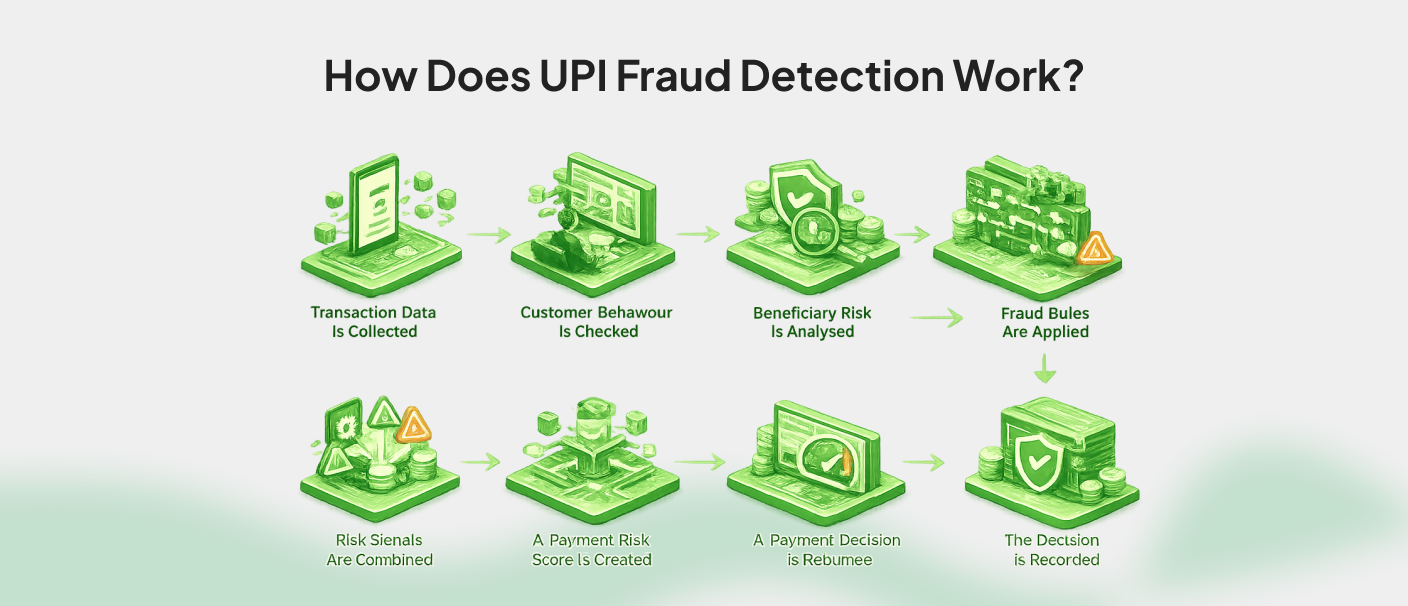
UPI fraud detection works by collecting transaction data, checking customer and beneficiary behaviour, applying fraud rules, calculating risk, and returning a payment decision.
1. Transaction Data Is Collected
The system first receives information when a UPI transaction is initiated.
This may include:
- Sender account
- Beneficiary account
- Transaction amount
- Transaction time
- Payment purpose
- Device information
- IP address
- Customer location
- Account age
- Payment application
- Previous transaction history
- Authentication activity
- Beneficiary history
This data creates the base for UPI transaction risk analysis.
The faster the system receives and processes the information, the better the chance of stopping suspicious activity before settlement.
2. Customer Behaviour Is Checked
The system compares the payment with the customer’s previous transaction behaviour.
It may ask:
- Does the customer normally make this type of payment?
- Is the transaction amount unusual?
- Is the device familiar?
- Is the beneficiary new?
- Is the payment location expected?
- Is the transaction happening at an unusual time?
- Has the customer recently changed account details?
- Has the account triggered previous fraud alerts?
- Has the account been inactive for a long period?
This behavioural context helps reduce false positives.
A transaction that is unusual for one customer may be completely normal for another.
3. Beneficiary Risk Is Analysed
UPI fraud detection should evaluate both the sender and the receiver.
The beneficiary may be checked for:
- Previous fraud alerts
- Multiple incoming payments
- Rapid outgoing transfers
- Shared devices
- Linked accounts
- Common beneficiaries
- Complaint history
- Unusual payment velocity
- Low balance retention
- Connection to known mule accounts
- Sanctions or watchlist exposure
Beneficiary monitoring is especially useful for detecting mule accounts and coordinated fraud networks.
4. Fraud Rules Are Applied
The transaction is checked against configured fraud rules.
These may include:
- High-value payment rule
- New beneficiary rule
- Device change rule
- Location anomaly rule
- Payment velocity rule
- Multiple failed-attempt rule
- Account takeover rule
- Mule account rule
- Transaction splitting rule
- Dormant account activity rule
- Sanctions rule
- Watchlist rule
Fraud rules should be configurable because fraud patterns change over time.
Risk teams should be able to adjust thresholds, conditions, and actions without depending on long development cycles.
5. Risk Signals Are Combined
A strong UPI fraud detection system does not treat every signal separately.
It combines related signals to identify possible fraud typologies.
For example:
New device + new beneficiary + high-value payment + unusual location
This may indicate account takeover.
Multiple incoming payments + rapid outgoing transfers + low balance retention
This may indicate mule account behaviour.
Repeated small payments + linked beneficiaries + unusual transaction frequency
This may indicate transaction splitting.
Combining signals helps teams detect stronger patterns and reduce unnecessary alerts.
6. A Payment Risk Score Is Created
After the signals are evaluated, the transaction receives a risk score.
It may be classified as:
- Low risk
- Medium risk
- High risk
- Critical risk
The system may also calculate separate scores for:
- Account takeover risk
- Mule account risk
- Velocity abuse risk
- Beneficiary risk
- Transaction splitting risk
- Sanctions exposure
Typology-level scoring helps fraud analysts understand why the payment is considered risky.
7. A Payment Decision Is Returned
The system returns a decision based on the risk score and the institution’s fraud policy.
The decision may be:
- Pass
- Flag
- Hold
- Block
- Escalate
- Request additional authentication
- Send for analyst review
Low-risk payments can continue without unnecessary delay.
High-risk transactions can be stopped or reviewed while action is still possible.
8. The Decision Is Recorded
Every decision should be stored with complete supporting information.
This may include:
- Transaction details
- Risk score
- Triggered rules
- Detected fraud typology
- Supporting signals
- Final payment decision
- Reviewer information
- Analyst notes
- Timestamp
- Escalation history
- Final case outcome
This creates an audit-ready decision record.
It also helps fraud teams understand which rules are working and which alerts are creating false positives.
Key Use Cases of UPI Fraud Detection
1. Real-Time Payment Monitoring
Real-time monitoring helps banks and fintechs evaluate UPI transactions while they are still active.
This is important because delayed monitoring may only identify fraud after the funds have moved.
The system can identify:
- Sudden high-value payments
- Unusual transaction frequency
- New beneficiary activity
- Device changes
- Location anomalies
- Rapid fund movement
- Repeated failed attempts
- Payments linked to risky accounts
2. Account Takeover Detection
A compromised account may show sudden changes in behaviour.
UPI fraud detection can connect signals such as:
- New device
- Password reset
- New beneficiary
- Unusual location
- High-value payment
- Failed login attempts
- Change in transaction timing
This helps teams identify possible account takeover before the payment is completed.
3. Mule Account Detection
Mule accounts may receive money from several accounts and transfer it quickly.
UPI monitoring can identify:
- Multiple incoming payments
- Rapid outgoing transfers
- Fan-in and fan-out patterns
- Shared devices
- Common beneficiaries
- Linked accounts
- Low balance retention
- Pass-through behaviour
4. Transaction Splitting Detection
Fraudsters may divide a larger payment into smaller transactions to avoid limits.
The system can monitor:
- Repeated small payments
- Similar transaction values
- Multiple payments within short intervals
- Linked beneficiaries
- Common sender or receiver patterns
- Activity just below configured thresholds
5. New Beneficiary Risk Checks
New beneficiaries can be evaluated using customer history, beneficiary behaviour, and transaction context.
A new beneficiary combined with a new device, unusual location, and high-value payment may require stronger review.
6. Fraud Alert Prioritisation
Fraud teams may receive more alerts than they can review immediately.
Risk scoring helps arrange alerts by severity so analysts can focus first on transactions with the strongest fraud indicators.
7. Customer Friction Reduction
Not every unusual payment should be blocked.
Context-based risk scoring helps banks allow low-risk payments while applying stronger checks only to suspicious transactions.
This improves both fraud control and customer experience.
Common UPI Fraud Detection Challenges
Too Many False Positives
Broad rules may flag genuine customers who use new devices, add beneficiaries, or make unusual payments.
If too many legitimate transactions are flagged, customers may face delays and fraud analysts may become overloaded.
Fraud Is Detected Too Late
If alerts are generated after settlement, the fraud team may only investigate after the money has moved.
UPI fraud monitoring needs to happen in real time or close to real time.
Transaction Data Is Scattered
Customer information, device data, transaction history, beneficiary records, and previous alerts may exist in different systems.
This makes it difficult to create a complete risk view.
Rules Are Too Static
Fraud patterns change quickly.
Rules that worked earlier may become less effective when fraudsters change transaction values, devices, beneficiaries, or account networks.
Beneficiary Risk Is Ignored
Some systems focus only on the sender.
However, mule and scam-related risk may be visible in the beneficiary’s transaction history and connected accounts.
Linked Accounts Are Not Analysed
Fraud may involve several accounts, devices, and beneficiaries working together.
Reviewing every transaction individually can miss the wider network.
Decision Reasons Are Unclear
A fraud score without supporting reasons is difficult for analysts to trust.
Every alert should explain which signals and rules contributed to the decision.
Audit Records Are Incomplete
If fraud decisions are stored across spreadsheets, emails, and separate systems, teams may struggle to explain why a payment was passed, flagged, or blocked.
What Features Should UPI Fraud Detection Software Have?
A strong UPI fraud detection platform should include:
- Real-time UPI transaction monitoring
- Payment risk scoring
- Suspicious payment alerts
- Account takeover detection
- Mule account detection
- Payment velocity monitoring
- Beneficiary risk analysis
- Device and location checks
- Configurable fraud rules
- Transaction splitting detection
- Typology-level risk scoring
- Pass, flag, hold, or block decisions
- Analyst review workflows
- Alert prioritisation
- API integration
- Audit trails
- Role-based access
- Secure data handling
- Fraud dashboards
- Rule performance reporting
For banks and fintech companies, the most important features are real-time monitoring, flexible rules, contextual risk scoring, beneficiary analysis, explainable decisions, and audit-ready records.
How SecureFlow Helps Banks and Fintechs Detect UPI Fraud
SecureFlow is built for banks, fintech companies, NBFCs, payment platforms, and financial service providers that need to detect payment risk before money settles.
SecureFlow evaluates UPI transactions against configured rules, sanctions signals, velocity patterns, mule indicators, and other risk factors when a payment is initiated.
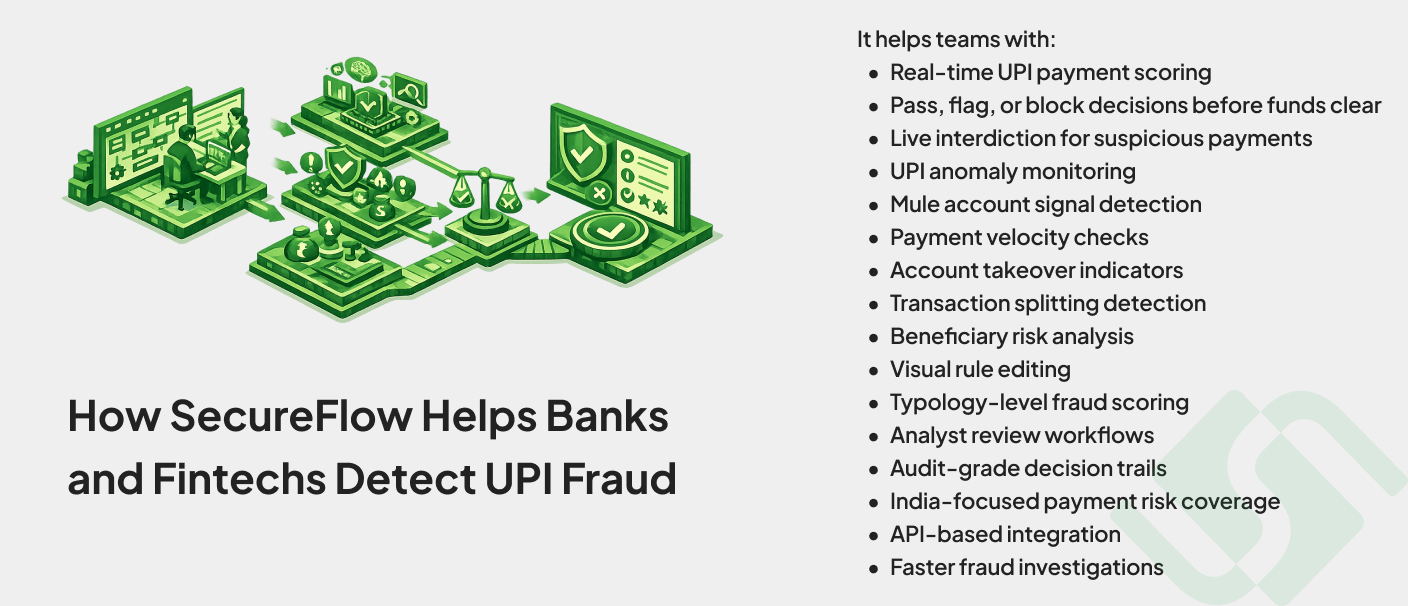
It helps teams with:
- Real-time UPI payment scoring
- Pass, flag, or block decisions before funds clear
- Live interdiction for suspicious payments
- UPI anomaly monitoring
- Mule account signal detection
- Payment velocity checks
- Account takeover indicators
- Transaction splitting detection
- Beneficiary risk analysis
- Visual rule editing
- Typology-level fraud scoring
- Analyst review workflows
- Audit-grade decision trails
- India-focused payment risk coverage
- API-based integration
- Faster fraud investigations
SecureFlow evaluates different fraud rules and payment signals in parallel.
Instead of waiting for one check to finish before beginning another, relevant risk checks can be completed together. This helps the system return a decision quickly enough to support real-time payment processing.
SecureFlow also gives risk and compliance teams a visual way to create and adjust transaction rules.
This reduces dependency on engineering teams for every fraud threshold or rule change.
Instead of waiting until suspicious activity becomes a recovery problem, banks and fintech companies can use SecureFlow to identify payment risk at the transaction stage.
It helps teams understand not only whether a payment is risky, but also why the payment received that decision.
Who Should Use UPI Fraud Detection Software?
UPI fraud detection software is useful for:
- Banks
- Fintech companies
- NBFCs
- Payment gateways
- Payment aggregators
- Digital lenders
- Wallet providers
- Neobanks
- Embedded finance platforms
- Merchant payment platforms
- Fraud operations teams
- Risk teams
- Compliance teams
- Transaction monitoring teams
- Payment operations teams
Any financial institution that processes UPI payments and needs to identify suspicious transactions before settlement should consider using UPI fraud detection software.
Want to explore more practical insights on AI development, automation, and conversational AI? Read more blogs at Cloudastra Technologies or contact us for business enquiries through Cloudastra Contact Us.
FAQs
1. What is UPI fraud detection?
UPI fraud detection is the process of monitoring UPI transactions, customer accounts, devices, beneficiaries, and payment behaviour to identify suspicious activity before financial loss occurs.
2. Why do banks need real-time UPI fraud detection?
Banks need real-time UPI fraud detection because payments can be completed within seconds. Real-time monitoring helps teams identify and stop suspicious transactions before funds move.
3. What types of UPI fraud can be detected?
UPI fraud detection can help identify account takeover, mule account activity, transaction splitting, payment velocity abuse, suspicious beneficiaries, linked-account fraud, and unusual payment behaviour.
4. What is UPI payment risk scoring?
UPI payment risk scoring assigns a risk level to a transaction using signals such as transaction value, customer history, device information, location, payment velocity, beneficiary activity, and linked-account behaviour.
5. What is mule account detection?
Mule account detection identifies accounts that receive and rapidly transfer suspicious funds. It may use transaction movement, connected accounts, shared devices, fan-in and fan-out patterns, and balance-retention behaviour.
6. Can UPI fraud detection reduce false positives?
Yes. False positives can be reduced by combining multiple signals, comparing transactions with customer history, applying customer-specific thresholds, and using contextual risk scoring.
7. Should every payment to a new beneficiary be blocked?
No. A new beneficiary does not automatically mean fraud. The payment should be evaluated using transaction value, device information, customer behaviour, location, and beneficiary risk.
8. What is the difference between UPI fraud detection and fraud investigation?
UPI fraud detection focuses on identifying and stopping suspicious payments before or during processing. Fraud investigation usually happens after an alert or fraudulent transaction has already occurred.
9. How does SecureFlow support UPI fraud detection?
SecureFlow helps banks and fintechs evaluate UPI transactions in real time, apply configurable fraud rules, detect mule and velocity signals, calculate payment risk, and return pass, flag, or block decisions before funds clear.
10. Does SecureFlow maintain fraud decision records?
Yes. SecureFlow maintains audit-grade decision trails containing transaction context, risk signals, triggered rules, scores, and final outcomes.
11. Can SecureFlow help detect mule accounts?
Yes. SecureFlow can evaluate transaction movement, velocity patterns, account relationships, and other mule indicators to identify potentially suspicious account behaviour.
12. Who should use SecureFlow?
SecureFlow is useful for banks, fintech companies, NBFCs, payment gateways, payment aggregators, digital lenders, wallet providers, fraud teams, and transaction monitoring teams.