Customer risk reassessment helps fintech companies, banks, NBFCs and digital lenders identify when an existing customer’s compliance risk changes after onboarding.
A customer who appeared low risk when the account was opened may not remain low risk forever.
Their personal information, business activity, geography, ownership structure, sanctions exposure, PEP status or expected financial behaviour may change over time.
New information may also become available after onboarding.
For example:
- A customer may become politically exposed
- A business may appoint a new director
- A beneficial owner may change
- A customer may move to a higher-risk geography
- New sanctions information may appear
- A watchlist match may be identified
- The customer’s business activity may change
- Previously submitted documents may expire
- Account behaviour may no longer match the original profile
If the financial institution only screens the customer once during onboarding, these changes may remain undetected.
That is why customer risk reassessment is an important part of ongoing compliance.
It helps financial institutions review existing customers, update risk classifications and apply additional due diligence when new risk signals appear.
RiskIntel helps fintech teams bring customer screening, risk scoring, compliance alerts, scheduled reviews and decision records into a structured customer-risk workflow.
In simple terms, customer risk reassessment helps compliance teams answer one important question:
Is this customer still within the institution’s acceptable risk level?
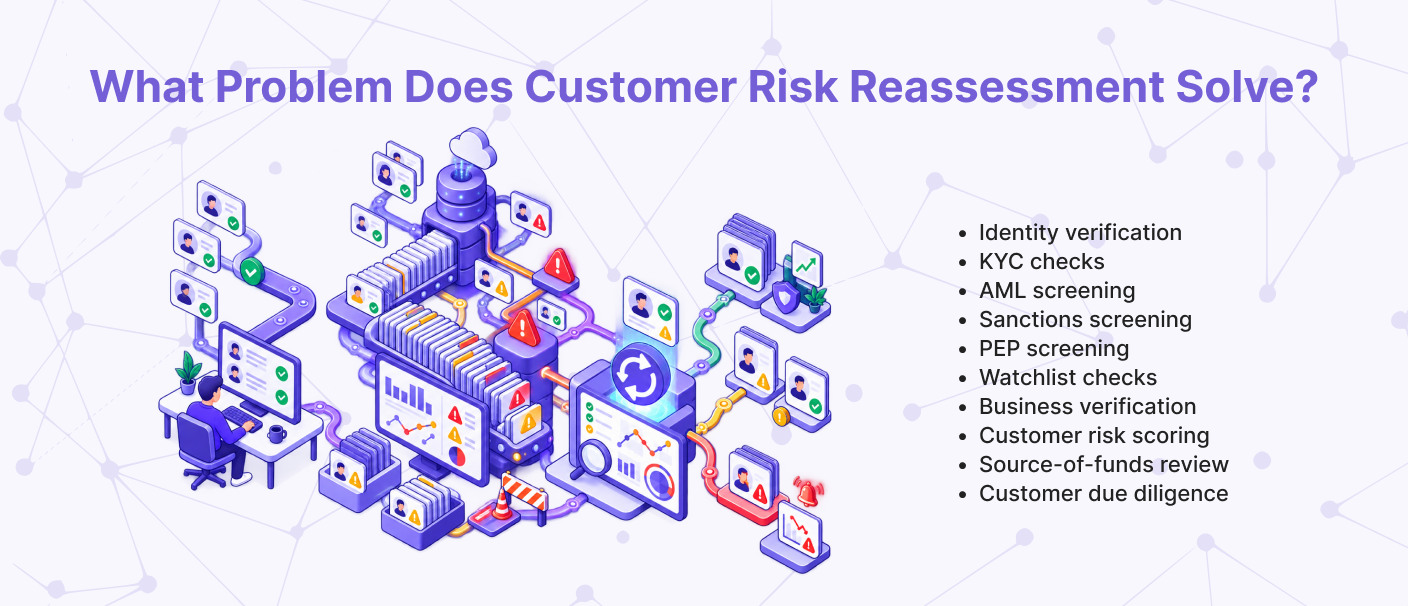
What Problem Does Customer Risk Reassessment Solve?
Fintech companies often perform detailed customer checks during onboarding.
These may include:
- Identity verification
- KYC checks
- AML screening
- Sanctions screening
- PEP screening
- Watchlist checks
- Business verification
- Customer risk scoring
- Source-of-funds review
- Customer due diligence
Once the customer is approved, however, their profile may receive limited attention unless a serious issue appears.
This creates a gap between onboarding compliance and ongoing customer-risk management.
Without a structured reassessment process, teams may depend on:
- Annual spreadsheet reviews
- Manual reminders
- Separate screening tools
- Email-based approvals
- Outdated customer information
- Fixed onboarding risk scores
- Disconnected compliance alerts
- Delayed document reviews
- Incomplete decision records
- Customer reviews triggered only after an incident
These methods may work when customer volume is low.
They become difficult to manage when a financial institution handles thousands or millions of active customers.
Customer risk reassessment solves this by helping teams review customer risk after onboarding and identify whether the original risk classification is still accurate.
What Is Customer Risk Reassessment?
Customer risk reassessment is the process of reviewing an existing customer’s information, screening results, risk factors and account relationship to determine whether their risk level has changed.
The customer may originally have been classified as:
- Low risk
- Medium risk
- High risk
- Prohibited or unacceptable risk
During reassessment, the institution checks whether the customer should remain in the same category.
The reassessment may examine:
- Customer identity information
- Address and geography
- Nationality
- Occupation
- Business activity
- Products used
- Expected account activity
- Ownership information
- Directors and related parties
- Sanctions results
- PEP status
- Watchlist results
- Previous compliance alerts
- Documentation status
- Source of funds
- Source of wealth
- Changes in customer behaviour
- Previous review decisions
The outcome may be:
- Risk level unchanged
- Risk level increased
- Risk level reduced
- Additional documents required
- Enhanced due diligence required
- Senior compliance approval required
- Customer relationship restricted
- Customer relationship reviewed for exit
Customer risk reassessment is not the same as repeating the entire onboarding process for every customer.
It is a risk-based review designed to focus attention on customers and changes that matter.
Why Is Onboarding Screening Alone Not Enough?
Onboarding screening shows the customer’s risk at one point in time.
It does not guarantee that the same risk level will remain accurate throughout the relationship.
Customer Information Changes
Customers may change:
- Address
- Country of residence
- Employment
- Business activity
- Legal structure
- Directors
- Ownership
- Contact details
- Expected financial activity
These changes may affect the customer-risk score.
External Risk Information Changes
Sanctions, PEP and watchlist databases are updated regularly.
A person or organisation that did not appear on a relevant list during onboarding may appear later.
Business Relationships Change
A business customer may:
- Add a new beneficial owner
- Appoint new directors
- Enter a higher-risk market
- Change its primary business activity
- Add new products
- Expand into cross-border transactions
- Form relationships with higher-risk entities
Documents Expire
Identity documents, licences, registrations and other records may expire.
If the institution does not track review dates, outdated records may remain in the customer file.
Customer Behaviour Changes
A customer may begin using the product in a way that does not match their original profile.
For example, an account expected to receive local low-value payments may begin receiving large international transfers.
This does not automatically mean financial crime.
However, it may justify an updated risk review.
What Is the Difference Between Customer Risk Scoring and Risk Reassessment?
Customer risk scoring calculates a customer’s risk level using available information and configured risk factors.
Customer risk reassessment reviews whether that score remains accurate after onboarding.
|
Area |
Customer risk scoring |
Customer risk reassessment |
|
Main purpose |
Assign an initial risk level |
Review whether risk has changed |
|
Typical timing |
During onboarding |
After onboarding |
|
Main inputs |
KYC, geography, business type and screening results |
Updated customer data, new alerts and profile changes |
|
Outcome |
Low-, medium- or high-risk classification |
Keep, increase or reduce risk level |
|
Review trigger |
New customer application |
Time-based or event-based trigger |
|
Compliance action |
Standard or enhanced onboarding |
Updated due diligence, escalation or monitoring |
|
Record required |
Initial risk decision |
Updated risk decision and reason |
The two processes should work together.
Initial scoring creates the starting profile.
Reassessment keeps that profile current.
When Should Customer Risk Be Reassessed?
Customer risk may be reassessed through scheduled reviews or event-based triggers.
Scheduled Customer Risk Reviews
Scheduled reviews happen at defined intervals.
The frequency may depend on the customer’s risk level.
For example:
- Low-risk customers may be reviewed less frequently
- Medium-risk customers may receive more regular reviews
- High-risk customers may require frequent reassessment
The institution should define review frequency according to its policies, products, customer types and regulatory obligations.
Scheduled reviews help prevent customer records from remaining unchanged for long periods.
Event-Based Customer Risk Reviews
Event-based reassessment happens when a meaningful change or alert occurs.
Possible triggers include:
- New sanctions match
- New PEP match
- New watchlist result
- Change in address
- Change in nationality
- Change in business activity
- Change in ownership
- New director or related party
- Expired document
- New high-risk geography
- Unusual account behaviour
- New compliance alert
- Material change in expected activity
- Previous review becoming outdated
- Product-risk change
- Adverse information becoming available
Event-based reviews help teams respond sooner instead of waiting for the next scheduled review date.
Risk-Based Customer Review
Risk-based review combines scheduled and event-based monitoring.
The institution applies more frequent or detailed reviews to customers with higher risk.
This avoids reviewing every customer with the same level of effort.
What Risk Changes Should Fintech Companies Monitor?
Sanctions Status Changes
A customer or related party may appear on a sanctions list after onboarding.
A possible match may require:
- Customer rescreening
- Identity comparison
- Match-quality review
- Compliance escalation
- Transaction restriction
- Enhanced due diligence
- Decision documentation
A possible sanctions match should not automatically be treated as confirmed.
The compliance team should compare available identifying information and follow the institution’s review policy.
PEP Status Changes
A customer may become politically exposed after opening the account.
A related party, family member or close associate may also create additional risk.
PEP status does not automatically mean wrongdoing.
However, it may require:
- Updated customer risk score
- Enhanced due diligence
- Source-of-funds review
- Source-of-wealth review
- Senior approval
- More frequent monitoring
Watchlist Changes
Customers may appear on:
- Regulatory lists
- Enforcement lists
- Internal blacklists
- Criminal watchlists
- Adverse-risk databases
- Other relevant risk lists
Possible matches should be reviewed using available customer information.
Geography Changes
A change in residence, business location or transaction exposure may affect customer risk.
Risk may increase when the customer:
- Moves to a higher-risk jurisdiction
- Begins operating in a new market
- Starts receiving international payments
- Adds customers or suppliers in higher-risk regions
- Changes tax residency
Business Activity Changes
A customer may change the products or services they provide.
For example, a company initially classified as a local technology consultancy may begin offering financial services or cross-border payment support.
The new activity may require:
- Updated business classification
- Additional documentation
- Licence verification
- Risk-score adjustment
- Enhanced review
Ownership Changes
Business ownership can change after onboarding.
New beneficial owners, shareholders or directors may need to be screened.
Ownership changes may create risk when:
- The new owner is politically exposed
- A related party appears on a sanctions list
- Ownership becomes more complex
- Information about control is unclear
- A higher-risk jurisdiction becomes involved
Product-Usage Changes
A customer may begin using products that carry different levels of risk.
For example:
- A domestic customer begins using cross-border payments
- A low-value account begins processing larger amounts
- A borrower begins using additional lending products
- A merchant starts processing a new category of payments
Behavioural Changes
Changes in customer activity may indicate that the original profile is no longer accurate.
Examples include:
- Sudden increase in transaction value
- New geographic activity
- New counterparties
- Unexpected business volumes
- Activity inconsistent with the declared business
- Multiple compliance alerts
- Increased use of higher-risk products
Behavioural changes should be assessed with customer context.
Unusual activity does not automatically mean misconduct.
How Does Customer Risk Reassessment Work?
Customer risk reassessment follows a structured process from review trigger to final decision.
1. A Review Is Triggered
The review may begin because:
- The scheduled review date arrives
- Customer information changes
- A new sanctions result appears
- A PEP match is identified
- A watchlist alert is generated
- A document expires
- A compliance analyst requests a review
- The customer’s activity changes
- A related party changes
- An internal risk rule is triggered
The reason for the review should be recorded.
2. Existing Customer Information Is Collected
The reviewer should have access to:
- Customer identity
- Original onboarding information
- Initial risk score
- Previous screening results
- Previous alerts
- Previous review decisions
- Documents
- Products used
- Expected activity
- Related parties
- Compliance notes
- Review history
This provides context for evaluating the change.
3. Updated Information Is Requested or Retrieved
The institution may need updated:
- Identity documents
- Address proof
- Business registration
- Ownership details
- Director information
- Source-of-funds information
- Source-of-wealth information
- Product-use information
- Expected account activity
- Licences or permissions
The level of information required should match the identified risk.
4. Screening Checks Are Repeated
Relevant checks may include:
- Sanctions rescreening
- PEP rescreening
- Watchlist rescreening
- Related-party screening
- Business-entity screening
- High-risk geography checks
- Internal compliance checks
The institution should record which checks were performed and when.
5. New and Previous Results Are Compared
The reviewer should identify what has changed.
Examples include:
- New PEP status
- New sanctions alert
- Higher-risk geography
- New business activity
- New beneficial owner
- Expired documentation
- New watchlist result
- Increased expected transaction value
A comparison view helps the analyst focus on meaningful changes.
6. The Customer Risk Score Is Recalculated
The updated customer profile may be scored using factors such as:
- Customer type
- Geography
- Occupation
- Business activity
- Product risk
- Delivery channel
- Expected financial activity
- Sanctions results
- PEP status
- Watchlist results
- Ownership complexity
- Source of funds
- Previous alerts
The new score may be compared with the previous score.
7. A Compliance Decision Is Made
The outcome may be:
- Keep the current risk level
- Increase the risk level
- Reduce the risk level
- Request additional information
- Begin enhanced due diligence
- Apply additional monitoring
- Escalate for senior approval
- Restrict a product
- Review the customer relationship
The final action should follow the institution’s policy.
8. The Decision Is Recorded
The reassessment record should include:
- Review trigger
- Review date
- Information reviewed
- Screening results
- Previous risk score
- Updated risk score
- Identified changes
- Analyst notes
- Documents requested
- Escalation history
- Final decision
- Decision reason
- Reviewer
- Approver
- Next review date
This creates an audit-ready customer-risk history.
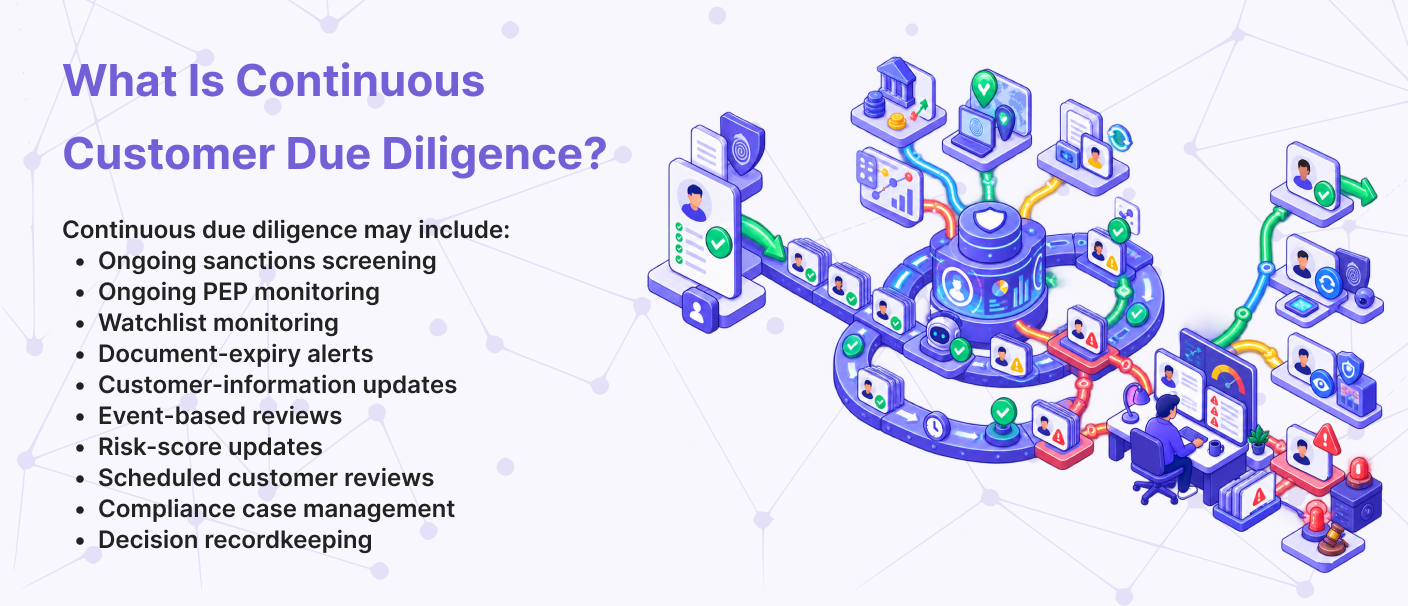
What Is Continuous Customer Due Diligence?
Continuous customer due diligence is an approach in which customer risk is reviewed throughout the relationship rather than only during onboarding.
It does not necessarily mean that every customer receives a full manual review every day.
It means the institution maintains a process for identifying meaningful changes and triggering the appropriate action.
Continuous due diligence may include:
- Ongoing sanctions screening
- Ongoing PEP monitoring
- Watchlist monitoring
- Document-expiry alerts
- Customer-information updates
- Event-based reviews
- Risk-score updates
- Scheduled customer reviews
- Compliance case management
- Decision recordkeeping
The objective is to keep the customer-risk profile current.
Periodic Review vs Event-Driven Review
|
Area |
Periodic review |
Event-driven review |
|
Trigger |
Scheduled date |
New information or alert |
|
Timing |
Fixed intervals |
When a material change occurs |
|
Main purpose |
Confirm the profile remains accurate |
Respond to a specific risk change |
|
Coverage |
Broad review |
Targeted review |
|
Example |
Annual high-risk customer review |
New sanctions or PEP match |
|
Main risk |
Important change may occur between reviews |
Too many low-quality alerts |
|
Best approach |
Use with event-based monitoring |
Use with scheduled reviews |
The strongest approach combines both.
Scheduled reviews provide regular control.
Event-based reviews help teams respond to new risk without waiting.
How Can Fintechs Prioritise Customer Risk Reviews?
Not every review should receive the same priority.
Teams can prioritise reviews using:
- Current customer risk level
- Severity of the new alert
- Strength of the screening match
- Customer value
- Product risk
- Geography
- Previous compliance history
- Time since the last review
- Number of unresolved alerts
- Documentation status
- PEP or sanctions exposure
- Ownership complexity
Possible review priorities include:
- Critical
- High
- Medium
- Standard
A high-confidence sanctions alert should receive faster attention than a minor customer-information update.
What Features Should Customer Risk Reassessment Software Have?
A strong customer-risk reassessment platform should include:
- Scheduled customer reviews
- Event-based review triggers
- Sanctions rescreening
- PEP rescreening
- Watchlist monitoring
- Customer risk scoring
- Risk-score history
- Customer profile comparison
- High-risk customer identification
- Compliance alerts
- Document-expiry tracking
- Review assignment
- Analyst notes
- Escalation workflows
- Approval workflows
- Ongoing customer monitoring
- Audit trails
- Reporting
- Role-based access
- API integration
- Secure data handling
- Next-review scheduling
For fintech companies, the most important features are review triggers, updated screening, risk-score history, clear case ownership and audit-ready decisions.
Manual Risk Reviews vs Structured Customer Risk Reassessment
|
Capability |
Manual review process |
Structured reassessment |
|
Review scheduling |
Spreadsheet reminders |
Scheduled review workflow |
|
Risk-change detection |
Dependent on manual checks |
Event-based compliance alerts |
|
Sanctions rescreening |
Separate manual process |
Connected screening workflow |
|
PEP rescreening |
Reviewed periodically |
Integrated into reassessment |
|
Risk-score update |
Manual calculation |
Consistent recalculation |
|
Profile comparison |
Analysts compare multiple records |
Previous and updated information connected |
|
Case assignment |
Email or spreadsheet |
Assigned compliance workflow |
|
Escalation |
Manual follow-up |
Defined escalation process |
|
Decision history |
Stored across systems |
Audit-ready record |
|
Next review |
Manually scheduled |
Review date maintained in the workflow |
How RiskIntel Helps Fintechs Reassess Customer Risk
RiskIntel by Cloudastra helps fintech companies, banks, NBFCs and digital lenders manage customer risk beyond the initial onboarding decision.
RiskIntel supports:
- AML compliance checks
- Sanctions screening
- PEP screening
- Watchlist monitoring
- Customer risk scoring
- High-risk customer identification
- Compliance alerts
- Scheduled risk reviews
- Ongoing customer monitoring
- Investigation of customer-risk changes
- Analyst review workflows
- Escalation history
- Audit-ready decision records
- Faster compliance decisions
- Centralised customer-risk information
Instead of leaving the original onboarding risk score unchanged, teams can use RiskIntel to review updated customer information and screening results.
The platform helps compliance teams understand:
- What changed
- When the change was identified
- Which screening result created the alert
- Whether the customer-risk score increased
- Which analyst reviewed the case
- Why the final decision was made
- When the next review is required
RiskIntel can help teams move from static customer-risk profiles to a more structured ongoing monitoring process.
This does not mean every alert should result in customer rejection.
A possible match or risk change should be reviewed using customer information, screening context and the institution’s compliance policy.
How Can Fintech Companies Implement Customer Risk Reassessment?
Define Review Frequencies
The institution should define how often each risk category is reviewed.
Review frequency may differ for:
- Low-risk customers
- Medium-risk customers
- High-risk customers
- PEPs
- Business customers
- Cross-border customers
- Higher-risk products
Define Event-Based Triggers
Document the events that should create a customer review.
Examples include:
- Sanctions alert
- PEP alert
- Watchlist alert
- Ownership change
- Geography change
- Document expiry
- Business-activity change
- Unusual account activity
- Product-use change
Define Required Review Information
For each trigger, identify:
- Information required
- Screening checks required
- Documents required
- Reviewer
- Approver
- Completion deadline
- Possible outcomes
Configure Risk Factors
The customer-risk model should reflect the institution’s:
- Customer types
- Products
- Markets
- Delivery channels
- Regulatory obligations
- Risk appetite
Connect Customer Data
Relevant data may come from:
- KYC system
- Customer database
- Core banking system
- Lending platform
- Payment platform
- Compliance screening tools
- Document system
- Case-management system
- CRM
Assign Review Ownership
Every reassessment case should have:
- Assigned analyst
- Review deadline
- Escalation path
- Approver
- Final outcome
- Next review date
Test the Workflow
Before full deployment, teams should test:
- Alert volume
- Match quality
- Review workload
- Risk-score changes
- Escalation accuracy
- Missing customer data
- Review completion time
Review Performance
Teams should monitor:
- Reviews completed on time
- Overdue reviews
- Risk-level increases
- Risk-level reductions
- High-risk customers identified
- False-positive alerts
- Escalation volume
- Average review time
- Documentation gaps
Common Customer Risk Reassessment Challenges
Customer Data Is Outdated
Risk decisions may be inaccurate when addresses, business details, ownership information or documents have not been updated.
Too Many Alerts
Broad screening settings may create large review queues.
Alerts should be prioritised according to match strength and customer risk.
Review Frequencies Are Not Risk-Based
Reviewing every customer at the same interval creates unnecessary workload.
Higher-risk customers should receive greater attention.
Risk Scores Are Not Updated
A customer may complete a review, but the original score remains unchanged.
The new information should be reflected in the current risk profile.
Review Reasons Are Not Recorded
Teams should document why the review started and which information changed.
Screening and Risk Scoring Are Disconnected
If screening results exist in one system and risk scores in another, analysts may struggle to understand the complete customer profile.
High-Risk Cases Are Not Escalated
The institution should define when a case requires senior compliance or enhanced due diligence.
No Next Review Date Is Set
Every completed review should create an appropriate next-review date.
Audit Records Are Incomplete
The institution should be able to show:
- When the review occurred
- What triggered it
- Which checks were performed
- What changed
- Who reviewed the case
- Why the decision was made
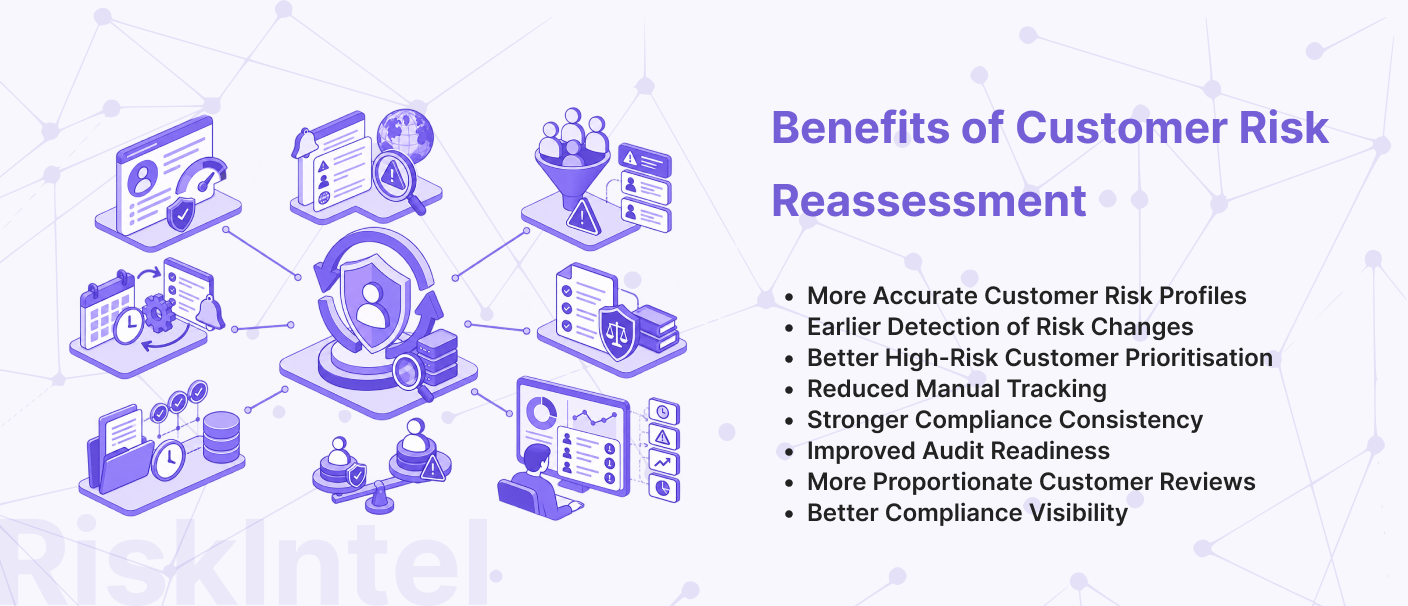
Benefits of Customer Risk Reassessment
More Accurate Customer Risk Profiles
Customer classifications remain connected to current information instead of only onboarding data.
Earlier Detection of Risk Changes
New sanctions, PEP, watchlist or profile changes can be reviewed sooner.
Better High-Risk Customer Prioritisation
Compliance teams can focus on customers whose risk has increased.
Reduced Manual Tracking
Scheduled reviews, alerts and decisions can be managed in one workflow.
Stronger Compliance Consistency
Structured reassessment reduces differences between analyst decisions.
Improved Audit Readiness
Every review, alert, score change and decision can be documented.
More Proportionate Customer Reviews
Low-risk customers do not need the same level of review as high-risk profiles.
Better Compliance Visibility
Managers can monitor pending reviews, overdue cases, escalations and risk-level changes.
Who Should Use Customer Risk Reassessment Software?
Customer risk reassessment software is useful for:
- Fintech companies
- Banks
- NBFCs
- Digital lenders
- Neobanks
- Payment companies
- Payment aggregators
- Embedded finance platforms
- Wealthtech companies
- Insurtech companies
- Merchant onboarding platforms
- Cross-border payment providers
- Compliance teams
- AML teams
- Customer due diligence teams
- Financial crime risk teams
Any financial institution that maintains long-term customer relationships should consider how customer risk is reviewed after onboarding.
Want to explore more practical insights on AI development, automation, and conversational AI? Read more blogs at Cloudastra Technologies or contact us for business enquiries through Cloudastra Contact Us.
Frequently Asked Questions
1. What is customer risk reassessment?
Customer risk reassessment is the process of reviewing an existing customer’s information, screening results and risk factors to determine whether their risk level has changed.
2. Why should customer risk be reviewed after onboarding?
Customer information, sanctions exposure, PEP status, geography, business activity and ownership can change after onboarding. The original risk score may therefore become outdated.
3. How often should customer risk be reassessed?
Review frequency should depend on the customer’s risk level, institution policy, products and regulatory requirements. Higher-risk customers usually require more frequent review.
4. What triggers a customer risk review?
Common triggers include scheduled review dates, sanctions alerts, PEP matches, watchlist results, ownership changes, document expiry, geography changes and significant customer-profile changes.
5. What is an event-driven customer review?
An event-driven review begins when a meaningful customer-risk change or compliance alert occurs instead of waiting for the next scheduled review.
6. What is continuous customer due diligence?
Continuous customer due diligence is the ongoing process of monitoring customer information and risk throughout the business relationship.
7. Is customer risk reassessment the same as KYC refresh?
A KYC refresh updates customer identity and documentation. Risk reassessment uses updated information and screening results to determine whether the customer’s risk level should change.
8. Can a customer’s risk level decrease?
Yes. If risk factors change or previous concerns are resolved, the institution may reduce the customer’s risk level according to its policy.
9. Does every sanctions or PEP alert mean the customer is high risk?
No. Possible matches should be reviewed using available identifying information. A name similarity alone may be a false positive.
10. How does RiskIntel support customer risk reassessment?
RiskIntel supports customer screening, risk scoring, compliance alerts, scheduled reviews, ongoing monitoring and audit-ready decision records.
11. Can RiskIntel show why a customer’s risk changed?
RiskIntel can help teams connect updated screening information, risk factors, review notes and decisions in one customer-risk workflow.
12. Who should use RiskIntel?
RiskIntel is useful for fintech companies, banks, NBFCs, digital lenders, neobanks, payment companies and compliance teams managing customer risk.