Repayment plan management helps lenders create a structured recovery process for borrowers who cannot immediately clear an overdue balance but may still be willing and able to repay through an organised payment arrangement.
For banks, NBFCs and fintech lenders, every overdue borrower is different.
One borrower may have missed an EMI accidentally and can pay immediately after a reminder.
Another may need a few additional days.
A third borrower may be able to make only a partial payment today and complete the remaining amount later.
Another may need human assistance before committing to a repayment schedule.
Treating all of these borrowers with the same collection workflow can create unnecessary friction and reduce recovery efficiency.
This is where repayment plan management becomes important.
It helps lending and collection teams organise repayment arrangements, track borrower commitments, schedule follow-ups and understand whether the borrower is progressing toward recovery.
A structured repayment-plan workflow can help teams answer practical questions such as:
- What amount has the borrower agreed to repay?
- When is the next payment expected?
- Has the borrower completed the agreed payment?
- Is the repayment plan still active?
- Has a scheduled payment been missed?
- Does the borrower need another reminder?
- Should the case move to agent follow-up?
- Does the account need escalation?
- Which repayment plans are producing successful recovery?
- Which borrowers require additional attention?
DebtPulse helps lenders manage repayment plans and borrower self-service alongside risk-based prioritisation, automated collection workflows, personalised communication and portfolio-level recovery visibility.
In simple terms, repayment plan management helps lenders move from:
“This borrower is overdue.”
to:
“This is the borrower’s agreed recovery path, this is the next expected action, and this is what should happen if the plan is not followed.”
What Problem Does Repayment Plan Management Solve?
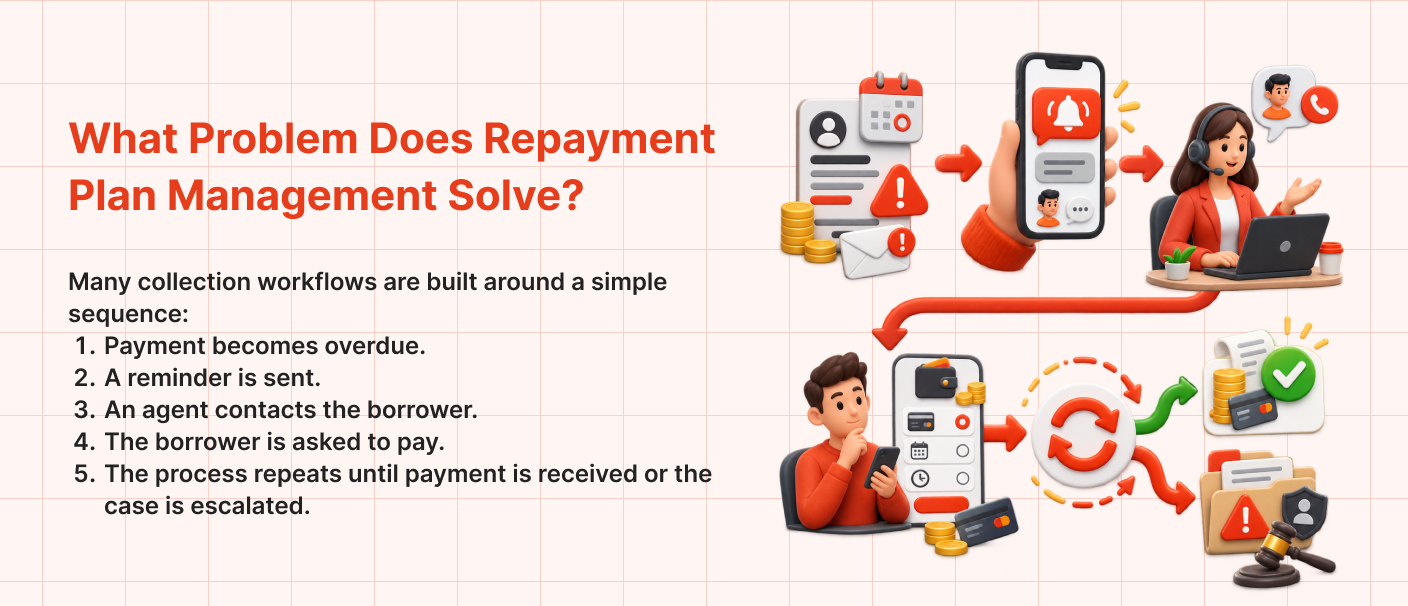
Many collection workflows are built around a simple sequence:
- Payment becomes overdue.
- A reminder is sent.
- An agent contacts the borrower.
- The borrower is asked to pay.
- The process repeats until payment is received or the case is escalated.
This approach may work for straightforward overdue accounts.
However, it becomes less effective when borrowers cannot clear the complete amount immediately.
Without structured repayment plan management, teams may rely on:
- Agent notes
- Spreadsheets
- Verbal commitments
- Email records
- Manual calendars
- Personal reminders
- Disconnected payment information
- Separate communication systems
This creates several problems.
Repayment Agreements Are Not Structured
An agent may record:
“Borrower will pay next week.”
But this does not clearly capture:
- Exact payment date
- Expected amount
- Remaining overdue balance
- Whether payment is partial or complete
- Next follow-up
- Responsible agent
- Escalation condition
Without structured information, collection teams cannot manage the commitment consistently.
Different Agents Handle the Same Situation Differently
One agent may offer a structured follow-up.
Another may simply call again.
A third may immediately escalate the account.
Inconsistent workflows make recovery harder to manage across large portfolios.
Partial Payments Are Difficult to Track
A borrower may pay part of the overdue amount.
If the remaining balance and next payment date are not recorded clearly, the account may return to a general overdue queue.
Follow-Ups Are Missed
When repayment dates are tracked manually, collection teams may contact borrowers too early, too late or not at all.
Managers Cannot See Expected Recovery
Without structured repayment-plan information, managers cannot easily understand:
- How many plans are active
- Which payments are expected this week
- Which plans are progressing
- Which plans have missed payments
- Which borrowers require escalation
- How much recovery may come from active repayment arrangements
Repayment plan management solves these problems by creating a defined workflow for recording, monitoring and acting on borrower repayment arrangements.
What Is Repayment Plan Management?
Repayment plan management is the process of recording and monitoring an agreed repayment arrangement between a lender and an overdue borrower.
A repayment plan may include:
- Outstanding balance
- Agreed payment amount
- Payment schedule
- Next payment date
- Number of expected payments
- Partial payments
- Remaining balance
- Communication history
- Responsible collection agent
- Reminder schedule
- Plan status
- Follow-up requirement
- Escalation condition
The purpose is not simply to record that the borrower intends to pay.
The purpose is to create a recovery workflow around that agreement.
A repayment plan may move through stages such as:
- Proposed
- Awaiting borrower confirmation
- Active
- Payment due
- Partially completed
- Payment missed
- Rescheduled
- Completed
- Escalated
This gives collection teams a clearer understanding of what should happen next.
Repayment Plan vs Promise to Pay: What Is the Difference?
Repayment plans and promises to pay are related, but they are not exactly the same.
A promise to pay usually represents a borrower’s commitment to make a specific payment by a particular date.
A repayment plan can represent a broader arrangement involving multiple payments or an organised recovery schedule.
|
Area |
Promise to Pay |
Repayment Plan |
|
Main purpose |
Track one repayment commitment |
Manage a structured recovery schedule |
|
Number of payments |
Usually one commitment |
May include multiple payments |
|
Main information |
Date and promised amount |
Schedule, amounts and remaining balance |
|
Best for |
Short-term borrower commitment |
Longer or structured recovery |
|
Follow-up |
After promised date |
Throughout the repayment schedule |
|
Completion |
Promise fulfilled |
Entire repayment arrangement completed |
|
Missed payment |
Broken promise |
Plan may need follow-up or review |
Both can be part of the same collection strategy.
For example, a borrower on a repayment plan may make a promise to pay the next scheduled amount on Friday.
DebtPulse can support both structured repayment-plan management and promise-to-pay tracking within the broader recovery workflow.
Why Should Lenders Offer Structured Repayment Workflows?
A collection process should not assume that every overdue borrower has the same reason for missing a payment.
Borrowers may become overdue because of:
- Temporary cash-flow problems
- Salary delays
- Business payment delays
- Unexpected expenses
- Administrative errors
- Forgotten due dates
- Incorrect payment information
- Short-term financial hardship
A structured recovery workflow helps collection teams identify the appropriate next action.
Some borrowers may only need a reminder.
Others may require an agent conversation.
Some may need to make a partial payment before completing the remaining amount.
The objective is to match the recovery action to the borrower’s actual situation instead of repeatedly applying the same collection pressure.
How Does Repayment Plan Management Work?
A structured repayment-plan process can follow the borrower from overdue identification through final resolution.
1. The Overdue Account Is Identified
The collection system first identifies accounts requiring recovery action.
Relevant information may include:
- Borrower name
- Loan account
- EMI amount
- Outstanding balance
- Due date
- Days past due
- Delinquency stage
- Repayment history
- Previous promises
- Communication history
- Borrower risk level
This provides the context needed before discussing a repayment arrangement.
2. The Borrower Is Prioritised
Not every overdue account needs immediate human intervention.
Borrowers can be prioritised using:
- Days past due
- Outstanding amount
- Repayment history
- Previous communication response
- Broken promises
- Borrower risk
- Delinquency stage
- Account value
- Previous collection activity
Lower-risk borrowers may continue through automated communication.
More complex cases may move to an agent.
3. The Borrower Is Contacted
Communication may take place through approved channels such as:
- SMS
- Voice call
- IVR
- Mobile application
- Agent call
The objective is to understand the borrower’s repayment status and identify an appropriate next action.
4. A Repayment Arrangement Is Recorded
When an appropriate arrangement is agreed, the system should record the relevant information.
This may include:
- Total overdue amount
- Agreed amount
- Payment date
- Number of instalments
- Frequency
- First payment date
- Remaining balance
- Borrower notes
- Responsible agent
Accurate records prevent different agents from receiving different information about the same borrower.
5. The Plan Becomes an Active Workflow
Once recorded, the plan should not remain as a static note.
It should generate appropriate actions.
For example:
- Reminder before payment date
- Payment-status check
- Follow-up task
- Agent notification
- Missed-payment alert
- Escalation workflow
- Plan-completion update
This transforms the repayment agreement into a manageable recovery workflow.
6. Payments Are Tracked
As payments arrive, the plan status should be updated.
The system should help teams understand:
- Amount expected
- Amount received
- Remaining balance
- Next expected payment
- Whether payment arrived on time
- Whether the plan is progressing
7. Missed Payments Trigger Follow-Up
When a scheduled payment is missed, the lender may need to:
- Send a reminder
- Create an agent task
- Contact the borrower
- Review the plan
- Record another commitment
- Escalate the account
The correct action depends on the lender’s collection policy and borrower circumstances.
8. The Plan Is Completed or Escalated
When all required payments are completed, the recovery plan can be closed.
If repeated payments are missed, the case may move into another collection stage.
The complete history should remain available for future review.
What Information Should a Repayment Plan Record?
A useful repayment-plan record should include enough information for another authorised agent or manager to understand the case immediately.
Borrower Information
- Borrower identity
- Loan account
- Contact details
- Customer segment
Loan Information
- Loan product
- Original repayment schedule
- Overdue amount
- Days past due
- Current delinquency stage
Repayment Arrangement
- Agreed amount
- Number of payments
- Payment dates
- Payment frequency
- Partial-payment details
- Remaining balance
Communication Information
- Last contact
- Communication channel
- Borrower response
- Agent notes
- Next follow-up
Plan Status
- Proposed
- Active
- Payment due
- Partial payment received
- Payment missed
- Completed
- Escalated
Ownership
- Assigned agent
- Collection team
- Manager
- Escalation owner
Keeping these details together reduces reliance on scattered notes and spreadsheets.
What Is Borrower Self-Service in Debt Collection?
Borrower self-service gives borrowers a digital way to interact with certain parts of the repayment process without requiring an agent for every action.
Depending on the lender’s approved workflow, self-service may help borrowers:
- Review repayment information
- View outstanding balances
- Access available repayment options
- Confirm payment commitments
- Make approved payments
- Review upcoming payment dates
- Access communication history
- Request assistance
The specific options should follow the lender’s policies.
DebtPulse supports repayment-plan management and borrower self-service as part of its broader debt recovery workflow.
Why Is Borrower Self-Service Useful?
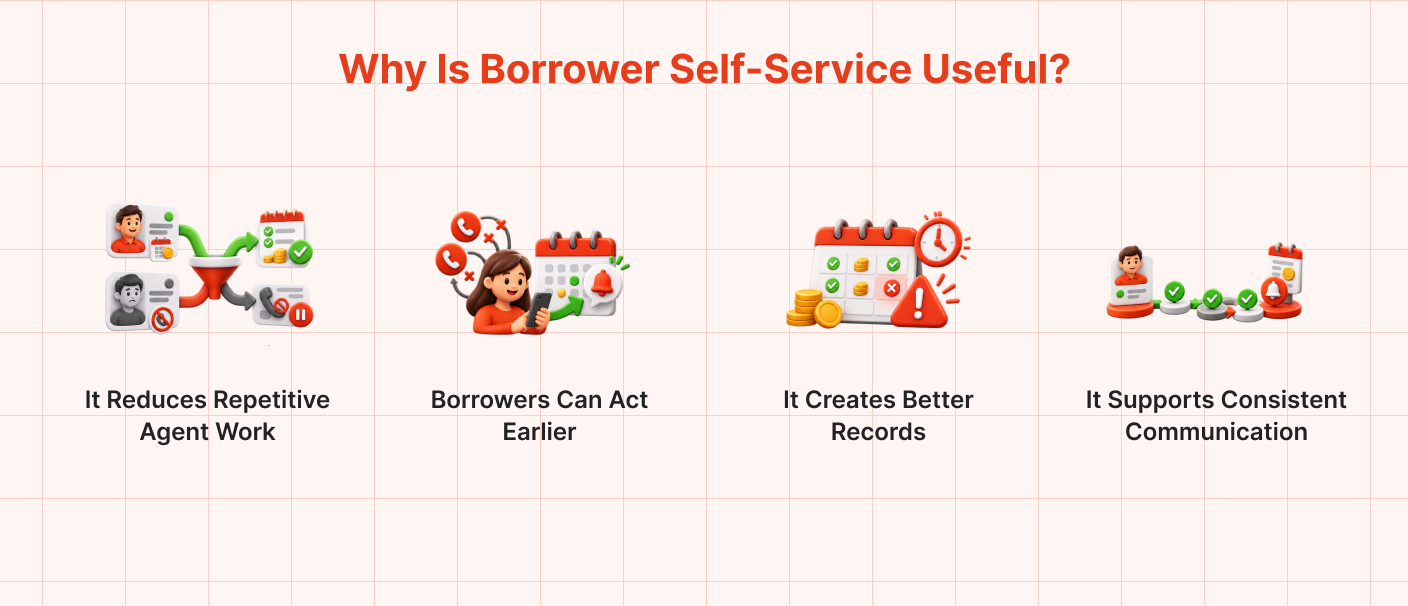
It Reduces Repetitive Agent Work
Agents do not need to manually answer every basic repayment-status request.
Borrowers Can Act Earlier
A borrower may prefer to review their account or make a payment without waiting for an agent call.
It Creates Better Records
Digital actions can become part of the borrower’s recovery history.
It Supports Consistent Communication
Approved information is presented through a structured workflow instead of depending entirely on individual agents.
Agents Can Focus on Complex Cases
Human attention can be reserved for:
- High-risk borrowers
- Broken plans
- Disputes
- Difficult repayment situations
- Escalated accounts
How Can Repayment Plans Improve Collection Efficiency?
Better Recovery Prioritisation
Active repayment-plan borrowers can be separated from borrowers who are completely non-responsive.
This helps teams avoid unnecessary contact.
Fewer Repetitive Calls
Borrowers following their plans may only need scheduled reminders rather than repeated agent calls.
Faster Identification of Broken Plans
The system can identify missed scheduled payments instead of waiting for a manual portfolio review.
More Consistent Follow-Up
Every plan follows a defined workflow.
Better Manager Visibility
Managers can see active plans, upcoming payments and cases requiring attention.
Clearer Agent Worklists
Agents can focus on:
- Missed-plan payments
- Broken promises
- High-risk accounts
- Unresponsive borrowers
- Escalated cases
instead of manually reviewing every overdue account.
How Should Lenders Segment Borrowers Before Offering Repayment Plans?
Repayment plans should not automatically be treated as the correct action for every overdue account.
Borrowers can first be segmented using factors such as:
- Days past due
- Outstanding amount
- Previous repayment behaviour
- Number of missed payments
- Previous promises
- Communication response
- Borrower risk
- Loan product
- Delinquency stage
- Previous collection actions
Lower-Risk Borrowers
These borrowers may have:
- Strong repayment history
- First missed payment
- Quick communication response
- Low overdue balance
They may only need reminders or a short recovery workflow.
Medium-Risk Borrowers
These borrowers may have:
- Multiple late payments
- Partial payments
- Previous repayment commitments
- Variable communication response
They may require more structured follow-up.
Higher-Risk Borrowers
These borrowers may have:
- Deeper delinquency
- Multiple broken promises
- Repeated non-response
- Large overdue amounts
- Previous escalation
They may require specialist or manager intervention according to lender policy.
Borrower segmentation allows recovery teams to apply resources more intelligently.
How Should Repayment Plan Reminders Work?
A repayment plan becomes less useful when borrowers and agents have to remember every payment date manually.
Automated reminders can support the workflow.
Possible communication stages include:
Before the Payment Date
A reminder can confirm:
- Upcoming payment date
- Expected amount
- Approved payment method
On the Payment Date
The borrower can receive a payment-due notification.
After a Missed Payment
The workflow may:
- Send another reminder
- Create an agent task
- Mark the payment as overdue
- Move the borrower into a follow-up queue
After Successful Payment
The system can:
- Record the payment
- Update the remaining balance
- Confirm receipt
- Identify the next expected payment
The goal is to keep the recovery workflow organised without creating unnecessary communication.
What Happens When a Borrower Misses a Repayment Plan Payment?
One missed payment should create a defined next action.
The workflow may depend on:
- Borrower history
- Number of previous missed payments
- Delinquency stage
- Outstanding amount
- Communication response
- Risk level
Possible actions include:
- Automated reminder
- Agent follow-up
- New promise-to-pay request
- Plan review
- Manager escalation
- Movement into another recovery stage
Repeated missed payments may indicate that the current arrangement is no longer effective.
The collection team then needs a clear process for deciding what happens next.
Repayment Plan Management vs Manual Collection Tracking
|
Capability |
Manual repayment tracking |
Structured repayment plan management |
|
Plan records |
Agent notes or spreadsheets |
Centralised repayment record |
|
Payment dates |
Personal reminders |
Structured schedule |
|
Partial payments |
Manually calculated |
Recorded against the plan |
|
Borrower communication |
Separate channels |
Connected recovery history |
|
Follow-ups |
Manually scheduled |
Workflow-driven |
|
Missed payments |
Identified manually |
Easier to identify and prioritise |
|
Case ownership |
May be unclear |
Assigned agent or team |
|
Manager visibility |
Manual reporting |
Recovery dashboards |
|
Plan status |
Updated manually |
Structured status |
|
Audit history |
Scattered |
Centralised collection history |
What Features Should Repayment Plan Management Software Have?
A strong repayment-plan management system should include:
- Borrower profile
- Loan account information
- Overdue balance tracking
- Repayment-plan records
- Partial-payment tracking
- Remaining-balance visibility
- Payment-date tracking
- Borrower segmentation
- Automated reminders
- Multi-channel communication
- Promise-to-pay tracking
- Follow-up tasks
- Agent assignment
- Escalation workflows
- Borrower self-service
- Payment-status updates
- Collection history
- Recovery dashboards
- Portfolio reporting
- Audit trails
- Role-based access
- API integration
- Secure data handling
For lenders, the most important capabilities are structured repayment records, payment tracking, automated follow-up, borrower communication and manager visibility.
What Metrics Should Lenders Track?
Repayment-plan performance should be measured at both borrower and portfolio levels.
Active Repayment Plans
The number of currently active arrangements.
Expected Payment Value
The amount scheduled for recovery during a defined period.
Payments Received
The amount successfully collected from active plans.
Plan Completion Rate
The percentage of plans completed according to their defined repayment workflow.
Missed-Payment Rate
The percentage of scheduled payments that were not received as expected.
Partial Payment Rate
The percentage of borrowers making partial progress toward recovery.
Plan Escalation Rate
The percentage of plans that move into higher-intensity collection workflows.
Average Time to Recovery
The time required to resolve an overdue account after the repayment workflow begins.
Borrower Response Rate
The percentage of borrowers responding to repayment communications.
Agent Intervention Rate
The percentage of active plans requiring manual agent involvement.
These metrics help managers understand whether repayment arrangements are genuinely improving recovery or simply delaying escalation.
Common Repayment Plan Management Challenges
Plans Are Stored Only in Agent Notes
Unstructured notes are difficult to monitor at scale.
Payment Amounts Are Not Clearly Recorded
A borrower may agree to “pay something next week” without a specific commitment.
This makes follow-up difficult.
Partial Payments Do Not Update the Workflow
When payment information remains disconnected from collections, agents may contact borrowers using outdated balances.
Too Many Manual Follow-Ups
Agents should not manually track every future payment date.
No Clear Escalation Rule
A plan may continue indefinitely despite repeated missed payments.
Borrowers Receive Conflicting Messages
One system may send a reminder while an agent gives different information.
Plan Performance Is Not Measured
Managers need visibility into whether structured arrangements actually produce recovery.
Every Borrower Gets the Same Plan
Borrower situations and risk levels differ.
A recovery workflow should reflect relevant customer and account information.
How DebtPulse Helps Lenders Manage Repayment Plans
DebtPulse is an AI-powered debt intelligence and recovery platform designed for modern financial institutions.
It helps lenders move from reactive collection work toward more structured and predictive recovery operations.
According to the current Cloudastra documentation, DebtPulse supports:
- Predicting high-risk borrowers before default
- AI-driven borrower prioritisation
- Automated multi-channel collection workflows
- Personalised borrower communication
- Repayment-plan management
- Borrower self-service
- Real-time portfolio dashboards
- Reduced repetitive manual work
- Compliance and audit tracking
- Recovery visibility for collection leaders
For repayment-plan workflows, this means lenders can connect the repayment arrangement with the broader borrower recovery process.
Instead of keeping repayment agreements in spreadsheets or disconnected agent notes, teams can manage borrower recovery with more structure.
DebtPulse can help teams understand:
- Which borrowers are being actively managed
- Which accounts require human attention
- Where personalised communication is needed
- Which recovery workflows are progressing
- Which borrower segments carry higher risk
- How the overall collection portfolio is performing
This helps lenders avoid treating repayment plans as isolated promises.
The repayment arrangement becomes part of the borrower’s wider recovery journey.
How DebtPulse Fits Into the Complete Recovery Workflow
DebtPulse supports more than repayment-plan tracking.
The platform combines several recovery capabilities around the borrower.
Risk Intelligence
DebtPulse can help teams identify and prioritise higher-risk borrowers.
Borrower Segmentation
Borrowers can be organised according to risk and recovery needs.
Automated Collection Workflows
Routine reminders and follow-ups can be automated through structured workflows.
Personalised Borrower Communication
Different borrower segments can receive more relevant recovery communication.
Repayment Plan Management
Structured repayment arrangements can be managed as part of the recovery process.
Borrower Self-Service
Borrowers can interact with approved parts of their repayment workflow digitally.
Portfolio Visibility
Collection managers can monitor recovery performance through dashboards.
Audit Tracking
Important recovery activity can be maintained as part of the collection history.
Together, these capabilities help lenders move away from fragmented recovery operations.
Benefits of Repayment Plan Management With DebtPulse
More Structured Borrower Recovery
Repayment arrangements become part of a defined workflow instead of remaining in agent notes.
Better Borrower Segmentation
Different borrowers can receive different recovery actions based on risk and behaviour.
Reduced Manual Work
Routine communication and workflow actions can be automated.
Better Borrower Experience
Borrowers can receive clearer information about what is expected next.
More Agent Focus
Agents can spend more time on cases requiring judgement instead of routine follow-up.
Better Portfolio Visibility
Managers can understand recovery progress across the portfolio.
More Consistent Communication
Borrower interactions can follow defined workflows instead of depending entirely on individual agent practices.
Stronger Recovery Records
Repayment actions and collection activity can be organised for internal review and audit requirements.
How Can Lenders Implement Repayment Plan Management?
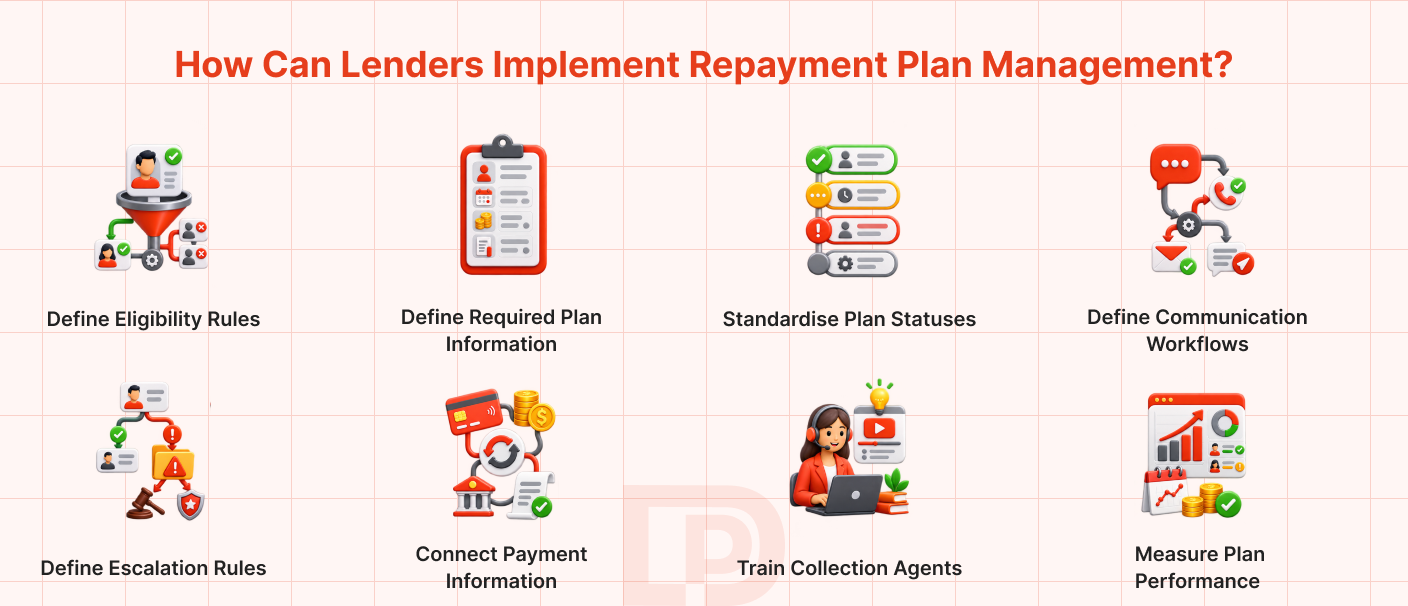
1. Define Eligibility Rules
Decide which accounts may enter a repayment-plan workflow.
Consider:
- Delinquency stage
- Borrower risk
- Loan type
- Outstanding balance
- Previous payment history
- Previous promises
- Collection history
2. Define Required Plan Information
Every plan should capture consistent information such as:
- Amount
- Dates
- Frequency
- Remaining balance
- Borrower confirmation
- Responsible agent
- Next action
3. Standardise Plan Statuses
Possible statuses include:
- Proposed
- Active
- Due
- Partially paid
- Missed
- Completed
- Escalated
4. Define Communication Workflows
Determine what communication should happen:
- Before payment
- On payment date
- After payment
- After missed payment
- After repeated missed payments
5. Define Escalation Rules
Document when the case should move to:
- Agent review
- Senior collector
- Manager
- Another approved recovery stage
6. Connect Payment Information
Collection teams need current payment status to avoid contacting borrowers using outdated information.
7. Train Collection Agents
Agents should understand:
- How to record plans
- Which information is required
- How partial payments are handled
- How borrower outcomes are recorded
- When escalation is required
8. Measure Plan Performance
Managers should monitor whether repayment-plan workflows actually improve recovery.
Who Should Use Repayment Plan Management Software?
Repayment plan management software is useful for:
- Banks
- NBFCs
- Fintech lenders
- Digital lending platforms
- Microfinance institutions
- Loan servicing companies
- Consumer lenders
- Business lenders
- Vehicle finance companies
- Embedded finance providers
- Buy Now, Pay Later providers
- Collection departments
- Debt recovery teams
- Loan servicing teams
It is especially useful for lenders managing large numbers of overdue borrowers where manual tracking becomes difficult.
Want to explore more practical insights on AI development, automation, and conversational AI? Read more blogs at Cloudastra Technologies or contact us for business enquiries through Cloudastra Contact Us.
Frequently Asked Questions
1. What is repayment plan management?
Repayment plan management is the process of recording, monitoring and managing an agreed recovery schedule for an overdue borrower.
2. Why do lenders need repayment plan management?
Lenders need it because some overdue borrowers cannot clear the complete amount immediately. A structured system helps teams track payments, follow-ups and the remaining balance.
3. What is the difference between a repayment plan and a promise to pay?
A promise to pay usually tracks one borrower commitment. A repayment plan may manage a broader schedule containing multiple payments or recovery stages.
4. Can repayment plans include partial payments?
A repayment-plan workflow can record partial payments and track the remaining overdue balance according to the lender’s approved arrangement.
5. What happens when a borrower misses a repayment-plan payment?
The workflow may trigger a reminder, agent follow-up, plan review or escalation according to lender policy and borrower risk.
6. How can lenders track repayment plans?
Lenders can use a digital recovery platform to record payment schedules, borrower communication, payment status, follow-up actions and plan outcomes.
7. What is borrower self-service?
Borrower self-service allows customers to interact digitally with approved parts of the repayment process instead of requiring an agent for every action.
8. Can repayment plan management reduce manual collection work?
Yes. Structured schedules, automated communication and workflow-driven follow-ups can reduce repetitive manual tracking.
9. Should every overdue borrower receive a repayment plan?
No. The appropriate recovery action should depend on borrower circumstances, account status, lender policy and risk.
10. How does DebtPulse support repayment-plan management?
DebtPulse supports repayment-plan management alongside borrower self-service, risk-based prioritisation, automated collection workflows, personalised communication and recovery dashboards.
11. Can DebtPulse help identify high-risk borrowers?
Yes. DebtPulse is designed to help lending teams identify and prioritise higher-risk borrowers as part of the wider recovery process.
12. Does DebtPulse support borrower communication?
Yes. DebtPulse supports automated multi-channel collection workflows and personalised borrower communication.
13. Can managers monitor recovery performance in DebtPulse?
DebtPulse supports portfolio-level recovery visibility through dashboards and collection insights.
14. Who should use DebtPulse?
DebtPulse is useful for banks, NBFCs, fintech lenders, digital lending platforms and loan servicing teams managing debt recovery at scale.