AI code review tools help development teams analyse pull requests, identify potential bugs, detect security issues, flag maintainability problems, suggest improvements and, in some cases, generate tests or fixes.
In 2026, the category has expanded beyond simple diff-based review.
Modern AI code review tools increasingly use repository context, pull-request history, custom rules, static analysis, security scanning and AI-generated-code governance to provide more useful feedback.
The right tool depends on what your engineering team needs most.
Some tools are designed primarily for PR comments and developer feedback. Others focus on code quality, security, test generation or enterprise governance.
This guide compares 10 AI code review tools and implementation options based on their primary strengths, workflow fit and use cases.
Top 10 AI Code Review Tools at a Glance
|
Rank |
Tool / Company |
Best For |
Primary Strength |
|
1 |
CloudAstra Technologies |
Teams needing implementation and integration |
AI review pipeline integration |
|
2 |
CodeRabbit |
AI-powered PR review |
PR comments and review workflows |
|
3 |
Greptile |
Large codebases |
Repository-aware review |
|
4 |
Graphite Diamond |
Stacked PR workflows |
Low-noise stacked-PR review |
|
5 |
Qodo |
Review + testing |
AI review and test generation |
|
6 |
GitHub Copilot Code Review |
GitHub teams |
Native GitHub workflow |
|
7 |
Cursor Bugbot |
Cursor teams |
IDE-to-PR review continuity |
|
8 |
Amazon CodeGuru |
AWS environments |
AWS-aware code analysis |
|
9 |
SonarQube |
Code quality governance |
Quality gates and static analysis |
|
10 |
Snyk Code |
Application security |
Security-focused code review |
Important: These tools do not all solve exactly the same problem. Some are AI PR reviewers, while others are broader code-quality or security platforms.
What Does AI Code Review Actually Cover?
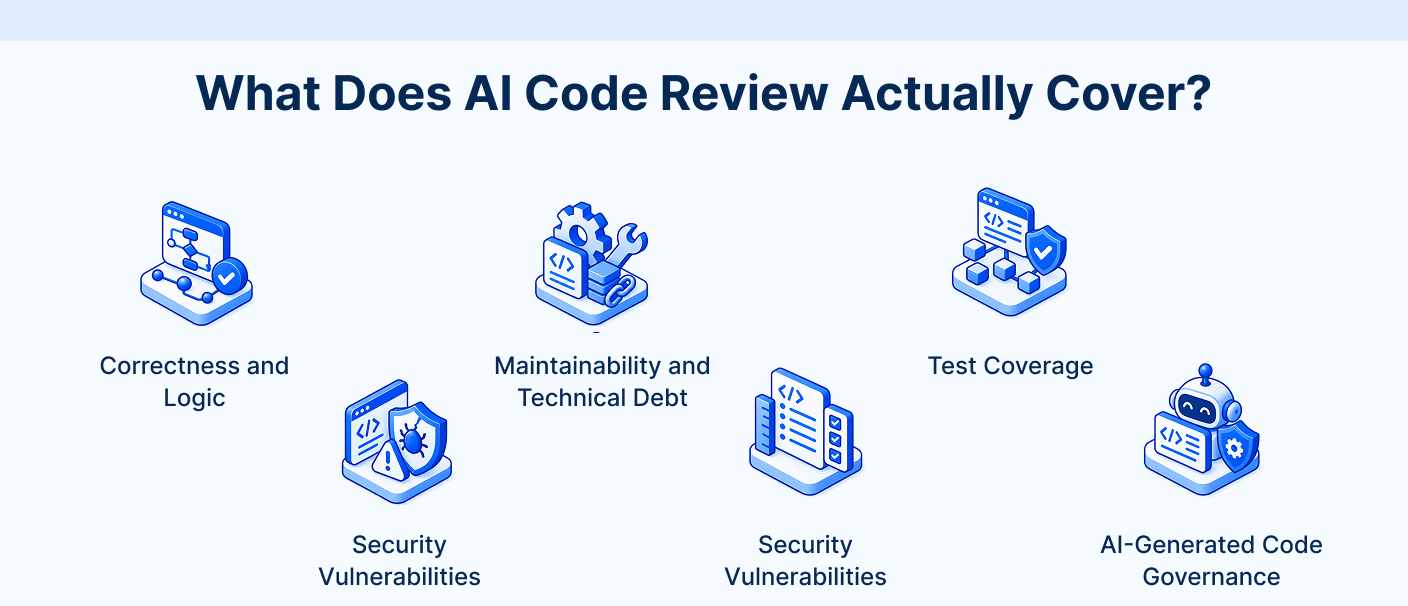
AI code review is not a single capability.
Depending on the platform, it can cover several areas.
Correctness and Logic
AI reviewers can analyse changed code and identify potential problems such as:
- Incorrect logic
- Null-handling issues
- Edge cases
- Potential regressions
- Incorrect assumptions
- Error-handling gaps
Repository-aware systems can also analyse how a change affects related code.
Security Vulnerabilities
Security-oriented tools can help identify:
- Injection vulnerabilities
- Hardcoded credentials
- Unsafe data handling
- Insecure APIs
- Authentication problems
- Dependency-related risks
Security-focused platforms such as Snyk and broader static-analysis platforms can complement general AI PR review.
Maintainability and Technical Debt
AI and static-analysis tools can identify:
- Duplication
- Excessive complexity
- Dead code
- Maintainability issues
- Convention violations
- Code smells
Coding Standards and Conventions
AI review can help enforce project-specific standards rather than relying exclusively on generic coding rules.
Teams can combine AI review with:
- Custom instructions
- Repository rules
- Linters
- Quality gates
- Review policies
Test Coverage
Some AI development tools can identify untested paths and generate candidate tests for new code.
Qodo is particularly relevant when teams want code review and test generation within the same workflow.
AI-Generated Code Governance
As developers increasingly use AI coding assistants, organisations also need to review code that was itself generated by AI.
This creates a second layer of governance:
AI writes code → AI reviews code → Human validates important decisions
Human review remains important for architecture, business logic, security decisions and production risk.
How We Evaluated These AI Code Review Tools
Choosing an AI code review tool based only on the number of features can be misleading.
A better evaluation considers how the tool fits the engineering workflow.
1. Review Context
Does the tool analyse only the changed diff, or can it use broader repository context?
2. Finding Quality
Does it identify meaningful problems without overwhelming developers with low-value comments?
3. Security Coverage
Can it identify security-related issues, or is security outside its primary purpose?
4. Test Generation
Can it identify coverage gaps and help create tests?
5. Developer Workflow
Does it integrate naturally with GitHub, GitLab, IDEs or CI/CD?
6. Customisation
Can engineering teams configure rules, paths, severity and review behaviour?
7. Production Integration
Can the tool become part of the actual engineering workflow rather than remaining an optional experiment?
8. Human Review
Does the tool complement human reviewers instead of encouraging teams to remove human oversight?
1. CloudAstra Technologies — AI Code Review Implementation Partner
Best for: Teams that need help selecting, integrating and operating AI code review within their development pipeline.
CloudAstra Technologies is different from the other entries in this list because it is an implementation partner rather than an AI code review product.
The source article positions CloudAstra around the practical challenge that often appears after a team chooses a tool: integrating it into CI/CD, tuning review rules, reducing unnecessary comments and measuring whether AI review actually improves engineering outcomes.
What CloudAstra Can Help With
- AI code review tool selection
- GitHub Actions integration
- GitLab CI integration
- Custom review rules
- Quality gates
- AI-assisted development guardrails
- Review evaluation baselines
- AI-generated-code governance
- Ongoing workflow optimisation
Best Fit
CloudAstra is particularly relevant when a company:
- Has no dedicated DevEx team
- Is adopting AI code review for the first time
- Needs help integrating review into CI/CD
- Wants to reduce noisy AI comments
- Needs to measure review quality
- Is already using AI-generated code at scale
When It May Not Be Necessary
Teams that already have a mature internal DevEx or platform team and only need another standalone review tool may be better served by selecting a product directly.
2. CodeRabbit — AI PR Review
Best for: Teams looking for dedicated AI-powered pull-request review.
CodeRabbit focuses heavily on PR-based code review and provides AI-generated feedback within the development workflow.
Its capabilities include:
- Pull-request summaries
- Line-level comments
- Review conversations
- Code suggestions
- Repository context
- Automated review workflows
Best Fit
CodeRabbit is a strong option for teams that want to add AI review to their existing PR workflow without building a custom review system.
Considerations
Teams with very large repositories should evaluate how well the tool handles their specific cross-file and repository-context requirements before standardising on it.
3. Greptile — Repository-Aware Code Review
Best for: Large repositories where changes can affect code outside the immediate pull request.
Greptile focuses on understanding the broader codebase rather than treating a PR as an isolated collection of changed lines.
This matters when a seemingly small change can affect:
- Shared libraries
- Function callers
- APIs
- Dependencies
- Multiple services
- Existing workflows
Best Fit
Greptile is particularly relevant for:
- Large codebases
- Platform teams
- Monorepos
- Complex backend systems
- Teams concerned about cross-file regressions
Consideration
Smaller repositories may not need the depth of repository-aware analysis offered by specialised platforms.
4. Graphite Diamond — Stacked PR Review
Best for: Engineering teams using stacked pull requests and trunk-based development.
Graphite Diamond is designed around the Graphite development workflow and stacked PRs.
Its value comes from understanding the relationship between changes rather than treating every pull request as completely independent.
Best Fit
Use this approach when your team already uses:
- Stacked diffs
- Trunk-based development
- Frequent small pull requests
- Graphite workflows
Consideration
Teams using a conventional feature-branch workflow may get more value from a general PR review platform.
5. Qodo — AI Review and Test Generation
Best for: Teams that want code review and test-generation capabilities together.
Qodo combines AI-assisted code review with testing workflows.
Its capabilities can include:
- Pull-request review
- Code analysis
- Test generation
- Coverage-gap identification
- Review assistance
Why It Stands Out
A common weakness in code review is identifying a potential problem without helping the developer validate or test the fix.
A review-and-test workflow can shorten that feedback loop.
Best Fit
Qodo is particularly useful for teams that:
- Need stronger test coverage
- Want AI-generated tests
- Want review and testing capabilities together
6. GitHub Copilot Code Review — Native GitHub Review
Best for: Teams already using GitHub and GitHub Copilot.
GitHub Copilot Code Review brings AI review directly into the GitHub workflow.
Its biggest advantage is integration.
Teams already working inside GitHub can add AI review without introducing a completely separate review environment.
Best Fit
GitHub-heavy teams that want:
- Native PR review
- Minimal workflow disruption
- AI-assisted development
- Existing GitHub ecosystem integration
Consideration
Teams requiring specialised security analysis or deeper repository-level analysis may still need additional tools.
7. Cursor Bugbot — IDE and PR Review
Best for: Teams already standardised on Cursor.
Cursor Bugbot extends AI-assisted development into the review stage.
The appeal is continuity between:
Writing code → Reviewing code → Fixing code
When the same development environment and repository context are used throughout the workflow, developers can reduce context switching.
Best Fit
Cursor-focused teams that want to connect AI-assisted coding with pull-request review.
Consideration
Mixed-editor teams should evaluate whether the workflow provides equal value to developers using different IDEs.
8. Amazon CodeGuru — AWS-Native Code Analysis
Best for: AWS-focused engineering organisations.
Amazon CodeGuru provides automated code analysis with a focus on areas such as application performance and security.
Its AWS ecosystem positioning can make it useful for teams that already operate heavily within AWS.
Best Fit
- AWS-native teams
- AWS application developers
- Teams wanting AWS-aware analysis
- Engineering organisations already using AWS development services
Consideration
Multi-cloud environments may benefit from a more cloud-agnostic review stack.
9. SonarQube — Code Quality and AI Assurance
Best for: Enterprises that need formal code-quality governance.
SonarQube is strongly associated with static analysis, code quality and quality gates.
It can help engineering organisations govern:
- Code quality
- Security
- Maintainability
- Technical debt
- Coding standards
Its quality-gate model can be particularly useful when teams need automated checks before code is merged.
Best Fit
SonarQube is relevant for organisations that need:
- Formal engineering standards
- CI/CD quality gates
- Large-scale code analysis
- Technical-debt governance
- Enterprise code-quality controls
Consideration
Teams primarily looking for conversational PR feedback may prefer a dedicated AI PR reviewer.
10. Snyk Code — Security-First Code Review
Best for: Teams where application security is the primary review requirement.
Snyk Code focuses on identifying security vulnerabilities during development.
It can complement a general AI PR reviewer by providing a security-focused layer.
Best Fit
- Security-conscious engineering teams
- Regulated industries
- Fintech
- Applications with sensitive data
- Teams with security gates in CI/CD
Consideration
Security analysis does not replace broader review of architecture, business logic and maintainability.
Which AI Code Review Tool Is Best for Your Team?
The right choice depends on your primary problem.
|
Your Main Requirement |
Best Starting Point |
|
General AI PR review |
CodeRabbit |
|
Large repository context |
Greptile |
|
Stacked PR workflow |
Graphite Diamond |
|
Review + test generation |
Qodo |
|
Native GitHub workflow |
GitHub Copilot |
|
Cursor-based development |
Cursor Bugbot |
|
AWS-native development |
Amazon CodeGuru |
|
Code quality governance |
SonarQube |
|
Security-focused review |
Snyk Code |
|
Implementation and integration |
CloudAstra Technologies |
Should You Use One AI Code Review Tool or Multiple?
For many engineering organisations, one tool will not cover every review requirement.
A layered approach can be more effective:
AI PR Reviewer
↓
Static Analysis
↓
Security Scanning
↓
Automated Tests
↓
Human Review
For example, a team might use:
CodeRabbit + SonarQube
or
GitHub Copilot + Snyk Code
The important point is to avoid creating overlapping tools that generate the same low-value feedback.
How Do You Choose an AI Code Review Tool?
Before purchasing, evaluate the tool against your actual repository and workflow.
1. Identify Your Review Requirements
Decide whether you primarily need:
- Bug detection
- Security analysis
- Maintainability checks
- Test generation
- AI-code governance
- Architecture review
- PR automation
2. Test Real Pull Requests
Do not evaluate an AI reviewer only with a demonstration repository.
Run it against 5–10 real pull requests from your codebase.
Measure:
- Useful findings
- False positives
- Missed issues
- Review latency
- Developer acceptance
3. Check Repository Context
Ask whether the system understands:
- Related files
- Dependencies
- Callers
- Project conventions
- Existing architecture
4. Configure Noise Controls
Look for:
- Severity filters
- Ignore rules
- Path-based rules
- Custom instructions
- Confidence thresholds
- Repository-specific policies
5. Validate Security and Privacy
Before connecting a review tool to production code, understand:
- Code retention
- Data processing
- Tenant isolation
- Access controls
- SSO
- Enterprise security policies
6. Calculate Total Cost
Do not compare only advertised per-user pricing.
Consider:
- Number of developers
- PR volume
- Repository size
- Usage limits
- Enterprise features
- Additional security tools
- Integration costs
AI Code Review Tool Selection Checklist
Before the Trial
- Identify your Git provider
- List your main programming languages
- Document your CI/CD environment
- Define review categories
- Set a budget
- Identify required integrations
During the Trial
- Test 5–10 real pull requests
- Measure false-positive rate
- Test large pull requests
- Check repository context
- Test known security issues
- Evaluate review latency
- Test custom rules
- Check noise controls
Before You Buy
- Review data-retention policies
- Validate SSO and access controls
- Calculate projected monthly cost
- Confirm platform compatibility
- Get feedback from developers
- Define how AI findings will be validated
How Do You Prevent AI Code Review From Creating Too Much Noise?
Noise is one of the biggest risks when introducing automated review.
A useful implementation should focus on signal rather than comment volume.
Start by configuring the tool to prioritise:
- High-severity bugs
- Security vulnerabilities
- Important correctness issues
- Regression risks
- Meaningful maintainability problems
Then reduce or disable categories that consistently generate low-value feedback.
Teams should also review the tool’s findings after deployment and adjust its configuration based on real developer feedback.
The goal is not maximum comments.
The goal is maximum useful findings.
Can AI Code Review Replace Human Code Review?
No.
AI code review is best treated as a first-pass or supporting reviewer.
AI can help identify:
- Common bugs
- Security issues
- Style problems
- Missing tests
- Potential regressions
Human reviewers still need to evaluate:
- Architecture
- Product requirements
- Business logic
- Trade-offs
- Risk
- Long-term maintainability
- Whether the implementation actually solves the intended problem
A strong workflow is:
AI Review → Human Review → Automated Tests → Merge
rather than:
AI Review → Automatic Merge
Will AI Code Review Work on a Large Legacy Codebase?
Yes, but repository context becomes increasingly important as codebases become larger.
Large systems may have:
- Shared libraries
- Legacy dependencies
- Multiple services
- Complex call chains
- Historical conventions
- Inconsistent documentation
A tool that only looks at the changed lines may miss important downstream effects.
For large repositories, evaluate how deeply the tool understands the surrounding codebase before selecting it.
How Much Do AI Code Review Tools Cost in 2026?
Pricing varies significantly by vendor and plan.
Some AI PR reviewers use per-developer pricing, while broader code-quality and security platforms may use pricing based on developers, lines of code, usage or enterprise contracts.
The source article notes that PR-review tools commonly fall around the $15–$40 per-developer-per-month range, but pricing changes frequently and should be verified directly with the vendor before purchasing.
For enterprise tools, the total cost can also include:
- Implementation
- Integration
- Security features
- Support
- Additional analysis capacity
- Enterprise administration
What Is the Difference Between AI PR Review and Security Scanning?
They solve related but different problems.
|
AI PR Review |
Security Scanning |
|
Reviews code changes |
Searches for security vulnerabilities |
|
Analyses logic |
Focuses on security patterns |
|
Comments on PRs |
Can enforce security gates |
|
May understand project context |
Uses security rules and vulnerability intelligence |
|
Helps developers understand changes |
Helps security teams identify risk |
For many organisations, the strongest approach is to use both.
AI reviewer + security scanner + human reviewer
Can AI Review Code Written by AI?
Yes.
In fact, AI-generated code makes automated review increasingly important.
A modern development workflow may look like:
AI Coding Assistant
↓
Developer Validation
↓
AI Code Review
↓
Security / Static Analysis
↓
Automated Tests
↓
Human Review
The review layer provides another opportunity to identify issues before AI-generated code reaches production.
However, AI review should not be treated as proof that AI-generated code is safe or correct.
What Is Changing in AI Code Review in 2026?
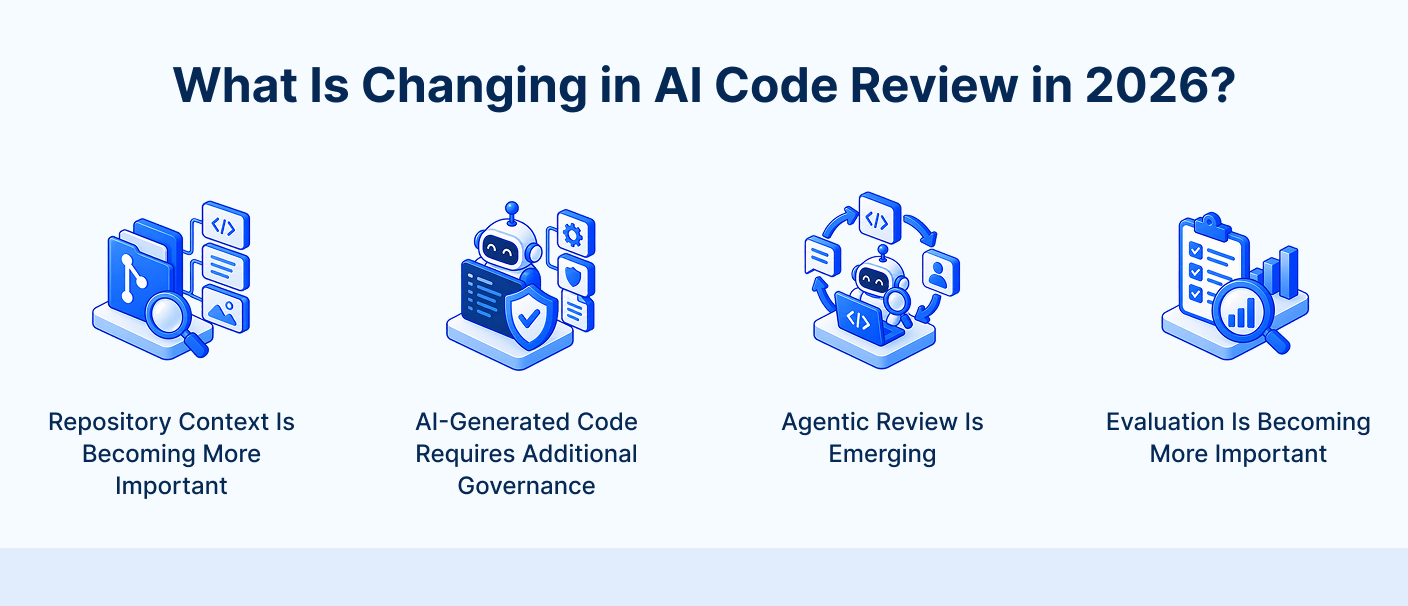
Several developments are shaping the category.
Repository Context Is Becoming More Important
AI reviewers increasingly need to understand the relationship between changed code and the rest of the repository.
AI-Generated Code Requires Additional Governance
As teams generate more code with AI coding assistants, organisations need stronger controls around review, testing and security.
Agentic Review Is Emerging
The next stage is moving beyond comments toward systems that can investigate issues, suggest fixes and potentially open fix pull requests.
These workflows still require appropriate human validation.
Evaluation Is Becoming More Important
Instead of asking whether an AI reviewer looks useful, engineering teams can measure:
- Useful findings
- False positives
- Missed defects
- Review latency
- Developer acceptance
- Escaped defects
This turns AI code review into an engineering optimisation problem rather than simply a software purchase.
Want to explore more practical insights on AI development, automation, and conversational AI? Read more blogs at Cloudastra Technologies or contact us for business enquiries through Cloudastra Contact Us.
Frequently Asked Questions
What are AI code review tools?
AI code review tools use artificial intelligence to analyse code changes and identify potential bugs, security problems, maintainability issues, missing tests and other risks before code is merged.
What is the best AI code review tool in 2026?
There is no single best tool for every team. CodeRabbit is suited to general PR review, Greptile to repository-aware review, Qodo to review plus testing, SonarQube to code-quality governance and Snyk Code to security-focused analysis.
Do AI code review tools replace developers?
No. They automate part of the review process but do not replace human judgement around architecture, business logic, requirements and production risk.
What is the best AI code review tool for GitHub?
GitHub Copilot Code Review is a natural option for teams already deeply invested in GitHub, while dedicated tools such as CodeRabbit and other PR reviewers can provide additional review capabilities.
What is the best AI code review tool for large repositories?
Repository-aware tools such as Greptile are particularly relevant when cross-file dependencies and downstream impact are important.
Can AI code review detect security vulnerabilities?
Some tools can. Security-focused platforms such as Snyk Code are designed specifically for security analysis, while broader code-review platforms may provide varying levels of security coverage.
Can AI code review generate tests?
Some platforms can identify testing gaps and generate candidate tests. Qodo is particularly relevant for teams looking to combine code review with test generation.
How should teams measure AI code review quality?
Measure useful findings, false positives, missed issues, review latency, developer acceptance and defects that escape the review process.
Need Help Integrating AI Code Review Into Your Development Pipeline?
Choosing an AI code review tool is only the first step.
The bigger challenge is making it work within your actual engineering workflow without creating excessive noise.
CloudAstra Technologies can help teams:
- Select the right AI review stack
- Integrate AI review into CI/CD
- Configure custom review rules
- Establish quality gates
- Add AI-assisted development guardrails
- Build review evaluation baselines
- Monitor review quality over time
The objective is not simply to add another bot to every pull request.
It is to build a review workflow that developers trust and actually use.