AI adoption is moving faster than many organizations’ governance processes.
Companies are deploying generative AI, machine learning models, AI agents, automated decision systems, and third-party LLMs across customer service, lending, hiring, healthcare, insurance, operations, and other business functions.
But putting an AI system into production creates questions that go far beyond model accuracy.
Organizations increasingly need to understand:
What AI systems are we operating?
What risks do they create?
Which regulations and internal policies apply?
How are decisions documented?
Can we identify bias, drift, hallucinations, or other undesirable behavior?
Can we explain what happened if an auditor, customer, regulator, or internal risk team asks?
This is where AI compliance tools and AI governance platforms become important.
These platforms can help organizations manage AI inventories, classify risk, document models, monitor production behavior, maintain audit trails, evaluate fairness, and support regulatory governance.
However, AI compliance is not one software category.
Some platforms focus on AI governance.
Others specialize in model monitoring and observability.
Some concentrate on bias, explainability, or model-risk management.
And implementation partners help organizations translate governance requirements into actual technical controls and operational processes.
This guide compares 10 AI compliance tools and implementation options in 2026 based on their primary strengths, ideal users, and role within an AI governance program.
Top 10 AI Compliance Tools and Partners at a Glance
|
Rank |
Tool / Partner |
Type |
Best For |
Primary Strength |
|
1 |
CloudAstra Technologies |
Implementation Partner |
Teams needing implementation support |
AI governance implementation |
|
2 |
Credo AI |
Governance Platform |
Enterprise AI governance |
Policy and risk management |
|
3 |
Holistic AI |
Governance Platform |
Responsible AI and risk assessment |
Governance and AI assurance |
|
4 |
Fairly AI |
Risk & Governance |
Regulated organizations |
AI risk management |
|
5 |
Monitaur |
Governance & Assurance |
Regulated industries |
Model governance and assurance |
|
6 |
Fiddler AI |
Observability |
Production AI/ML teams |
Explainability and monitoring |
|
7 |
Arthur AI |
AI Monitoring |
Production AI teams |
Model and LLM monitoring |
|
8 |
WhyLabs |
AI Observability |
Engineering-led teams |
Data and model observability |
|
9 |
IBM watsonx.governance |
Enterprise Governance |
Large enterprises |
AI lifecycle governance |
|
10 |
ModelOp |
AI Governance |
Banks and regulated enterprises |
Model and AI governance |
Important: These are not ten identical products. CloudAstra is positioned as an implementation partner, while the remaining entries provide different combinations of governance, monitoring, observability, risk management, and compliance capabilities.
What Is an AI Compliance Tool?
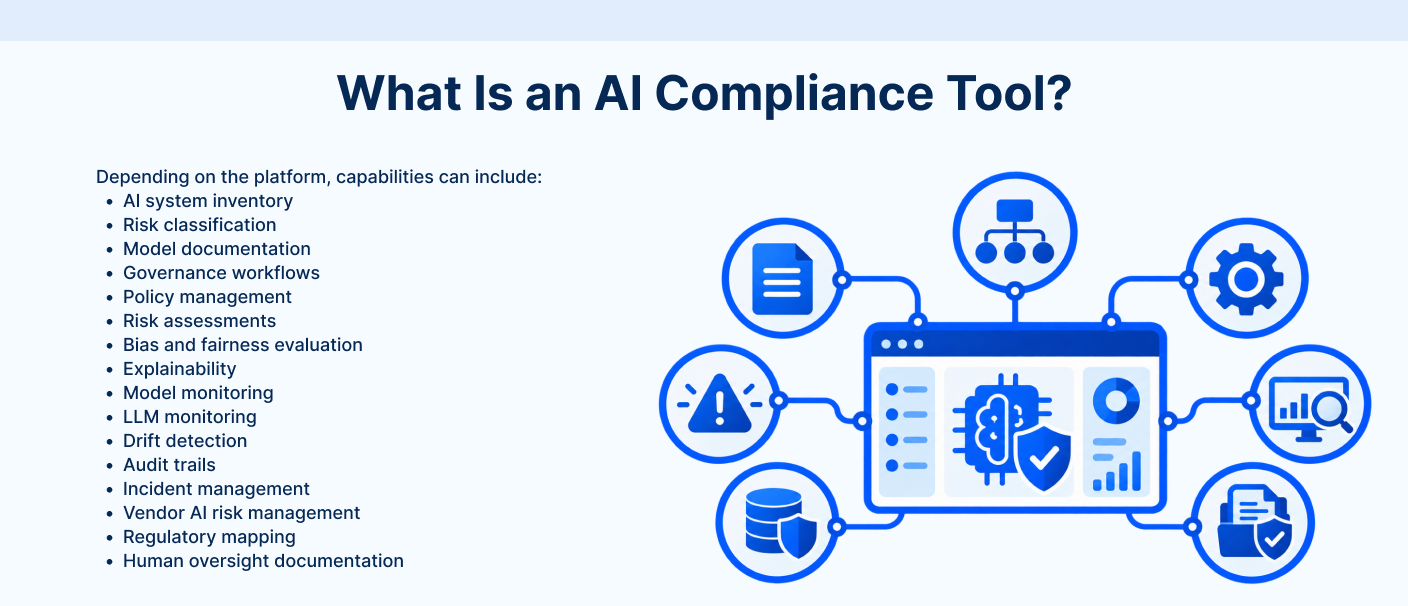
An AI compliance tool is software designed to help organizations govern AI systems and manage the risks, controls, documentation, monitoring, and evidence associated with their use.
Depending on the platform, capabilities can include:
- AI system inventory
- Risk classification
- Model documentation
- Governance workflows
- Policy management
- Risk assessments
- Bias and fairness evaluation
- Explainability
- Model monitoring
- LLM monitoring
- Drift detection
- Audit trails
- Incident management
- Vendor AI risk management
- Regulatory mapping
- Human oversight documentation
An AI compliance platform does not automatically make an organization compliant.
Instead, it provides infrastructure that can help teams identify requirements, implement controls, document decisions, monitor systems, and maintain evidence.
Why Are AI Compliance Tools Becoming More Important in 2026?
AI governance has moved from a theoretical discussion into an operational requirement for many organizations.
The reason is straightforward.
AI systems are increasingly influencing real business decisions.
They can help determine:
- Which customer receives an offer
- Which transaction is flagged
- Which applicant receives additional review
- Which support response is generated
- Which document is summarized
- Which borrower receives a risk score
- Which employee candidate progresses
- Which operational action occurs automatically
As AI becomes more deeply connected to business workflows, organizations need stronger visibility into how those systems behave.
At the same time, AI regulation and enterprise procurement expectations are increasing the importance of governance, documentation, monitoring, and risk management.
The result is a new requirement:
Organizations need to govern AI throughout its lifecycle—not only before deployment.
What Does AI Compliance Actually Cover?
AI compliance is not a single checkbox.
A mature governance program may involve several layers.
1. AI System Inventory
Organizations first need to know what AI they are using.
This sounds simple, but large organizations may operate:
- Internal machine learning models
- Third-party LLM APIs
- AI assistants
- AI agents
- Vendor-provided AI features
- Automated decision systems
- Recommendation systems
- Risk models
- Generative AI applications
Without an inventory, it becomes difficult to determine which systems require additional controls.
2. Risk Classification
Different AI systems create different levels and types of risk.
An internal summarization tool does not necessarily require the same controls as an AI system involved in employment, lending, healthcare, or another consequential decision.
Risk classification helps organizations determine which systems require stronger governance.
3. AI Documentation
Governance teams need documentation explaining important aspects of an AI system.
Depending on the system and regulatory context, documentation can include:
- Intended use
- System architecture
- Model information
- Data sources
- Known limitations
- Evaluation methodology
- Performance information
- Human oversight
- Monitoring processes
- Risk controls
- Incident procedures
Good documentation makes AI systems easier to review internally and externally.
4. Bias and Fairness Assessment
AI systems used in sensitive or consequential contexts may require evaluation for potential bias and unfair outcomes.
Organizations may need to evaluate performance across relevant groups and investigate whether model behavior creates unacceptable disparities.
5. Explainability
Some organizations need to understand why a model produced a particular output or decision.
Explainability becomes especially important in regulated environments and high-impact use cases.
6. Production Monitoring
An AI system that performed well during testing may behave differently after deployment.
Production monitoring can help teams identify:
- Data drift
- Model drift
- Performance degradation
- Hallucinations
- Toxicity
- Unexpected outputs
- Bias changes
- Prompt injection attempts
- Other operational anomalies
AI governance therefore continues after launch.
7. Human Oversight
Automation does not eliminate accountability.
Organizations should define:
- Which decisions AI can make
- Which decisions require approval
- When humans intervene
- How users challenge outcomes
- How exceptions are handled
- Who owns the final decision
8. Incident Management
Organizations need processes for identifying and responding to serious AI failures.
A structured incident process can include:
Detection → Classification → Investigation → Containment → Documentation → Corrective Action → Follow-Up
9. Third-Party AI Risk
Many companies do not train their own foundation models.
Instead, they use third-party models or AI-enabled software.
That does not remove the need for governance.
Organizations still need to understand how external AI components are used within their own systems and what risks those deployments create.
How We Evaluated These AI Compliance Tools
A useful AI compliance comparison should evaluate more than the number of features on a product page.
The following criteria provide a more practical framework.
Governance Capabilities
Can the platform help organizations manage policies, AI inventories, risks, controls, and governance workflows?
Regulatory Mapping
Can organizations map AI systems and controls against relevant regulatory or risk-management frameworks?
Monitoring
Can the platform monitor AI behavior after deployment?
Explainability
Does it help teams investigate how or why models produce certain outputs?
Risk Management
Can teams identify, categorize, prioritize, and manage AI risks?
Auditability
Does the system maintain evidence of assessments, controls, decisions, and governance activity?
Integration
Can it work with the organization’s existing AI, data, cloud, and development environment?
Operational Fit
Does the platform match the organization’s size, industry, technical maturity, and compliance requirements?
1. CloudAstra Technologies — AI Governance Implementation Partner
Type: Implementation Partner
Best For: Organizations that need help turning AI governance requirements into working technical and operational controls.
CloudAstra Technologies is different from the software platforms in this list.
Rather than providing only an AI compliance product, CloudAstra can help organizations design and implement AI governance processes around their existing technology stack.
This can include work around:
- AI system discovery
- Risk classification
- Governance documentation
- Monitoring architecture
- AI evaluation
- Technical controls
- Human oversight
- AI application architecture
- Compliance-oriented engineering workflows
Why Use an Implementation Partner?
Buying governance software does not automatically answer questions such as:
Which AI systems belong in the inventory?
How should risks be classified?
Which monitoring metrics matter?
Where should human approval occur?
How should an incident workflow connect with engineering?
What evidence needs to be maintained?
Implementation partners help connect the governance framework with the technical system.
Best Fit
CloudAstra can be relevant for organizations that:
- Already have AI systems in development or production
- Need governance implementation support
- Have limited internal AI governance engineering capacity
- Need to connect compliance requirements with engineering workflows
- Want to integrate monitoring and controls into existing AI systems
When It May Not Be Necessary
Organizations with mature internal AI governance, legal, risk, platform engineering, and compliance teams may only require a software platform.
2. Credo AI — Enterprise AI Governance Platform
Best For: Enterprises building centralized AI governance programs.
Credo AI focuses on helping organizations manage AI governance and risk across their AI portfolio.
Its positioning is particularly relevant for organizations that need structured oversight across multiple AI systems.
Capabilities can include areas such as:
- AI governance
- Risk management
- Policy management
- AI inventory
- Regulatory mapping
- Governance workflows
- Vendor AI risk
Why It Stands Out
Large enterprises frequently have multiple AI systems across different departments.
A centralized governance layer can help standardize how those systems are assessed and managed.
Best Fit
Credo AI is particularly relevant for:
- Large enterprises
- Formal governance teams
- Organizations operating many AI systems
- Businesses establishing centralized AI policy
Consideration
Smaller companies with only one or two relatively simple AI use cases may not require the breadth of an enterprise governance platform.
3. Holistic AI — AI Governance, Risk and Assurance
Best For: Organizations focused on responsible AI, governance, risk assessment, and AI assurance.
Holistic AI operates across several parts of the AI governance lifecycle.
Its positioning can be relevant for organizations that need structured assessment of AI risks and responsible-AI practices.
Potential Use Cases
- AI risk assessment
- Governance
- Responsible AI
- AI assurance
- Bias assessment
- Regulatory readiness
Best Fit
Organizations operating higher-impact AI systems where governance and assurance are important parts of the deployment process.
Consideration
Engineering teams primarily looking for lightweight production observability may prefer a monitoring-focused platform.
4. Fairly AI — AI Risk Management and Governance
Best For: Organizations that need structured AI risk management.
Fairly AI focuses on helping organizations identify, evaluate, and manage risks associated with AI systems.
This can be particularly relevant in regulated or risk-sensitive environments.
Key Areas
- AI risk management
- Governance workflows
- Model documentation
- Risk assessments
- Framework alignment
Best Fit
Financial services, insurance, and other organizations where model and AI risk management are important.
Consideration
Teams whose main challenge is deep production observability may need complementary monitoring infrastructure.
5. Monitaur — AI Governance and Assurance
Best For: Regulated industries requiring structured model governance and assurance.
Monitaur focuses on governance and assurance around models and AI systems.
For regulated organizations, the ability to maintain structured evidence around model development, review, and operation can be particularly valuable.
Potential Strengths
- Model governance
- Assurance
- Documentation
- Review workflows
- Governance evidence
Best Fit
- Insurance
- Financial services
- Regulated enterprises
- Organizations with formal model governance processes
Consideration
Smaller generative-AI applications may not require the same level of governance structure.
6. Fiddler AI — AI Observability and Explainability
Best For: Teams that need production monitoring and explainability across AI/ML systems.
Fiddler AI approaches AI governance from the observability side.
Production AI teams need visibility into what happens after deployment.
This can include monitoring:
- Model performance
- Drift
- Explainability
- Bias
- LLM behavior
- Production anomalies
Why It Matters
Governance documentation tells organizations how an AI system is supposed to behave.
Observability helps determine how it is actually behaving in production.
Best Fit
- Production ML teams
- LLM applications
- Financial services
- High-impact models
- Organizations requiring explainability
Consideration
Organizations looking primarily for policy-management and regulatory-governance workflows may need a broader governance platform alongside observability.
7. Arthur AI — Production AI Monitoring
Best For: Organizations operating multiple production AI systems.
Arthur AI focuses on monitoring AI and model behavior in production environments.
This can help organizations identify problems that emerge after deployment.
Monitoring Can Include
- Model performance
- Drift
- LLM behavior
- Hallucination-related evaluation
- Toxicity
- Other production AI risks
Best Fit
Product and engineering teams that already have AI in production and need stronger operational visibility.
Consideration
Monitoring is only one component of AI compliance.
Organizations may still need governance, documentation, policy management, and broader risk-management processes.
8. WhyLabs — AI and Data Observability
Best For: Engineering-led organizations that want observability around data and AI systems.
WhyLabs approaches AI governance from a monitoring and observability perspective.
Its ecosystem has included open-source tooling around data and model profiling, which can be attractive to technical teams wanting more control over implementation.
Potential Use Cases
- Data monitoring
- Model monitoring
- AI observability
- Production quality checks
- Engineering-led governance
Best Fit
Engineering organizations that want observability integrated closely with existing development and data workflows.
Consideration
Compliance teams looking for ready-made governance assessments and policy workflows may need additional tooling.
9. IBM watsonx.governance — Enterprise AI Governance
Best For: Large enterprises requiring broad AI governance within an enterprise technology environment.
IBM watsonx.governance is designed around governance across the AI lifecycle.
Enterprise organizations may use governance platforms to manage:
- AI risk
- Model lifecycle
- Documentation
- Monitoring
- Governance workflows
- Regulatory requirements
Best Fit
- Large enterprises
- Financial institutions
- Existing IBM environments
- Formal AI governance programs
Consideration
Smaller organizations should evaluate whether they require the complexity and breadth of an enterprise governance suite.
10. ModelOp — AI and Model Governance for Regulated Enterprises
Best For: Financial institutions and other organizations with mature model-risk requirements.
ModelOp focuses heavily on governance across AI and model lifecycles.
This makes it particularly relevant where organizations already have established model-risk-management processes.
Potential Use Cases
- Model inventory
- Governance workflows
- Model lifecycle management
- Risk management
- Documentation
- Enterprise oversight
Best Fit
- Banks
- Insurance organizations
- Financial institutions
- Large regulated enterprises
Consideration
AI-native startups with a small number of models may prefer a lighter governance stack.
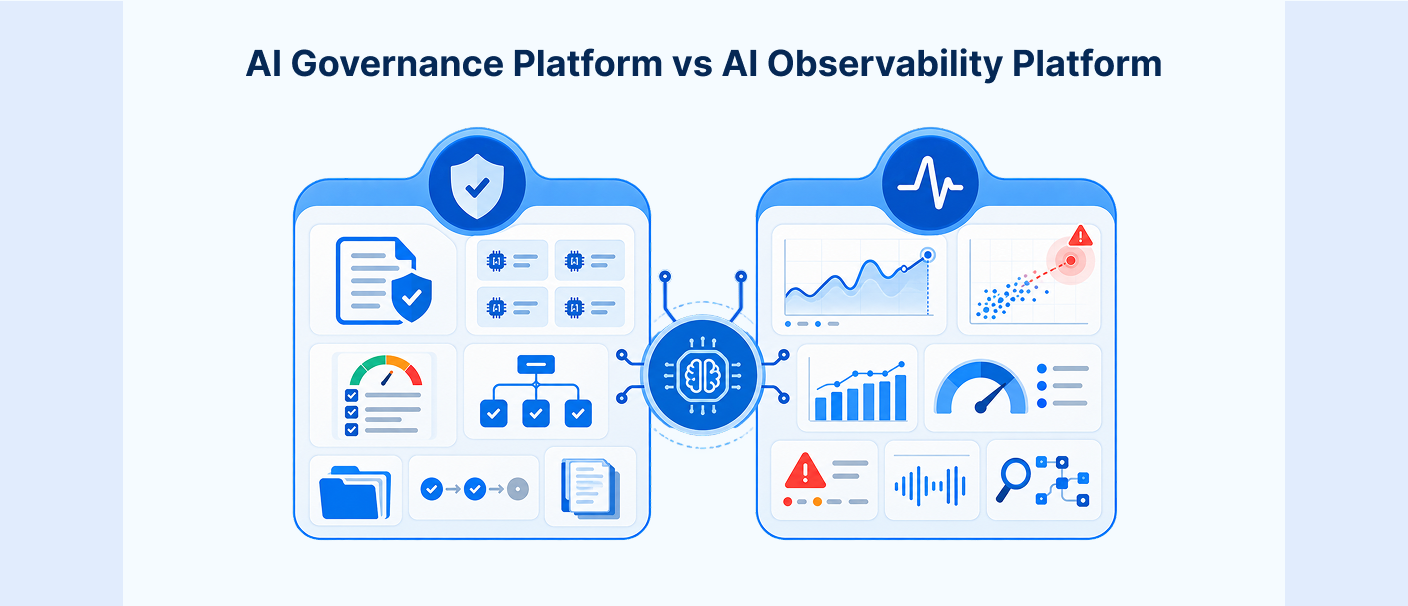
AI Governance Platform vs AI Observability Platform
One of the most important distinctions when choosing AI compliance software is the difference between governance and observability.
|
AI Governance Platform |
AI Observability Platform |
|
Manages AI policies |
Monitors production AI |
|
Maintains AI inventory |
Tracks model behavior |
|
Supports risk assessments |
Detects drift |
|
Maps controls |
Measures performance |
|
Maintains governance evidence |
Identifies runtime problems |
|
Supports audit workflows |
Provides operational telemetry |
|
Helps document systems |
Helps understand system behavior |
Many organizations eventually need both.
A practical architecture might look like:
AI Inventory
↓
Risk Classification
↓
Governance Controls
↓
Pre-Deployment Evaluation
↓
Production Deployment
↓
Observability & Monitoring
↓
Incident Detection
↓
Governance Review
↓
Updated Controls
AI Compliance Tool vs AI Compliance Implementation Partner
Software and implementation services solve different problems.
AI Compliance Platform
Provides the infrastructure for:
- Governance
- Risk records
- Policies
- Monitoring
- Assessments
- Documentation
- Audit evidence
Implementation Partner
Helps determine:
- What needs to be governed
- How controls should work
- Where monitoring belongs
- What needs to be documented
- How governance integrates with engineering
- How AI systems should be evaluated
- How human oversight should work
For some organizations, a platform alone is sufficient.
Others may need:
Governance Platform + Monitoring Platform + Implementation Support
How Do You Choose the Right AI Compliance Tool?
The right platform depends on the actual governance problem you are trying to solve.
Step 1: Inventory Your AI Systems
List:
- Internal models
- Generative AI applications
- AI agents
- Third-party AI services
- Automated decision systems
- AI-enabled vendor products
You cannot govern systems you do not know exist.
Step 2: Identify the Applicable Risk Context
Determine:
- Where the system is deployed
- What decisions it influences
- Who is affected
- What data it processes
- Whether it operates in a regulated sector
- Whether humans review outputs
This helps determine the level of governance required.
Step 3: Identify Your Biggest Governance Gap
Ask what is currently missing.
Is the problem:
- AI inventory?
- Documentation?
- Risk classification?
- Bias testing?
- Explainability?
- Monitoring?
- Audit evidence?
- Incident management?
- Vendor AI risk?
Do not buy a large governance suite if the actual problem is only production monitoring.
Step 4: Evaluate Integration Requirements
The tool needs to fit your AI stack.
Evaluate compatibility with:
- Model providers
- LLM APIs
- Cloud infrastructure
- MLOps systems
- Data platforms
- CI/CD
- Logging infrastructure
- Internal governance tools
Step 5: Evaluate Evidence and Auditability
Ask:
Can we show what assessments were performed?
Can we show who approved the system?
Can we demonstrate which controls were active?
Can we reconstruct an incident?
Can we export evidence for internal or external review?
Governance without evidence is difficult to demonstrate.
Which AI Compliance Tool Is Best for Your Organization?
|
Your Primary Requirement |
Strong Starting Point |
|
AI governance implementation |
CloudAstra Technologies |
|
Enterprise governance |
Credo AI |
|
Responsible AI and assurance |
Holistic AI |
|
AI risk management |
Fairly AI |
|
Regulated model governance |
Monitaur |
|
Explainability + monitoring |
Fiddler AI |
|
Production AI monitoring |
Arthur AI |
|
Engineering-led observability |
WhyLabs |
|
Enterprise governance suite |
IBM watsonx.governance |
|
Financial model governance |
ModelOp |
The correct choice depends on your organization, AI portfolio, jurisdiction, industry, technical environment, and governance maturity.
Can One AI Compliance Tool Handle Everything?
Usually, organizations should be cautious about expecting one platform to solve every governance problem.
AI compliance spans multiple disciplines:
Legal + Risk + Compliance + Engineering + Data + Security + Product
A company might use one platform for governance and another for runtime observability.
For example:
Governance Platform
↓
AI Development Environment
↓
Evaluation Framework
↓
Production Monitoring
↓
Incident Management
↓
Human Review
↓
Governance Evidence
The important objective is not maximizing the number of tools.
It is ensuring there are no important governance gaps between them.
What Should You Ask an AI Compliance Vendor?
Before purchasing a platform, ask questions that reveal how it will operate inside your organization.
Governance
- Can we maintain an inventory of AI systems?
- Can we classify systems by risk?
- Can we create custom governance policies?
- Can we assign control owners?
Regulatory Support
- Which frameworks does the platform currently support?
- How are regulatory mappings updated?
- Can mappings be customized?
Monitoring
- Can the platform monitor our specific model types?
- Does it support generative AI?
- Can we define custom metrics?
Integration
- Which model providers are supported?
- Which MLOps platforms are supported?
- Can it integrate with our data and logging systems?
Auditability
- Can evidence be exported?
- Are assessment changes versioned?
- Can reviewer actions be traced?
- Can we reconstruct historical decisions?
Security
- How is AI data handled?
- What is retained?
- What access controls are available?
- What enterprise security features are supported?
Can You Build AI Compliance Tooling In-House?
Yes, some organizations can.
A small company with only a few AI systems may be able to build an internal governance process using:
- AI inventory documents
- Risk-assessment templates
- Evaluation pipelines
- Monitoring dashboards
- Incident procedures
- Documentation repositories
- Approval workflows
However, complexity increases as the AI portfolio grows.
An organization operating dozens or hundreds of AI systems may need:
- Centralized inventory
- Automated assessments
- Policy management
- Evidence management
- Multiple framework mappings
- Enterprise access controls
- Cross-team workflows
- Continuous monitoring
At that point, dedicated governance software may become more practical.
Do You Need AI Compliance Tools When Using Third-Party LLMs?
Using a third-party model does not remove the need to govern the application built around it.
Consider a company using an external LLM inside a customer-facing application.
The organization still controls:
- What data enters the model
- How prompts are designed
- What tools the model can access
- How outputs are used
- Whether outputs affect customers
- Where human review occurs
- How incidents are handled
- What monitoring exists
The model provider manages the underlying model.
The deploying organization still needs to manage the risks created by its particular implementation and use case.
How Should Organizations Monitor AI Systems After Deployment?
Pre-deployment testing is not enough.
Production AI systems can change because of:
- New input data
- User behavior
- Prompt changes
- Model updates
- Retrieval changes
- External integrations
- Business-process changes
A monitoring strategy can include:
Performance Monitoring
Is the system still achieving its intended objective?
Drift Monitoring
Have input or output patterns changed?
LLM Evaluation
Are hallucination, relevance, safety, or other quality metrics changing?
Bias Monitoring
Are outcomes changing across relevant groups?
Security Monitoring
Are users attempting prompt injection, jailbreaks, or other adversarial interactions?
Incident Monitoring
Are failures being identified and escalated?
Monitoring results should feed back into governance.
What Is the Role of Human Oversight in AI Compliance?
Human oversight is one of the most important components of responsible AI deployment.
Organizations should define:
Who can override the AI?
When must a human review an output?
What happens when confidence is low?
How can users challenge a decision?
Who investigates incidents?
Who is ultimately accountable?
Human oversight should not be an abstract policy statement.
It should be designed into the workflow.
For example:
AI Recommendation
↓
Risk Threshold
↓
Low Risk → Automated Workflow
Higher Risk → Human Review
↓
Approve / Reject / Escalate
↓
Decision Recorded
This makes oversight operational rather than theoretical.
What Are Common AI Compliance Mistakes?
Treating Compliance as a One-Time Project
AI governance needs to continue after deployment.
Buying Software Before Understanding the Risk
Start with AI inventory and risk assessment before choosing tooling.
Documenting Systems but Not Monitoring Them
Documentation describes intended behavior.
Monitoring reveals actual behavior.
Monitoring Systems Without Governance Ownership
Someone needs responsibility for responding to identified problems.
Ignoring Third-Party AI
External models and AI-enabled vendor products should still be considered within the organization’s AI governance process.
Collecting Evidence Manually Forever
Manual governance may work initially but becomes difficult as the AI portfolio grows.
Assuming AI Compliance Equals Legal Compliance
Software can support governance and evidence management, but legal interpretation and regulatory obligations may require qualified legal and compliance professionals.
What Is Changing in AI Governance in 2026?
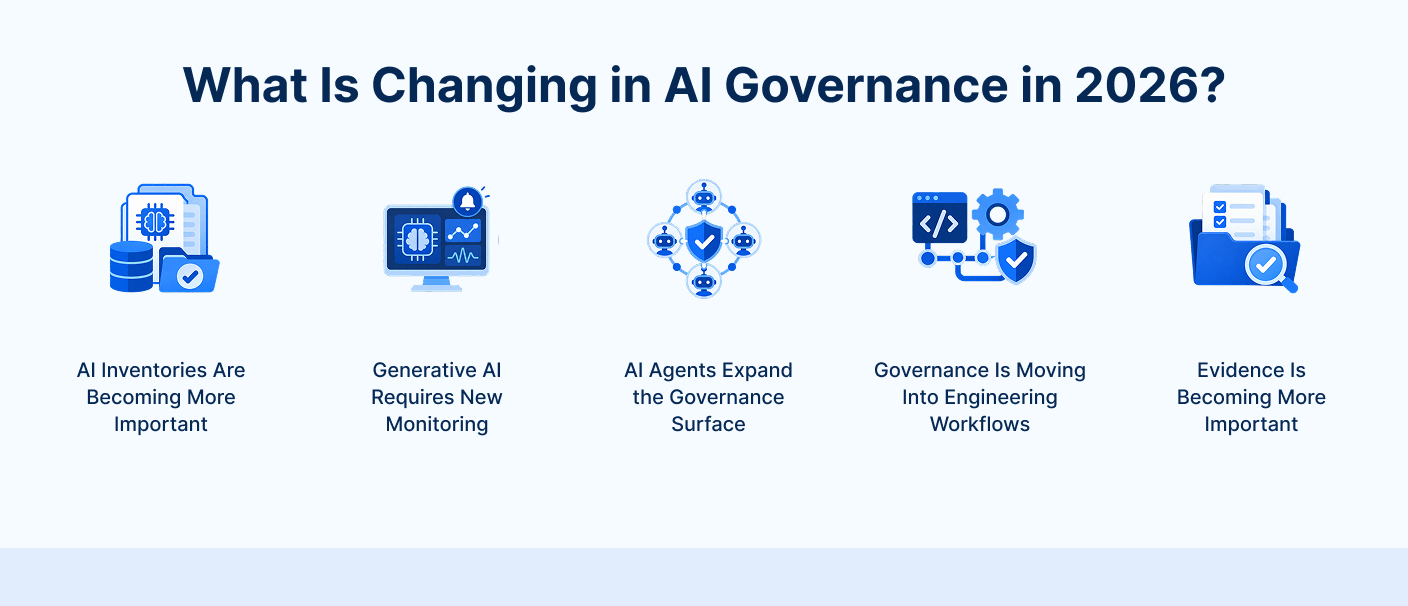
AI governance is increasingly becoming an operational engineering discipline rather than only a policy exercise.
Several trends are driving this shift.
AI Inventories Are Becoming More Important
Organizations need visibility into where AI exists across the business.
Generative AI Requires New Monitoring
Traditional model-performance metrics are not sufficient for many LLM applications.
Teams increasingly evaluate:
- Hallucination
- Relevance
- Safety
- Toxicity
- Retrieval quality
- Tool behavior
AI Agents Expand the Governance Surface
Agents can take actions rather than simply generate responses.
Governance therefore needs to consider:
- Tool permissions
- Action boundaries
- Approval requirements
- Memory
- External systems
- Human escalation
Governance Is Moving Into Engineering Workflows
Controls increasingly need to exist inside development, deployment, monitoring, and incident-management systems.
Evidence Is Becoming More Important
Organizations need to demonstrate not simply that a policy exists, but that controls were actually implemented and followed.
Want to explore more practical insights on AI development, automation, and conversational AI? Read more blogs at Cloudastra Technologies or contact us for business enquiries through Cloudastra Contact Us.
Frequently Asked Questions
What are AI compliance tools?
AI compliance tools are platforms that help organizations manage AI governance, risk assessments, documentation, monitoring, policies, controls, and audit evidence.
What is the best AI compliance tool in 2026?
There is no single best platform for every organization. Credo AI is oriented toward enterprise governance, Fiddler and Arthur toward production monitoring, ModelOp toward model governance, while other platforms address different portions of the AI governance lifecycle.
What is the difference between AI governance and AI compliance?
AI governance is the broader system of policies, responsibilities, controls, monitoring, and oversight used to manage AI. Compliance focuses more specifically on meeting applicable legal, regulatory, contractual, and internal requirements.
Do startups need AI compliance software?
Not every startup needs an enterprise governance platform. The requirement depends on the number of AI systems, use cases, industry, customers, jurisdictions, and associated risk.
Do AI compliance tools automatically make a company compliant?
No. Tools support governance, monitoring, documentation, and evidence. Organizations still need appropriate policies, controls, ownership, technical implementation, and professional legal or compliance interpretation where required.
Do I need AI governance if I use OpenAI, Anthropic, or another third-party model?
Potentially, yes. Organizations still need to govern how third-party models are integrated, what data they receive, what outputs are used for, and what controls exist around the resulting application.
What is AI model governance?
AI model governance is the process of managing models across their lifecycle, including development, validation, approval, deployment, monitoring, change management, and retirement.
What should an AI compliance platform include?
Depending on the use case, useful capabilities can include AI inventory, risk assessments, policy management, regulatory mapping, monitoring, explainability, audit trails, incident management, and governance workflows.
Can AI compliance be automated?
Parts of governance can be automated, including monitoring, evidence collection, risk workflows, alerts, and reporting. Human judgment remains important for risk acceptance, legal interpretation, exceptions, and high-impact decisions.
How should companies choose an AI compliance tool?
Start by inventorying AI systems, identifying applicable risks and requirements, determining governance gaps, evaluating integrations, testing evidence workflows, and then selecting software that addresses those specific needs.