Choosing an AI development company is different from choosing a traditional software development vendor.
A startup does not simply need engineers who can integrate an API.
It may need a partner capable of making decisions around:
- AI architecture
- Large language models
- Retrieval-augmented generation
- AI agents
- Model integrations
- Data pipelines
- Production infrastructure
- Evaluation
- Monitoring
- Security
- Product strategy
- Scalability
For founders, the challenge is even greater.
Startups usually operate with limited budgets, aggressive timelines, incomplete requirements, and strong pressure to reach product-market fit quickly.
That means the best AI development company for a large enterprise may not be the best AI partner for a seed-stage startup.
The best AI development companies for startups combine AI engineering capability with startup-friendly delivery, realistic budgets, strategic product guidance, and the ability to get a production product into users’ hands quickly.
This guide compares 10 AI development companies and talent platforms that can serve different startup needs in 2026.
The ranking covers firms suited to early-stage MVP development, conversational AI, enterprise-grade engineering, remote AI talent, predictive machine learning, and specialized AI product development.
Top 10 AI Development Companies for Startups at a Glance
|
Rank |
Company |
Best For |
Engagement Type |
|
1 |
CloudAstra Technologies |
Seed to Series A AI products |
AI-first development partner |
|
2 |
Toptal |
Flexible individual AI specialists |
Talent marketplace |
|
3 |
ThoughtWorks |
Growth-stage engineering scale |
Engineering consultancy |
|
4 |
Radixweb |
Budget-conscious startup development |
Software development company |
|
5 |
Master of Code |
Conversational AI and chatbots |
AI development specialist |
|
6 |
Sarvika Technologies |
End-to-end product development |
Full-stack development partner |
|
7 |
LeewayHertz |
AI + blockchain products |
AI development company |
|
8 |
Turing |
Remote AI engineering teams |
Talent platform |
|
9 |
DataRobot |
Predictive ML and AutoML |
AI/ML platform |
|
10 |
Andela |
Long-term AI engineering talent |
Talent network |
The right choice depends less on rank and more on your startup’s stage, budget, product complexity, internal technical leadership, and preferred engagement model.
What Is an AI Development Company?
An AI development company helps businesses design, build, integrate, deploy, and improve software products that use artificial intelligence.
Depending on the company, services may include:
- AI product strategy
- Generative AI development
- LLM integration
- Retrieval-augmented generation
- AI agents
- Machine learning
- Natural language processing
- Computer vision
- AI automation
- Data engineering
- Model integration
- AI application development
- MLOps
- AI monitoring
- Cloud deployment
- Product design
- Full-stack development
Some AI development companies provide only technical implementation.
Others operate more like product partners and help founders determine what should be built, which technologies should be used, and how the product should evolve after launch.
That distinction matters significantly for startups.
Why Do Startups Hire AI Development Companies?
Startups typically hire AI development partners for one of five reasons.
1. They Need to Reach Market Faster
Founders often have limited time to validate an idea.
A long development cycle can consume runway before the startup has meaningful user feedback.
An experienced AI team may already understand common architecture patterns, AI APIs, data pipelines, evaluation workflows, and deployment requirements.
This can reduce the amount of experimentation required before the first production version is ready.
2. They Do Not Have an Internal AI Team
Building a complete AI engineering team can require multiple skill sets.
Depending on the product, a startup may need:
- AI engineers
- Backend engineers
- Frontend engineers
- Data engineers
- Cloud engineers
- Product designers
- DevOps support
- Technical architecture
Hiring all of these roles internally at an early stage may not be practical.
A development partner can provide access to several capabilities through one engagement.
3. They Need Technical Strategy
Many startup founders know the problem they want to solve but do not yet know the best technical architecture.
Questions may include:
Should we use RAG or fine-tuning?
Do we need multiple AI agents?
Which model provider should we use?
Should we build or buy a specific AI component?
How do we control hallucinations?
How do we evaluate output quality?
How will the system scale after launch?
A strong AI development partner should help answer these questions rather than simply implement a predefined specification.
4. They Need Flexible Engineering Capacity
AI products often evolve quickly.
A startup may initially need four engineers for an MVP and later require only one or two for ongoing development.
Flexible engagement models can make this easier than building a large internal team immediately.
5. They Need Post-Launch Iteration
AI products are rarely finished at launch.
Real users reveal problems that are difficult to predict during development.
Teams may need to improve:
- Prompts
- Retrieval
- Model selection
- Agent behavior
- Latency
- Cost
- Reliability
- Evaluations
- User experience
- Guardrails
The best AI development companies therefore support iteration rather than treating launch as the end of the engagement.
How We Evaluated the Best AI Development Companies for Startups
The original ranking evaluates firms around the factors that matter most to startup founders.
Speed to Production
How quickly can the company move from idea to a usable product?
Startups benefit from short feedback loops.
The faster users can interact with the product, the faster founders can learn whether they are solving the right problem.
Startup-Friendly Pricing
A provider designed mainly for large enterprises may require engagement sizes that are unrealistic for early-stage companies.
Startup founders should evaluate:
- Minimum project size
- Monthly engagement requirements
- Hourly rates
- Fixed-price options
- Team flexibility
- Post-launch costs
Strategic Input
Founders frequently need more than implementation.
A strong partner should challenge weak technical assumptions, identify unnecessary complexity, and recommend more efficient approaches.
AI Engineering Depth
An AI company should demonstrate more than basic API integration.
Relevant depth may include:
- Production RAG
- Agent orchestration
- AI workflows
- Model evaluation
- Data engineering
- AI observability
- LLM integration
- Prompt architecture
- Backend systems
- Cloud infrastructure
Post-Launch Support
A startup should understand what happens after the product goes live.
AI systems often require continued tuning and monitoring.
Post-launch support can therefore be as important as initial development.
1. CloudAstra Technologies — AI-First Growth Partner for Startups
Best For: Seed to Series A startups that need product strategy and AI engineering within one engagement.
CloudAstra Technologies positions itself as an AI-first development partner for startups and growth-stage companies.
Rather than functioning only as an outsourced development team, the company combines AI engineering with technical strategy and broader product support.
The source article positions CloudAstra around AI-first delivery, AI-agent-assisted internal workflows, production RAG, multi-agent systems, LLM integration, MCP tool servers, and growth support beyond engineering.
Why CloudAstra Can Fit Startups
Early-stage companies often need someone who can help answer:
- What should the first version include?
- Which AI architecture is appropriate?
- What should be postponed?
- Where should AI actually be used?
- Which model providers fit the product?
- What should be built internally?
- How should the system be structured for later scale?
That combination of strategy and implementation can be useful when the startup does not yet have a full technical organization.
Core Areas
CloudAstra’s positioning in the source includes:
- AI application development
- Production RAG
- Multi-agent systems
- LLM integrations
- MCP-based tooling
- Full-stack development
- Product strategy
- AI-first engineering
- Growth support
Best Fit
CloudAstra is most relevant for:
- Seed-stage companies
- Series A startups
- AI-native SaaS products
- Founders without a full internal engineering team
- Startups needing both architecture and implementation
Potential Limitation
The original article positions CloudAstra primarily toward startups and mid-market businesses rather than very large enterprises with long procurement cycles.
2. Toptal — Flexible AI Engineering Talent
Best For: Technical founders who need individual AI specialists rather than a fully managed development company.
Toptal operates differently from a conventional AI development agency.
It is a talent marketplace that connects businesses with individual developers and specialists.
For startups, this model can be useful when an internal CTO or engineering lead already exists and needs additional capacity.
Possible specialists can include:
- AI engineers
- Machine learning engineers
- Data scientists
- NLP engineers
- Backend engineers
Advantages
The biggest advantage is flexibility.
A startup can bring in specialized talent without necessarily hiring a full-time employee.
This is particularly useful when a project requires expertise in one narrow area.
Best Fit
Toptal is a strong option when:
- You have technical leadership internally
- You know exactly which role you need
- You can manage engineers yourself
- You need temporary or flexible capacity
Potential Limitation
The source article notes that companies using the talent model generally need to manage the selected engineers themselves rather than receiving a complete strategic and project-management layer.
3. ThoughtWorks — Engineering Excellence for Growth-Stage Startups
Best For: More mature startups that need strong engineering practices while scaling.
ThoughtWorks is widely associated with software engineering, agile delivery, and enterprise technology consulting.
For AI startups, its value may be strongest after the company has moved beyond the initial proof-of-concept stage.
A growing startup may need to improve:
- Architecture
- Testing
- Development processes
- Reliability
- Security
- Team structure
- Engineering quality
ThoughtWorks can be a stronger fit in these situations than for a founder seeking the lowest-cost MVP.
Strengths
The source highlights:
- Strong engineering culture
- Agile delivery
- Testing discipline
- Responsible AI frameworks
- Global delivery
Best Fit
- Series B+ startups
- Complex platforms
- Startups scaling engineering organizations
- Products requiring strong engineering governance
Potential Limitation
Its consulting-oriented model can make it less suitable for very early startups where budget constraints and rapid MVP validation are the dominant priorities.
4. Radixweb — AI Development for Budget-Conscious Startups
Best For: Early-stage companies looking for broader software development capability at competitive delivery costs.
Radixweb provides software-development services across multiple technology areas, with AI and machine-learning capabilities forming part of the wider service portfolio.
For startups, this broad capability can be useful when the product includes significant traditional software development alongside AI.
Examples might include:
- Dashboards
- Mobile applications
- SaaS platforms
- AI integrations
- Analytics
- Backend systems
Strengths
The source highlights:
- Competitive pricing
- Broad technology capability
- Large engineering team
- Flexible engagement models
Best Fit
- Pre-seed startups
- Seed-stage startups
- Budget-sensitive products
- Products where AI is one part of a larger application
Potential Limitation
Because AI is one service line among many, founders building technically advanced AI-native products should verify the depth of the specific team assigned to their project.
5. Master of Code — Conversational AI Specialist
Best For: Startups building customer-facing chatbots, voice assistants, and conversational experiences.
Master of Code has a more specialized positioning than many companies on this list.
Its strongest fit is conversational AI.
Potential applications include:
- Customer support bots
- AI assistants
- Voice assistants
- Messaging experiences
- Conversational commerce
- WhatsApp-based customer experiences
Why Specialization Matters
Conversational AI has unique engineering requirements.
Teams need to think about:
- Conversation flow
- Context
- Intent handling
- Response quality
- Integrations
- Human escalation
- Voice or messaging channels
- Analytics
A specialist company may bring deeper experience in these areas than a general development firm.
Best Fit
Startups whose product itself is centered around conversational experiences.
Potential Limitation
The source positions the company as more narrowly focused on conversational AI, so founders building broad multi-agent platforms or other AI categories may require additional expertise.
6. Sarvika Technologies — Full-Stack AI Product Development
Best For: Founders who want design, development, and deployment handled by one team.
Sarvika Technologies is positioned in the source as a broader full-stack technology partner.
That can be valuable for non-technical founders who do not want to coordinate multiple vendors.
A complete product may require:
Product Strategy
↓
UI/UX
↓
Frontend
↓
Backend
↓
AI Integration
↓
Cloud Deployment
One provider covering the full lifecycle can simplify project coordination.
Strengths
The source highlights:
- Full-stack delivery
- Product strategy
- UI/UX
- Development
- Deployment
- Project-management support
Best Fit
- Non-technical founders
- Startups needing end-to-end product development
- AI-enabled SaaS products
Potential Limitation
For highly specialized AI-native architectures, founders should confirm the depth of experience with the specific AI stack required.
7. LeewayHertz — AI and Blockchain Development
Best For: Startups combining AI with blockchain or Web3.
LeewayHertz has a distinctive cross-domain positioning.
The company works across AI and blockchain technologies, which can make it relevant to startups building products where the two technologies intersect.
Potential areas include:
- Decentralized AI
- Financial technology
- Supply-chain systems
- Workflow automation
- Blockchain-based applications
The source also references LeewayHertz’s ZBrain platform for LLM-based enterprise workflows.
Best Fit
Startups that genuinely require both AI and blockchain expertise.
Potential Limitation
If blockchain is unrelated to the product, a more AI-specialized company may offer a closer fit.
8. Turing — Remote AI Engineering Teams
Best For: Startups that want to expand engineering capacity through remote developers.
Turing combines talent matching with remote engineering services.
This makes it useful for startups that already know what they are building and mainly need more technical capacity.
Strengths
The source highlights:
- AI-driven talent matching
- Remote engineering
- Team scaling
- Productivity tooling
- Flexible hiring structures
Best Fit
- Startups with internal engineering leadership
- Teams scaling quickly
- Companies needing multiple remote engineers
- Longer-term development capacity
Potential Limitation
Like other talent platforms, it may not replace the need for strong internal product and technology leadership.
9. DataRobot — Predictive Machine Learning and AutoML
Best For: Data-heavy startups focused on predictive machine learning rather than primarily generative AI.
Not every AI startup is building an LLM product.
Some companies need models for:
- Classification
- Forecasting
- Anomaly detection
- Prediction
- Risk analysis
- Data-driven decisioning
DataRobot focuses more heavily on machine learning automation and model lifecycle capabilities.
Why It Is Different
Instead of functioning primarily like an outsourced software-development team, DataRobot provides a platform-oriented approach.
This can accelerate machine-learning development for teams that already have suitable data.
Best Fit
- Predictive analytics startups
- Data science teams
- Classical ML workloads
- Companies with structured datasets
Potential Limitation
The source notes that it can be less suitable for startups whose primary requirements are generative AI, conversational AI, or broader custom software development.
10. Andela — Long-Term AI Engineering Talent
Best For: Startups that want individual engineers who can integrate into an existing development organization.
Andela connects companies with technical talent across global markets.
The model works particularly well when a company already has:
- Product leadership
- Technical architecture
- Engineering processes
- Internal management
and mainly needs additional engineering capacity.
Strengths
The source highlights:
- Global engineering talent
- Long-term placements
- Flexible team expansion
- Strong vetting
- Integration into existing teams
Best Fit
- Technical founders
- Startups building longer-term engineering teams
- Companies that do not need full project outsourcing
Potential Limitation
It is more of a talent model than a fully managed product-development service.
Quick Comparison: Which AI Development Company Fits Your Startup?
|
Startup Situation |
Recommended Starting Point |
|
Need AI strategy + product development |
CloudAstra Technologies |
|
Need one specialist AI engineer |
Toptal |
|
Need mature engineering practices |
ThoughtWorks |
|
Need cost-conscious full-stack development |
Radixweb |
|
Building conversational AI |
Master of Code |
|
Need product design + engineering together |
Sarvika Technologies |
|
Building AI + blockchain |
LeewayHertz |
|
Need remote engineering capacity |
Turing |
|
Building predictive ML products |
DataRobot |
|
Need long-term individual engineers |
Andela |
Which AI Development Company Is Best for Your Startup Stage?
Startup stage should strongly influence vendor selection.
Pre-Seed / Idea Stage
At this point, the primary objective is usually validation.
You do not need the most complicated architecture.
You need enough of the product to answer:
Do users actually want this?
A smaller, flexible development partner may be more suitable than a large enterprise consultancy.
Seed Stage
Seed-stage startups typically have more clarity around the problem.
Now the challenge becomes building a production product that is stable enough for real users.
Teams may need:
- Better architecture
- Authentication
- Payments
- AI evaluation
- Observability
- Product analytics
- Admin systems
- Scalable backend infrastructure
This is often where a managed AI development partner provides significant value.
Series A
At Series A, engineering priorities begin shifting.
The startup may already have product-market evidence.
Now it needs to scale.
Priorities can include:
- Performance
- Reliability
- Security
- Engineering processes
- Hiring
- Technical debt
- Infrastructure
- Cost optimization
Larger engineering partners or scalable talent platforms may become more appropriate.
AI Development Company vs AI Talent Platform
Founders often compare agencies with platforms such as Toptal, Turing, or Andela.
The models solve different problems.
|
AI Development Company |
AI Talent Platform |
|
Provides managed delivery |
Provides individual engineers |
|
Often includes project management |
Usually requires internal management |
|
Can provide technical strategy |
Strategy often stays with client |
|
Owns broader project outcome |
Individual contributes to assigned work |
|
Useful for non-technical founders |
Best with internal technical leadership |
|
Team can include multiple disciplines |
Hire specific roles as required |
If you have a strong CTO, hiring individual engineers may work well.
If you need someone to own architecture, implementation, delivery, and coordination, a managed development company may be a better fit.
AI Development Company vs Hiring an In-House Team
This is another important founder decision.
Development Company
Advantages can include:
- Faster team formation
- Access to multiple skill sets
- Flexible project structure
- Lower recruiting burden
- Easier short-term scaling
Potential drawbacks include:
- Less direct control
- Knowledge transfer requirements
- Dependency on external delivery
In-House Team
Advantages include:
- Deep product ownership
- Long-term institutional knowledge
- Strong internal collaboration
- Direct management
Potential drawbacks include:
- Recruiting time
- Higher fixed operating costs
- Difficulty hiring specialized AI talent
- Slower initial team formation
For many startups, the practical model is hybrid:
Development Partner → Validate Product → Build Internal Team → Continue Specialized External Support
What Should You Look for in an AI Development Partner?
Founders should evaluate more than portfolios and hourly rates.
Production AI Experience
Ask whether the company has shipped AI systems used by real customers.
A prototype and a production system are very different.
Production AI introduces issues around:
- Reliability
- Cost
- Latency
- Evaluation
- Security
- Monitoring
- Error handling
- Scaling
Architecture Expertise
The partner should be able to explain why a specific architecture is appropriate.
Be cautious if every problem is solved with the same technology.
Full-Stack Capability
Many AI products still require conventional software engineering.
A production AI SaaS product may need:
- React or Next.js frontend
- Backend APIs
- Databases
- Authentication
- Payments
- Notifications
- Cloud infrastructure
- Admin dashboards
AI expertise without product engineering depth can leave major gaps.
Evaluation Capability
AI output must be measured.
Ask how the company plans to evaluate:
- Accuracy
- Relevance
- Hallucination
- Retrieval quality
- Agent behavior
- User outcomes
Transparent Communication
Startup requirements change quickly.
The development partner should be comfortable discussing tradeoffs rather than hiding behind the original specification.
Post-Launch Support
Understand whether the company remains involved after launch.
An AI application often requires tuning after real usage begins.
What Questions Should You Ask an AI Development Company Before Hiring?
Ask questions that reveal how the team thinks.
Product Questions
- How would you reduce our MVP scope?
- Which features should we postpone?
- What is the biggest technical risk?
- How would you validate the AI workflow?
AI Questions
- Which models would you evaluate and why?
- Would you use RAG, fine-tuning, or neither?
- How would you reduce hallucinations?
- How will outputs be evaluated?
- How will model costs be controlled?
Engineering Questions
- How will the backend be structured?
- How will the product scale?
- What happens when an AI provider fails?
- How will data be secured?
- What monitoring will be included?
Delivery Questions
- Who owns architecture?
- Who communicates with us?
- How frequently do we receive working builds?
- What happens when scope changes?
- What support exists after launch?
Good answers should explain tradeoffs instead of promising that every requirement is simple.
What AI Products Can Development Companies Build for Startups?
AI development partners can work across many product categories.
AI SaaS Platforms
Examples include:
- AI productivity tools
- Analytics platforms
- AI copilots
- Vertical SaaS products
- AI workflow systems
RAG Applications
RAG systems combine language models with external knowledge sources.
Potential uses include:
- Internal knowledge assistants
- Customer-support tools
- Legal document search
- Financial research
- Enterprise knowledge systems
AI Agents
AI agents can combine reasoning with tools and workflows.
Examples include:
- Sales agents
- Customer-support agents
- Research agents
- Operations agents
- Internal automation systems
Conversational AI
This includes:
- Chatbots
- Voice agents
- Messaging assistants
- Customer-service automation
Predictive AI
Machine learning remains valuable for:
- Forecasting
- Risk prediction
- Anomaly detection
- Classification
- Recommendation systems
How Much Does an AI Development Company Cost?
The source article provides example budget ranges ranging from smaller startup projects into higher-cost complex AI systems and enterprise engagements.
Actual cost varies substantially based on:
- Product complexity
- Number of integrations
- AI architecture
- Data requirements
- Security
- Frontend scope
- Infrastructure
- Testing
- Model costs
- Team composition
- Timeline
Rather than selecting a provider only by hourly rate, founders should compare:
Total Cost → Delivery Scope → Time to Market → Product Quality → Ongoing Cost
A low hourly rate can still produce a more expensive project if development takes significantly longer or requires extensive rework.
How Long Does It Take to Build an AI Product?
There is no universal timeline.
The source article presents a relatively aggressive AI-first MVP delivery model and contrasts it with longer traditional development cycles.
In practice, timeline depends on:
- Product scope
- Data availability
- Integrations
- Model requirements
- AI evaluation
- Security
- Compliance
- UI complexity
- Number of users
- Required reliability
The best way to shorten development time is usually not simply adding more engineers.
It is reducing unnecessary scope.
A focused MVP should answer the startup’s most important business assumption with the least engineering required.
Should Startups Build AI From Scratch?
Usually, not every part.
Startups can often combine existing models, APIs, cloud infrastructure, and open-source frameworks rather than training foundation models from the ground up.
The architecture might look like:
Existing LLM
Startup Data
RAG
Business Logic
Tools / APIs
Application Layer
This can reduce development complexity significantly.
The real competitive advantage often comes from:
- Proprietary data
- Unique workflow
- Better user experience
- Vertical expertise
- Better evaluation
- Distribution
- Product integration
rather than owning the underlying foundation model.
What Are Common Mistakes When Hiring an AI Development Company?
Choosing Based Only on Price
The cheapest vendor is not always the lowest-cost option once rework and delays are considered.
Hiring Without Defining the Business Problem
Do not begin with:
“We need AI.”
Begin with:
“We need users to accomplish this outcome.”
Overbuilding the MVP
Founders often try to build the final platform before validating basic demand.
Ignoring AI Evaluation
An AI feature is not production-ready simply because the output looks good in a demo.
Choosing a Company Without Full-Stack Capability
AI is usually only part of the product.
Ignoring Post-Launch Costs
Model usage, infrastructure, vector databases, observability, and external APIs can create ongoing costs.
Not Planning for Failure
AI providers can experience:
- Rate limits
- Downtime
- Slow responses
- Unexpected output
- Model changes
Production architecture should account for these possibilities.
What Does an AI-First Development Company Mean?
An AI-first development company uses AI not only inside client products but also within its own engineering process.
This can include:
- AI-assisted coding
- Automated testing
- Documentation assistance
- Code review
- AI research
- Development agents
- Workflow automation
The objective is to increase engineering leverage.
However, faster coding alone does not guarantee a better product.
The company still needs:
- Strong architecture
- Testing
- Human technical oversight
- Security
- Product judgment
- Quality control
AI-first development is most valuable when AI increases engineering productivity without reducing engineering discipline.
What Is the Best AI Development Company for Startups?
There is no universal winner.
The right company depends on what the startup actually needs.
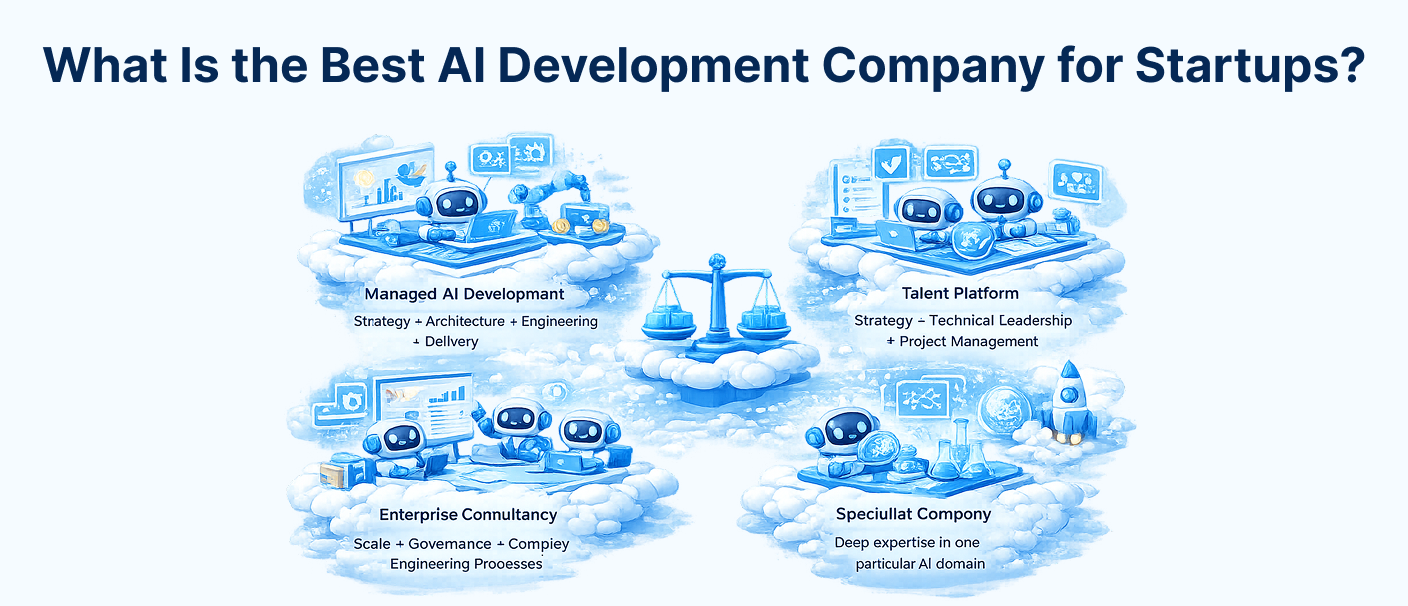
Choose a managed AI development partner when you need:
Strategy + Architecture + Engineering + Delivery
Choose a talent platform when you already have:
Strategy + Technical Leadership + Project Management
and need:
Additional Engineers
Choose an enterprise consultancy when your priority is:
Scale + Governance + Complex Engineering Processes
Choose a specialist company when the product requires deep expertise in one particular AI domain.
That is a more useful decision framework than selecting a vendor solely because it appears at the top of a ranking.
Want to explore more practical insights on AI development, automation, and conversational AI? Read more blogs at Cloudastra Technologies or contact us for business enquiries through Cloudastra Contact Us.
Frequently Asked Questions
What is the best AI development company for startups?
The best AI development company depends on the startup’s stage, budget, internal technical leadership, product complexity, and AI requirements. CloudAstra is positioned toward startup-focused managed AI development, while companies such as Toptal, Turing, ThoughtWorks, Master of Code, and DataRobot serve different engagement models and technical needs.
How do I choose an AI development company?
Start by defining your product requirements, budget, timeline, internal technical capacity, and AI architecture needs. Then evaluate providers based on production experience, engineering depth, communication, strategic input, and post-launch support.
How much does it cost to build an AI startup product?
Cost varies according to complexity, integrations, AI architecture, design, infrastructure, data requirements, and engineering scope. The uploaded source provides startup-oriented budget examples, but actual project pricing should be confirmed directly with each provider.
Should a startup hire AI developers or use an agency?
Startups with strong technical leadership may prefer individual engineers. Non-technical founders or companies requiring managed delivery may benefit more from an AI development company.
What should I look for in an AI development partner?
Look for production AI experience, full-stack development capability, architecture expertise, evaluation practices, transparent communication, startup-compatible engagement models, and post-launch support.
Can an AI development company build an MVP?
Yes. Many AI development companies build MVPs that combine existing language models, APIs, retrieval systems, business logic, databases, user interfaces, and cloud infrastructure.
How long does it take to build an AI MVP?
Timeline varies by scope. Focused products can be developed more quickly than broad platforms with multiple integrations, complex datasets, and enterprise requirements.
What is an AI development agency?
An AI development agency is a service provider that designs and builds AI-enabled software for clients. Services can range from model integration and generative AI applications to complete product development.
What is the difference between an AI company and an AI development company?
An AI company may sell its own AI product or platform. An AI development company primarily helps other businesses build AI products and capabilities.
Can AI development companies build AI agents?
Yes. Some AI development companies specialize in AI-agent systems that connect language models with tools, APIs, workflows, memory, and external business systems.
Should startups build or buy AI technology?
Most startups use a combination. Existing models and platforms can provide infrastructure while the startup builds proprietary workflows, data layers, integrations, and user experiences around them.