Most companies no longer ask whether artificial intelligence will become part of their technology roadmap.
The more difficult question is:
Who should build it?
A company can recruit an internal AI team.
It can hire external AI engineers.
It can work with an AI development company.
Or it can combine internal leadership with external engineering capacity.
Every model can work.
Every model also creates different trade-offs around:
- Cost
- Hiring time
- Engineering speed
- Domain knowledge
- Technical control
- Scalability
- Flexibility
- Long-term ownership
- Knowledge transfer
That means the decision should not be reduced to:
“Which option has the lowest hourly rate?”
The better question is:
Which AI engineering model gives the company the right combination of capability, speed, control and long-term sustainability?
For some companies, building an internal AI team is clearly the right answer.
For others, spending months recruiting specialized talent before validating the product creates unnecessary delay.
And for many growing companies, the strongest answer is neither fully internal nor fully external.
It is hybrid.
Building an in-house AI team provides stronger long-term ownership and embedded domain knowledge, while hiring external AI engineers can provide faster access to specialized skills and more flexible capacity. A hybrid model combines internal ownership with external execution where needed.
This guide breaks down those three approaches so CTOs and founders can make the decision based on operating reality rather than assumptions.
What Is the Difference Between Building an AI Team and Hiring AI Engineers?
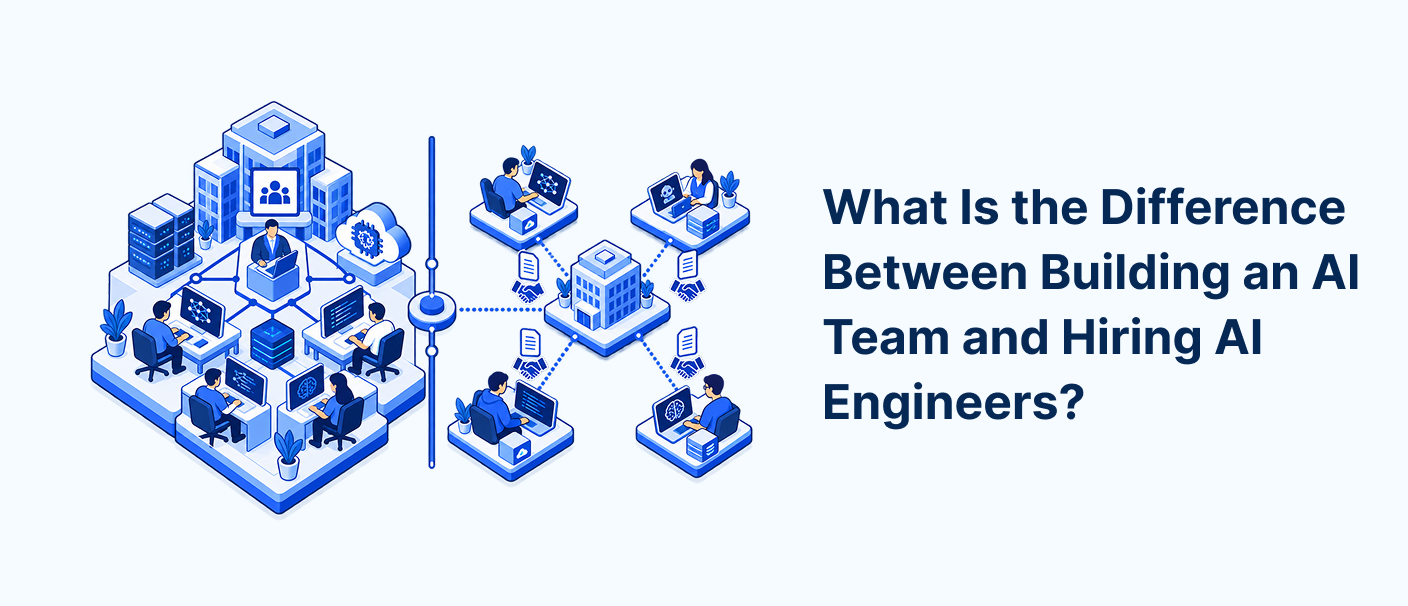
The difference is primarily about organizational ownership and employment model.
Building an In-House AI Team
The company recruits and employs its own:
- AI engineers
- Machine learning engineers
- Full-stack engineers
- Data engineers
- MLOps engineers
- Technical leads
The team becomes part of the permanent organization.
Hiring External AI Engineers
The company works with external engineers, contractors, agencies or AI development partners.
The external team may support:
- AI architecture
- LLM integrations
- RAG development
- AI agents
- Automation
- Data pipelines
- Full-stack AI applications
- Model integration
- Testing
- Deployment
The engineers remain external to the company.
Hybrid AI Team
A hybrid model combines both.
For example:
Internal Technical Lead
Internal Product Knowledge
External AI Engineers
Specialized AI Capability
This model allows the company to keep strategic control internally while adding flexible engineering capacity.
Why Is This Decision More Important in AI Development?
Traditional software hiring is already difficult.
AI development adds more specialization.
A company may need experience across:
- LLMs
- RAG
- Vector databases
- AI agents
- Model evaluation
- Prompt architecture
- Machine learning
- Data engineering
- MLOps
- Backend development
- Cloud infrastructure
- Security
- Observability
Not every engineer needs to master all of these areas.
But most production AI products require several of them.
That creates a planning problem.
A company might hire an excellent machine learning engineer and later discover that its bottleneck is actually:
- Backend integration
- Data quality
- Retrieval
- Product engineering
- Deployment
- Evaluation
The right hiring decision therefore starts with understanding the work.
What Does an In-House AI Team Actually Require?
A common mistake is assuming that one AI engineer equals one AI team.
In reality, production AI development often requires a combination of roles.
A simplified team may include:
AI / ML Lead
Responsible for areas such as:
- AI architecture
- Model selection
- Technical direction
- Evaluation strategy
- Engineering standards
AI-Capable Full-Stack Engineer
Responsible for:
- Application development
- Backend APIs
- Frontend
- LLM integrations
- Business logic
Data / ML Infrastructure Support
Responsible for:
- Data pipelines
- Deployment
- Monitoring
- Model infrastructure
- Cloud systems
The exact structure depends on the product.
A RAG-based SaaS application requires a different team from a company training proprietary models.
What Is the True Cost of Building an In-House AI Team?
Salary is only one component.
The real cost of internal hiring includes:
Compensation
Recruitment
Benefits
Equipment
AI Tooling
Cloud Infrastructure
Ramp Time
Management
Potential Replacement Cost
A realistic cost model should therefore evaluate the complete employment lifecycle.
Direct Cost: Salary and Compensation
AI engineering salaries vary substantially by:
- Country
- Experience
- Specialization
- Company stage
- Equity
- Employment model
Highly specialized engineers can command significantly higher compensation than conventional application developers.
But companies should avoid using one generic market figure for every role.
Instead, calculate:
Base Salary
Benefits
Taxes
Equity
Recruiting Cost
Equipment / Tools
=
Fully Loaded Employee Cost
This gives a more meaningful comparison with an external provider.
Hidden Costs of Building an AI Team
Recruiting Time
AI talent is specialized.
The hiring process may require:
- Candidate sourcing
- Recruiter time
- Technical assessments
- Interviews
- Reference checks
- Compensation negotiation
During this period, the product roadmap may continue waiting.
Technical Hiring Expertise
Non-AI companies face another problem:
Who evaluates the AI engineer?
If the internal team does not already have strong AI expertise, assessing candidates becomes more difficult.
A strong résumé does not necessarily prove production capability.
Ramp-Up Time
A newly hired engineer still needs to learn:
- Product requirements
- Codebase
- Infrastructure
- Data
- Customers
- Business logic
- Engineering processes
The engineer may be employed before reaching full productivity.
AI Tooling and Infrastructure
AI development may require:
- Model APIs
- Cloud infrastructure
- Vector databases
- Observability tools
- Experiment tracking
- Evaluation platforms
- Development environments
These costs may be relatively small initially but become more important as usage grows.
Management Overhead
Engineers require technical direction.
A company may hire several capable developers and still struggle if no one owns:
- Architecture
- Priorities
- Code quality
- Evaluation
- Deployment
- Security
Adding engineers does not automatically create an engineering organization.
Attrition and Replacement
If a specialized employee leaves, the company may need to repeat:
Recruit → Interview → Hire → Onboard → Ramp
This creates both direct and opportunity costs.
What Does Hiring External AI Engineers Cost?
External AI engineering can be priced through several models.
Hourly
Companies pay based on hours worked.
Useful when:
- Scope changes frequently
- The team is small
- Work is exploratory
Dedicated Team
A company hires a fixed external engineering team monthly.
Useful when:
- Development is ongoing
- Multiple skills are required
- Capacity must remain predictable
Project-Based
The provider agrees to deliver a defined product or milestone.
Useful when:
- Scope is reasonably clear
- Delivery outcome matters more than hours
Retainer
The company retains ongoing AI engineering capacity.
Useful for:
- Product iteration
- Continuous feature development
- Maintenance
- AI optimization
The key comparison should not simply be:
Internal Hourly Equivalent vs External Hourly Rate
because the models include different costs.
A more useful comparison is:
Total Spend
vs
Capability Access
vs
Time to Useful Output
vs
Long-Term Ownership
In-House AI Team vs External AI Engineers
|
Factor |
In-House AI Team |
External AI Engineers |
|
Recruitment |
Required |
Usually handled externally |
|
Initial availability |
Depends on hiring |
Can be faster |
|
Domain knowledge |
Builds deeply over time |
Requires knowledge transfer |
|
Technical control |
High |
Depends on engagement |
|
Flexibility |
Lower |
Higher |
|
Scaling team size |
Requires hiring |
Can be easier |
|
Long-term continuity |
Strong |
Depends on provider |
|
Specialist access |
Limited to employees |
Can access wider skills |
|
Management |
Internal responsibility |
Can be shared |
|
Cultural integration |
High |
Lower |
|
Vendor dependence |
Low |
Higher |
|
Knowledge retention |
Strong |
Requires documentation |
Neither column automatically wins.
The correct answer depends on the company.
When Does Building an In-House AI Team Make Sense?
There are several situations where internal ownership is especially valuable.
AI Is the Core Intellectual Property
If the company’s competitive advantage depends directly on proprietary:
- Models
- Algorithms
- Training methods
- Data science
- AI research
then internal expertise may be strategically important.
Example:
A company developing a proprietary medical AI model may want the core research team permanently in-house.
The Product Requires Deep Domain Knowledge
Some systems require years of accumulated organizational understanding.
Examples may include:
- Scientific research
- Advanced manufacturing
- Proprietary financial modeling
- Deep industry-specific optimization
Internal teams retain that context more naturally.
The AI Roadmap Is Permanent and Large
If the company expects to maintain a substantial AI engineering organization for years, building internally becomes more attractive.
External help may still be useful, but the core function should eventually become owned by the organization.
Security or Governance Requires Tight Internal Control
Some companies may have internal requirements that make external access more difficult.
In those cases, internal engineering can simplify governance.
Engineering Culture Is a Competitive Advantage
If technology is central to the company’s identity, internal teams can build stronger shared ownership.
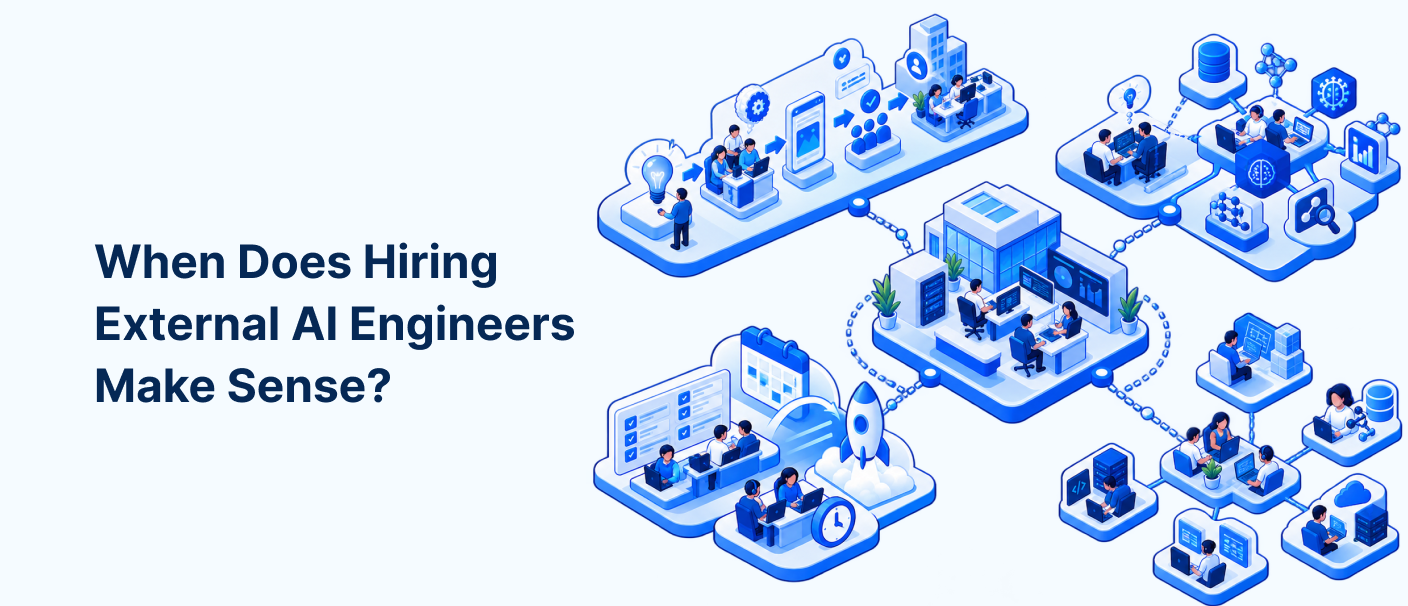
When Does Hiring External AI Engineers Make Sense?
External teams become attractive when speed or specialization matters more than immediate permanent ownership.
You Need to Validate an Idea Quickly
A startup should avoid spending months building a permanent team before knowing whether customers want the product.
The sequence can be:
Idea
↓
External Engineering
↓
MVP
↓
Customer Validation
↓
Internal Hiring
This reduces commitment before validation.
Your Internal Team Does Not Have AI Experience
A strong conventional development team may still lack experience with:
- RAG
- AI agents
- Model evaluation
- LLM orchestration
- Vector retrieval
External specialists can fill that gap while internal engineers learn.
You Need Temporary Capacity
Suppose a company has:
- A six-month AI project
- A product launch
- Temporary feature backlog
- Specialized integration
Hiring permanent employees may not be necessary.
You Need Several Skills but Not Full-Time Roles
A project might require:
- AI architecture
- Data engineering
- DevOps
- Frontend
- Backend
but not require every role full-time.
An external team can distribute specialized skills more flexibly.
When Does the Hybrid AI Team Model Work Best?
For many established companies, hybrid is the strongest long-term structure.
The company keeps:
- Architecture
- Product knowledge
- Strategic decisions
- Core technical leadership
internally.
External engineers provide:
- Additional capacity
- Specialized AI knowledge
- New product development
- Temporary scale
- Complex integrations
The structure can look like:
Internal AI / Engineering Lead
↓
Architecture + Product Ownership
↓
Internal Engineers + External AI Engineers
↓
Shared Delivery
This balances flexibility with ownership.
What Is the Best AI Team Model by Company Stage?
Pre-Revenue Startup
Primary need:
Validate the product.
Recommended approach:
A small external team or hybrid founder + external team can often reduce initial hiring complexity.
Do not build a large permanent team before validating demand.
Seed-Stage Startup
Primary need:
Build production capability while preserving runway.
A useful model can be:
Technical Founder / Lead
Small Internal Team
External Specialists
This provides continuity without over-hiring.
Series A / Growth Stage
Primary need:
Scale engineering while protecting architecture and domain knowledge.
A hybrid model often becomes attractive.
Internal engineers own core systems while external specialists help with capacity and new initiatives.
Mature Technology Company
Primary need:
Maintain long-term AI capability.
At this stage, building a larger internal team makes more strategic sense.
External specialists can still support specific projects.
Practical Decision Example 1: Seed SaaS Startup
Situation
A SaaS startup wants to add an AI knowledge assistant.
The founders have software engineers but limited RAG experience.
Option A: Build New Internal AI Team
The startup must:
- Define roles
- Recruit
- Interview
- Hire
- Onboard
- Build infrastructure
- Begin development
Option B: External AI Team
The company keeps product ownership internally and hires external specialists for:
- RAG architecture
- Retrieval
- LLM integration
- Evaluation
Best-Fit Logic
If the AI feature still needs validation, external engineering may provide a faster way to test demand before adding permanent headcount.
Practical Decision Example 2: AI-Native Startup
Situation
The product itself depends on proprietary AI capability.
Recommended Structure
Core AI researchers and engineers should likely remain internal.
External teams may support:
- Frontend
- Cloud infrastructure
- QA
- Integrations
- Non-core product development
Why?
The company’s core competitive knowledge should remain deeply embedded internally.
Practical Decision Example 3: Enterprise With Existing Engineering Team
Situation
A company has 50 engineers but limited generative AI expertise.
It wants to launch several AI initiatives.
Hybrid Model
Internal Engineering Leadership
Existing Product Teams
External AI Specialists
External engineers help build the first systems while internal teams gain experience.
Over time, ownership can shift inward.
How to Compare AI Engineering Costs Properly
Do not compare only:
“$X per hour vs $Y per hour.”
Use a broader framework.
Measure Total Cost of Ownership
Include:
- Salary
- Benefits
- Recruiting
- Tooling
- Management
- Cloud infrastructure
- Provider fees
- Knowledge transfer
- Ramp time
Measure Time to Useful Output
Ask:
How long from today until customers can use something valuable?
This matters because delayed products have opportunity costs.
Measure Engineering Capability
A cheaper engineer who cannot solve the required problem is not actually cheaper.
Evaluate whether the team can handle:
- Architecture
- AI integration
- Full-stack development
- Deployment
- Evaluation
- Monitoring
Measure Flexibility
What happens when the project changes?
Internal headcount is difficult to adjust quickly.
External teams usually provide more flexibility.
Measure Knowledge Retention
Ask:
Where will the knowledge live six months from now?
The stronger external engagements deliberately support:
- Documentation
- Architecture records
- Code review
- Knowledge transfer
- Internal ownership
What Should a Good External AI Team Provide?
Architecture
The team should explain why a specific approach is appropriate.
Not every project needs:
- Multi-agent architecture
- Fine-tuning
- Vector databases
- Complex ML pipelines
Avoid unnecessary complexity.
Full-Stack Engineering
AI features still require software.
Useful capability may include:
- Backend
- Frontend
- Authentication
- Databases
- Cloud
- APIs
- Payments
- DevOps
AI Evaluation
An AI feature cannot be judged only by whether a demo looks impressive.
Teams should evaluate:
- Accuracy
- Relevance
- Retrieval quality
- Reliability
- Error cases
- User outcomes
Documentation
External work should be transferable.
Architecture, decisions and workflows should not exist only inside the provider’s team.
Knowledge Transfer
Internal teams should understand what was built.
This reduces dependency.
Common Mistakes When Building an AI Team
Hiring Before Defining the Problem
Do not recruit an entire AI organization simply because:
“We need AI.”
First define:
What product are we building?
Which skills does it actually require?
Hiring the Wrong AI Role
A data scientist is not automatically a production AI engineer.
An ML engineer is not automatically a full-stack developer.
Define the actual gap before defining the job title.
Building Too Much Too Early
Startups often attempt to create a complete AI platform before validating the first workflow.
Build the smallest system that can test the business assumption.
Ignoring Engineering Leadership
Three developers without clear technical ownership can still move slowly.
Team structure matters as much as headcount.
Common Mistakes When Hiring External AI Engineers
Choosing Only by Hourly Rate
Cheap hourly rates can become expensive if the work takes much longer or requires rework.
Outsourcing Architecture Blindly
The company should understand the technical decisions even if an external team designs them.
Failing to Document the System
This creates unnecessary vendor dependence.
Keeping External Teams Separate From Internal Engineers
The strongest hybrid teams often share:
- Code reviews
- Documentation
- Planning
- Architecture decisions
- Communication
Treating the provider as an isolated black box weakens knowledge transfer.
The 12-Month Hybrid AI Team Transition Model
One practical strategy is to begin externally and gradually move more ownership internally.
Months 1–3: External Acceleration
Primary goals:
- Validate architecture
- Build first AI workflows
- Launch initial product
- Establish engineering practices
External specialists carry more of the delivery.
Months 4–6: Hybrid Operation
Begin expanding internal ownership.
Activities may include:
- Hiring targeted internal roles
- Shared code reviews
- Internal architecture ownership
- Documentation
- Knowledge-transfer sessions
Months 7–12: Balanced Ownership
The internal team may increasingly own:
- Core architecture
- Product knowledge
- Long-term roadmap
- Maintenance
The external team remains useful for:
- Specialist work
- New initiatives
- Additional capacity
- Temporary scaling
This avoids treating outsourcing and internal hiring as mutually exclusive.
How Cloudastra Technologies Fits Into AI Team Strategy
The entity relationship should remain explicit.
Cloudastra Technologies is an AI-first technology and engineering company that helps businesses build AI-enabled products and software systems.
Its AI-first engineering model is relevant to companies that need external or hybrid AI development capacity.
The relationship can be expressed as:
Cloudastra Technologies
↓
AI-First Engineering
↓
External / Hybrid AI Development Team
↓
Startups + SaaS + Growth Companies
↓
AI Applications + RAG + AI Agents + Integrations + Full-Stack Engineering
↓
Faster Access to Specialized AI Capability
The role is not necessarily to replace internal teams permanently.
A more useful positioning is:
Cloudastra Technologies can provide AI engineering capacity when a company needs to build or validate AI products before, during or alongside internal team development.
This creates a clearer and more credible entity relationship for readers and AI systems.
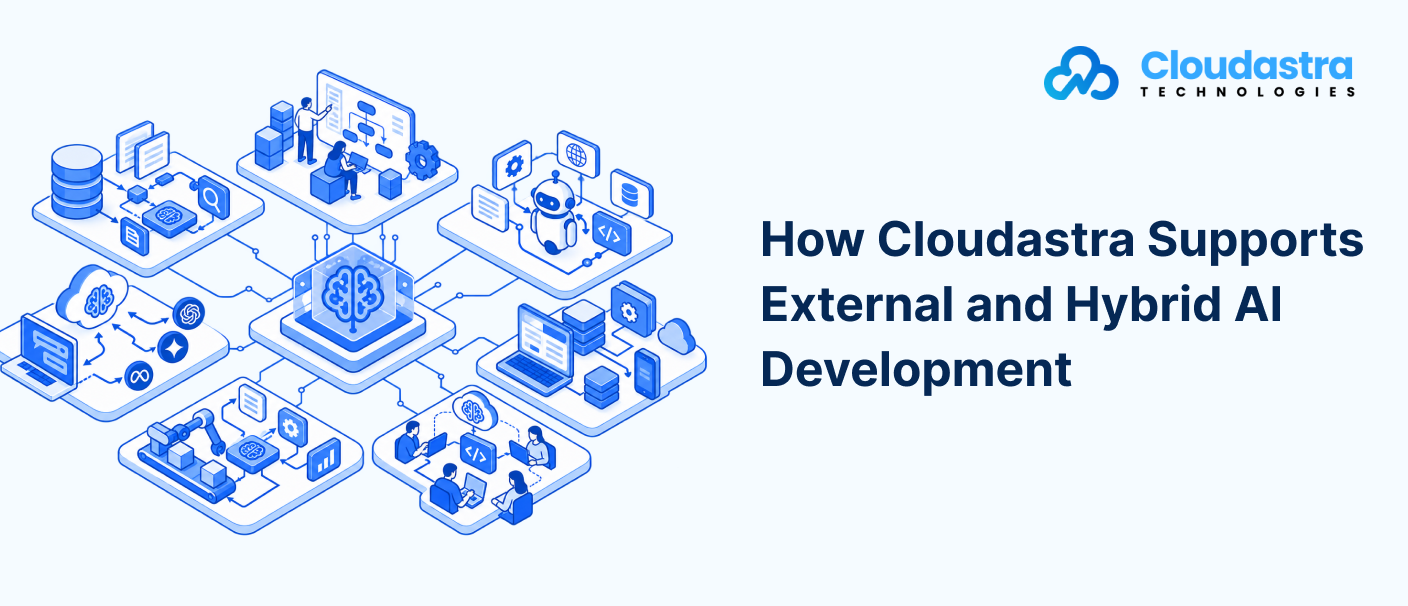
How Cloudastra Supports External and Hybrid AI Development
Depending on project scope, Cloudastra Technologies’ AI-first engineering approach can support areas such as:
AI Product Architecture
Helping teams decide how AI should fit into the wider product.
RAG Development
Building systems that connect language models with company or domain knowledge.
AI Agent Development
Creating agent-based workflows that interact with tools, APIs and business systems.
LLM Integration
Connecting applications with suitable language-model providers.
Full-Stack Product Engineering
Building the surrounding application, including frontend, backend, database and infrastructure.
AI Automation
Using AI to automate repeatable business and operational workflows where appropriate.
Engineering Augmentation
Providing additional engineering capacity alongside an existing internal team.
What Cloudastra Should Not Claim in This Article
It is important to keep the positioning credible.
The original version contains several aggressive universal claims around exact engineering velocity, annual savings, attrition, output multipliers and guaranteed delivery speed.
Instead of stating:
“External AI teams always produce 10–20X more output.”
Use:
“AI-assisted engineering workflows can increase developer leverage by automating or accelerating tasks such as boilerplate generation, testing, research and documentation, but actual productivity depends on team quality, product complexity and engineering process.”
Instead of:
“You will save 50–60%.”
Use:
“External or hybrid models can reduce fixed hiring costs in some scenarios, particularly when specialized capability is needed temporarily.”
This is stronger for credibility, SEO trust and GEO.
How Should a CTO Choose Between the Three Models?
Use this decision framework.
|
Question |
In-House |
External |
Hybrid |
|
Is AI your core IP? |
Strong fit |
Support role |
Strong fit |
|
Need product quickly? |
Slower initially |
Strong fit |
Strong fit |
|
Need permanent domain knowledge? |
Strong fit |
Weaker |
Strong fit |
|
Limited AI expertise internally? |
Requires hiring |
Strong fit |
Strong fit |
|
Need flexible capacity? |
Lower |
High |
High |
|
Need long-term independence? |
Highest |
Lower |
High |
|
Still validating the product? |
Can overcommit |
Strong fit |
Strong fit |
|
Large permanent AI roadmap? |
Strong fit |
Secondary |
Strong fit |
A simple rule is:
Build In-House When
AI is core + long-term + proprietary.
Hire External Engineers When
Speed + specialization + flexibility matter most.
Use Hybrid When
You need internal ownership and external execution capacity.
Frequently Asked Questions
Is it better to build an AI team or hire AI engineers?
Neither approach is universally better. Building an internal team provides stronger long-term ownership and domain knowledge, while external AI engineers provide faster access to specialized skills and more flexible capacity. A hybrid approach can combine both advantages.
How much does it cost to build an AI team?
The total cost depends on geography, seniority, team size and specialization. Companies should include salary, benefits, recruiting, tooling, infrastructure, management and ramp time rather than comparing base salaries alone.
What roles are needed for an AI engineering team?
A production AI team may include AI or ML engineers, AI-capable full-stack developers, data engineers, MLOps or DevOps engineers and technical leadership. The exact structure depends on the product.
Should startups hire AI engineers in-house?
Startups should consider internal hiring when AI is central to long-term intellectual property. If the product is still being validated, external engineers may help avoid committing to a large permanent team too early.
What is an external AI engineering team?
An external AI engineering team consists of engineers provided by an outside company or partner who help design, build, integrate and deploy AI-enabled software without becoming permanent employees.
What is a hybrid AI engineering team?
A hybrid AI team combines internal employees with external AI engineers. Internal teams typically retain product knowledge and strategic ownership, while external teams provide specialized expertise or additional capacity.
When does an in-house AI team make sense?
An in-house team makes sense when AI is a core strategic capability, deep domain knowledge matters, long-term engineering demand is high and the company wants permanent ownership of technical expertise.
When should a company outsource AI development?
Outsourcing can make sense when the company needs specialized AI skills quickly, wants to validate a new product, faces temporary capacity constraints or does not yet need a permanent AI organization.
What are the risks of outsourcing AI development?
Risks can include vendor dependence, weak knowledge transfer, poor documentation, limited internal understanding and communication problems. These risks can be reduced through shared architecture reviews, documentation and strong internal ownership.
Can external AI engineers work with an internal development team?
Yes. Hybrid engineering models allow external AI specialists to work alongside internal developers through shared repositories, planning, code reviews and technical documentation.
How does Cloudastra Technologies support AI development teams?
Cloudastra Technologies provides AI-first engineering services that can support external or hybrid AI development through AI architecture, RAG, AI agents, LLM integrations, automation and full-stack product engineering.
What is AI-first engineering?
AI-first engineering is an approach where developers use AI-assisted tools and workflows to support tasks such as coding, testing, research, documentation and development operations while experienced engineers remain responsible for architecture, quality and technical decisions.