Agent-Driven SDLC: How AI-First Engineering Teams Build Software 10–20X Faster
Agent-driven SDLC is a software development approach where AI agents handle major parts of planning, coding, testing, deployment, and monitoring under human supervision.
Instead of using AI only as an autocomplete tool, AI-first engineering teams use agents as active executors across the software development lifecycle. Engineers still make architectural decisions, review quality, and handle business-critical judgment, but agents take over the repeatable development work that usually slows teams down.
What Problem Does Agent-Driven SDLC Solve?
Traditional software development is slow because too much of the process depends on sequential human execution.
A product manager writes requirements. Engineers break them into tickets. Developers pick tasks one by one. QA teams test late in the cycle. DevOps teams manage deployment. Monitoring happens after release. Every stage needs handoffs, meetings, clarification, reviews, and rework.
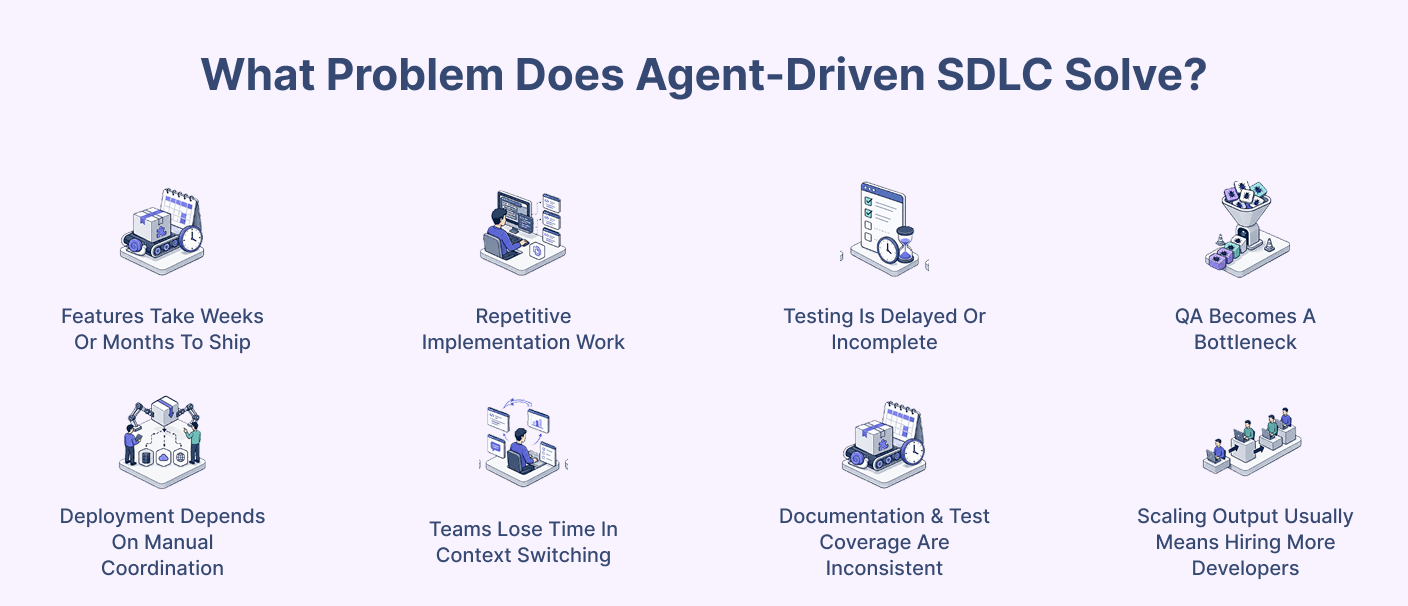
This creates common delivery problems:
- Features take weeks or months to ship
- Engineers spend time on repetitive implementation work
- Testing is delayed or incomplete
- QA becomes a bottleneck
- Deployment depends on manual coordination
- Teams lose time in context switching
- Documentation and test coverage are inconsistent
- Scaling output usually means hiring more developers
Agent-driven SDLC solves this by using AI agents to execute repeatable software development tasks in parallel. Human engineers guide the architecture, review the output, and handle exceptions, while agents handle much of the planning, implementation, testing, and release workflow.
The result is not just faster typing. It changes how engineering output is produced.
Cloudastra also supports AI-first delivery workflows through Nigmabot, helping teams automate repetitive tasks, improve execution speed, and build smarter software development processes.
What Is Agent-Driven SDLC?
Agent-driven SDLC is a software development lifecycle where AI agents act as the primary executors of development tasks across requirements, architecture, coding, testing, deployment, and monitoring.
In a traditional SDLC, humans execute most of the work and AI may assist in small parts. In an agent-driven SDLC, engineers define direction and guardrails, while agents execute structured tasks.
In simple terms, agent-driven SDLC helps teams answer questions like:
- Can this feature be broken into implementation-ready tasks automatically?
- Which parts of the codebase will be affected?
- Can multiple components be built in parallel?
- Can tests be generated and repaired automatically?
- Can deployment checks run without manual coordination?
- Can production issues be monitored and linked back to recent changes?
- Can engineers spend more time on architecture and less time on repetitive work?
This is the main difference between AI-assisted development and AI-first engineering.
AI-assisted development helps individual developers work faster. Agent-driven development changes the operating model of the engineering team.
AI-Added vs AI-First Development
Most companies using AI in engineering are still doing AI-added development.
That means developers use tools like AI autocomplete, chat-based debugging, code explanation, or boilerplate generation. This is useful, but it usually gives incremental productivity gains. The human is still the main executor.
AI-first engineering is different.
In AI-first engineering, agents are not just helpers. They are assigned work across the development lifecycle. They analyze the codebase, generate plans, write code, create tests, fix failures, prepare deployment checks, and monitor release outcomes.
The engineer’s role changes from “write every line of code” to “design the system, direct the agents, review the output, and protect quality.”
AI-added development usually looks like this:
- Developer writes code
- AI suggests completions
- Human writes tests
- CI/CD runs checks
- Human reviews deployment
- Human monitors production
Agent-driven development looks like this:
- Agent decomposes requirements
- Agent proposes architecture impact
- Agents implement tasks in parallel
- Testing agents generate and run test suites
- Deployment agents manage release checks
- Monitoring agents track production issues
- Human engineers review architecture, security, quality, and business logic
This is why agent-driven SDLC is not just a tool upgrade. It is a workflow upgrade.
How Much Faster Is Agent-Driven SDLC?
In Cloudastra’s AI-first engineering model, agent-driven SDLC is designed to deliver 10–20X faster software delivery compared to traditional development cycles.
The speed improvement comes from three areas:
First, agents work in parallel. Instead of five engineers working on five tasks sequentially, multiple agents can work across independent parts of the task graph at the same time.
Second, agents do not lose time in context switching. They can move from implementation to testing to repair loops without waiting for meetings, handoffs, or manual coordination.
Third, repeatable work gets automated. Test generation, code repair, documentation, deployment checks, and monitoring reports can be handled faster when agents follow predefined guardrails.
For example, a feature that may take a traditional team 2–4 weeks can often be compressed into a few days when architecture is clear, scope is well-defined, and agents are operating inside a controlled workflow.
This does not mean every project becomes 20X faster automatically. Agent-driven SDLC works best when the task is structured, the codebase has clear patterns, and humans define strong boundaries for the agents.
The Six Phases of Agent-Driven SDLC
1. Requirements to Task Decomposition
In a traditional SDLC, a product manager or engineering lead writes a PRD, engineers read it, ask questions, create tickets, estimate effort, and then plan the sprint.
This can take one or two days for a feature.
In an agent-driven SDLC, a high-level feature description can be given to a planning agent. The agent analyzes the existing codebase, identifies affected files, breaks the feature into implementation tasks, estimates complexity, and creates a dependency map.
The human role does not disappear. Engineers still review the decomposition, adjust priorities, add business constraints, and approve the plan.
This phase is useful because it reduces planning time and gives teams a clearer starting point before implementation begins.
2. Architecture to Design Decisions
Architecture is where human judgment still matters most.
In traditional teams, a senior engineer may write a design document, review trade-offs, run a team discussion, and revise the architecture over several days.
In agent-driven development, an architecture agent can analyze codebase structure, imports, dependencies, data flow, existing patterns, and integration points. It can then suggest a design that fits the current system and highlights which areas may be affected.
The human engineer validates the design against real-world constraints such as:
- Latency requirements
- Security expectations
- Cost limits
- Compliance rules
- Product priorities
- System reliability
- Long-term maintainability
This is where AI agents in software development should support engineers, not replace them. Agents can surface options, but humans decide which trade-offs make sense.
3. Implementation to Parallel Execution
Traditional implementation is usually sequential. Engineers pick tickets, write code, wait for reviews, fix issues, and then move to the next task.
Agent-driven implementation works differently.
Once the architecture and task graph are approved, implementation agents can work on independent components in parallel. One agent may update backend logic. Another may generate frontend changes. Another may create database migrations. Another may write test coverage.
Each agent follows the approved architecture, coding conventions, file boundaries, and guardrails.
The human engineer reviews the final output for:
- Architecture fit
- Security concerns
- Business logic
- Edge cases
- Code maintainability
- Integration risks
This is where agent-driven development can create major speed gains. Parallel execution reduces the time lost in sequential handoffs.
4. Testing to Automated Quality Loops
Testing is one of the strongest use cases for agent-driven SDLC.
In traditional teams, test coverage is often inconsistent. Developers may write unit tests, QA may test manually, and edge cases are often discovered late.
In an agent-driven workflow, testing agents can generate unit tests, integration tests, and end-to-end tests from the implementation and requirements. They can run the test suite, identify failures, and trigger repair loops until the code passes predefined quality gates.
This improves both speed and consistency.
The goal is not only high coverage. The goal is better coverage across happy paths, failure paths, edge cases, and regression risks.
Human engineers still need to review whether the tests reflect real business expectations. Agents can generate coverage, but humans decide whether the coverage is meaningful.
5. Deployment to Intelligent Release
Traditional deployment depends heavily on human coordination.
A CI/CD pipeline may run checks, but a human usually decides when to deploy, whether to roll back, and how to monitor the release.
In agent-driven SDLC, a deployment agent can help manage release steps such as:
- Running final checks
- Deploying to staging
- Validating acceptance criteria
- Promoting to production
- Monitoring release metrics
- Watching error rates and latency
- Triggering rollback if thresholds are crossed
Humans define the deployment policies. They decide which environments matter, what rollback thresholds should apply, and when manual approval is required.
The agent handles routine release execution within those guardrails.
6. Monitoring to Continuous Improvement
Monitoring is often treated as a post-release activity. Teams ship the feature, watch dashboards, respond to alerts, and investigate incidents when something breaks.
Agent-driven SDLC makes monitoring part of the lifecycle.
Monitoring agents can watch production metrics, connect anomalies to recent deployments, summarize incidents, and escalate issues with context. In some cases, they may suggest fixes or trigger predefined remediation steps.
This creates a feedback loop.
Monitoring data can inform future planning, architecture decisions, test coverage, and deployment rules. Over time, the system becomes better at predicting risk and improving delivery quality.
When Agent-Driven SDLC Works Best
Agent-driven SDLC works best when the work is structured, repeatable, and pattern-based.
It is especially useful for:
- Greenfield web and mobile applications
- SaaS product development
- API development
- Internal tools
- MVP builds
- Data pipelines
- Integration-heavy projects
- Dashboard and admin systems
- Standard CRUD workflows
- Test generation and QA automation
- Feature expansion in well-structured codebases
These projects have clear patterns, predictable architecture, and repeatable implementation tasks. Agents perform well in this environment because they can follow examples, reuse conventions, and execute defined workflows.
When Agent-Driven SDLC May Not Work Well
Agent-driven SDLC is not suitable for every type of software work.
It may be limited in areas such as:
- Novel algorithm research
- Deep scientific experimentation
- Safety-critical systems with strict human-traceability requirements
- Highly regulated systems where every decision must be manually justified
- Poorly documented legacy systems
- Codebases with inconsistent architecture
- Projects with unclear requirements
- Work that requires deep domain judgment at every step
In these cases, AI agents can still assist, but they should not be the primary executors.
The quality of agent-driven development depends heavily on clear requirements, strong architecture, clean codebase patterns, and human review.
What Team Structure Works for Agent-Driven Development?
Agent-driven development changes the structure of engineering teams.
Traditional teams often include many developers, QA engineers, DevOps engineers, and managers coordinating work across sprints.
Agent-driven teams are usually smaller but more senior.
A typical agent-driven team may include:
- Senior architect
- Agent operators
- Full-stack engineers who review agent output
- QA or test automation owner
- DevOps or platform engineer
- Product owner or technical product manager
If AI agents are expected to work inside team chat or collaboration tools, teams should first understand the difference between messaging apps vs communication platforms.
The biggest change is that junior-level repetitive work is reduced. Agents can handle boilerplate, test generation, implementation tasks, and documentation more efficiently when the system is well-defined.
Human engineers focus more on:
- Architecture
- Product logic
- Security
- Review quality
- Edge cases
- Compliance constraints
- Agent guardrails
- System-level decision-making
This does not mean developers become unnecessary. It means the developer role becomes more strategic.
How to Implement Agent-Driven SDLC
Teams should not switch to agent-driven development overnight.
A safer approach is to transition in phases.
Phase 1: Agent-Assisted Development
Start with low-risk areas such as test generation, code review support, documentation, and small bug fixes.
At this stage, human developers remain the primary coders. Agents support them by reducing repetitive work.
This phase helps the team build trust in agent output.
Phase 2: Agent-Primary Implementation
Once the team is comfortable, agents can start handling implementation for selected new features.
Engineers define requirements, review plans, set guardrails, and approve outputs. Critical paths and complex legacy areas can still stay human-led.
This phase helps teams compare velocity, quality, and review effort against traditional development.
Phase 3: Agent-Driven SDLC
In the final phase, agents handle most standard lifecycle tasks across planning, implementation, testing, deployment, and monitoring.
Engineers focus on architecture, business logic, security review, complex edge cases, and system-level ownership.
This staged approach works better because teams need time to trust agents, define review standards, and build internal processes around AI-first engineering.
Common Challenges in Agent-Driven SDLC
Poor Requirements Create Poor Output
Agents perform better when requirements are clear. If the input is vague, the output may be technically correct but misaligned with business expectations.
Weak Architecture Leads to Rework
If the system architecture is messy or inconsistent, agents may copy bad patterns or make changes that increase technical debt.
Human Review Still Matters
Agent-written code still needs review. Engineers must check architecture, security, performance, compliance, and product logic.
Teams May Not Trust Agent Output
If teams jump too quickly into agent-primary work, engineers may rewrite everything manually. This slows adoption and reduces confidence.
Guardrails Are Required
Agents need clear boundaries around which files they can modify, what libraries they can use, what patterns are approved, and which tests must pass.
Monitoring and Rollback Need Strong Policies
Automated deployment is useful only when rollback thresholds, alert rules, and escalation paths are clearly defined.
What Tools Are Needed for Agent-Driven SDLC?
A strong agent-driven SDLC setup usually needs:
- AI coding agents
- Codebase analysis tools
- Automated testing infrastructure
- CI/CD pipelines
- Code review workflows
- Deployment automation
- Monitoring and alerting tools
- Documentation systems
- Issue tracking tools
- Guardrail and approval processes
- Secure access controls
The exact tools may vary, but the principle is the same. Agents need access to the right context, clear instructions, test feedback, and controlled permissions.
Without that foundation, agent-driven development can become risky.
How Cloudastra Helps Teams Move to AI-First Engineering
Cloudastra helps companies adopt AI-first engineering by building production-ready applications with agent-driven workflows.
The approach focuses on using AI agents across planning, implementation, testing, deployment, and monitoring while keeping human engineers responsible for architecture, quality, and business decisions.
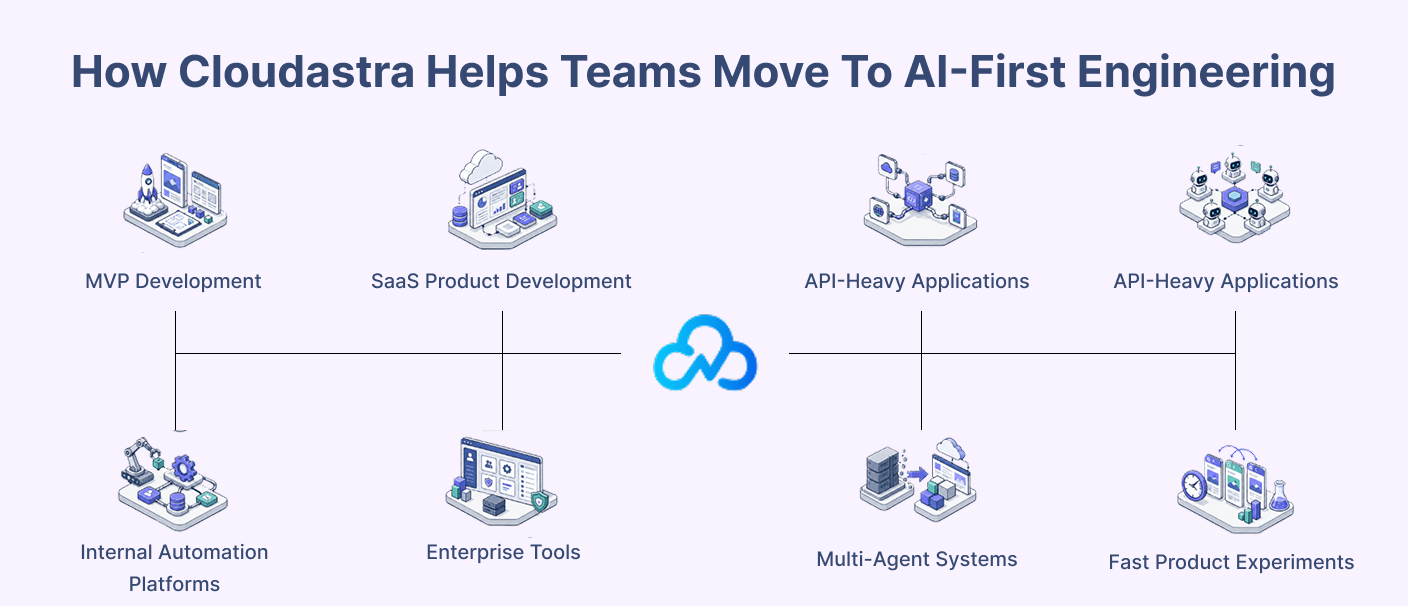
Cloudastra’s AI-first engineering process is useful for:
- MVP development
- SaaS product development
- AI application development
- Internal automation platforms
- Enterprise tools
- API-heavy applications
- Multi-agent systems
- Modernization projects
- Fast product experiments
Instead of treating AI as a small productivity add-on, Cloudastra uses AI agent teams to compress delivery timelines, improve consistency, and ship production-grade systems faster.
Who Should Consider Agent-Driven SDLC?
Agent-driven SDLC is useful for:
- CTOs
- Engineering leaders
- Startup founders
- SaaS companies
- Product teams
- AI-first startups
- Agencies building MVPs
- Enterprise innovation teams
- Teams with clear product requirements
- Companies that need faster release cycles
It is especially useful for teams that need to ship faster but do not want to grow engineering headcount linearly.
Want to explore more helpful insights on AI, automation, and enterprise technology? Read more blogs at Cloudastra Technologies or connect with us for business enquiries through Cloudastra Contact Us.
FAQs
1. What is agent-driven SDLC?
Agent-driven SDLC is a software development lifecycle where AI agents handle major tasks across planning, coding, testing, deployment, and monitoring, while human engineers guide architecture, review quality, and make business-critical decisions.
2. How is agent-driven SDLC different from AI-assisted development?
AI-assisted development uses tools like autocomplete or chat-based coding help while humans remain the primary executors. Agent-driven SDLC uses AI agents as active executors, with engineers directing, reviewing, and setting guardrails.
3. How much faster is agent-driven development?
Agent-driven development can significantly reduce delivery time when requirements are clear and the codebase has strong patterns. Cloudastra’s AI-first model targets 10–20X faster delivery by using parallel agent execution, automated testing loops, and reduced manual handoffs.
4. Does agent-driven SDLC replace developers?
It does not remove the need for engineers. It changes their role. Developers spend less time on repetitive implementation and more time on architecture, review, security, business logic, and system-level decisions.
5. What types of projects are best for agent-driven SDLC?
Agent-driven SDLC works best for SaaS products, MVPs, API development, internal tools, dashboards, integrations, data pipelines, and structured web or mobile applications.
6. What are the risks of agent-driven development?
The main risks are unclear requirements, weak architecture, poor guardrails, low-quality review, and overtrusting agent output. Human supervision is still essential.
7. How can a team start with agent-driven SDLC?
A good starting point is to use agents for test generation, code review, documentation, and small implementation tasks. Once the team builds trust, agents can gradually take on larger parts of the development lifecycle.