Promise to pay tracking helps lenders record, monitor, and follow up on repayment commitments made by overdue borrowers.
Instead of depending on agent notes, spreadsheets, or memory, lenders can use structured promise tracking to identify upcoming commitments, detect broken promises, trigger follow ups, and prioritize borrowers who need immediate attention. DebtPulse helps collection teams manage these repayment commitments through automated workflows, borrower communication tracking, and recovery dashboards.
Introduction
A promise to pay is one of the most important signals in debt recovery.
When a borrower confirms that they will make a payment on a specific date, the collection team gets a clear opportunity to recover the overdue amount without immediately escalating the case.
The problem is that many lenders do not track these promises properly.
A borrower may commit to paying on Friday, but the promise is written only in an agent’s notes. Another borrower may promise a partial payment, but the amount is not recorded clearly. A missed commitment may not be noticed until several days later.
As collection volume grows, these gaps become expensive.
A broken promise that is not followed up quickly can move the account into a deeper delinquency bucket. Agents may repeatedly contact borrowers who have already committed to pay, while high risk broken promises remain unnoticed.
Promise to pay tracking gives lenders a structured way to record commitments, monitor due dates, trigger reminders, and respond quickly when a borrower does not pay as promised.
What Is Promise to Pay Tracking?
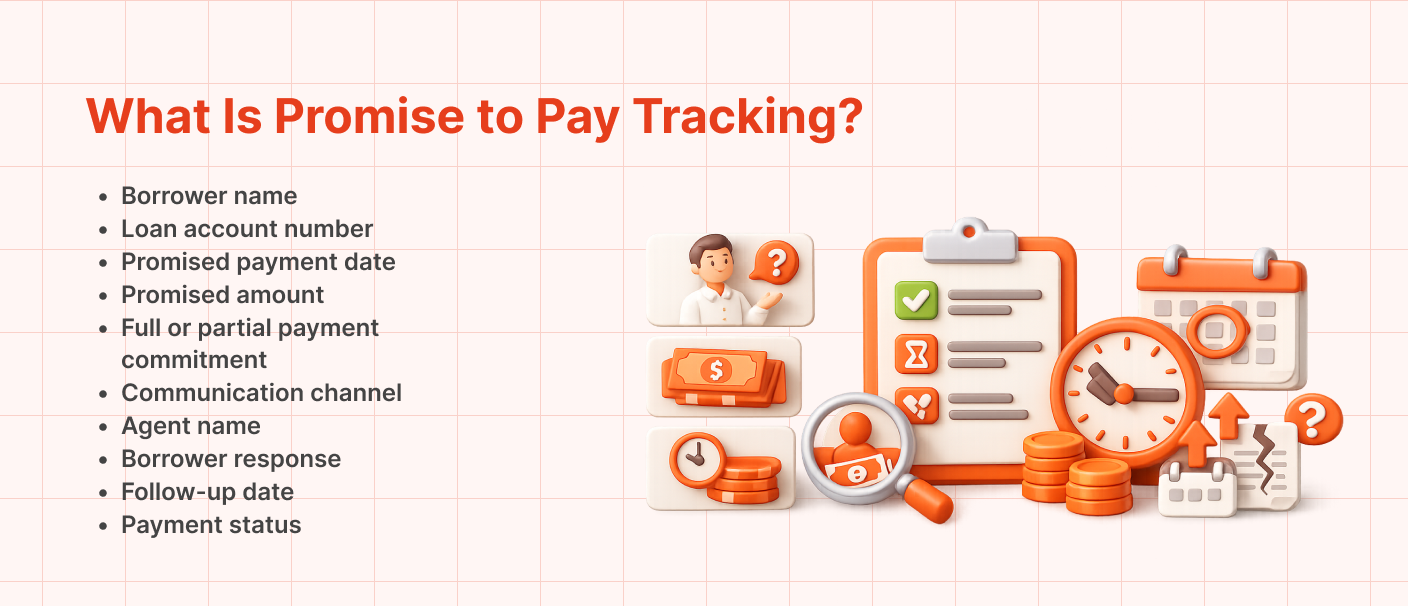
Promise to pay tracking is the process of recording and monitoring a borrower’s commitment to make a payment by a specific date.
A promise to pay record may include:
- Borrower name
- Loan account number
- Promised payment date
- Promised amount
- Full or partial payment commitment
- Communication channel
- Agent name
- Borrower response
- Follow up date
- Payment status
- Broken promise reason
- Escalation status
- Collection notes
The objective is to make every repayment commitment visible and actionable.
Without a proper system, promises may be scattered across:
- Agent notebooks
- Spreadsheets
- Call recordings
- WhatsApp chats
- CRM notes
- Email threads
- Personal reminders
This makes it difficult for managers to know which promises are active, which have been fulfilled, and which have been broken.
In simple terms, promise to pay tracking helps lenders answer:
Who promised to pay, how much did they promise, when was it due, and what happened afterward?
Why Lenders Need Promise to Pay Tracking
Lenders need promise to pay tracking because a repayment commitment loses value when it is not monitored properly.
A borrower who has made a promise may require a reminder before the due date. If the payment does not arrive, the collection team may need to contact the borrower immediately.
When this process is manual, several problems appear:
- Agents forget follow up dates
- Promises remain hidden in notes
- Managers cannot see upcoming commitments
- Broken promises are identified too late
- Borrowers receive duplicate calls
- Partial payment promises are not tracked properly
- Agents use inconsistent follow up processes
- High-value commitments are not prioritized
- Recovery forecasts become inaccurate
- Escalation happens too late
Promise to pay tracking creates a clear recovery timeline for each borrower.
It helps lenders separate borrowers who are actively engaging from borrowers who repeatedly make commitments without paying.
This allows collection teams to use a softer approach for genuine commitments and stronger follow up for repeated broken promises.
How Promise to Pay Tracking Works
Promise to pay tracking works by recording the borrower’s commitment, scheduling reminders, monitoring payment activity, and triggering follow up when the promise is fulfilled or broken.
1. The Borrower Makes a Repayment Commitment
A promise may be made through:
- Phone call
- SMS
- IVR
- Mobile application
- Collection portal
- Field agent interaction
The borrower may promise:
- Full EMI payment
- Partial payment
- Settlement payment
- Payment on salary date
- Payment after a specific event
- Payment in multiple parts
The promise should be recorded immediately.
2. The Promise Details Are Captured
The collection system records important information such as:
- Promised amount
- Promised date
- Payment method
- Reason for delay
- Preferred communication channel
- Agent responsible
- Next follow up time
Clear promise details reduce confusion later.
For example, “will pay soon” is not a useful commitment. “Will pay ₹8,000 on 15 July through UPI” is specific and measurable.
3. The Promise Is Added to the Recovery Queue
Once recorded, the promise should appear in the agent and manager dashboard.
The system may group promises as:
- Due today
- Due tomorrow
- Due this week
- High value promise
- Partial payment promise
- Promise awaiting confirmation
- Broken promise
- Repeated broken promise
This helps teams plan daily collection activity.
4. Reminders Are Sent Before the Due Date
Borrowers may need a reminder before the promised date.
A reminder may be sent through:
- SMS
- IVR
- In app notification
- Agent call task
The message can include:
- Promised amount
- Payment date
- Payment link
- Account details
- Support contact
These reminders improve the chance that the borrower completes the payment on time.
5. Payment Activity Is Checked
The system checks whether the promised payment has been received.
The result may be:
- Full promise fulfilled
- Partial payment received
- Payment pending
- Payment failed
- No payment received
- Payment received after due date
This status should update automatically wherever possible.
Manual payment matching can delay follow up and create duplicate communication.
6. Broken Promises Are Flagged
If the payment is not received by the promised date, the system marks the commitment as broken.
The account may then be moved into a higher priority recovery queue.
Broken promise tracking helps teams identify borrowers who:
- Missed one commitment
- Repeatedly break promises
- Stop responding after committing
- Pay only a small portion
- Ask for repeated extensions
- Make commitments without clear intent
These accounts may require stronger follow up or escalation.
7. The Next Recovery Action Is Triggered
Based on the outcome, the system may:
- Close the promise as fulfilled
- Schedule another reminder
- Assign an agent call
- Request a revised payment date
- Escalate to a senior collector
- Move the borrower into a higher risk segment
- Trigger field collection
- Start settlement review
- Add the case to a legal review queue
This creates a consistent debt recovery workflow.
Key Features of Promise to Pay Tracking Software
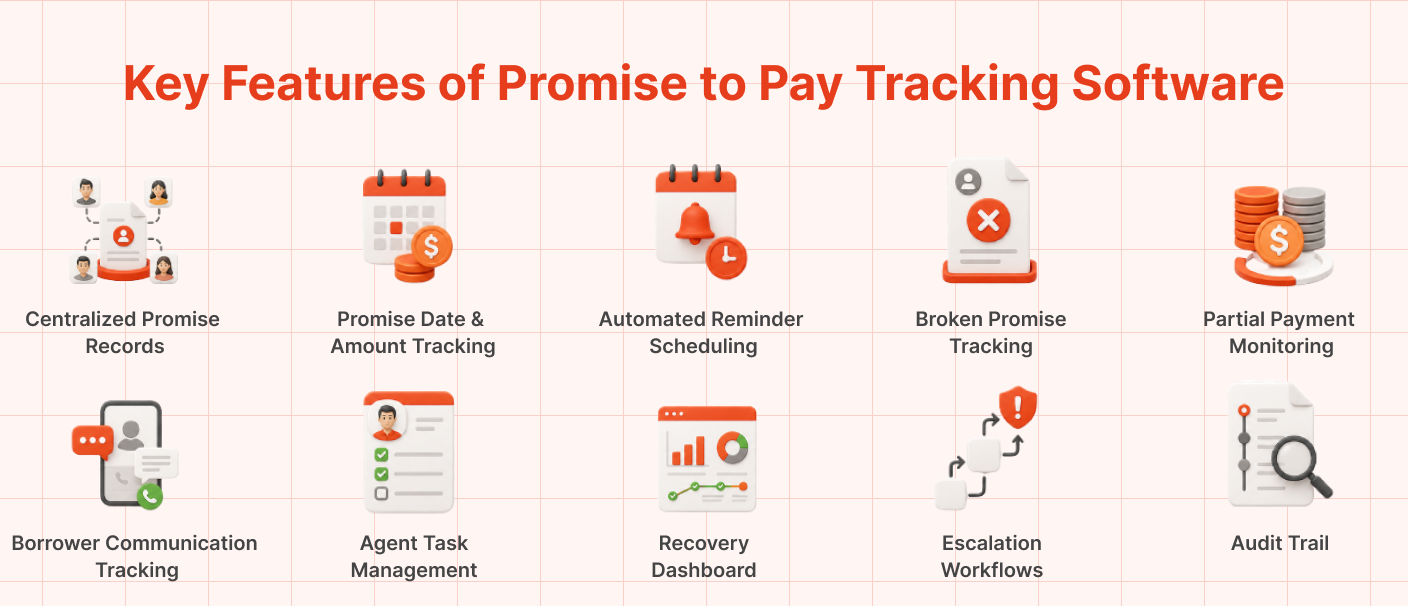
Centralized Promise Records
Every borrower commitment should be stored in one place.
This gives agents and managers a complete view of repayment commitments.
Promise Date and Amount Tracking
The system should record both the payment date and promised amount.
This helps teams distinguish full payment commitments from partial payment plans.
Automated Reminder Scheduling
Collection follow up automation helps send reminders before the commitment becomes due.
This reduces dependency on agents remembering every promise manually.
Broken Promise Tracking
The system should automatically flag commitments that were not fulfilled.
Repeated broken promises should receive a higher risk priority.
Partial Payment Monitoring
A borrower may pay part of the promised amount.
The system should track the amount received, the remaining balance, and the next commitment.
Borrower Communication Tracking
Every call, message, reply, and payment link interaction should be connected to the promise record.
This helps agents understand the complete borrower history.
Agent Task Management
Agents should receive clear tasks for:
- Upcoming promises
- Due today promises
- Broken promises
- Revised commitments
- High value accounts
This creates a more organized collection process.
Recovery Dashboard
Managers should be able to view:
- Active promises
- Promises due today
- Fulfilled promises
- Broken promises
- Partial payments
- Promise value
- Agent wise performance
- Recovery rate by commitment type
Escalation Workflows
Repeated broken promises can be automatically escalated based on lender policy.
This prevents high risk accounts from remaining in low priority queues.
Audit Trail
Every promise, reminder, status change, payment, agent action, and escalation should be recorded.
This supports internal review and recovery governance.
Use Cases of Promise to Pay Tracking
1. Early Stage Delinquency Follow Up
Borrowers in early delinquency may respond positively to a reminder and a clear payment commitment.
Promise tracking helps lenders follow up without applying unnecessary pressure.
2. Broken Promise Management
When a borrower misses a committed date, the system can immediately flag the account and create a new follow-up task.
This reduces delays after broken commitments.
3. Partial Payment Plans
Some borrowers may not be able to pay the full overdue amount.
Lenders can track partial payment commitments and remaining balances through a structured workflow.
4. High Value Account Prioritization
Promises involving larger overdue amounts can be prioritized for closer monitoring.
Managers can assign senior agents to high value commitments.
5. Repeated Commitment Analysis
A borrower who repeatedly promises to pay but does not complete payment may require a different recovery approach.
Promise history helps teams identify this pattern.
6. Agent Performance Monitoring
Managers can compare:
- Promises created
- Promises fulfilled
- Broken promise rates
- Recovery value
- Follow up completion
- Agent response time
This helps identify coaching and workload needs.
7. Recovery Forecasting
Active promises can provide an expected recovery view.
Managers can estimate how much repayment may be received during the week or month.
Benefits of Promise to Pay Tracking
Faster Follow Up
Collection teams can act immediately when a borrower misses a commitment.
This reduces the delay between promise failure and recovery action.
Better Recovery Visibility
Managers can see the value and status of all active promises.
This improves recovery planning.
Reduced Manual Work
Agents do not need to maintain personal reminder lists or manually search old notes.
The system organizes follow up tasks automatically.
Fewer Missed Commitments
Automated reminders help borrowers remember the agreed payment date.
Better Borrower Experience
Borrowers who communicate and commit to payment can receive a more appropriate follow-up process.
This avoids unnecessary repeated calls.
Improved Collection Prioritization
Broken promises, repeated commitments, and high-value cases can be prioritized separately.
More Accurate Recovery Forecasts
Managers can use active promise values to estimate upcoming collections.
Stronger Accountability
Every promise and follow up action is recorded with the responsible agent and outcome.
Common Challenges in Promise to Pay Tracking
Vague Commitments
Statements such as “I will pay soon” are difficult to track.
Agents should record a specific date and amount.
Promises Stored in Personal Notes
When commitments remain in notebooks or personal files, managers cannot monitor them.
All promises should be recorded centrally.
No Reminder Before the Due Date
A reminder sent before the promised date can improve payment completion.
Waiting until the promise is broken reduces recovery chances.
Late Broken Promise Detection
If a missed commitment is noticed several days later, the account may move deeper into delinquency.
Broken promise alerts should be immediate.
Duplicate Borrower Contact
Without centralized tracking, multiple agents may contact the same borrower even after a commitment has been recorded.
This creates a poor borrower experience.
Ignoring Partial Payments
A partial payment should not automatically close the promise.
The remaining balance and next commitment must be tracked.
No Escalation Policy
Repeated broken promises need a defined next step.
Without escalation rules, the same ineffective follow up may continue.
Incomplete Communication History
Agents need access to previous calls, messages, commitments, and payment outcomes before contacting the borrower again.
How DebtPulse Helps With Promise to Pay Tracking
DebtPulse by Cloudastra helps NBFCs, banks, fintech lenders, and loan servicing teams record, monitor, and follow up on borrower payment commitments.
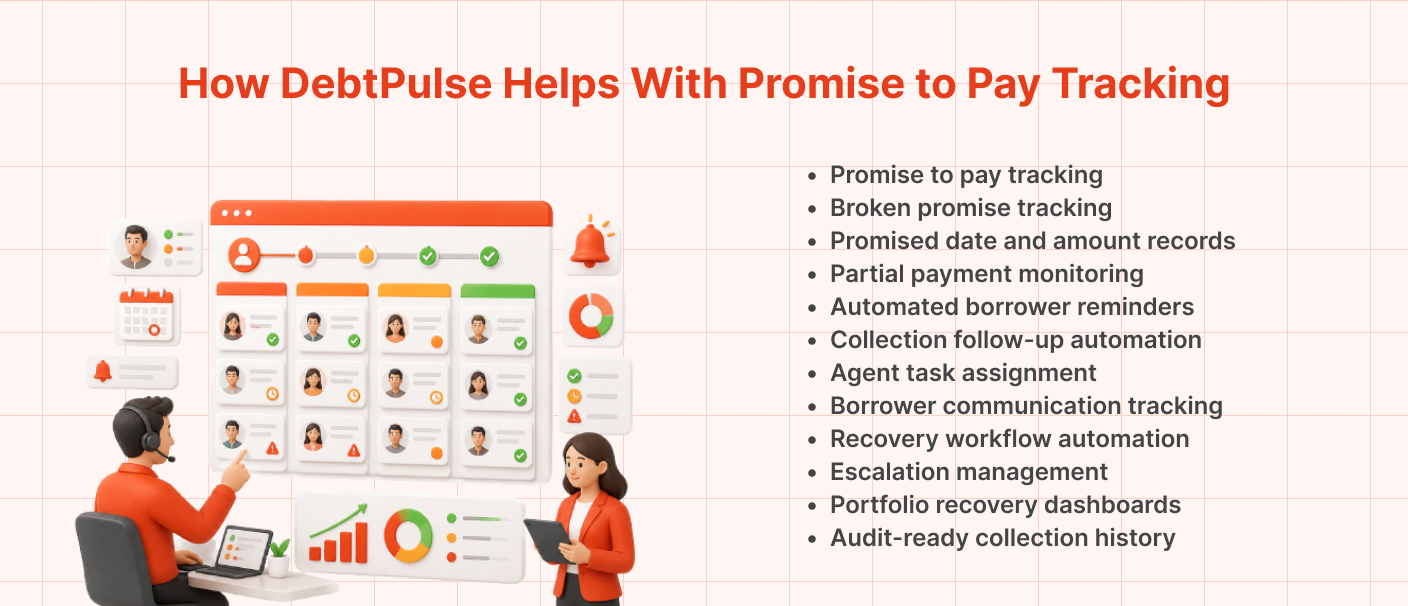
DebtPulse supports:
- Promise to pay tracking
- Broken promise tracking
- Promised date and amount records
- Partial payment monitoring
- Automated borrower reminders
- Collection follow-up automation
- Agent task assignment
- Borrower communication tracking
- Recovery workflow automation
- Escalation management
- Portfolio recovery dashboards
- Audit ready collection history
Instead of depending on spreadsheets, call notes, and personal reminders, lenders can use DebtPulse to manage every promise through one structured debt recovery workflow.
DebtPulse helps teams identify which promises are due, which have been fulfilled, which have been broken, and which borrowers need immediate follow up.
This gives collection agents clearer priorities and gives managers better visibility into expected recovery, broken commitments, and agent performance.
Who Should Use DebtPulse?
DebtPulse is useful for:
- NBFCs
- Banks
- Digital lenders
- Loan servicing companies
- Microfinance institutions
- Embedded finance platforms
- Collection agencies
- Recovery teams
- Collection managers
- Credit operations teams
- Risk teams
- Lending product teams
It is especially useful for lenders managing large overdue portfolios where borrower commitments are difficult to track manually.
Businesses looking to improve their B2B sales and marketing workflows can explore Cloudastra Technologies and learn more about AI powered automation and intelligent business systems.
FAQs
1. What is promise to pay tracking?
Promise to pay tracking is the process of recording and monitoring a borrower’s commitment to pay a specific amount by a specific date.
2. Why is promise to pay tracking important for lenders?
It helps lenders follow up on repayment commitments, identify broken promises quickly, prioritize risky borrowers, and improve recovery visibility.
3. What information should be recorded in a promise to pay?
Lenders should record the promised amount, payment date, borrower response, communication channel, responsible agent, payment status, and next follow up action.
4. What is a broken promise to pay?
A broken promise occurs when a borrower does not make the agreed payment by the promised date.
5. How does collection follow up automation help?
Collection follow up automation schedules reminders, creates agent tasks, updates promise status, and triggers escalation when a payment is missed.
6. Can lenders track partial payment promises?
Yes. A promise tracking system can record the amount received, remaining balance, and the next promised payment date.
7. How does promise to pay tracking improve debt recovery?
It helps teams act faster, reduce missed follow ups, prioritize broken promises, and maintain a structured recovery workflow.
8. How does DebtPulse support promise to pay tracking?
DebtPulse helps lenders record repayment commitments, automate reminders, track fulfilled and broken promises, assign follow up tasks, monitor partial payments, and manage escalation workflows.