Beneficial ownership screening helps fintech companies, NBFCs, banks, lenders, and payment platforms identify the real individuals who own, control, or benefit from a business.
Instead of screening only the company name, compliance teams can examine directors, shareholders, ultimate beneficial owners, related entities, sanctions exposure, PEP links, and other risk signals. RiskIntel helps teams centralize beneficial ownership checks and maintain clear, audit-ready records before approving a business relationship.
Introduction
A business can appear legitimate on the surface while its real ownership structure remains unclear.
The registered company name may not reveal who ultimately controls the business, who benefits from its activity, or whether a hidden owner is connected to sanctions, political exposure, litigation, fraud, or regulatory action.
This creates a major compliance risk for financial institutions.
A fintech company may approve a merchant, corporate borrower, vendor, or business partner after checking only the legal entity. However, the real risk may sit behind that entity.
It may involve:
- A hidden beneficial owner
- A sanctioned shareholder
- A politically exposed director
- A connected shell company
- A high-risk parent organization
- An undisclosed control relationship
- A director linked to previous regulatory action
Manual company checks often fail to identify these connections.
Beneficial ownership screening gives compliance teams a structured way to understand who really owns and controls a business before onboarding, approving credit, processing payments, or entering a commercial relationship.
What Is Beneficial Ownership Screening?
Beneficial ownership screening is the process of identifying and evaluating the individuals who ultimately own, control, or benefit from a business.
These individuals are often called ultimate beneficial owners, or UBOs.
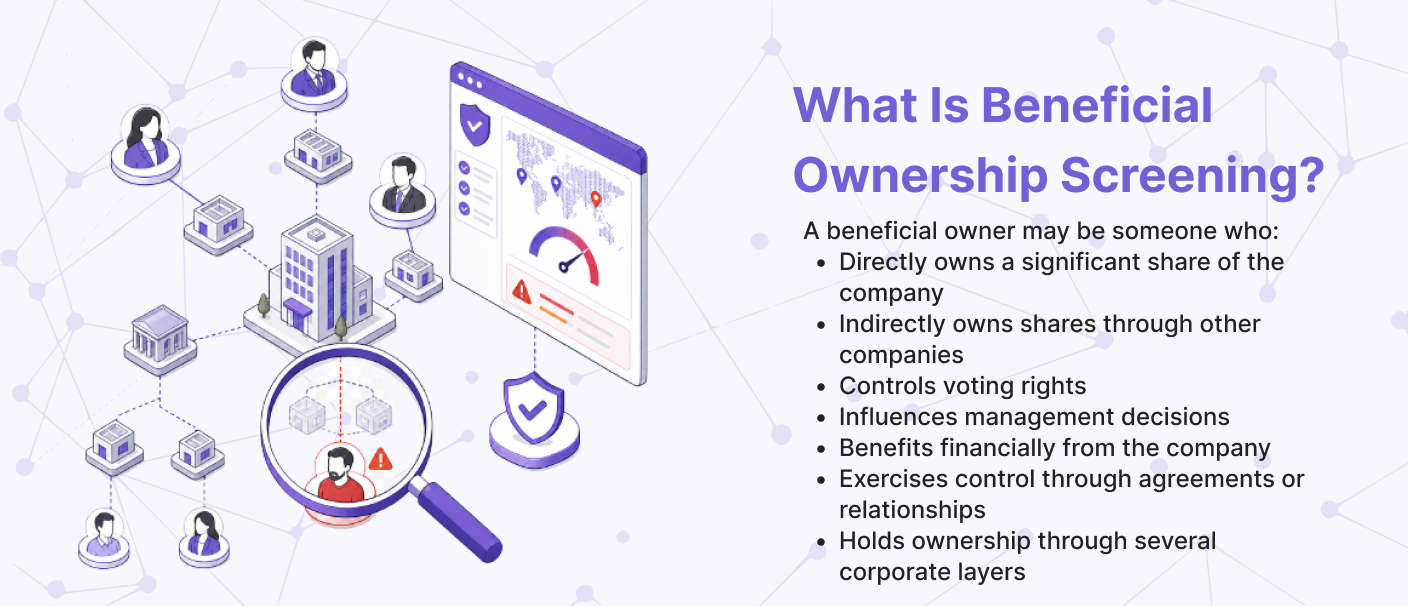
A beneficial owner may be someone who:
- Directly owns a significant share of the company
- Indirectly owns shares through other companies
- Controls voting rights
- Influences management decisions
- Benefits financially from the company
- Exercises control through agreements or relationships
- Holds ownership through several corporate layers
Beneficial ownership screening goes beyond checking the registered company name.
It may include screening:
- Directors
- Shareholders
- Promoters
- Partners
- Trustees
- Ultimate beneficial owners
- Parent companies
- Subsidiaries
- Related entities
- Authorized signatories
- Controlling individuals
The objective is to understand the real ownership and control structure behind the business.
In simple terms, beneficial ownership screening helps financial institutions answer:
Who is really behind this company, and does that person create compliance risk?
Why Fintech Companies Need Beneficial Ownership Screening
Fintech companies need beneficial ownership screening because business onboarding can hide risk behind complex legal structures.
A merchant may be registered under one company but controlled by another. A corporate borrower may have several holding entities. A vendor may use nominee directors. A business customer may have shareholders located in high-risk regions.
Without deeper screening, the visible company may look clean while the real owner carries significant risk.
This can expose fintech companies to:
- Sanctions violations
- Money laundering risk
- Regulatory action
- Fraud exposure
- Reputational damage
- Hidden related-party risk
- Shell company misuse
- Tax and legal risk
- Corruption exposure
- Weak audit evidence
Manual UBO screening also creates operational problems.
Compliance teams may need to search company records, regulatory lists, director databases, sanction lists, and ownership documents separately.
As onboarding volume grows, this process becomes slow and inconsistent.
Beneficial ownership screening helps fintech teams apply a repeatable process across every business customer.
It improves visibility without forcing analysts to investigate every company manually from the beginning.
How Beneficial Ownership Screening Works
Beneficial ownership screening works by collecting business information, identifying ownership relationships, screening connected individuals and entities, and recording the final compliance decision.
1. Business Information Is Collected
The process begins with basic company information.
This may include:
- Legal company name
- Trade name
- Registration number
- Tax identification number
- Registered address
- Business type
- Incorporation date
- Industry
- Country of registration
- Contact information
- Website
- Business documents
Depending on the market, this may also include corporate registration records, GSTIN details, partnership records, or local regulatory information.
Clean business data is important because incorrect registration details can lead to weak ownership checks.
2. Directors and Shareholders Are Identified
The next step is to identify the people and entities connected to the company.
This may include:
- Directors
- Shareholders
- Partners
- Promoters
- Trustees
- Company secretaries
- Authorized signatories
- Parent companies
- Subsidiaries
The purpose is to build a clear ownership and control structure.
A company may have only a few direct shareholders, or it may have several layers of corporate ownership.
3. The Ultimate Beneficial Owner Is Determined
The system then works through the ownership chain to identify the real individual who ultimately controls or benefits from the company.
For example:
- Company A is owned by Company B
- Company B is owned by Holding Company C
- Holding Company C is controlled by an individual
That individual may be the ultimate beneficial owner.
The process may consider:
- Direct ownership percentage
- Indirect ownership percentage
- Voting rights
- Management control
- Financial benefit
- Control through agreements
- Influence without formal ownership
A complete UBO screening process should not stop at the first corporate shareholder.
It should continue until the actual controlling individual is identified.
4. Connected Individuals Are Screened
Once directors, shareholders, and beneficial owners are identified, they are screened against relevant risk sources.
These may include:
- Sanctions lists
- PEP databases
- Watchlists
- Regulatory action records
- Litigation databases
- Adverse media
- Internal blocklists
- High-risk country indicators
- Enforcement records
- Corporate disqualification records
This helps the compliance team understand whether any connected person creates additional risk.
5. Related Entities Are Reviewed
The risk may not come only from an individual.
Related companies may also create concern.
The system may review:
- Parent organizations
- Subsidiaries
- Sister companies
- Common directors
- Shared addresses
- Connected shareholders
- Repeated corporate relationships
- Previously flagged businesses
This can help identify hidden relationships and broader business networks.
6. Ownership Risk Is Scored
The company may then receive an ownership-related risk score.
The score may consider:
- Number of ownership layers
- Jurisdictions involved
- Sanctions exposure
- PEP exposure
- High-risk countries
- Missing ownership information
- Nominee relationships
- Unusual corporate structure
- Adverse media
- Director history
- Previous regulatory action
The company may be classified as:
- Low risk
- Medium risk
- High risk
- Critical risk
- Requires enhanced due diligence
This helps teams decide how much review is required.
7. The Case Is Reviewed
Possible risk matches should be reviewed by a compliance analyst.
The analyst may examine:
- Ownership documents
- Company records
- Match details
- Director information
- UBO identity details
- Sanctions results
- PEP results
- Watchlist results
- Supporting evidence
- Customer explanations
The analyst can then record whether the case is:
- Cleared
- Approved
- Approved with conditions
- Sent for enhanced due diligence
- Escalated
- Rejected
- Awaiting more information
8. Ongoing Monitoring Is Applied
Beneficial ownership can change after onboarding.
A company may add a new director, transfer shares, change control, or become connected to a higher-risk entity.
Ongoing monitoring helps teams detect these changes.
The business can be rescreened when:
- Directors change
- Ownership changes
- New shareholders are added
- Regulatory lists are updated
- Sanctions lists change
- Risk level increases
- Periodic review becomes due
- A suspicious transaction is detected
This helps the institution manage risk throughout the business relationship.
Key Features of Beneficial Ownership Screening Software
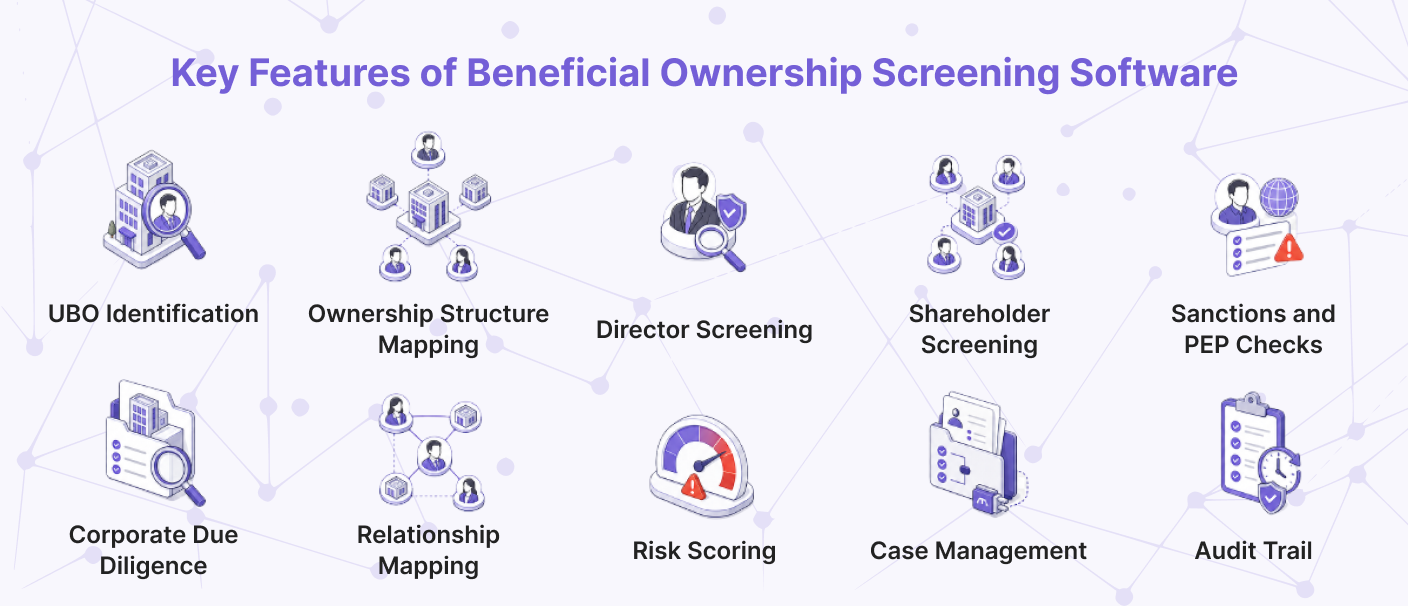
UBO Identification
The system should help identify the individuals who ultimately own or control the business.
This is the core requirement of beneficial ownership screening.
Ownership Structure Mapping
Ownership structure mapping helps compliance teams understand how companies, directors, shareholders, and beneficial owners are connected.
Director Screening
Director screening checks whether company directors appear on sanctions lists, PEP databases, watchlists, litigation records, or regulatory databases.
Shareholder Screening
Shareholders should be screened individually and through connected entities.
This helps identify indirect risk.
Sanctions and PEP Checks
Every identified beneficial owner should be checked for sanctions and political exposure.
A match may require stronger review.
Corporate Due Diligence
Corporate due diligence should combine ownership, registration, director, litigation, regulatory, and watchlist information.
This gives teams a broader view of business risk.
Relationship Mapping
Relationship mapping shows how individuals and companies are linked.
This can reveal repeated directors, shared addresses, connected entities, and hidden ownership patterns.
Risk Scoring
The system should convert ownership complexity and compliance signals into a clear risk level.
This helps teams prioritize reviews.
Case Management
Possible matches should move through a structured investigation workflow.
The case should include supporting evidence, analyst notes, decisions, and escalation history.
Audit Trail
Every search, match, decision, and review action should be recorded.
This supports internal audits and regulatory reviews.
API Integration
API integration allows beneficial ownership screening to run inside merchant onboarding, corporate lending, vendor approval, or business KYC workflows.Use Cases of Beneficial Ownership Screening
1. Merchant Onboarding
Payment companies can screen merchants, directors, shareholders, and beneficial owners before activating payment services.
This helps identify hidden business risk before transaction activity begins.
2. Corporate Borrower Due Diligence
NBFCs and digital lenders can examine ownership structures before approving business loans.
This helps identify connected-party, fraud, and regulatory risk.
3. Vendor and Partner Screening
Fintech companies can screen technology vendors, collection agencies, outsourcing partners, and service providers.
This supports stronger third-party compliance.
4. Business Account Opening
Banks and neobanks can identify the real individuals behind a company before opening an account.
This reduces the chance of onboarding shell companies or hidden high risk owners.
5. Embedded Finance Partnerships
Embedded finance providers often work through platforms, merchants, and intermediaries.
Beneficial ownership screening helps identify risk across the wider partnership network.
6. Cross-Border Business Screening
Companies operating across multiple jurisdictions may have complex ownership structures.
UBO screening helps identify foreign ownership, high risk jurisdictions, and hidden control relationships.
7. Ongoing Business Monitoring
Existing business customers can be rescreened when ownership or directorship changes.
This helps maintain current compliance records.
8. Enhanced Due Diligence
High-risk businesses may require deeper review.
Beneficial ownership data helps analysts understand what additional evidence is needed.
Benefits of Beneficial Ownership Screening
Better Visibility Into Real Ownership
Compliance teams can see who truly owns and controls the business.
This reduces the risk of relying only on the visible company name.
Earlier Risk Detection
Sanctions, PEP, litigation, and regulatory connections can be identified before onboarding.
Faster Corporate Due Diligence
Automated screening reduces the need to search multiple systems manually.
More Consistent Decisions
Every business can be reviewed through the same structured process.
This reduces differences between analysts.
Stronger AML Compliance Checks
Beneficial ownership screening supports a more complete AML compliance process.
It helps identify ownership structures that may be used to hide financial crime risk.
Reduced Shell Company Risk
Complex or hidden ownership patterns can be flagged for additional review.
Better Audit Readiness
Every ownership check and compliance decision can be recorded with supporting evidence.
Improved Onboarding Efficiency
Low-risk businesses can move through onboarding faster, while complex cases receive deeper review.
Stronger Ongoing Monitoring
Ownership and director changes can be detected after onboarding.
Common Challenges in Beneficial Ownership Screening
Complex Ownership Structures
Some companies have multiple ownership layers across different jurisdictions.
Identifying the final beneficial owner can require deeper analysis.
Missing Ownership Information
Businesses may provide incomplete or outdated shareholder records.
This can delay screening.
Nominee Directors and Shareholders
Nominee arrangements can make it difficult to identify the real controlling individual.
These cases may require enhanced due diligence.
Inconsistent Company Records
Business names, addresses, registration details, and director information may appear differently across data sources.
Screening Only the Company Name
A clean company name does not mean the directors or beneficial owners are low risk.
All connected individuals should be reviewed.
Ignoring Indirect Ownership
A beneficial owner may control the company through several intermediate entities.
Screening should follow the ownership chain.
One-Time Screening
Ownership structures change.
A company approved today may have a different director or shareholder later.
High False Positives
Common names may create sanctions or PEP alerts.
Supporting details such as date of birth, nationality, and address are needed to clear them.
No Clear Escalation Process
High-risk ownership matches require a defined review and approval process.
Without it, cases may remain unresolved.
How RiskIntel Helps With Beneficial Ownership Screening
RiskIntel by Cloudastra helps fintech companies, NBFCs, banks, lenders, payment platforms, and financial institutions screen businesses, directors, shareholders, and ultimate beneficial owners.
RiskIntel supports:
- Beneficial ownership screening
- UBO screening
- Director screening
- Shareholder checks
- Sanctions screening
- PEP screening
- Watchlist screening
- Corporate due diligence
- GSTIN and company data checks
- Litigation and regulatory risk checks
- Relationship mapping
- Customer and business risk scoring
- Ongoing monitoring
- Case review workflows
- Audit-ready compliance records
Instead of screening only the registered company name, compliance teams can use RiskIntel to examine the wider ownership and control structure.
This helps teams identify hidden risk before approving a merchant, corporate borrower, vendor, business customer, or financial partner.
RiskIntel also helps analysts manage possible matches through one structured workflow, reducing dependence on spreadsheets, separate search tools, and disconnected review records.
For growing financial companies, this creates a faster and more consistent approach to business onboarding and corporate compliance.
Who Should Use RiskIntel?
RiskIntel is useful for:
- NBFCs
- Digital lenders
- Banks
- Fintech companies
- Payment gateways
- Payment aggregators
- Neobanks
- Embedded finance platforms
- Corporate lending teams
- Merchant onboarding teams
- Vendor risk teams
- Compliance teams
- AML teams
- Risk teams
- Business operations teams
It is especially useful for organizations that onboard companies, merchants, vendors, corporate borrowers, or financial partners.
Want to explore more practical insights on AI development, automation, and conversational AI? Read more blogs at Cloudastra Technologies or contact us for business enquiries through Cloudastra Contact Us.
FAQs
1. What is beneficial ownership screening?
Beneficial ownership screening is the process of identifying and evaluating the individuals who ultimately own, control, or benefit from a business.
2. What is a UBO?
A UBO, or ultimate beneficial owner, is the real individual who ultimately owns, controls, or benefits from a company, even when ownership passes through other entities.
3. Why is beneficial ownership screening important?
It helps financial institutions identify hidden sanctions, PEP, fraud, regulatory, and money laundering risk behind a business.
4. Is screening the company name enough?
No. Compliance teams should also screen directors, shareholders, beneficial owners, parent companies, and related entities.
5. What information is checked during UBO screening?
UBO screening may check names, ownership percentage, nationality, address, date of birth, company relationships, sanctions, PEP status, watchlists, litigation, and regulatory records.
6. What is the difference between director screening and beneficial ownership screening?
Director screening checks the individuals managing the company. Beneficial ownership screening identifies the individuals who ultimately own or control it. The same person may be both, but not always.
7. Should beneficial owners be monitored after onboarding?
Yes. Ownership structures, directors, sanctions status, and regulatory risk can change over time.
8. How does RiskIntel support beneficial ownership screening?
RiskIntel helps teams screen businesses, directors, shareholders, and beneficial owners against sanctions, PEP, watchlist, litigation, regulatory, and corporate risk data while maintaining structured case records and audit trails.