AI Consultant Hourly Rates in 2026: What Businesses Should Expect to Pay
AI consultant hourly rates in 2026 usually range from $80 to $600 per hour, depending on the consultant’s experience, delivery model, project complexity, and whether the work is advisory, technical, or production-focused.
Solo AI consultants may charge lower rates, boutique AI consultancies usually sit in the mid-range, and Big 4 or enterprise consulting firms charge the highest rates. But hourly pricing alone does not show the full cost. The real cost depends on who actually does the work, how long the engagement runs, what is included, and whether the output reaches production.
For businesses planning AI projects, the goal is not to hire the cheapest AI consultant. The goal is to choose the right pricing model for the scope, timeline, risk, and expected business outcome.
What Problem Does AI Consulting Rate Planning Solve?
Most companies struggle to understand whether an AI consulting quote is reasonable.
One consultant may quote $100 per hour. A boutique AI firm may quote $250 per hour. A Big 4 consulting firm may quote $500 per hour. Another vendor may avoid hourly pricing and offer a fixed $75K project.
Without clear benchmarks, businesses can easily overpay, under-scope, or choose the wrong model.
Common problems include:
- Paying enterprise rates for work that does not need enterprise consulting
- Hiring a low-cost consultant who cannot deliver production systems
- Getting stuck in long discovery phases
- Paying senior rates while junior people do most of the work
- Choosing hourly billing when fixed-fee delivery would be better
- Underestimating hidden costs
- Hiring strategy consultants when implementation is needed
- Receiving recommendations without a clear build plan
- Missing post-launch support and infrastructure costs
- Getting locked into proprietary tools or frameworks
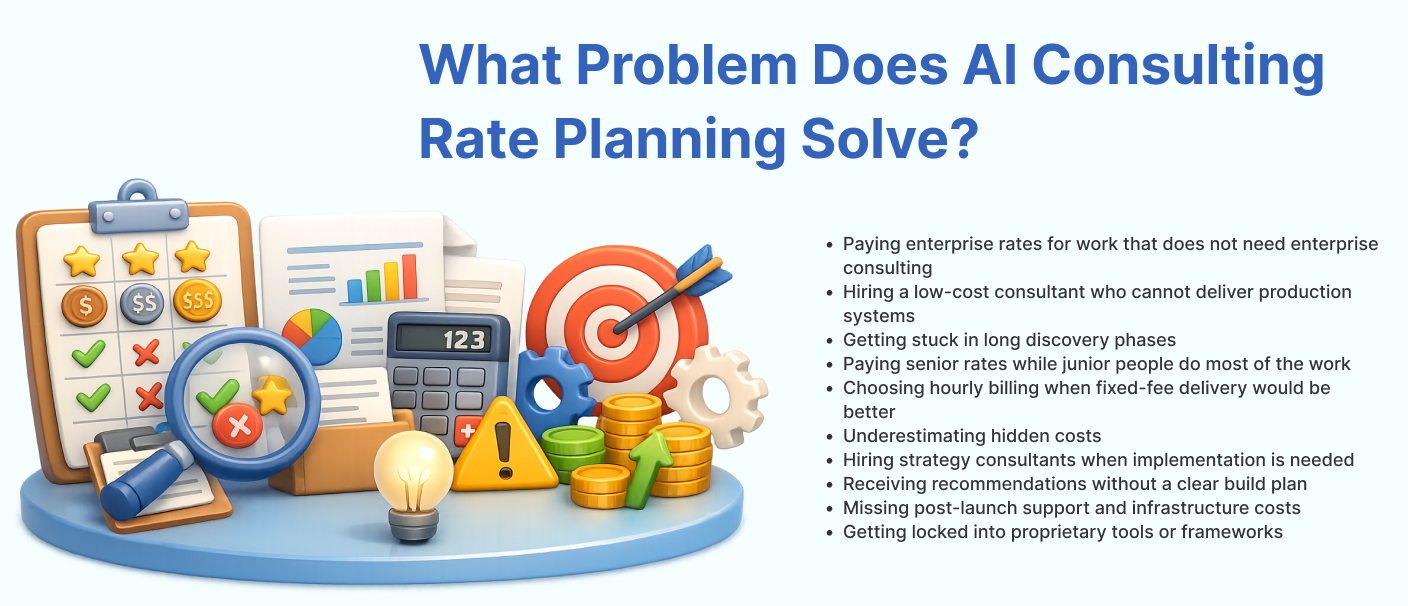
AI consulting rate planning helps businesses compare pricing models, understand what each rate tier includes, and avoid paying for consulting activity that does not create measurable value.
What Are AI Consultant Hourly Rates?
AI consultant hourly rates are the fees charged by AI consultants, engineers, advisors, agencies, or consulting firms for AI strategy, architecture, implementation, review, and ongoing support.
These rates may cover work such as:
- AI strategy consulting
- AI readiness assessment
- AI product roadmap
- AI architecture design
- Build-vs-buy analysis
- RAG system planning
- LLM integration guidance
- AI chatbot consulting
- Multi-agent system design
- Prompt engineering support
- Data pipeline review
- Model evaluation
- AI governance planning
- Code review
- Technical advisory
- Production deployment support
- AI team mentoring
In simple terms, AI consulting rates help businesses answer questions like:
- How much does an AI consultant cost?
- What should we pay for AI strategy?
- When does hourly consulting make sense?
- Should we choose hourly, retainer, or fixed-fee pricing?
- Why do Big 4 AI consulting firms cost more?
- What is a fair AI consulting rate for implementation?
- What hidden costs should we expect?
- How do we avoid overpaying for AI consulting?
The right pricing model depends on whether the business needs advice, leadership, hands-on engineering, or full delivery.
Why AI Consulting Rates Vary So Much
AI consulting rates vary because “AI consulting” can mean very different things.
Some consultants only advise. They help leadership teams understand AI opportunities, evaluate tools, and create a roadmap.
Some consultants are hands-on technical experts. They review code, design AI architecture, build prototypes, create RAG systems, integrate LLM APIs, and support deployment.
Some firms deliver full production systems with product design, engineering, testing, deployment, monitoring, and post-launch support.
The rate also depends on the type of provider.
A solo AI engineer may be affordable but may not cover strategy, security, architecture, and delivery management. A boutique consultancy may charge more but provide senior specialists. A Big 4 firm may charge premium rates because of brand trust, documentation, governance, and enterprise stakeholder management.
Rates also change based on:
- Geography
- Seniority
- Team structure
- Project risk
- Timeline pressure
- Industry compliance needs
- Strategy vs implementation scope
- Production deployment experience
- Post-launch support requirements
This is why the cheapest hourly rate is not always the lowest total cost.
How Much Do AI Consultants Charge in 2026?
AI consultant hourly rates in 2026 typically fall into these ranges:
- Solo AI consultants: $80–$200/hour
- Senior AI engineers or technical leads: $150–$250/hour
- Boutique AI consultancies: $150–$300/hour
- Principal AI consultants or senior advisors: $250–$500/hour
- Big 4 or enterprise AI consulting firms: $300–$600/hour
- Offshore AI-first agencies: $22–$50/hour
The uploaded Cloudastra guide compares three broad delivery models:
- Big 4 / enterprise firms: $300–$600/hour
- Boutique AI consultancies: $150–$300/hour
- Offshore AI-first agencies: $22–$50/hour
The difference is not only the hourly rate. It is also the delivery structure.
For enterprise teams that need more control over AI usage, IntegraAI can support safer multi-model chat adoption with privacy, flexibility, and management controls.
A large consulting firm may include senior partners, managers, analysts, documentation, and governance overhead. A boutique firm may give more direct access to specialists. An AI-first agency may reduce delivery cost by using AI-assisted engineering workflows and leaner teams.
For build-heavy AI projects, businesses should look beyond the rate and compare total delivery cost, production experience, timeline, and ownership.
The Three AI Consulting Pricing Models
1. Hourly AI Consulting
Hourly AI consulting usually costs $150–$500/hour, depending on seniority and scope.
This model works best when the work is uncertain, advisory, or short-term.
Hourly consulting is useful for:
- AI technical assessment
- AI roadmap review
- Architecture review
- Vendor quote review
- Build-vs-buy decisions
- AI implementation second opinion
- Code review
- Data readiness review
- Short-term expert guidance
At $150–$200/hour, businesses usually get a senior AI engineer or technical lead who can provide hands-on guidance, review systems, and support implementation.
At $200–$350/hour, the work usually combines strategy and implementation. This may include architecture design, tool selection, technical leadership, and oversight.
At $350–$500/hour, the work is usually strategy-heavy. This may include board-level AI transformation planning, M&A technical due diligence, AI governance, or enterprise roadmap design.
Hourly consulting is flexible, but it can become expensive if the scope is not controlled.
2. Fractional CTO or Monthly Retainer
A fractional AI CTO or AI advisor retainer usually costs $5,000–$15,000 per month.
This model works when the business needs ongoing technical leadership but does not need, or cannot yet hire, a full-time CTO.
A fractional AI CTO may help with:
- AI roadmap ownership
- Architecture decisions
- Engineering leadership
- Hiring support
- Sprint planning
- Vendor selection
- Code review
- AI governance
- Team mentoring
- Investor or board technical support
The uploaded guide notes that fractional CTO retainers usually work best for companies with 0–20 engineers that need strategic direction but cannot justify a full-time technical executive.
This model is useful for startups, SMBs, and growth-stage companies building AI products over several months.
The important question is whether the advisor comes alone or with an execution team. A solo advisor can guide strategy. An AI-first agency can combine leadership with implementation capacity.
3. Project-Based or Fixed-Fee AI Consulting
Project-based AI consulting usually costs $20,000 to $200,000+, depending on scope.
This model works when the deliverable is clear.
Examples include:
- AI proof of concept
- AI MVP
- RAG-powered knowledge base
- AI chatbot implementation
- Document classification pipeline
- Recommendation system upgrade
- Multi-agent workflow automation
- AI readiness assessment
- Production AI system with integrations
- Enterprise AI transformation roadmap
The uploaded guide gives common project ranges:
- $20K–$50K for an AI proof of concept or MVP
- $50K–$100K for a production AI system with integrations
- $100K–$200K+ for enterprise AI transformation
Fixed-fee pricing is useful when businesses want cost certainty, milestones, and a defined timeline.
It works best when scope is clear. If the scope is vague, fixed-fee projects can lead to change orders and budget expansion.
Big 4 vs Boutique vs Offshore AI-First Agencies
Big 4 and Enterprise Consulting Firms
Big 4 or enterprise AI consulting firms usually charge $300–$600/hour.
They are best for:
- Fortune 500 companies
- Board-level AI transformation
- Enterprise governance programs
- Regulated industries
- Large stakeholder environments
- Complex documentation and compliance needs
- Multi-department AI strategy
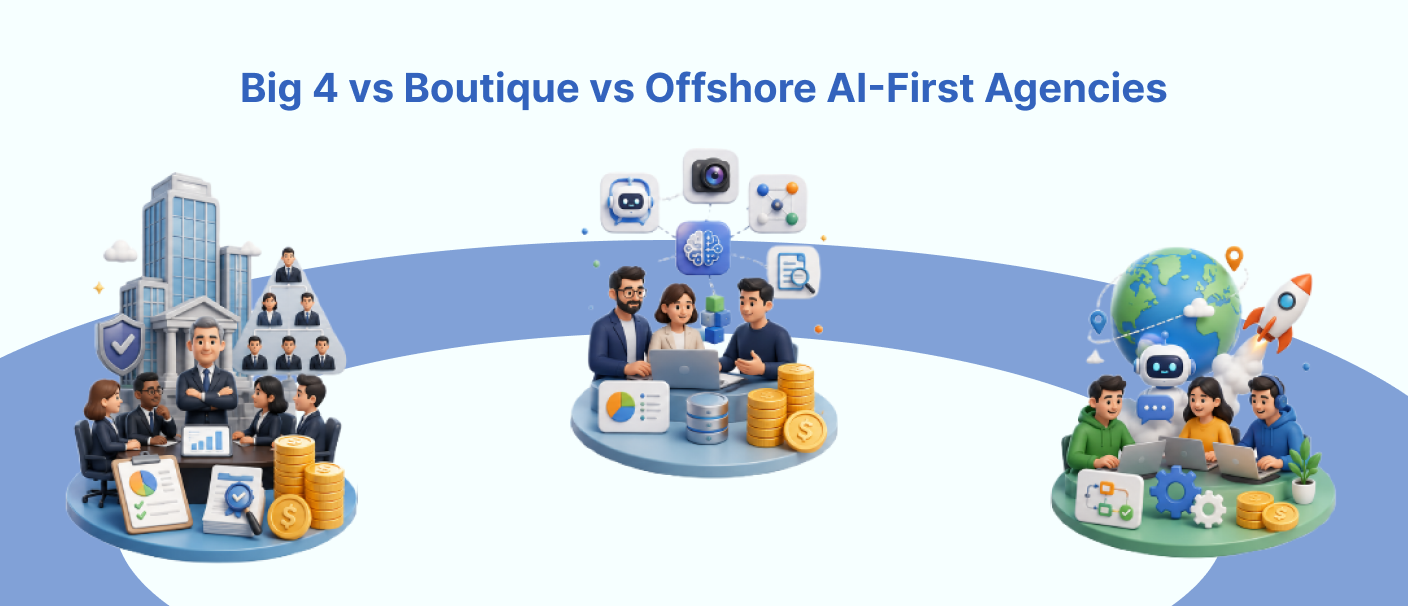
The benefit is brand credibility, stakeholder management, documentation, and governance structure.
The drawback is cost and delivery model. Large firms often use a pyramid structure where senior partners guide the engagement, but junior consultants do much of the execution.
This may make sense for enterprise strategy, but it can be too expensive for hands-on AI product development.
Boutique AI Consultancies
Boutique AI consultancies usually charge $150–$300/hour.
They are best for:
- Mid-market companies
- Specific AI domains
- NLP projects
- Computer vision
- Recommendation systems
- RAG systems
- AI product architecture
- Technical implementation with senior specialists
The benefit is that senior people are often directly involved.
Boutiques are useful when the business needs focused AI expertise and wants a smaller, more specialized team than a large consulting firm.
The drawback is that expertise may be narrow. Some boutiques may be strong in research but weaker in production delivery, or strong in strategy but less suited for full engineering execution.
Offshore AI-First Agencies
Offshore AI-first agencies may charge around $22–$50/hour, depending on scope and team structure.
They are best for:
- Startups
- Scale-ups
- SMBs
- AI MVPs
- RAG systems
- AI agents
- AI chatbot development
- Workflow automation
- Speed-critical AI projects
- Companies that want production delivery without Big 4 pricing
The benefit is lower cost, faster delivery, and leaner execution when the team uses AI-first engineering internally.
The uploaded guide explains that AI-first agencies can use AI Agent Teams to reduce manual engineering effort and ship faster than traditional consulting models.
This model works best when the buyer wants real implementation, not just strategy slides.
What Do You Actually Get at Each Price Point?
$80–$150/hour
At this level, businesses may get a solo AI consultant, freelance AI engineer, or offshore specialist.
This can work for:
- Prompt engineering support
- API integration help
- Small automation tasks
- Prototype review
- Basic AI tool setup
- Short technical support
The risk is that the consultant may not cover product strategy, security, architecture, or production deployment.
$150–$300/hour
At this level, businesses usually get senior technical guidance or boutique consulting support.
This can include:
- AI architecture design
- RAG system planning
- LLM integration review
- Build-vs-buy analysis
- AI roadmap
- Implementation oversight
- Production readiness review
This is often the practical range for serious AI consulting work.
$300–$600/hour
At this level, businesses are usually paying for enterprise strategy, brand trust, senior advisory, governance, and large-firm documentation.
This can include:
- Enterprise AI transformation
- Board-level strategy
- AI governance frameworks
- M&A technical diligence
- Large-scale operating model design
- Multi-department AI roadmap
This rate can be justified for executive-level decisions, but it is usually expensive for build-heavy implementation work.
Hidden Costs That Inflate AI Consulting Engagements
1. Travel and On-Site Requirements
Some consulting firms add travel costs on top of consulting fees.
The uploaded guide notes that Big 4 firms may add 15–25% in travel costs for on-site work.
Before signing, businesses should ask which parts truly require on-site presence and which can be handled remotely.
AI architecture, code review, model evaluation, and pipeline development can often be done remotely.
2. Change Orders and Scope Creep
Fixed-fee AI projects can become expensive if the scope is vague.
A phrase like “build an AI chatbot” can mean a simple FAQ bot or a complex RAG chatbot with CRM integration, multi-turn memory, analytics, and human escalation.
To avoid scope creep, businesses should request:
- Detailed deliverables
- Explicit exclusions
- Milestone definitions
- Change order caps
- Acceptance criteria
- Timeline assumptions
The uploaded guide notes that many AI consulting engagements exceed their original budgets because of scope changes.
3. Vendor Lock-In
Some consultants build on proprietary frameworks, internal platforms, or custom abstractions that only they can maintain.
This creates long-term cost risk.
Before signing, businesses should ask:
- Will we own the code?
- Can another team maintain it?
- Are standard frameworks used?
- Are prompts and pipelines documented?
- Are integrations portable?
- Is there a handover plan?
A lower upfront cost can become expensive if the business becomes locked into one vendor.
4. Knowledge Transfer Gaps
Consultants may finish the engagement and leave the internal team with a system they do not understand.
This creates long-term operational risk.
A good engagement should include:
- Documentation
- Architecture walkthroughs
- Code walkthroughs
- Runbooks
- Internal training
- Handover sessions
- Post-launch support window
The uploaded guide recommends budgeting 2–4 weeks of overlap for knowledge transfer when a consulting team hands off to an internal team.
5. Ongoing API and Infrastructure Costs
AI systems have monthly operating costs.
These may include:
- LLM API usage
- Vector database
- Hosting
- Monitoring
- Logging
- Evaluation pipelines
- Data processing
- Support and maintenance
Production AI systems can cost $2K–$10K+ per month to operate, depending on usage and complexity.
Every AI consulting proposal should include a first 6-month operating cost estimate.
Red Flags in AI Consulting Engagements
The Discovery Phase That Never Ends
Discovery is useful when it produces clear outputs.
But if discovery stretches for 8–12 weeks without a scoped implementation plan, the consultant may be billing to learn rather than applying expertise.
A strong AI consultancy should usually complete discovery in 2–4 weeks and deliver a clear scope, architecture recommendation, risks, and implementation plan.
Rates That Exclude Senior Time
A proposal may quote a blended rate, but the actual work may be done mostly by junior team members.
Businesses should ask for:
- Role-wise rate card
- Senior involvement percentage
- Who will actually do the work
- Who will review technical decisions
- Who owns delivery quality
This prevents paying senior rates for junior-heavy execution.
No Production Deployment Experience
Building an AI demo is different from deploying a production AI system.
Businesses should ask:
- How many production AI systems have you deployed?
- What monitoring do you set up?
- How do you handle model drift?
- What happens when output quality drops?
- How do you manage incidents?
- What does post-launch support include?
If the answers are vague, the consultant may be stronger in research or prototyping than production delivery.
Technology Recommendation Before Problem Understanding
A consultant who recommends a specific model, framework, or platform before understanding the business problem may be selling a familiar solution rather than solving the right problem.
Good consultants start with:
- Business goal
- User workflow
- Data availability
- Existing systems
- Constraints
- Security needs
- Success metrics
- ROI expectations
Technology should follow the problem, not the other way around.
No Discussion of What Not to Automate
A good AI consultant should tell the business what should not be automated.
Not every workflow needs AI. Some tasks are too low-value, too risky, too ambiguous, or too expensive to automate.
If every idea becomes a paid recommendation, the consultant may be optimizing for contract size instead of business outcome.
Which AI Consulting Pricing Model Fits Your Situation?
Choose Hourly Consulting If:
- You need a technical second opinion
- You need 2–4 weeks of expert review
- The scope is uncertain
- You want flexibility
- Your budget is under $30K
- You already have internal engineers
- You need guidance, not a full delivery team
Choose a Fractional CTO or Retainer If:
- You need ongoing AI leadership
- You are building an AI product over several months
- You do not have a full-time technical executive
- You need help with architecture, hiring, roadmap, and reviews
- You want relationship depth and accountability
- The work is continuous, not one fixed project
Choose Project-Based Consulting If:
- The deliverable is clearly defined
- You want a fixed timeline and budget
- You need a production system built
- You are comparing multiple vendor proposals
- The project has a natural end point
- You want milestone-based delivery
For most startups and SMBs, fixed-scope AI-first delivery is often easier to manage than open-ended hourly consulting.
How to Negotiate AI Consulting Rates
Ask for Volume or Duration Discounts
Longer engagements often create room for discounts.
A 6-month engagement may qualify for lower rates than a 3-month engagement because it reduces sales overhead for the consulting firm.
Ask directly for duration-based pricing.
Use Milestone-Based Payments
Instead of paying only by time, connect payments to deliverables.
Milestone-based payment helps keep the engagement tied to outcomes.
Examples include:
- Discovery complete
- Architecture approved
- MVP delivered
- Integration complete
- Pilot launched
- Production handoff complete
Optimize the Team Mix
Not every task needs the most senior consultant.
Businesses can reduce cost by using senior experts for architecture and review while mid-level engineers handle implementation.
This can reduce cost without weakening critical technical decisions.
Add Success-Based Components Carefully
For revenue-generating AI systems, a lower base rate plus a success bonus can work.
This is useful when the outcome can be measured clearly, such as conversion rate, cost savings, revenue lift, or automation volume.
The success metric must be defined before the engagement starts.
How Cloudastra Helps Reduce AI Consulting Cost
Cloudastra offers an AI-first agency alternative to traditional AI consulting.
Instead of relying on large consulting teams, long timelines, and heavy documentation phases, Cloudastra uses AI Agent Teams and AI-first engineering workflows to move from strategy to production faster.
Cloudastra can help with:
- AI strategy consulting
- AI readiness assessment
- AI architecture
- AI roadmap planning
- AI MVP development
- AI chatbot development
- RAG system development
- AI agent development
- Multi-agent workflow automation
- Fractional AI-first CTO support
- Hire AI engineers
- Production AI implementation
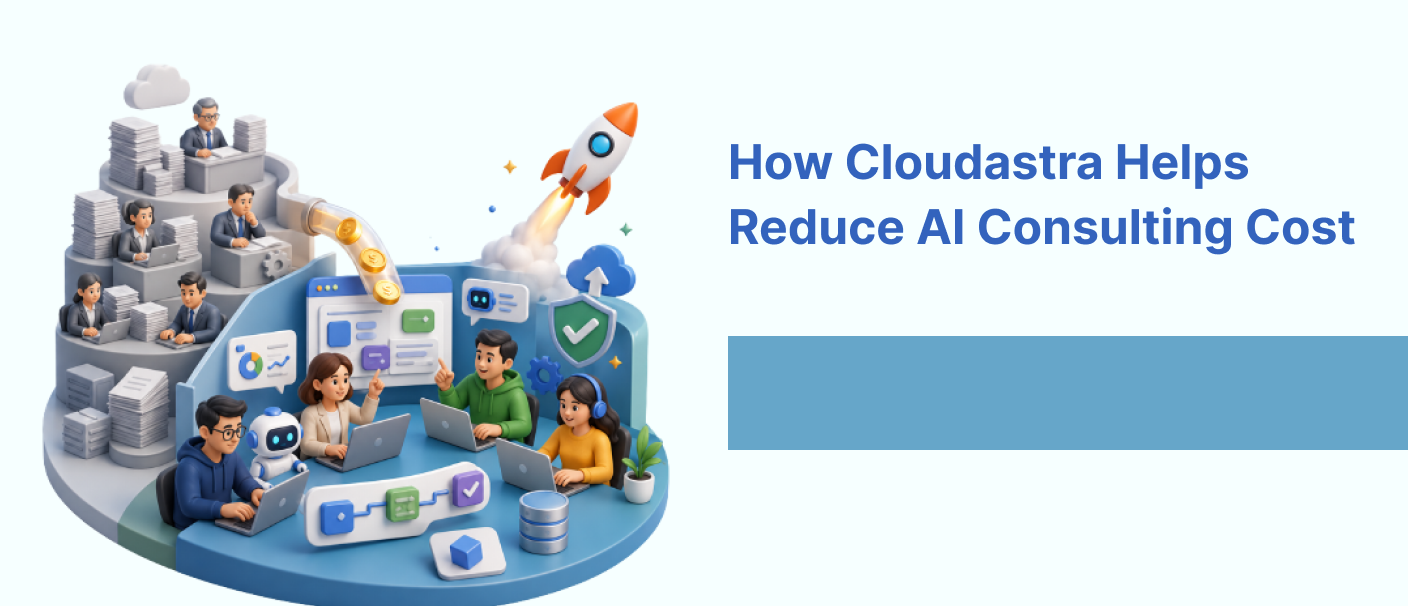
The uploaded guide explains that Cloudastra’s AI Agent Teams are designed to deliver production-ready applications in weeks, not months, with leaner teams and lower total delivery cost than traditional consulting models.
For businesses, this means the consulting budget is spent closer to actual implementation and less on overhead.
Who Should Read This AI Consulting Rate Guide?
This guide is useful for:
- Startup founders
- SMB owners
- CTOs
- Product leaders
- Enterprise innovation teams
- AI transformation teams
- Finance leaders reviewing AI budgets
- Companies comparing AI consulting quotes
- Businesses deciding between consultant, agency, or internal hire
- Teams planning AI MVPs
- Companies building AI agents or AI chatbots
- Businesses considering fractional AI leadership
It is especially useful if you have received AI consulting proposals and need to understand whether the rate, scope, and delivery model are reasonable.
Want to explore more practical insights on AI development, automation, and conversational AI? Read more blogs at Cloudastra Technologies or contact us for business enquiries through Cloudastra Contact Us.
FAQs
1. What are typical AI consultant hourly rates in 2026?
AI consultant hourly rates in 2026 usually range from $80 to $600/hour. Solo consultants may charge $80–$200/hour, boutique AI consultancies may charge $150–$300/hour, and Big 4 or enterprise firms may charge $300–$600/hour.
2. How much does AI consulting cost for a project?
AI consulting projects can cost $20K–$50K for a proof of concept or MVP, $50K–$100K for a production AI system with integrations, and $100K–$200K+ for enterprise AI transformation.
3. Is hourly AI consulting better than fixed-fee pricing?
Hourly consulting is better for uncertain or advisory work. Fixed-fee pricing is better when the deliverable is clear, the business wants cost certainty, and the project has a defined end point.
4. How much does a fractional AI CTO cost?
A fractional AI CTO or AI advisor usually costs around $5,000–$15,000 per month, depending on experience, time commitment, scope, and whether they are backed by an execution team.
5. Why do Big 4 AI consulting firms cost more?
Big 4 firms cost more because they include brand credibility, enterprise governance, documentation, stakeholder management, and large team structures. They are useful for enterprise strategy but may be expensive for hands-on AI implementation.
6. What hidden costs should businesses watch for?
Hidden costs include travel, change orders, vendor lock-in, knowledge transfer gaps, ongoing API and infrastructure costs, discovery phases, and post-launch support.
7. How does Cloudastra reduce AI consulting cost?
Cloudastra reduces AI consulting cost through AI-first engineering, AI Agent Teams, leaner delivery models, fixed-scope execution, and production-focused implementation instead of long strategy-heavy consulting cycles.