EMI reminder automation helps lenders, NBFCs, fintech companies, and loan servicing teams send timely repayment reminders to borrowers before due dates, on due dates, and after missed payments.
Instead of depending on manual follow ups, collection teams can use automated EMI reminders to improve repayment discipline, reduce missed payments, and identify borrowers who need early attention. DebtPulse helps lenders automate borrower communication, track repayment behavior, and manage collection workflows before accounts become seriously delinquent.
Introduction
Most collection problems do not start with serious default.
They often start with a missed EMI.
A borrower may forget the due date. An other may delay payment because of a temporary cash flow issue. Some borrowers may need repeated reminders before they act. Others may ignore messages until the account becomes overdue.
For lenders, this creates a major operational problem.
If every borrower needs manual calling, WhatsApp follow ups, SMS reminders, and status tracking, the collection team quickly becomes overloaded.
The result is usually delayed follow up, inconsistent messaging, and poor visibility into which borrowers are actually at risk.
EMI reminder automation solves this problem by making repayment communication timely, structured, and trackable.
It helps lenders remind borrowers before the due date, follow up after missed payments, and move risky accounts into the right collection workflow.
What Is EMI Reminder Automation?
EMI reminder automation is the process of automatically sending repayment reminders to borrowers based on loan due dates, payment status, borrower risk level, and collection rules.
These reminders may be sent through:
- SMS
- Voice calls
- App notifications
- IVR
- Collection agent tasks
The goal is to make sure borrowers receive the right reminder at the right time without manual effort from the collection team.
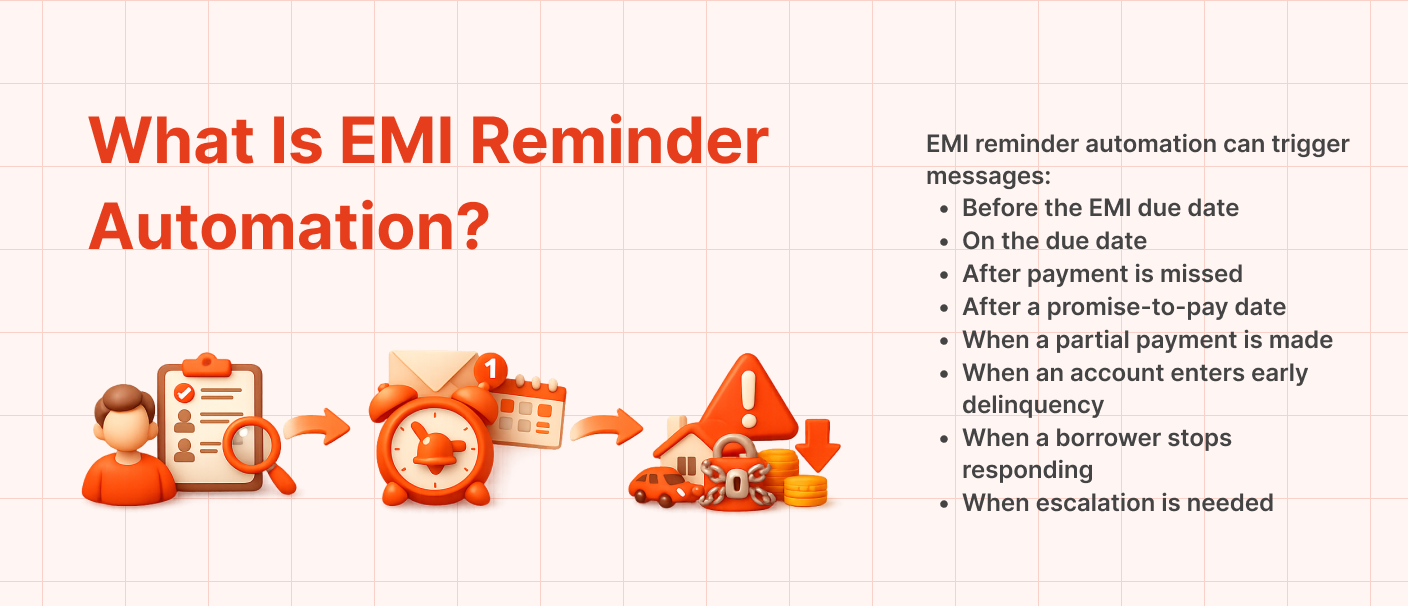
EMI reminder automation can trigger messages:
- Before the EMI due date
- On the due date
- After payment is missed
- After a promise to pay date
- When a partial payment is made
- When an account enters early delinquency
- When a borrower stops responding
- When escalation is needed
In simple terms, EMI reminder automation helps lenders answer:
Which borrower needs a reminder, when should it be sent, and what should happen if payment is still not made?
Why Lenders Need EMI Reminder Automation
Lenders need EMI reminder automation because manual repayment follow ups do not scale.
A small lending team may manage reminders through spreadsheets, phone calls, and manual WhatsApp messages.
That may work when the borrower base is small.
But as the number of loans increases, manual follow up becomes difficult.
Collection teams start facing problems like:
- Missed due date reminders
- Delayed borrower follow ups
- No clear record of communication
- Repeated manual calling
- Low agent productivity
- No prioritization of risky borrowers
- Poor visibility into overdue accounts
- Missed promise to pay dates
- Inconsistent borrower messaging
- Late escalation of delinquent accounts
This creates unnecessary pressure on the collection team.
Not every borrower needs an aggressive recovery action. Many borrowers only need timely reminders and easy repayment communication.
EMI reminder automation helps separate simple reminder cases from high risk collection cases.
This allows collection teams to focus more time on borrowers who are likely to delay, default, or require intervention.
How EMI Reminder Automation Works
EMI reminder automation works by connecting loan data, due dates, borrower profiles, repayment status, communication channels, and collection workflows into one structured process.
1. Loan and Borrower Data Is Collected
The system first collects borrower and loan information.
This may include:
- Borrower name
- Loan account number
- EMI amount
- EMI due date
- Loan type
- Payment status
- Outstanding amount
- Days past due
- Contact details
- Previous repayment behavior
- Promise to pay history
- Risk category
- Preferred communication channel
This data helps decide which reminder should be sent and when.
2. Reminder Rules Are Created
The lender can define reminder rules based on repayment timelines.
For example:
- Send reminder 5 days before due date
- Send reminder 2 days before due date
- Send reminder on due date morning
- Send follow up if payment is not received
- Send stronger message after 3 days overdue
- Assign case to agent after 7 days overdue
- Escalate if borrower breaks promise to pay
These rules make the process consistent.
Instead of relying on agents to remember every borrower, the system automatically triggers reminders based on the repayment stage.
3. Borrowers Are Segmented
Not every borrower should receive the same message.
Borrowers can be segmented based on:
- Repayment history
- Risk level
- Days past due
- Loan amount
- Previous missed payments
- Promise to pay behavior
- Communication response
- Borrower profile
- Collection priority
For example:
A low-risk borrower may receive a polite reminder.
A borrower with repeated delays may receive a stronger follow-up.
A high-risk borrower may be assigned to an agent earlier.
Borrower segmentation helps lenders avoid a one-size-fits-all collection process.
4. Automated EMI Reminders Are Sent
Once rules and borrower segments are defined, the system sends automated EMI reminders through selected channels.
These reminders may include:
- EMI amount
- Due date
- Payment link
- Loan account reference
- Late fee warning
- Support contact
- Promise-to-pay option
- Repayment instructions
The message should be clear and simple.
The purpose is to make repayment easier, not confuse the borrower.
5. Payment Status Is Tracked
After reminders are sent, the system tracks whether the borrower pays or not.
It may check:
- Payment received
- Partial payment received
- Payment failed
- Payment pending
- Promise-to-pay created
- No response
- Message delivered
- Message opened
- Call connected
- Call not answered
This gives collection teams better visibility into borrower behavior.
6. Follow-Ups Are Triggered Automatically
If payment is not received, follow-up actions can be triggered.
For example:
- Send another reminder
- Send WhatsApp follow-up
- Trigger voice call
- Assign borrower to collection agent
- Create agent task
- Escalate to supervisor
- Move account into delinquency workflow
- Mark borrower as high priority
This ensures no borrower slips through the cracks.
7. Promise-to-Pay Is Tracked
Some borrowers may respond by promising to pay on a specific date.
The system should track this promise.
If the borrower pays on the promised date, the case can be updated.
If the borrower misses the promise-to-pay date, the system can trigger another follow-up or escalation.
This helps collection teams reduce broken commitments and avoid manual tracking.
8. Reports Are Generated
The system can generate reports showing:
- Total reminders sent
- Payments collected after reminders
- Borrowers who missed due dates
- Broken promise-to-pay cases
- Agent follow-up status
- Channel performance
- Delinquency movement
- Recovery rate
- High-risk borrower list
These reports help managers understand what is working and where collection workflows need improvement.
Key Features of EMI Reminder Automation Software
Automated EMI Reminders
The system should automatically send EMI reminders before and after due dates.
This reduces manual effort and improves repayment communication.
Multi-Channel Communication
Borrowers should be reachable through multiple channels such as SMS, WhatsApp, email, voice, and app notifications.
Different borrowers respond better to different channels.
Loan Repayment Reminder Rules
Lenders should be able to set reminder rules based on due dates, days past due, borrower risk, and loan type.
Borrower Segmentation
The system should segment borrowers based on repayment behavior, risk level, overdue status, and communication response.
Payment Status Tracking
The system should track whether a borrower has paid, partially paid, missed payment, or created a promise-to-pay.
Promise-to-Pay Tracking
Promise-to-pay tracking helps teams follow up on borrower commitments without depending on manual notes.
Agent Task Assignment
When automation is not enough, the system should assign cases to collection agents.
This helps teams focus on borrowers who need human intervention.
Escalation Workflow
High-risk or non-responsive borrowers should move into escalation workflows.
This makes collection action more structured.
Dashboard and Reporting
Managers should be able to view repayment performance, overdue accounts, reminder success, and collection productivity.
Audit Trail
Every reminder, borrower response, agent action, and payment update should be recorded.
This helps teams maintain clear recovery records.
Use Cases of EMI Reminder Automation
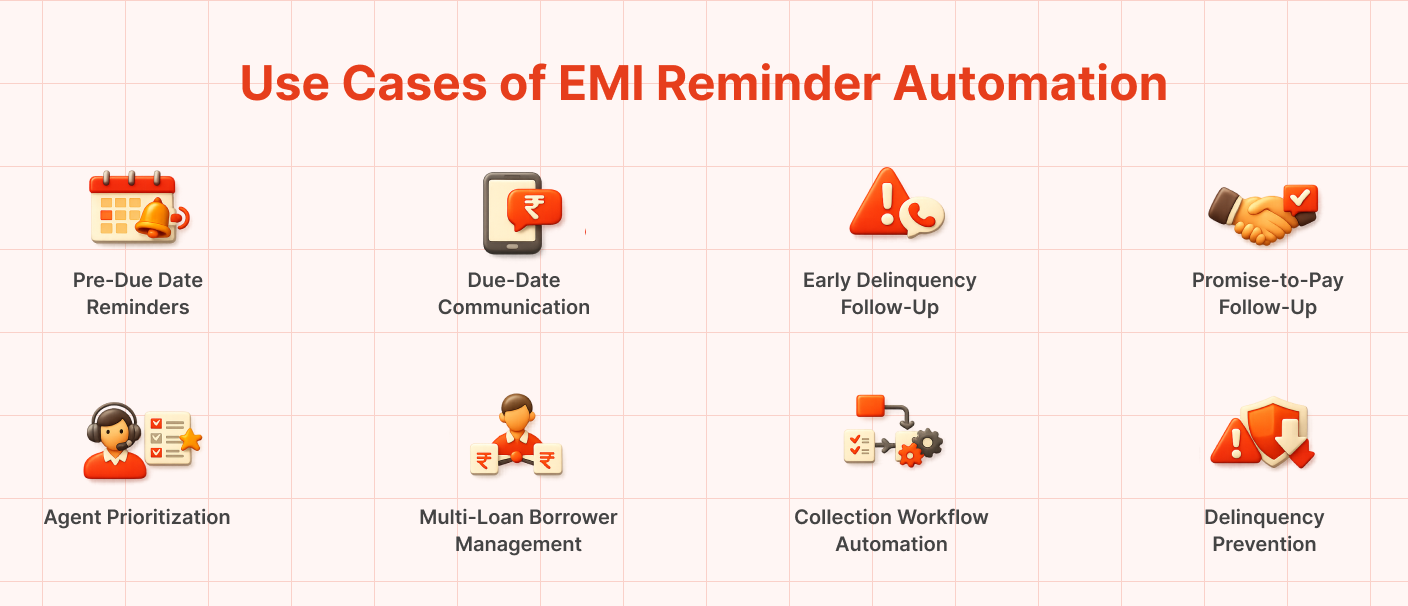
1. Pre-Due Date Reminders
Lenders can remind borrowers before the EMI due date.
This helps reduce forgetfulness and improves on-time payments.
2. Due-Date Communication
Borrowers can receive reminders on the actual due date with repayment details and payment links.
This makes repayment easier.
3. Early Delinquency Follow-Up
If a borrower misses payment, the system can send follow-up reminders before the account becomes more delinquent.
4. Promise-to-Pay Follow-Up
When a borrower promises to pay later, the system can track the commitment and remind both the borrower and collection team.
5. Agent Prioritization
Borrowers who ignore reminders or repeatedly delay payment can be assigned to agents faster.
6. Multi-Loan Borrower Management
If a borrower has multiple loans, the system can help track reminders and overdue status across accounts.
7. Collection Workflow Automation
Lenders can connect reminders, follow-ups, agent tasks, escalations, and recovery reporting into one workflow.
8. Delinquency Prevention
Timely reminders and early follow-ups help reduce accounts moving from minor delay to serious delinquency.
Benefits of EMI Reminder Automation
Fewer Missed Payments
Timely reminders help borrowers pay before or on the due date.
This reduces avoidable missed payments.
Better Collection Efficiency
Agents do not need to manually remind every borrower.
They can focus on high-risk and overdue accounts.
Faster Follow-Up
Automated workflows make sure follow-ups happen immediately after missed payments.
Improved Borrower Experience
Clear, timely, and polite reminders make repayment easier for borrowers.
Reduced Manual Work
Teams spend less time sending messages, updating spreadsheets, and tracking due dates manually.
Better Delinquency Prevention
Early reminders and structured follow-ups help reduce the chance of accounts becoming seriously overdue.
Stronger Recovery Visibility
Managers can see which borrowers paid, which ignored reminders, and which need collection action.
More Consistent Communication
Every borrower receives communication based on defined rules.
This reduces inconsistency between agents.
Better Promise-to-Pay Management
Teams can track borrower commitments and act quickly when promises are broken.
Common Challenges in EMI Reminder Automation
Poor Borrower Data
Incorrect phone numbers, outdated emails, or missing contact details can reduce reminder success.
Same Message for Every Borrower
A low-risk borrower and a repeat defaulter should not receive the same communication.
Segmentation is important.
Too Many Reminders
Sending too many reminders can irritate borrowers.
The system should control frequency and tone.
No Payment Link
A reminder without an easy payment option may not convert well.
Borrowers should receive clear repayment instructions.
No Promise-to-Pay Tracking
If promise-to-pay dates are not tracked, agents may miss follow-up opportunities.
Delayed Escalation
If non-responsive borrowers are not escalated on time, recovery becomes harder.
No Agent Visibility
Agents need to see reminder history, borrower responses, payment status, and previous follow-ups before calling.
Weak Reporting
Without reporting, managers cannot understand reminder performance or collection gaps.
How DebtPulse Helps With EMI Reminder Automation
DebtPulse by Cloudastra helps lenders, NBFCs, fintech companies, banks, and loan servicing teams automate EMI reminders and manage collection workflows with better visibility.
DebtPulse supports:
- EMI reminder automation
- Automated EMI reminders
- Loan repayment reminders
- Borrower segmentation
- Delinquency tracking
- Promise-to-pay tracking
- Collection follow-up automation
- Agent task assignment
- Recovery workflow management
- Borrower communication tracking
- Overdue account prioritization
- Dashboard and reporting
- Audit-ready recovery records
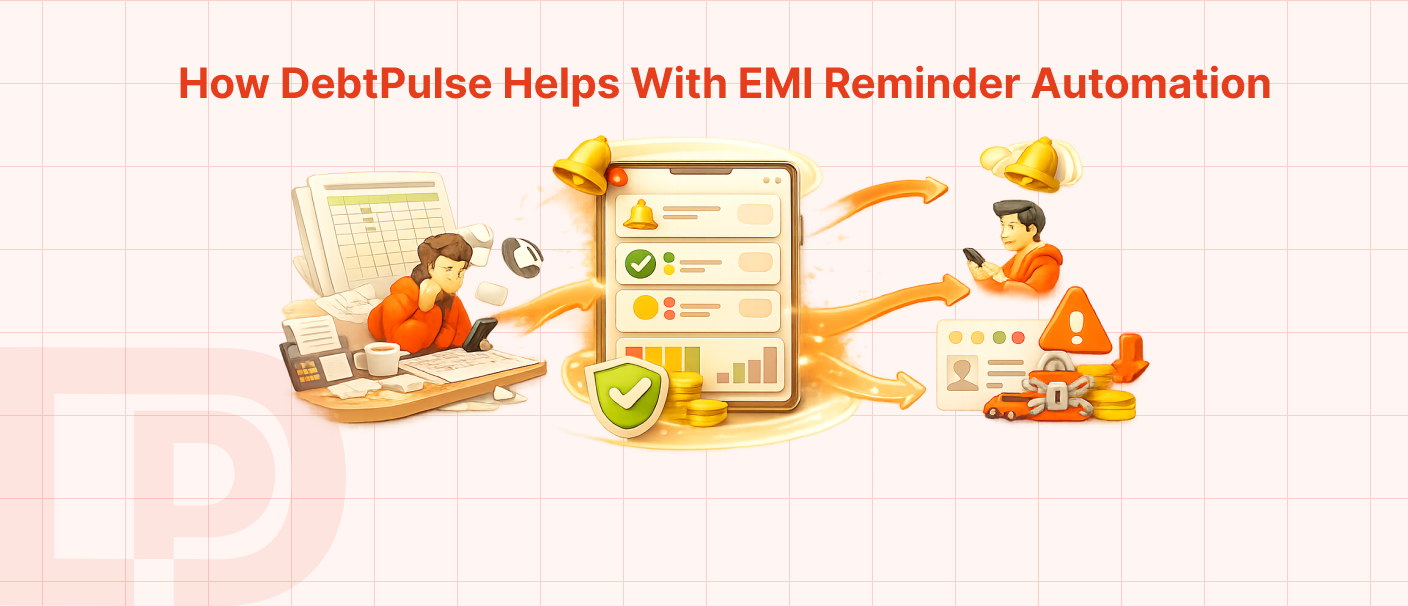
Instead of depending on spreadsheets and manual calls, collection teams can use DebtPulse to send timely reminders, track borrower responses, and move overdue accounts into the right workflow.
DebtPulse helps lenders identify which borrowers only need reminders and which borrowers need collection action.
This improves recovery efficiency while reducing unnecessary manual effort.
Who Should Use DebtPulse?
DebtPulse is useful for:
- NBFCs
- Banks
- Fintech lenders
- Digital lending platforms
- Loan servicing teams
- Microfinance institutions
- Collection teams
- Recovery managers
- Credit operations teams
- Risk teams
- EMI collection teams
- Lending operations teams
It is especially useful for lenders that handle large borrower volumes and need a better way to manage EMI reminders, missed payments, and early delinquency.
Want to explore more practical insights on AI development, automation, and conversational AI? Read more blogs at Cloudastra Technologies or contact us for business enquiries through Cloudastra Contact Us.
FAQs
1. What is EMI reminder automation?
EMI reminder automation is the process of automatically sending repayment reminders to borrowers before due dates, on due dates, and after missed payments.
2. Why do lenders need automated EMI reminders?
Lenders need automated EMI reminders to reduce missed payments, improve borrower communication, and reduce manual collection effort.
3. Can EMI reminders reduce delinquency?
Yes. Timely reminders and early follow-ups can help reduce avoidable missed payments and prevent accounts from moving into deeper delinquency.
4. What channels can be used for EMI reminders?
Lenders can use SMS, WhatsApp, email, voice calls, IVR, app notifications, and agent tasks depending on borrower preference and collection policy.
5. What is the difference between EMI reminders and collection follow-up?
EMI reminders are usually sent before or around the due date. Collection follow-up happens when payment is missed or the borrower becomes overdue.
6. Should every borrower receive the same reminder?
No. Borrowers should be segmented based on repayment behavior, risk level, overdue status, and communication response.
7. How does DebtPulse support EMI reminder automation?
DebtPulse helps lenders automate EMI reminders, track repayment status, manage promise-to-pay cases, assign follow-ups, prioritize overdue borrowers, and monitor collection performance.
8. Is EMI reminder automation useful for NBFCs?
Yes. EMI reminder automation is useful for NBFCs because it helps manage borrower communication at scale, reduce manual follow-up, and improve early delinquency control.